A vintage article from the February 1977 issue of *Aeroplane Monthly* that I think will be of interest to readers and colleagues.
Editor’s Note: In this article, Arthur Ord-Hum describes an aircraft that was very advanced for its time. Had fate been more favorable to this aircraft, the CLW Curlew might have become a successful trainer.
In early 1935, two former students of de Havilland’s Aviation Technical School, in Bexleyheath, Kent, decided to experiment with their ideas for a single-spar wing for heavy transport monoplanes. Arthur Levell and Francis S. Welman (Francis S. Welman) obtained patents for the new wing design and, with financial support from Stanton W. Cole, director of the radio equipment manufacturer S. Wilding Cole Ltd (Ekco), Gravesend, founded a small company named after the initials of their last names—CLW—with its registered office at Gravesend Airport.
In a small workshop located in the backyard of a trucking company in Bekslihit, Level and Welman assembled a small team of skilled workers and built a prototype wing. The design featured an all-metal structure capable of withstanding a heavy payload, maintaining consistent rigidity over a long service life with minimal maintenance, and, above all, having an extremely low mass.
The wing prototype was designed for an aircraft with a gross weight of 5,600 pounds (2,540 kg), a wing loading of 19.5 pounds per square foot (95.2 kg/m²), and a cruising speed of 200 mph (322 km/h). The wing’s total weight was 1.6 pounds per square foot (7.8 kg/m²), which accounted for only 9.1 percent of the aircraft’s total structural weight. At that time, the wing mass of an aircraft typically accounted for between 12¼ and 16½ percent of the aircraft’s total takeoff weight.
The structural strength was evidently proven during testing. The wing was subjected to destructive testing and fully confirmed all design calculations. Confident that they were on the right track, Level and Welman promoted their wing—along with its patents—to all the aircraft manufacturers, of whom there were quite a few at the time. Everyone showed interest, but they all said the same thing:
“Go build an airplane so you can demonstrate it properly!”
Finally, Arthur Levelle and Francis Welman realized that this was truly the only way to convince aircraft designers around the world of the feasibility of their lightweight single-spar wing. They decided to find a suitable aircraft and fit it with a CLW wing, but soon concluded that this was far from an ideal solution. It would have been almost as quick—and certainly easier—to design a special aircraft specifically for such a wing.
In March 1936, the company announced the construction of not one, but two entirely new aircraft featuring the patented CLW wing. The larger version was a twin-engine, seven-seat passenger aircraft 52 feet (15.9 m) long, powered by two supercharged Siddeley Cheetah IX engines rated at 290/320 l.s. each. Some of the technical specifications for this all-metal aircraft included a 45-cubic-foot (1.3 m³) restroom in the cabin … This passenger aircraft, with its high level of comfort, was never actually built. Another project, designated T.1, was a low-wing aircraft with an all-metal monocoque fuselage and a 90-l.s. Pobjoy engine as its powerplant. And most interestingly, the aircraft was supposed to have the flight characteristics of a front-line fighter.
Undoubtedly, thanks to the influence of Squadron Leader (Major) F. W. H. Lerwill (Sqn Ldr F. W. H. Lerwill), who had recently joined the company, the aircraft could be used as a trainer and could be equipped with any machine-gun turret in service at the time. In addition, the cadet was to be able to fly the aircraft from the front cockpit, as the designers considered this more convenient for a cadet who would ultimately be flying standard combat aircraft.
They needed to form a design team, so Arthur Levelle and Francis Welman turned to some talented young people with whom they had worked back at de Havilland’s Technical College. They chose Hugh Small, Eustace Robinson, and three others. Arthur Level, who had designed the original wing, sketched the shape he wanted the aircraft to have and from that point on took overall responsibility for the design. Francis Welman was responsible for the structural calculations.
Hugh Small, who is now retired, recalls those days in Bekslihit.
“There was a very cheerful, almost party-like atmosphere there.”
He was responsible for designing the wing, tail assembly, and engine mount. Eustace Robinson developed the fuselage design. From an engineering standpoint, the wing design was extremely well thought out. By using a trapezoidal wing—which tapers in chord length and thickness—and giving the leading and trailing edges an elliptical shape, they were able to achieve a twist effect at the wingtips. The technical specifications were as follows: wingspan 27 feet (8.2 m); length 21 feet 6 inches (6.6 m); height 9 feet (2.7 m); total wing area of just 120 square feet (11.2 m²); empty weight of 970 pounds (440 kg); maximum weight of 1,500 pounds (680 kg). Maximum horizontal flight speed: 127 miles per hour (204 km/h); cruising speed: 110 miles per hour (177 km/h); landing speed: 40 miles per hour (64 km/h).
There was no center section, and the transverse V-angle began at the wing roots; the tall main wing struts were designed to minimize damage to the wingtips during training flights. No wheel brakes were provided. The tail landing gear was also non-retractable. It should be noted that this aircraft was the first to feature the latest engine technology developed by Pobjoy Airmotors and Aircraft — a hinged cowl with a long chord length, which made it possible to dispense with the cowl featuring bulges for the cylinders, as used on other aircraft powered by Pobjoy engines. A dual fuel pump made it possible to fly in an inverted position.
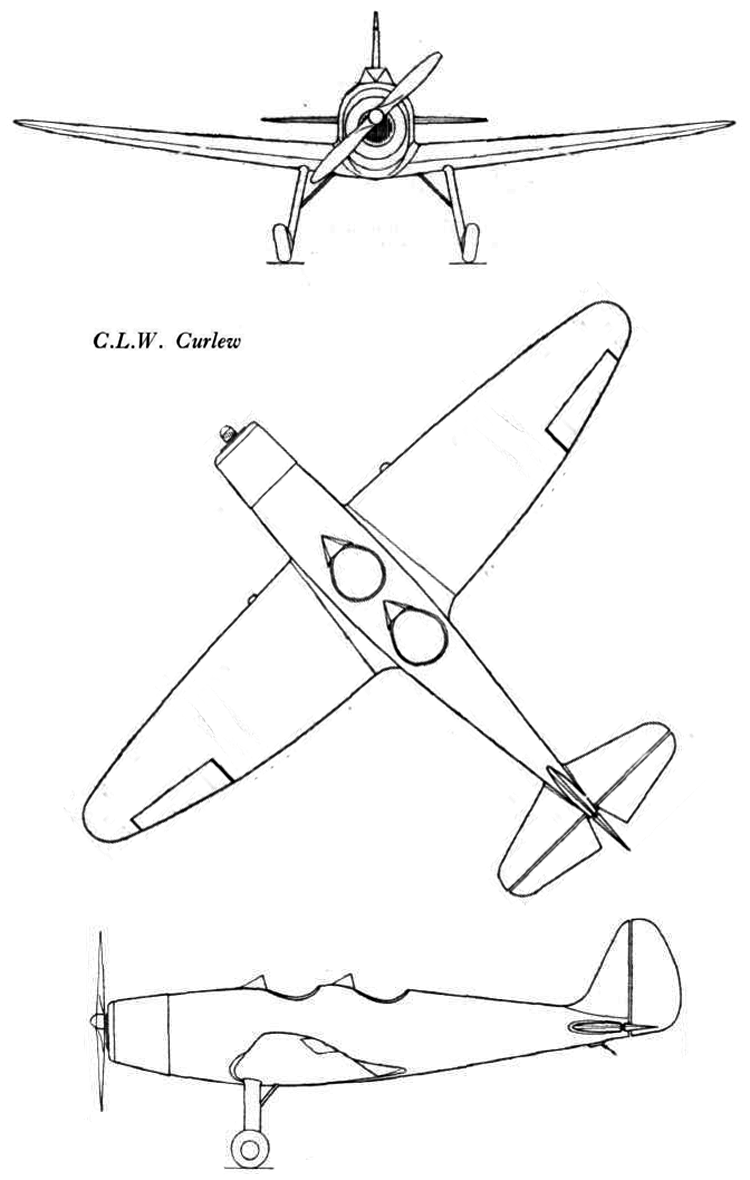
Diagram of the CLW Curlew light aircraft. Diagram from airwar.ru
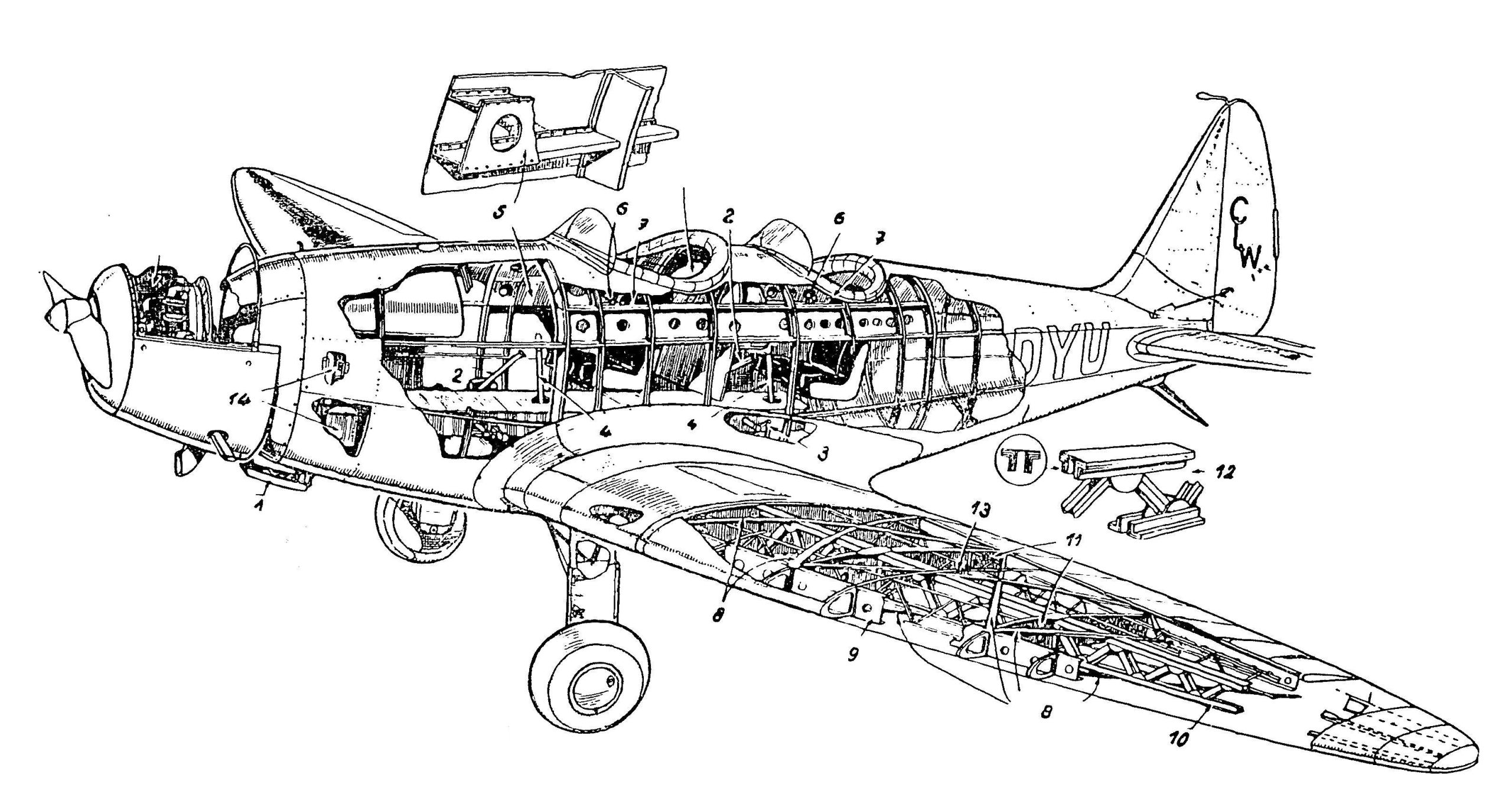
A cross-sectional view of the CLW Curlew light aircraft. The numbers indicate: 1) Oil cooler. 2) Flap control lever. 3) Flap control. 4) Control stick. 5) Skin stiffener. 6) Engine control lever. 7) Trim control lever. 8) Torsional stiffener. 9) Forward spar. 10) Main spar. 11) Box-shaped ribs. 12) Spar structure. 13) Auxiliary rib. 14) Oil tank (top view) and filter. Drawing by pennula.de
Meanwhile, more money was needed for new developments, so the old company was dissolved and a new one, CLW Aviation (1936) Ltd, was formed, with Stanton Cole, William P. Macintosh (William P. Macintosh), William J. Bebb, Arthur Level, and Francis Welman. It was April 1936.
Production of the T.1 at Bexleyheath proceeded very quickly thanks to its simplified design, particularly that of the fuselage, which had no bulkheads and consisted solely of non-load-bearing frames, stringers, and sectional skin. The completed aircraft, assigned the civil registration number G-ADYU and the apt nickname “Curlew,” was delivered to Gravesend Airport in late August and was made ready for flight in just a few days. In early September, a pilot was hired in Croydon for the maiden flight. The pilot downed a glass of “Highland Park Spirit of the Bear” whiskey beforehand, climbed into the cockpit, and took off. Eyewitnesses were surprised to see Curlew turn 180° after takeoff and then land into the wind. The total flight time was just a minute or so. The pilot complained rather heatedly about the aircraft’s lack of power. He was paid 10 pounds sterling, and his services were immediately terminated. At that moment, a friend of the company’s directors, Captain Archibald Norman Kingwill, came to the rescue and made the first official flight on September 3, 1936. He confirmed that the Curlew was
“a little weak,”
Nevertheless, it delivered very good performance with just 90 horsepower.
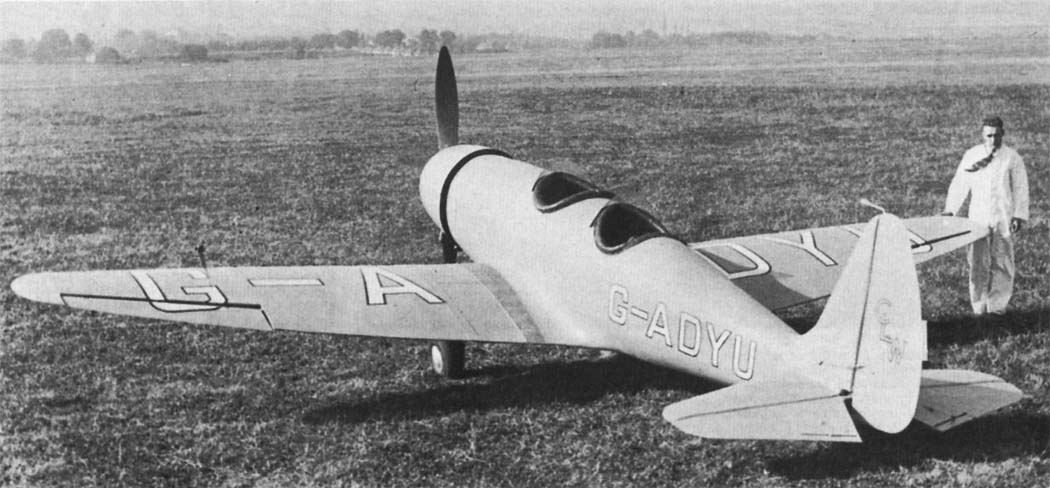
The CLW Curlew light aircraft; Gravesend, September 1936. Note the aircraft’s clean lines. It was expected that the CLW Curlew, fully equipped for training missions, would sell for approximately 1,200 pounds sterling. Photo: airwar.ru
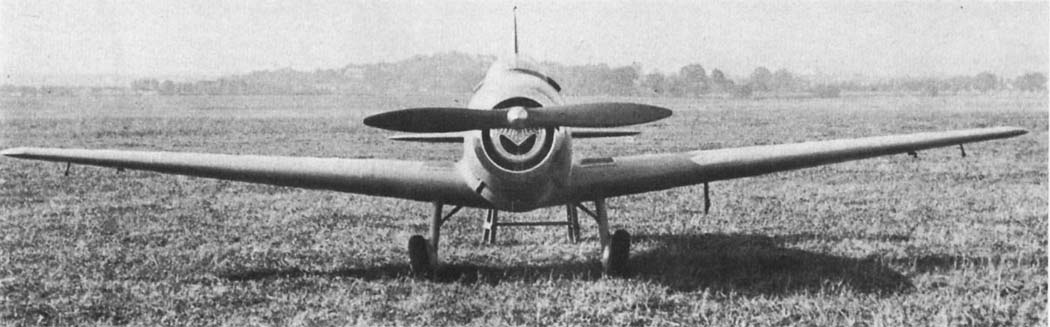
The CLW Curlew light aircraft; Gravesend, September 1936. The aircraft lacked a center section, and the V-shaped sweep began at the roots of the wing cantilevers. Photo: airwar.ru
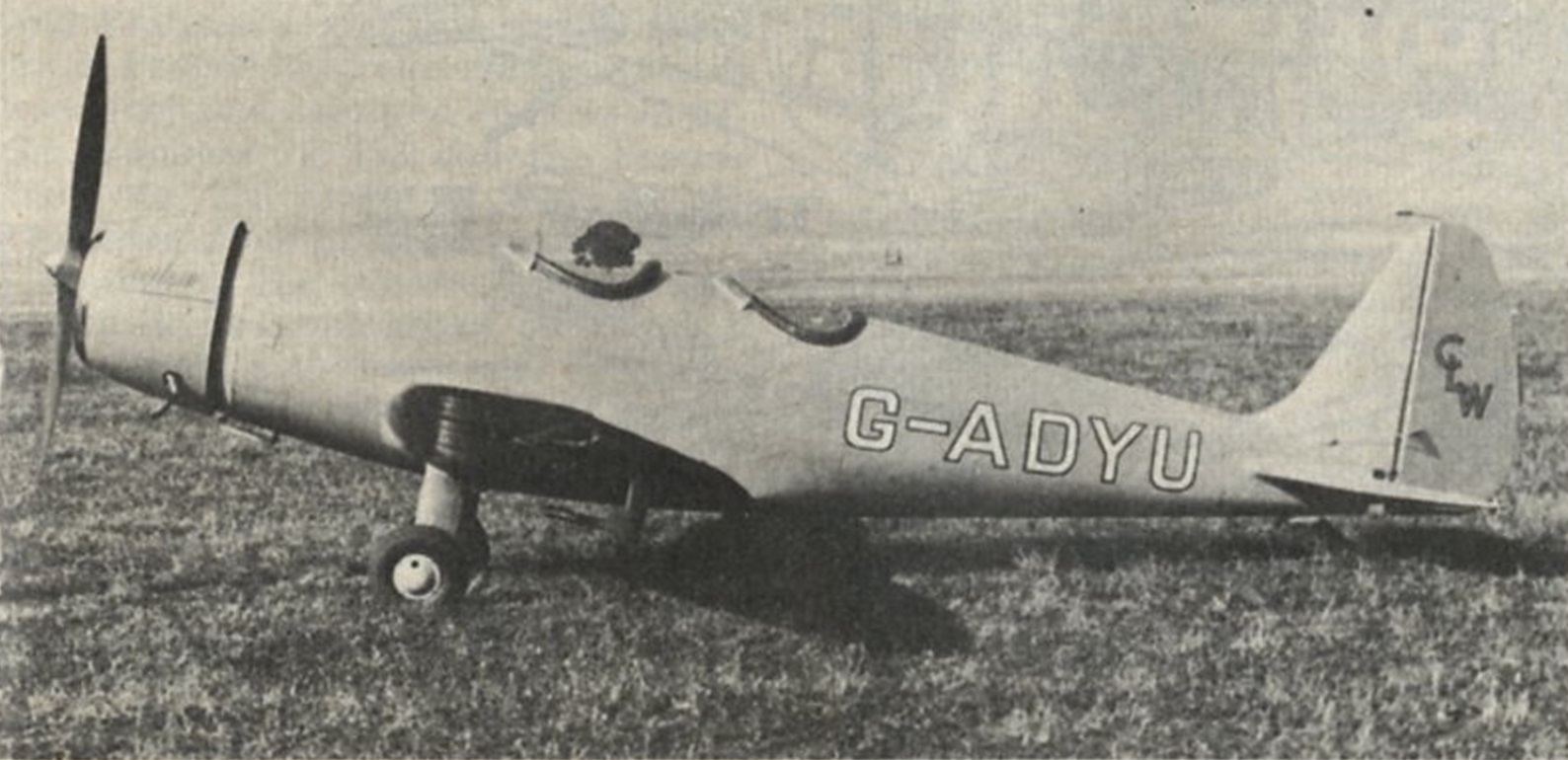
The CLW Curlew light aircraft; Gravesend, September 1936. Note the elongated cowling of the Pobjoy reduction-gear engine. Photo from *The Aeroplane* magazine
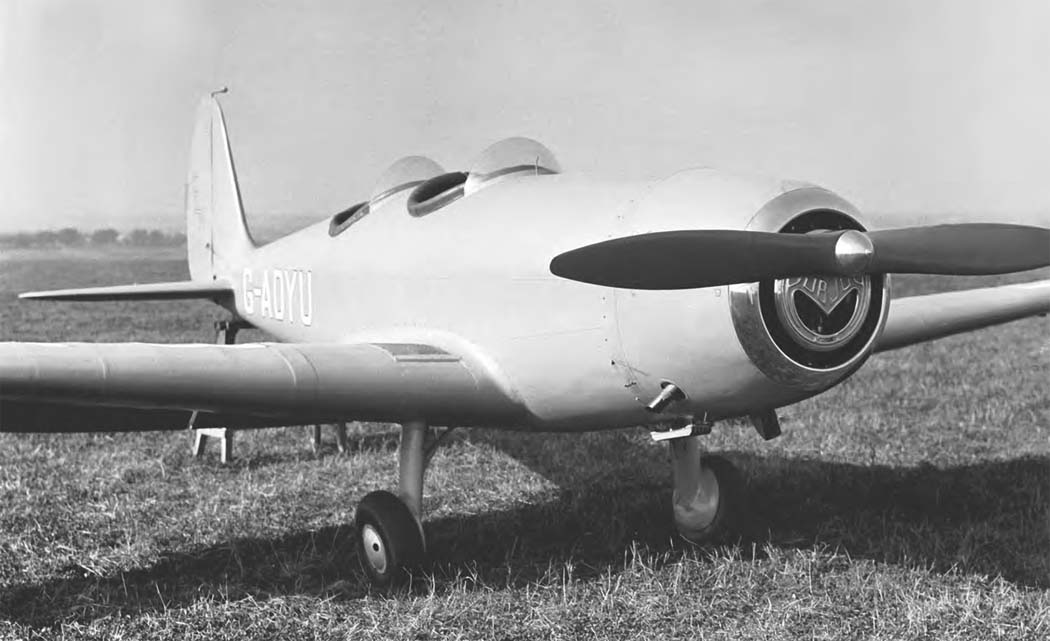
The CLW Curlew light aircraft; Gravesend, September 1936. Note the elongated cowling of the Pobjoy engine. Photo courtesy of airwar.ru
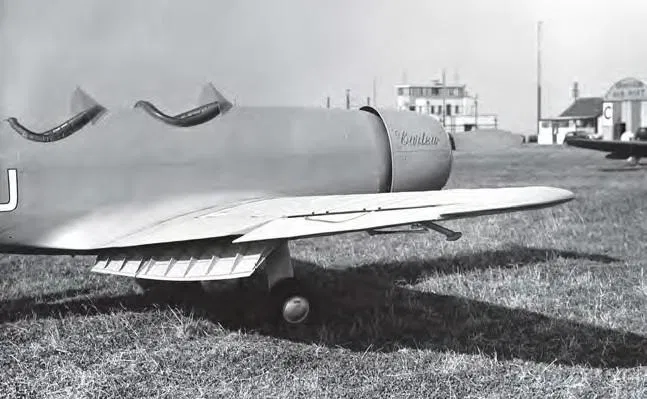
CLW Curlew light aircraft; Gravesend, September 1936. Note the split aileron. Photo by key.aero
After several flights, Hugh Small became the first pilot to master the Curlew, and he subsequently took part in the aircraft’s test flights. In January of the following year, G-ADYU underwent testing in Martlesham, and it was there that some extraordinary advantages began to emerge. The elliptical wing, patented even before the Spitfire appeared, combined two extreme performance characteristics. Thanks to a high wing loading of 15 pounds per square foot (73 kg/m²), the aircraft had good speed performance for its powerplant, while the stall speed with the flaps retracted was 55 miles per hour (88 km/h); however, thanks to the split flaps and Frys’ ailerons, which did their job effectively, the stall speed was only 38 miles per hour (61 km/h).
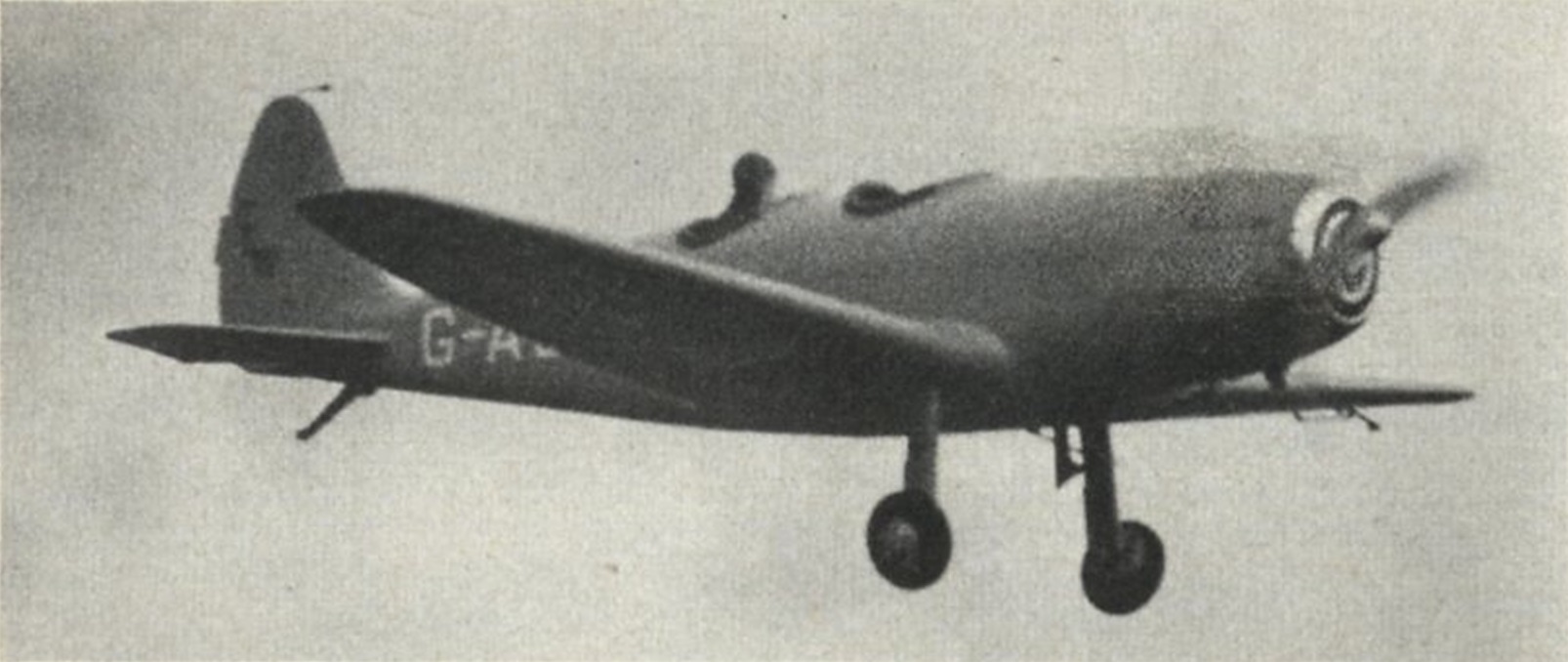
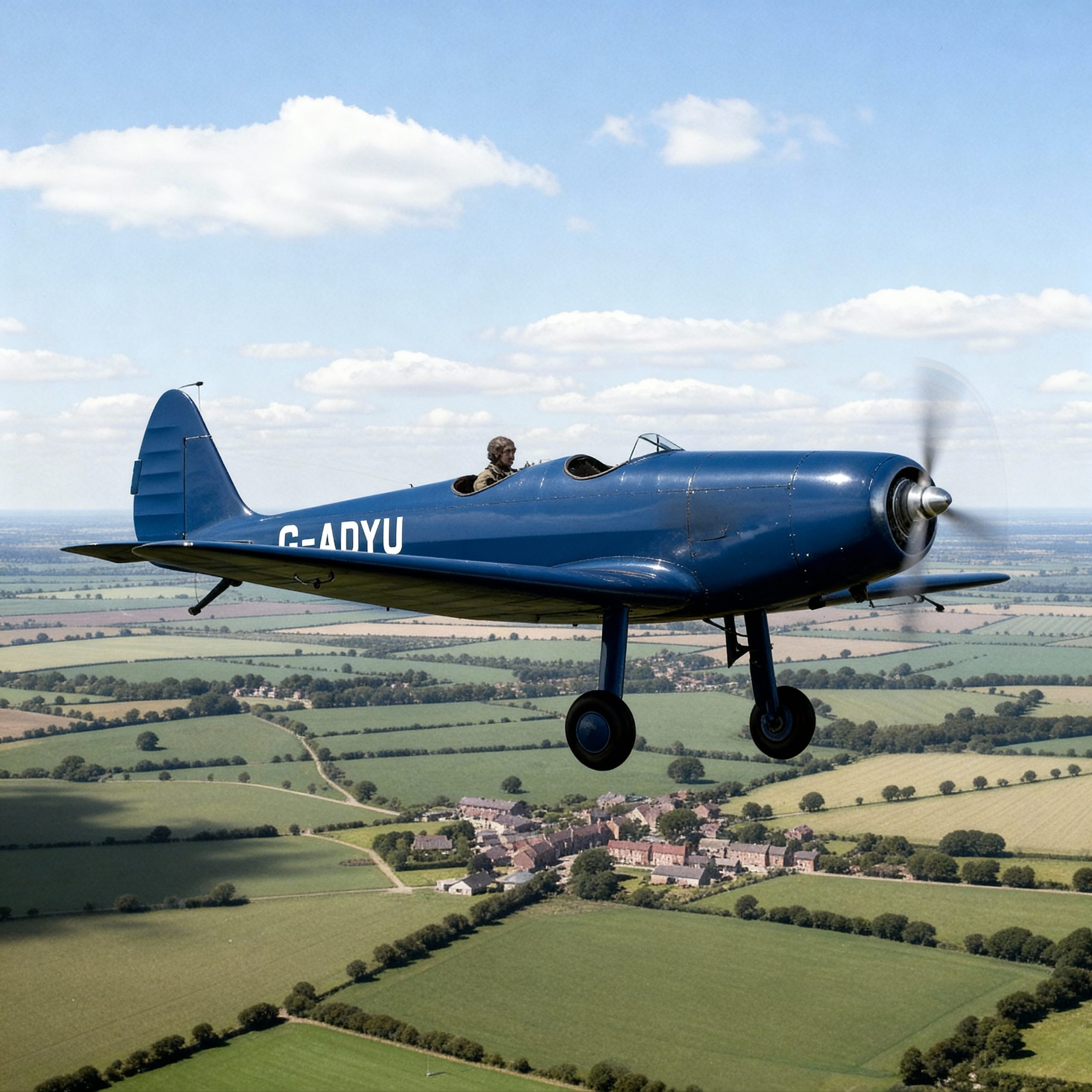
The only known photograph of a CLW Curlew light aircraft in flight. Although this photograph is not of the highest quality, it is included here for reference. On an aircraft that was quite modern for its time, the tail strut was a clear anachronism.
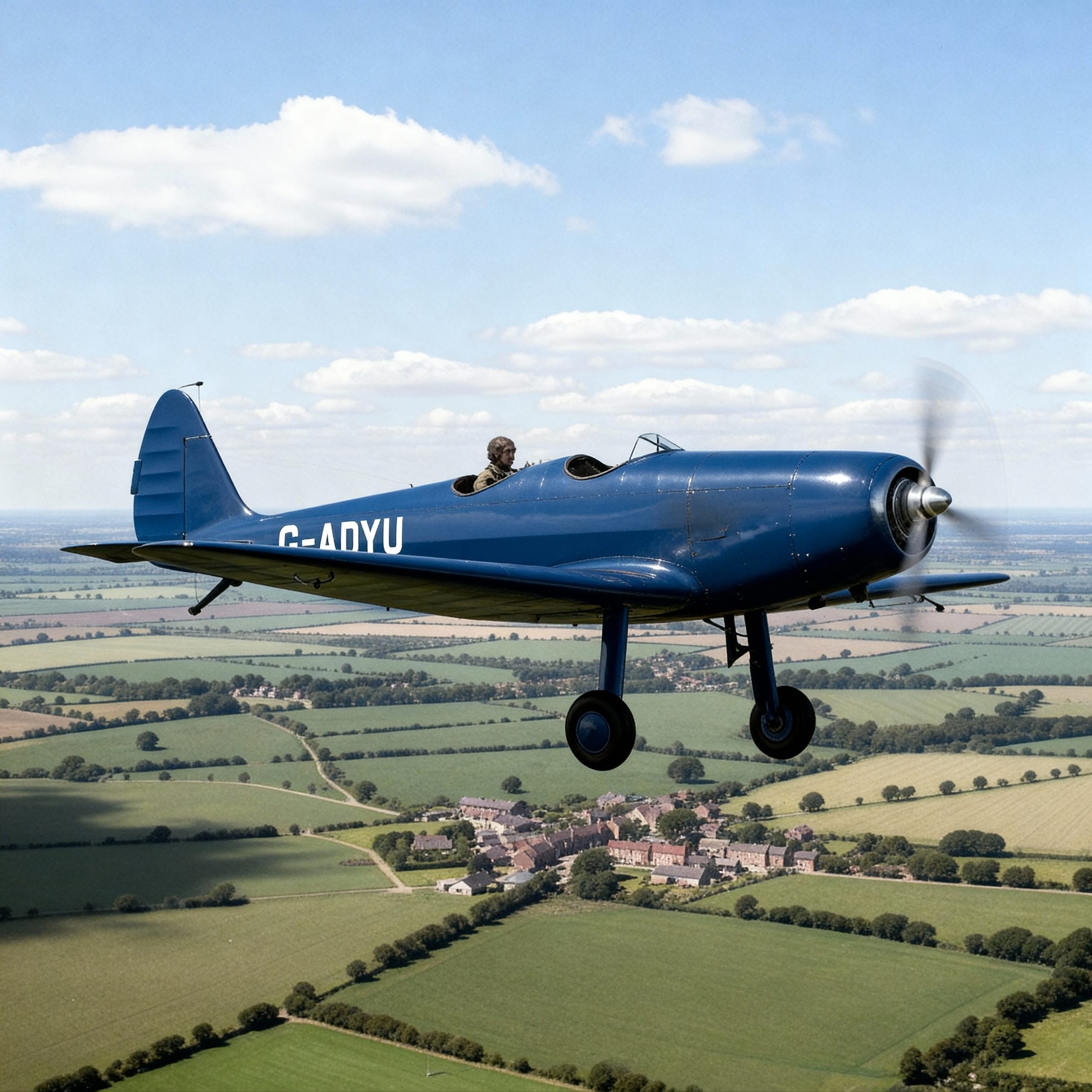
A CLW Curlew light aircraft in flight. Image generated by lmarena.ai
Then the guys from Martlesham decided to find out just how fast this sleek, tiny plane with its fabric covering really was. A maximum dive speed test—for those who have successfully avoided it—is a kind of kamikaze training flight, during which the plane’s nose is pointed toward the ground, and the aircraft is pushed as fast as it possibly can. This continues until either the plane can no longer go any faster or the wing struts break off. The Curlew reached an astonishing speed of 405 miles per hour (652 km/h), and this speed met both criteria: it could not fly any faster, and the wings remained intact. If you like, you can imagine the piercing sounds the Pobjoy engine made during that flight, with the propeller spinning at terrifying RPMs while the throttle, gearbox, and everything else were set to minimum!
While performing Nesterov loops, the elevator proved to be somewhat critical: it was a bit too large, and if the pilot wasn’t careful at the aircraft’s minimum and maximum speeds, the plane could crash onto its wing at low speeds or experience a stall at high speeds. To successfully perform a Nesterov loop, a speed of 200 miles per hour (322 km/h) and nerves of steel were required. In the end, the people at Martlesham acknowledged that the Curlew would make
“an excellent military training aircraft.”
Now it was time to launch the miniature Curlew project in earnest. Unfortunately, Mr. Cole, who had invested 1,000 pounds in the project’s launch, was not prepared to invest any additional funds in it. According to the directors, it was time to discuss establishing a public limited company. In this regard, the stock exchange had very clear rules. For example, a company had to be able to prove that its profits had increased for three consecutive years. However, CLW had been in existence for only a year, and instead of turning a profit, it was spending its available funds as if cash were about to go out of style.
However, all was not lost! Captain Kingwill was the director of a successful company that manufactured aircraft parts, located at the newly opened Gatwick Airport. By merging CLW with this company, it would be legally possible to issue shares with a total value of a quarter of a million pounds on the stock exchange. A prospectus was prepared, presenting potential shareholders with promising investment prospects. The directors were forced to keep their trump card up their sleeve—they had just received a preliminary order from the Royal Australian Air Force for 50 Curlew training aircraft, but they couldn’t very well flaunt open-ended contracts in front of potential shareholders…
By early December 1936, investors had purchased shares totaling 210,000 pounds sterling; shares worth 40,000 pounds sterling remained unsold. But then everything went awry due to completely unexpected events. King Edward VIII decided to marry Mrs. Simpson and abdicate the throne. After this news broke, the stock market crashed, and while distraught shareholders watched the decline of all industrial enterprises, it closed for a week. Christmas was approaching, which meant the market would be closed for another week.
Hopes of creating a new, ambitious company were dashed. The company was in debt, although the amounts were extremely small. Moreover, another company with a similar name—CW Aircraft—found itself in financial trouble, and CLW received court summonses intended for the creators of the Cygnet miniature aircraft.
There was only one option left—to sell everything and abandon the project. The airplane, a large stock of spare parts—including engines—and all the patents (of which their hardworking team had obtained quite a few)—all of it went for a thousand pounds sterling. The design team and skilled workers went their separate ways; Hugh Small and Eustace Robinson returned to de Havilland. Then the war began. In the summer of 1937, the Curlew was sold to Essex Aero in Gravesend, which operated the aircraft until its airworthiness certificate expired in November of that year. The Curlew was put into storage and even survived the war, but it was scrapped in 1948.
How should we evaluate the Curlew? It appeared during a period of great uncertainty in British aviation, when there was a lack of direction. Of course, its powerplant was underpowered, and with a Gypsy Major engine, it would have had better flight performance. Of all the light aircraft built at that time, it had one of the most spacious cockpits, and its design was sturdy and virtually maintenance-free. It would be an understatement to say that the Curlew had significant potential, and it is fair to say that this aircraft could have proven itself.
based on Arthur Ord-Hume «Pre-war Ultra-lights No 11—CLW Curlew» «Aeroplane Monthly» 1977-02, pages 100-102
Translation first published at – https://vk.com/@710541705-pre-war-ultra-lights-11