The Golden Pavilion Above a Burning Capital: How the Ashikaga Shogunate Led Japan into the Sengoku Age

In May 1333, smoke rose above Kamakura. The troops of Nitta Yoshisada had broken into the city that had served as the centre of samurai power for almost a century and a half. Hōjō Takatoki, the last effective ruler of the Kamakura shogunate, took refuge with his relatives and retainers in the clan temple of Tōshō-ji. When defeat became inevitable, the defenders set fire to the temple and took their own lives. The family that had ruled Japan from behind a succession of nominal shoguns vanished almost in a single day.
Kamakura had seemed nearly impregnable. Hills surrounded it on the landward side, and the roads into the city passed through narrow, fortified defiles. Yoshisada’s men failed to force their way through and instead bypassed the defences along the shore at Cape Inamuragasaki. A later chronicle turned the manoeuvre into legend: the commander supposedly cast his sword into the sea and asked the sea god to part the waters, whereupon a path opened for his army. In all likelihood, the warriors simply waited for the tide to recede. Yet even without a miracle, the fall of the Hōjō must have seemed unbelievable to contemporaries.
The Hōjō had never held the title of shogun. They had served as regents to shoguns who had long since become ceremonial figureheads. It was the regents who appointed officials, settled disputes over land and commanded the vassals. Their system had survived the Mongol invasions, court conspiracies and repeated rebellions, but by the fourteenth century its foundations had weakened. Samurai estates were divided among successive generations, land available as rewards was running out, and the enormous expense of defending the coast against the Mongols had brought the victors no new territory to distribute. Discontent was spreading.
Emperor Go-Daigo tried to harness that discontent and restore power to the imperial court. His first attempts ended in defeat and exile, but in 1333 important military commanders defected from the Hōjō. Ashikaga Takauji seized the shogunate’s headquarters in Kyoto, while Nitta Yoshisada marched on Kamakura. With the destruction of the Hōjō, the military government collapsed and Go-Daigo returned to the capital in triumph.
This is where the story of the Muromachi period begins: not with the foundation of a new shogunate, but with the destruction of the old one. The victors intended to restore direct imperial rule, yet within three years they were fighting one another. Their struggle produced the Ashikaga shogunate, divided the imperial house and created a political system that first reunited Japan and then opened the way to the Sengoku age.
The Ashikaga formally ruled from 1338 until 1573. The final century of their shogunate overlaps with the age of the “Warring States”. Our story therefore runs from the fall of the Hōjō to the Ōnin War—the moment when power began to slip away from Kyoto and into the hands of dozens of autonomous warlords.
The Victors Who Immediately Fell Out
After the fall of Kamakura, Go-Daigo attempted to restore the political order that had existed before the samurai took power. This brief experiment became known as the Kenmu Restoration. The warriors expected offices and estates in return for their victory, but the emperor’s first priority was to restore the authority of the old court nobility. Rewards were distributed slowly, decisions were made by aristocrats, and the men who had won the war increasingly felt that they had been cheated.
One of the leading figures in the uprising had been Ashikaga Takauji, a high-ranking warrior descended from the Minamoto. At the decisive moment, he had changed sides in favour of Go-Daigo and attacked the Hōjō forces in Kyoto. He now became a natural rallying point for those who believed the new regime had forgotten its warriors.
Takauji proved capable of turning their resentment into an army of his own. At first he acted in the emperor’s name. Then he began distributing estates without imperial permission and finally rebelled openly against the court. The fighting swung back and forth: Takauji lost Kyoto, retreated to Kyushu, raised a new army and returned. In 1336 he captured the capital and placed the compliant Emperor Kōmyō on the throne. Go-Daigo escaped south to the mountain settlement of Yoshino, taking the imperial regalia with him and declaring his rival illegitimate.
Japan now had two imperial courts. The Northern Court remained in Kyoto and supported the Ashikaga; the Southern Court at Yoshino continued the war in Go-Daigo’s name. Both bestowed titles, appointed governors and promised their followers the same lands. For a samurai, this created an attractive opportunity: if the reward offered by one court seemed inadequate, he could defect to the other. The war dragged on for more than half a century.
In 1338, the Northern Court granted Takauji the title of shogun. The new military government was established not in distant Kamakura, but beside the imperial court in Kyoto. Its headquarters was later built in the capital’s Muromachi district, which gave its name to the entire period.
A Shogun Surrounded by Overmighty Allies
The Ashikaga had reached power through a coalition of military houses and could not treat their allies as ordinary officials. The provinces were administered by shugo, military governors appointed by the shogunate. During the long war between the two courts, these governors acquired the right to collect a share of taxes, settle land disputes and command local warriors. Temporary powers gradually hardened into authority of their own.
This produced the shugo-daimyō: governors who controlled one or more provinces. They maintained troops, gathered their own vassals and dealt with their neighbours almost as independent rulers. The greatest military houses were simultaneously the pillars of the shogunate and its most serious threat. Without their armies, the Ashikaga could not suppress a rebellion; with those armies involved, any quarrel at court could turn into a civil war.
The system depended on balance. The shogun distributed offices, confirmed landholdings and played rivals against one another. The daimyō accepted his supremacy for as long as obedience brought them more than open defiance. Such an arrangement demanded great personal authority from the head of the Ashikaga house. Under a strong shogun, it provided a workable form of government. Under a weak one, every participant began testing how far he could go.
Even the reunification of the imperial courts came through negotiation rather than a decisive military victory. In 1392, the Southern Court surrendered the imperial regalia to its northern rival and the schism ended. The agreement was secured by the third shogun, Ashikaga Yoshimitsu—the dynasty’s most successful ruler and the man under whom Muromachi experienced its brief golden age.
The “King of Japan” in the Golden Pavilion
Yoshimitsu became shogun while still a child, but quickly learned how to handle powerful vassals. He brought overmighty houses to heel one at a time, preventing them from uniting against him, reconciled the two imperial courts and compelled the court aristocracy to treat the military ruler almost like a monarch. His headquarters in the Muromachi district became known as the Palace of Flowers. The shogunate was now so firmly established in the capital that the city began to reshape the military elite more profoundly than the military elite reshaped the city.
Earlier generations of samurai had prided themselves on austere simplicity and regarded courtly amusements with suspicion. Under Yoshimitsu, the warrior court adopted the ceremonies, poetry and tastes of the old aristocracy, combining them with Zen culture and Chinese models. The shogun patronised the actors Kan’ami and Zeami, whose art developed into classical Noh theatre. Chinese scrolls, porcelain and rare objects became more than decorations: the ability to recognise a masterpiece confirmed a man’s rank almost as effectively as an armed retinue.
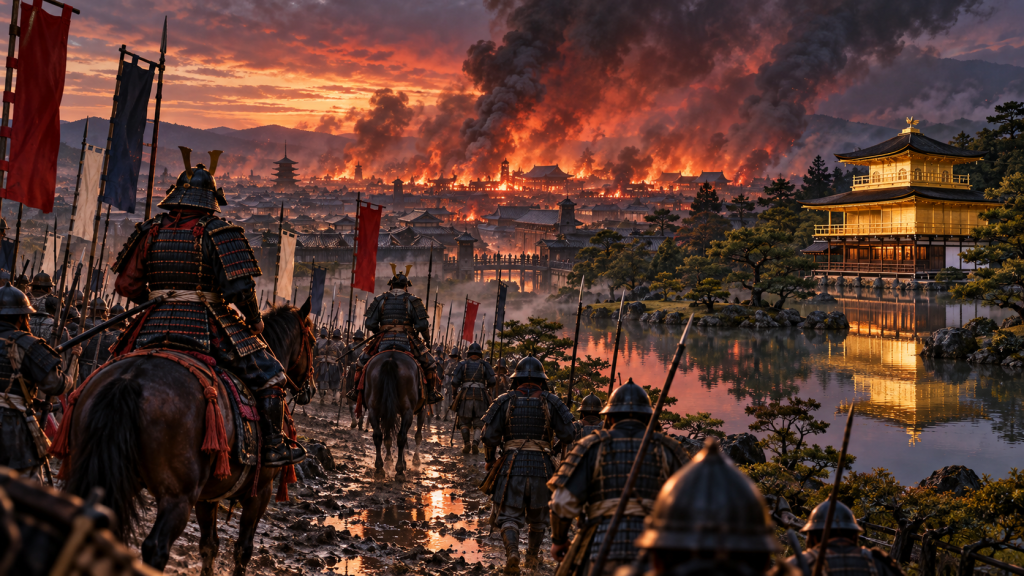
The best-known monument of the age was Kinkaku, the Golden Pavilion at Yoshimitsu’s Kitayama villa. Its splendour was a political statement. The head of the military government was demonstrating his ability to unite samurai power, the refinement of the imperial court and the prestige of Chinese civilisation.
Yoshimitsu also restored official trade with Ming China. Japanese ships carried swords, sulphur, copper and fans to China and returned with silk, coins, books, paintings and porcelain. Licensed trading vessels received special tallies that distinguished them from pirates. To gain access to this market, the shogun accepted the title “King of Japan” from the Ming emperor. Some members of the Japanese elite regarded such submission to a foreign sovereign as humiliating, but Yoshimitsu gained both profit and international recognition. In Kyoto, he no longer behaved merely as first among the warriors, but as the country’s effective ruler.
His power concealed the weakness of the entire structure. It belonged above all to Yoshimitsu himself. After his death in 1408, the institution of the shogunate remained, but its treasury, standing forces and control over the provinces were not strong enough to function without the ruler’s personal authority.
The Country Grew Richer as Its Government Grew Poorer
It is easy to mistake the political history of Muromachi for an uninterrupted succession of feuds. Yet Japan was developing rapidly. Agricultural methods improved, the use of money spread, and markets and port towns expanded. Merchants travelled the roads, ships moved along the coasts, monasteries financed trade, and urban communities learned to defend their interests for themselves. Kyoto once again became the political, commercial and cultural centre of the country.
The shogunate profited from trade and taxes levied in the capital, but much of the new wealth remained in the hands of provincial rulers, temples, moneylenders and urban corporations. The economy was becoming more complex faster than the state. People with money, weapons and local connections were increasingly unwilling to obey the demands of distant landowners without question.
In 1428, one of the first great uprisings demanding the cancellation of debts swept across the central provinces. Peasants, lesser warriors, carriers and townspeople attacked the offices of moneylenders and destroyed debt records. Such leagues were known as ikki. They might unite villages, the samurai of a particular region or the followers of a religious movement. For the authorities, this was an alarming sign: society was creating organisations of its own wherever the shogunate could no longer provide order.
The cultural flowering had the same reverse side. Art was becoming less dependent on the imperial court and spreading among the warrior elite, monasteries and wealthy townspeople. Noh theatre, gardens, ink painting, linked-verse poetry and the art of tea were developing into a common language of the elite. Ashikaga power could therefore decline while the culture created under its patronage became ever more influential.
The Shogun Chosen by Lot
After the death of the fifth shogun, there was no suitable heir. In 1428, the head of the military government was selected by lot from several members of the Ashikaga family. The choice fell on the former monk Yoshinori. Contemporaries may have seen the will of the gods in the result; the great daimyō saw a convenient ruler who owed his elevation to them. They were mistaken.
Yoshinori attempted to restore the authority the shogunate had possessed under his father, Yoshimitsu. He interfered in the succession disputes of military houses, confiscated estates, punished the disobedient and destroyed his opponents. For a time, fear did compel the provincial rulers to obey. Yet the Ashikaga still had no administrative machine capable of replacing the daimyō. The shogun could destroy one of them only with the assistance of the others—and every lord understood that he might be the next victim.
In 1441, the daimyō Akamatsu Mitsusuke invited Yoshinori to a feast and a Noh performance at his Kyoto residence. During the festivities, the host’s men killed the shogun. The assassin was later defeated, but the decisive damage had already been done. A military ruler who had tried to govern the nobility through fear was murdered in the house of his own vassal, surrounded by other vassals. After his death, the title passed to children while the heads of the great military houses increasingly made the decisions.
The Man Who Preferred Art to Power
The eighth shogun, Ashikaga Yoshimasa, went down in history as a weak ruler and a great patron of the arts. The combination made him an almost perfect symbol of Muromachi. While powerful families fought over offices and provinces, the shogun collected Chinese art, arranged poetry gatherings, designed gardens and tried to build a refined world shielded from politics by the walls of his residence.
The Higashiyama culture is closely associated with his circle. The shoin style of residential room took shape there, rules for arranging paintings and objects in an interior became increasingly sophisticated, and both Kanō-school painting and the aesthetics of tea developed. Yoshimasa’s residence later became the temple of Ginkaku-ji, home of the Silver Pavilion. The building was never actually covered in silver, but its restrained appearance proved no less influential than the gold of Kinkaku.
The problem was that a shogun could not simply withdraw from politics. Yoshimasa remained childless for years and named his younger brother Yoshimi as heir, persuading him to leave his monastery. Then, in 1465, the shogun’s wife Hino Tomiko gave birth to a son. A new faction appeared at court, determined to secure the succession for the boy. The family quarrel alone need not have destroyed the country, but it became entangled with succession struggles inside the Hatakeyama and Shiba houses. Behind them stood two great coalitions led by Hosokawa Katsumoto and Yamana Sōzen.
Each side intended to intimidate its opponent and strengthen its position at court. Neither planned to destroy Kyoto or begin a ten-year war. By 1467, however, tens of thousands of warriors had been drawn into the capital. Once the first mansion burned, retreat meant losing face, allies and perhaps one’s own domains.
The War Whose Victors Forgot What They Were Fighting For
The Ōnin War began as a tangle of succession disputes, personal enmities and struggles for influence over the shogun. Its original causes quickly lost their importance. Allies moved from one camp to another, troops fought for individual streets, and conflicts in the provinces continued independently of events in the capital.
Kyoto was an excellent setting for a court and a terrible place for a major war. The wooden city burned district by district. Palaces, temples and mansions became fortified camps surrounded by trenches. Residents fled, craftsmen moved their workshops to other towns, and once prosperous neighbourhoods became overgrown wastelands. The emperor and the shogun continued to distribute titles, but their documents carried weight only where an armed force was prepared to enforce them.
Both Hosokawa Katsumoto and Yamana Sōzen died in 1473. The war outlived its two leaders. It dragged on until 1477 and ended without a clear victor. The armies left the ruined capital without resolving most of the disputes that had brought them there.
The decisive changes were already taking place far from Kyoto. While the shugo-daimyō spent years in the capital, their deputies and local samurai took control of the provinces. Some refused to send taxes to their masters, others seized their neighbours’ lands, while still others allied themselves with village communities and temples. A title granted by the shogun could still confer legitimacy, but it no longer guaranteed obedience.
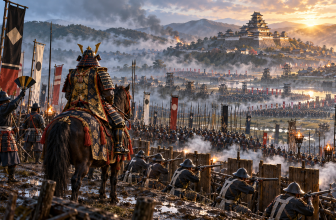
Japanese history remembers this process through the expression gekokujō—“the low overthrow the high”. Vassals displaced their lords, junior branches destroyed senior lines, and capable commanders became masters of provinces regardless of their ancestry. The governors who had lived at court and ruled through deputies gave way to a new kind of daimyō. These warlords resided in their own territories, built castles, issued their own laws and placed local warriors under their direct command.
This was the beginning of Sengoku. Some historians date it from the first fighting of the Ōnin War in 1467, others from the war’s end in 1477. Either way, the Ashikaga shogunate did not disappear. Its rulers retained the title for almost another century, participated in alliances and continued to command immense symbolic prestige. Oda Nobunaga did not drive the last Ashikaga shogun out of Kyoto until 1573.
The old Japan, however, had ended much earlier. When the armies withdrew from Kyoto’s blackened districts, it was clear that an order issued in the capital could no longer hold the country together. Power would now have to be assembled anew—province by province, castle by castle and army by army. The Muromachi period still continued on the calendar. The age of the Warring States had already begun.