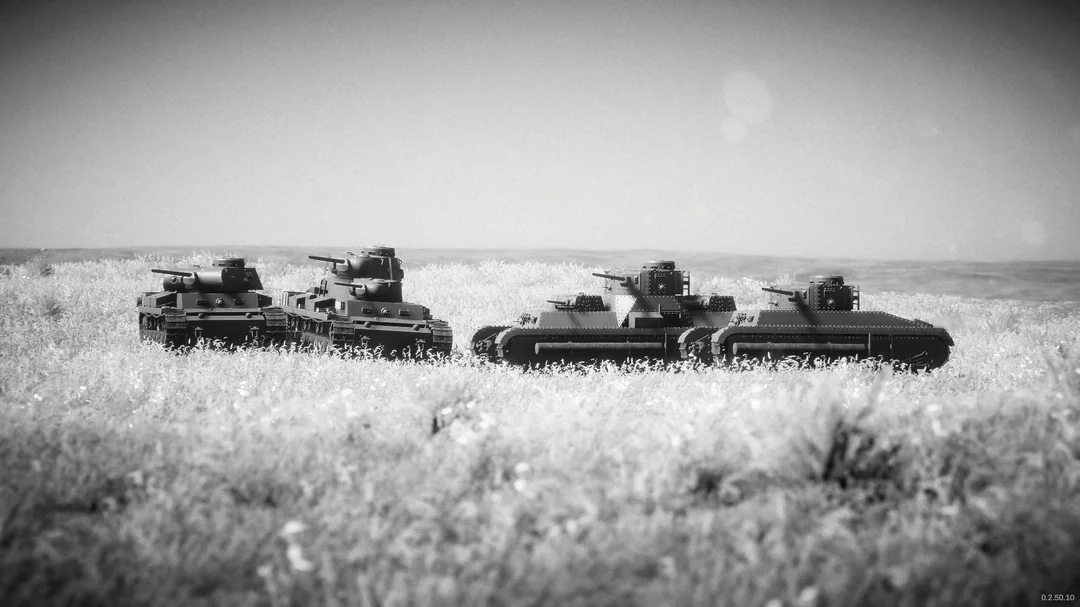
T-35 Heavy Tank
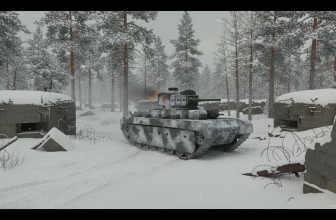
To begin with, it’s worth noting what this alternative design has in common with the real T-35. The designers retained the basic armor of the hull and turrets, the original multi-roller running gear with bogies, and the reliable M-17 aircraft engine. That’s where the similarities end. The main difference lies in the layout and firepower. Instead of the usual five turrets, the engineers reduced their number to three, completely redesigning the armament layout. The central main turret houses a unique 63.5-mm (2.5-inch) gun that has no direct counterparts in our world. The two small turrets, located on the sides, were equipped with 38.5-mm guns, which also represent a purely theoretical design by the alternative Soviet arms industry. This configuration allowed the “land cruiser” concept to be maintained while reducing the burden on the crew and simplifying fire coordination.
TTX T-35:
T-35M
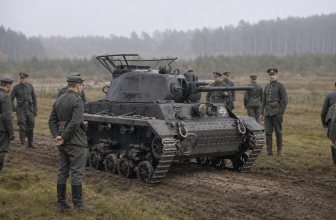
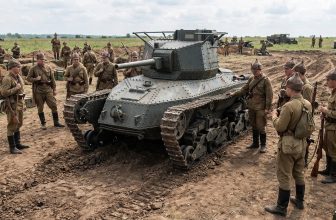
As the designation suggests, this is a modernized version of the previous tank. The modernization was radical, breaking away from the dogma of multiple turrets. The vehicle retained only a single turret with the same 63.5-mm gun, which allowed for a significant reduction in the hull’s dimensions and, thanks to the weight saved, an increase in armor protection around the entire perimeter. Reducing the crew to a commander-only configuration improved the vehicle’s survivability in combat. It was in this form that the tank entered World War II, serving as a transitional link between the pre-war giants and the new heavy tanks.
T-35M Specifications:
- Combat weight: 45 metric tons
- Crew: 6 people
- Engine: M-17T, 500 l.s.
- Chassis: reinforced axles, increased ground clearance
- Armor: front 50 mm, sides 35 mm, turret 45 mm
- Armament: 1 × 63.5-mm gun in a single turret
KV-1
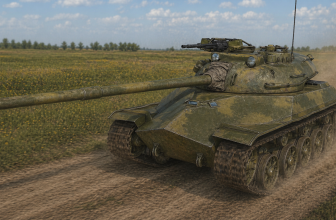
Just as in our world, the KV-1 didn’t appear until 1940, when the war was already underway. Based on experience from ongoing combat operations, the vehicle’s armor was radically increased to the level of a real KV—and even beyond. The tank’s front was protected not by 75-mm armor, but by 80-mm armor. The sides were given 75-mm protection, and the rear, 60-mm. It is also powered by the real-world V-2 diesel engine, which has proven itself to be highly reliable and fuel-efficient. However, its appearance differs significantly. Since the tank is welded, it can be assumed that in this alternate history, the USSR has made much greater progress in automatic and semi-automatic welding technologies. The hull was constructed primarily from flat armor plates, which simplified production and increased the structure’s rigidity. On early models, the armament was borrowed from the T-35, featuring the proven 63.5-mm gun.
KV-1 TTT:
- Combat weight: 47 metric tons
- Crew: 5 people
- Engine: V-2, 500 l.s.
- Chassis: independent torsion bar suspension
- Armor: bow 80 mm, sides 75 mm, stern 60 mm
- Armament: 1 × 63.5-mm gun (early models)
- Features: welded body made of flat armor plates
KV-1M
A modernized version appeared as early as 1941. The modernization primarily involved the installation of a new 76.2-mm gun, which was mounted in a new cast turret. The switch to a cast turret allowed for more efficient sloping angles and improved ballistic protection without increasing the vehicle’s weight. The new artillery system enabled the vehicle to reliably engage enemy medium tanks at ranges that were out of reach for earlier calibers.
KV-1M Specifications:
- Combat weight: 48 metric tons
- Crew: 5 people
- Engine: V-2K, 600 l.s.
- Chassis: torsion bar suspension with reinforced stabilizers
- Armor: front 80 mm, sides 75 mm, rear 60 mm, turret 75 mm
- Armament: 1 × 76.2-mm gun in a cast turret
KV-43
The latest model in the tank series is equipped with a cast, dome-shaped turret housing a new long-barreled 76.2-mm gun with high armor-penetration capabilities. The designers deliberately chose not to switch to an 85-mm caliber, opting instead for the high muzzle velocity and improved ballistics of the long-barreled gun. The dome-shaped turret provided excellent firing angles and increased the likelihood of enemy shells ricocheting. The vehicle became the logical culmination of the evolution of pre-war heavy tanks in this branch of reality.
KV-43 TTT:
- Combat weight: 49 metric tons
- Crew: 5 people
- Engine: V-2IS, 650 l.s.
- Undercarriage: upgraded rollers and wider tracks
- Armor: front 90 mm, sides 75 mm, rear 60 mm, turret 80 mm
- Armament: 1 × long-barreled 76.2-mm gun in a domed cast turret
SMK
Somewhere between the T-35 and the KV—just as in the real world—the SMK appeared in the USSR. The vehicle’s armament consisted of two guns, one 63.5 mm and one 38.5 mm, mounted in two independent turrets. Otherwise, the vehicle was similar to the real SMK, retaining its powerful torsion bar suspension and heavy armored hull. Only a single prototype was built, and the vehicle never entered mass production, as it was already clear to everyone that the era of multi-turret tanks was over. Even the flagship T-35 began to be produced in a single-turret version, which finally put an end to the concept of a “crawler-mounted artillery destroyer.” The sole SMK prototype remains a museum exhibit and a visual aid for designers seeking new directions in heavy tank development.
TTK SMSK:
- Combat weight: 55 metric tons
- Crew: 7 people
- Engine: an 850-l.s. diesel engine
- Chassis: four-roller bogies, torsion bar suspension
- Armor: front 60 mm, sides 40 mm, turrets up to 50 mm
- Armament: 1 × 63.5-mm gun in the main turret, 1 × 38.5-mm gun in the stern turret
An alternative development path for Soviet heavy tanks, proposed by Racercowan, demonstrates how quickly engineering innovation could respond to the challenges of the time. The move away from multi-turret designs, the early transition to welded hulls, and the logical evolution of calibers make these designs surprisingly plausible, even if they exist only on the blueprints of a parallel reality.