In our history, the “King Tiger” has remained a symbol of a belated technological leap, compounded by logistical problems and the Third Reich’s growing resource shortages. But in an alternate reality, where the course of World War II took a completely different turn, this vehicle took on a different meaning, a different tactical role, and, most importantly, a different enemy.
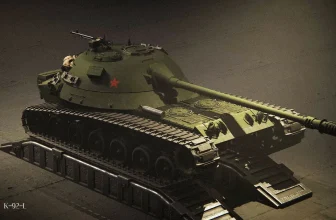
Let’s get one thing straight: despite the article’s title, the “IS” index never actually appeared in this world. Soviet heavy tanks continued to evolve within the “KV” line, and the super-heavy flagship—the equivalent of our IS-7—was designated the KV-7. It was this tank that served as the catalyst for the German response, which went down in history as the “King Tiger.”

The Bifurcation Point: “Barbarossa” South and the New World Order
It all began with a decision that, in our reality, was considered impossible. In early 1941, Admiral Erich Röder managed to convince Hitler to shift the main thrust of Operation Barbarossa to the south. The name of the operation remained the same, but its direction changed radically: the Wehrmacht did not advance on Moscow and Leningrad, but instead marched through the Balkans, Turkey, and the Middle East toward the heart of the British colonial empire.
By the end of 1941, German forces were stationed in Jerusalem, controlling the oil routes and the Suez Canal. By 1944, German columns advancing eastward had encountered Japanese troops in India. Pro-German puppet regimes were quickly established in all conquered territories, and the Reich’s resource base came under secure control.
The war did not directly involve the U.S. and the USSR. The absence of an Eastern Front radically altered the Wehrmacht’s logistics, and priority funding for jet aviation made it possible to successfully carry out “Sea Lion” in 1945. The British government evacuated to Canada. In 1946, with a short interval between them, nuclear tests were conducted: first in the U.S., then in Germany and the USSR. The world was plunged into a new kind of Cold War: a confrontation between the Nazi bloc and the U.S.-Soviet alliance. A direct war between Berlin and Moscow never took place, but the arms race flared up with unprecedented intensity.
The Evolution of Armored Vehicles: A World Without the “Panther”
The absence of engagements with Soviet T-34s and KV tanks radically changed the German school of tank design. The “Panther” never appeared in this world—there was no need for a medium tank with sloped armor and a powerful, long-barreled 75-mm gun, designed as a response to Soviet armor. The evolution of heavy tanks took a different path.
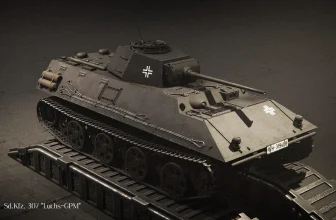
In Germany, as early as 1942, the Henschel company completed work on the VK 65.01 prototype heavy tank, which became the first mass-produced “Tiger.” However, these vehicles saw almost no combat during World War II. This was due to both the objective logistical difficulties of maintaining 50-metric-ton vehicles and the lack of worthy opponents in the main theaters of war (the USSR and the United States did not enter the war). These vehicles were mainly deployed to districts bordering the USSR, where the threat of a sudden Soviet strike persisted—a strike that never materialized.

A Stunning Demonstration of the KV-7
Everything changed on November 7, 1947. The KV-7 was unveiled at a parade on Red Square celebrating the 30th anniversary of the USSR. To the surprise of foreign observers, the announcer did not skimp on details, listing virtually all the tactical and technical characteristics of the new vehicle. Military delegations from around the world, including representatives from Germany and the United States, were present in the stands.
A quiet panic began to spread among armored forces. Intelligence agencies from all blocs received urgent orders to obtain blueprints, test range data, and armor samples. Many agents—both German and American—were captured by Soviet counterintelligence, but they already knew the most important thing: The USSR had outpaced everyone in the super-heavy tank class by creating a vehicle with a level of protection and firepower that was unprecedented for its time.
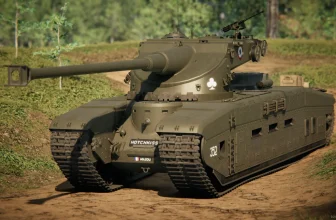
The Berlin engineering bureau needed a quick but effective solution. That is how the VK 70.01(H) project came to be, which went down in history as the “King Tiger” (Königstiger).

Design and Specifications of the VK 70.01(H)
Working under tight deadlines, Henschel decided against risky experiments with the undercarriage. Instead, the suspension and track drive of the older “Tiger” were extensively modernized and reinforced to accommodate the increased weight. The vehicle’s combat weight reached 73 metric tons.
Externally, the VK 70.01(H) hull resembled the Soviet KV-7: a distinctive “pike nose,” optimized angles of the armor plates, and a low profile designed to minimize its visibility on the battlefield. Its protection was brought up to a level comparable to that of its Soviet counterpart: the front of the hull and the turret were designed to withstand modern anti-tank weapons of a likely adversary.
At the heart of the tank was a 2,000-strong diesel engine, the result of a forced but successful collaboration between Maybach and Junkers. With this engine, the 73-metric-ton vehicle could accelerate to 70 km/h on paved surfaces, making it surprisingly maneuverable for its class.
But its main trump card was an entirely new 140-mm tank gun, designed specifically to meet the requirements for penetrating the frontal armor of the KV-7 and future American heavy tanks. The gun stabilization system, installed on a production vehicle for the first time in the world, brought its firepower to a level that allowed for effective firing at maximum ranges.

Mass Production and Its Place in History
In this form, the VK 70.01(H) was approved by the military leadership and put into mass production. Unlike in our history, the “Royal Tiger” of this world became neither a “paper tiger” nor a logistical nightmare. The Reich’s well-established infrastructure, the absence of an active land front, and a focus on technological competition made it possible to bring the vehicle into full-scale military service.
The tank was deployed to heavy tank battalions stationed along the Soviet border and at key locations across the European continent. It became a symbol of the German heavy tank tradition in a bipolar world, where every new tank was not merely a weapon, but a political statement and an element of a strategy of deterrence.

In lieu of a conclusion
In our history, the “Royal Tiger” has remained a heavy reminder of a belated industrial race. In a parallel reality, it became a living response to the Soviet KV-7, the product of a different strategic calculus and a different geopolitical chessboard. This 73-metric-ton machine, with a 2,000-horsepower engine and a 140-mm gun, bore the imprint of a world where World War II had ended differently, and the Cold War began with tank blueprints on the desks of designers in Berlin, Moscow, and Washington.
And in this world, the “Tiger” truly became the king.


Source of illustrations: https://www.reddit.com/r/SprocketTankDesign/comments/1sm8f9v/ah1_super_heavy_tank/