Ground-based radar has a limitation that cannot be overcome simply by increasing its power: the Earth is round. A low-flying aircraft or cruise missile can remain below the radar horizon until it gets relatively close. One way to gain additional response time is to lift the radar into the air.
Sweden’s GlobalEye addresses this problem using a long-range business jet with an elongated antenna housing above its fuselage. But the aircraft contains considerably more than radar equipment: it combines surveillance, information processing, and command-and-control capabilities.
On 15 October 2026, Saab presented the first GlobalEye for the Swedish Air Force, where it is designated S 106. The rollout does not mean the aircraft is entering operational service: verification and flight testing lie ahead, with delivery to the armed forces planned for 2027. Sweden has ordered three aircraft.
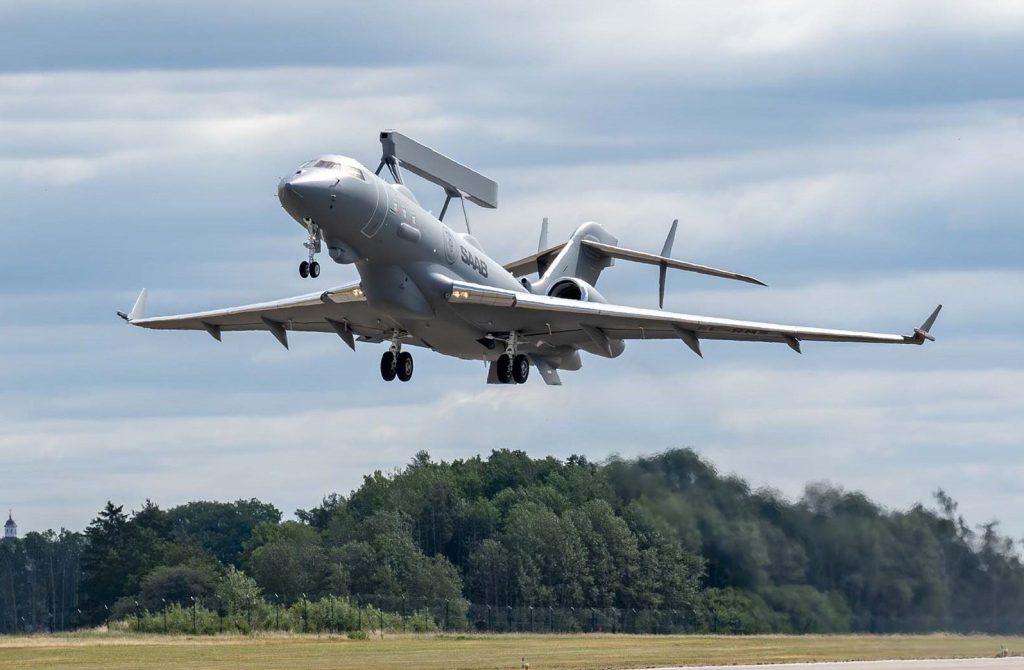
Why Raise a Radar Ten Kilometres Above the Ground?
A ground-based radar may see high-altitude targets clearly while detecting objects flying close to the surface much later. Hills and other obstacles further complicate surveillance.
An airborne early warning and control aircraft gains a different viewing geometry. From altitude, it can observe areas beyond a ground station’s horizon. This perspective is particularly useful when searching for low-flying targets.
On its GlobalEye product page, Saab states that the aircraft can detect low-flying threats at distances exceeding 400 km while operating at 35,000 feet — approximately 10.7 km. This is a manufacturer-stated capability, rather than a guaranteed detection range for every drone or missile: results depend on the target’s size and signature, interference, and observation conditions.
The benefit is measured in time. Earlier detection leaves more opportunities to identify a target, share the information, and organise an interception.
What Is Inside the Long Fairing?
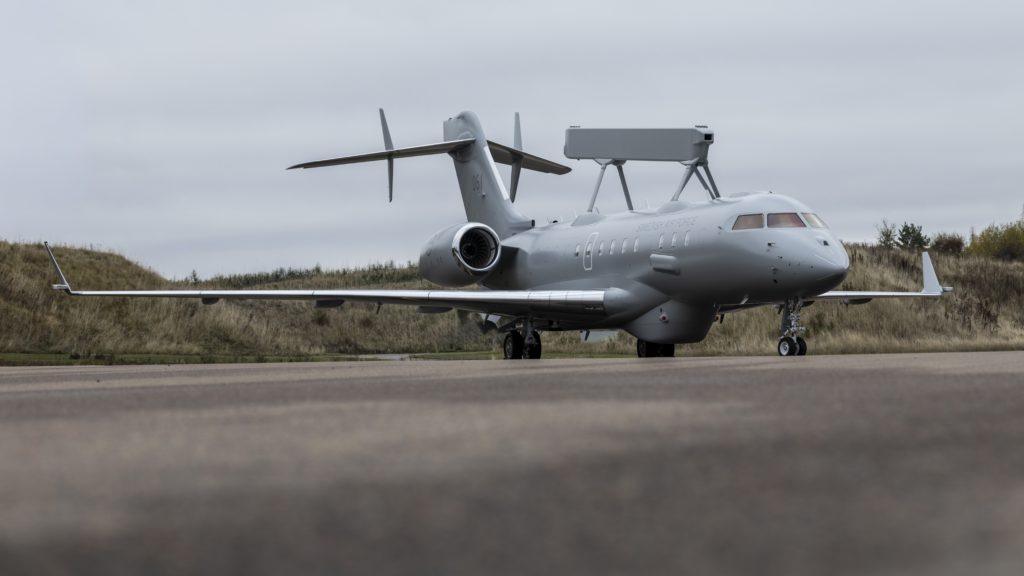
GlobalEye’s main sensor is the Erieye ER radar. Its approximately ten-metre antenna sits above the fuselage. Instead of a rotating radar dome, it uses an active electronically scanned array, or AESA.
This arrangement allows the radar to change its beam direction without mechanically turning the entire antenna. Within its available coverage sectors, it can divide its attention between searching for new objects and tracking those already detected.
Erieye ER uses gallium nitride, or GaN, technology, which enables efficient, high-power radio-frequency components. This matters for an airborne radar: additional power must fit within the aircraft’s weight, electricity supply, and cooling limits. Saab links the development of Erieye ER to increased output power and detection range.
A fixed antenna does not, however, provide identical performance in every direction. The aircraft’s position and patrol route remain part of how the system operates.
Why 650 Kilometres Is Not the Detection Range for Every Target
GlobalEye has a stated instrumented range of 650 km. That specification cannot automatically be applied to every object. A large aircraft at high altitude, a small drone, and a low-flying missile present very different detection challenges.
The radar must distinguish the reflected signal from interference and surface clutter, then maintain a reliable track. Even after a contact appears, there remains the question of whether enough information is available to determine what it is.
GlobalEye therefore draws on several sources of information. Radar provides one set of observations, passive sensors provide another, and electro-optical equipment can assist identification. The system’s value depends on how effectively these observations complement one another.
Aircraft, Ships, and Movement on the Ground
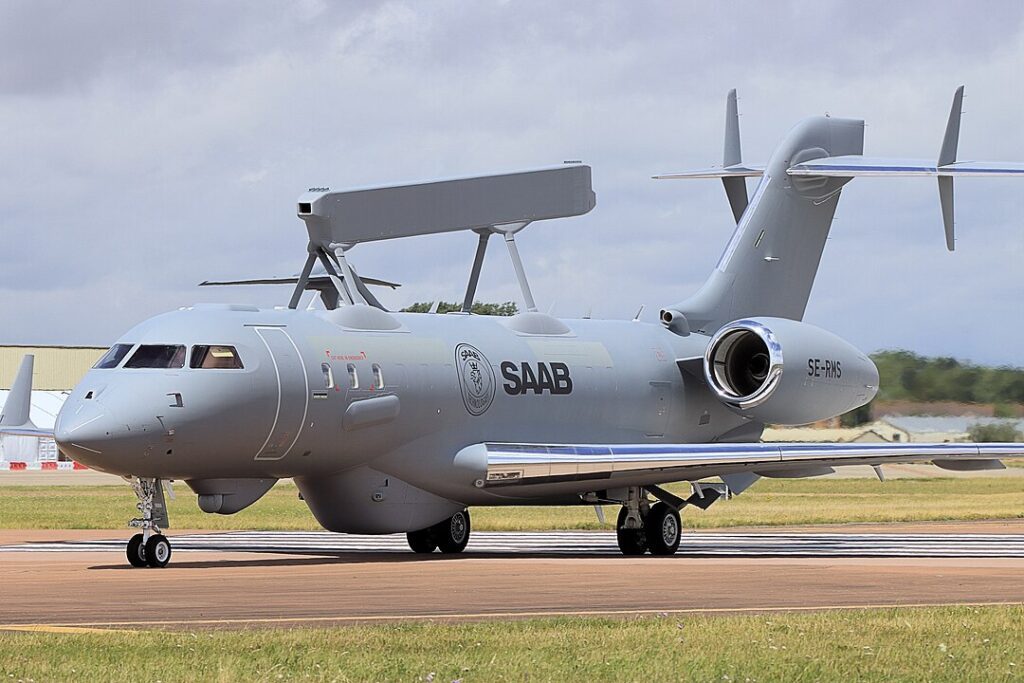
GlobalEye’s sensor suite includes Erieye ER, a maritime surveillance radar, an electro-optical system, and electronic intelligence equipment. It also incorporates identification systems and receivers for information transmitted by civil aircraft and maritime vessels.
This allows several tasks to be performed during one sortie. The aircraft can monitor the air picture, track maritime objects, and detect moving ground targets. The precise equipment fit and capabilities nevertheless depend on the customer’s configuration.
Information feeds into the onboard command-and-control system. Its job is to correlate observations, build a common picture, and distribute relevant information to other participants. This connection is what makes an AEW&C aircraft useful: detection must become timely information that fighters, ships, or ground units can act upon.
Why Choose a Business Jet?
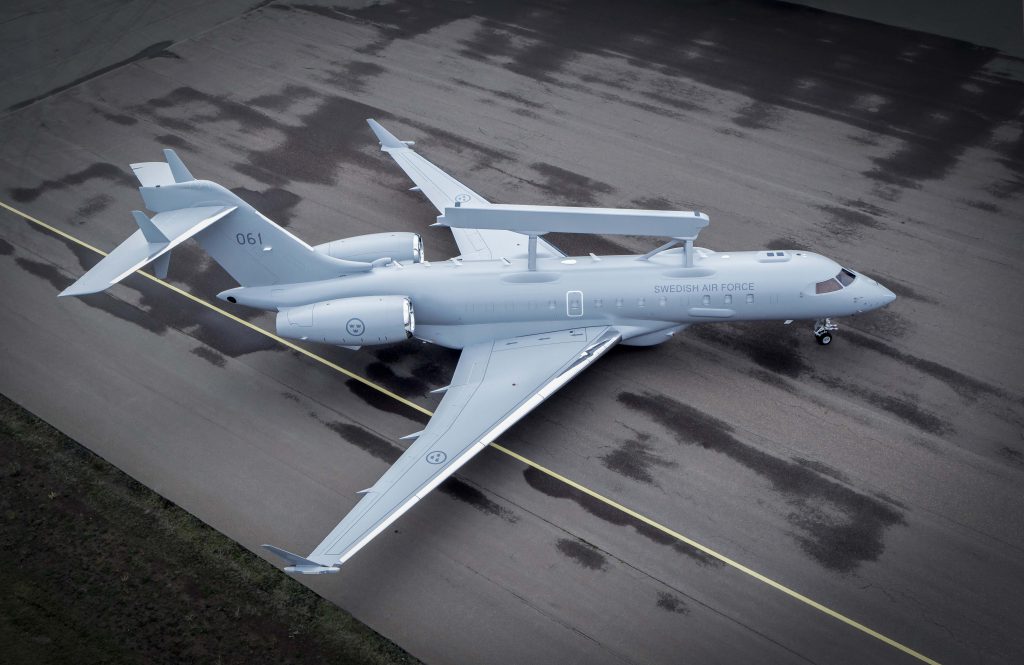
Sweden’s S 106 is based on the Bombardier Global 6000. Across the GlobalEye family, Saab offers the Global 6000/6500 platforms. These aircraft were designed for long flights, with pressurised cabins and conditions suitable for extended crew operations.
Converting a business jet into an AEW&C aircraft takes much more than adding a fairing, however. Saab strengthens the airframe to support the antenna, adds housings for other sensors, modifies the tail surfaces, and installs additional electrical power and cooling equipment.
The large antenna affects aerodynamics, while powerful electronics generate heat. All these changes must work together while preserving stability, controllability, and adequate endurance.
Key technical reference points:
| Role | Airborne early warning and control, surveillance |
| Swedish designation | S 106 |
| Swedish aircraft platform | Bombardier Global 6000 |
| Main radar | Erieye ER AESA |
| Main antenna length | Approximately 10 m |
| Instrumented range | 650 km |
| Family flight endurance | Around 12 hours, according to current Saab information |
| Swedish order | Three aircraft |
| Planned first delivery to Sweden | 2027 |
The family’s stated specifications should not be treated as guaranteed figures for every sortie. Time on station depends partly on the distance to the operating area and the fuel reserved for the return flight.
What Changes Compared with ASC 890?
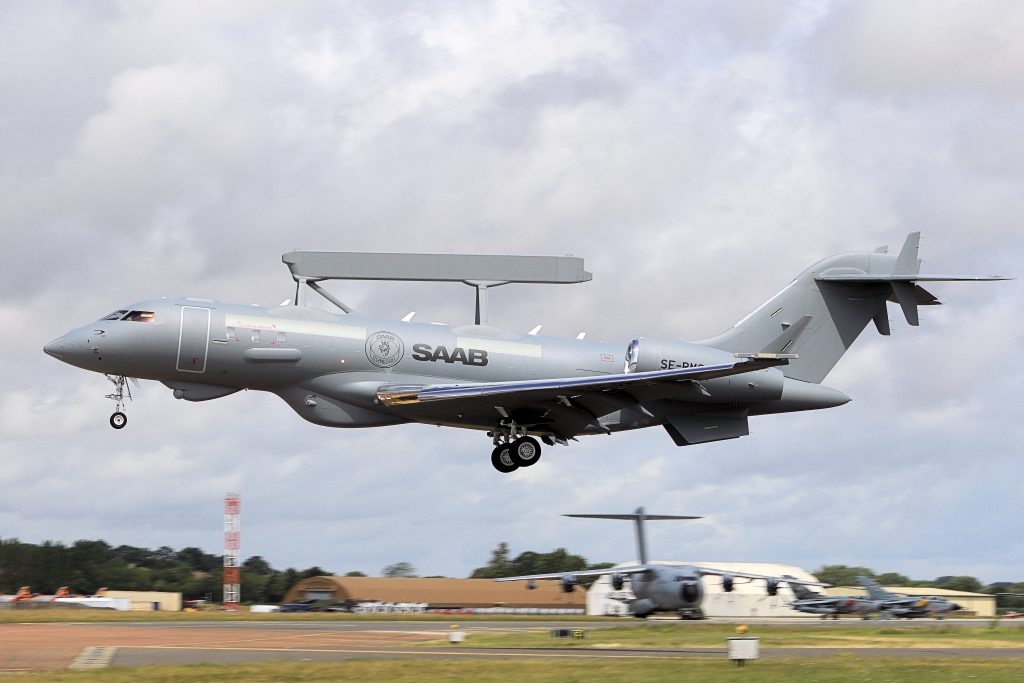
Sweden’s earlier ASC 890 used the Saab 340 turboprop platform and an Erieye-family radar. GlobalEye retains the recognisable dorsal antenna arrangement, but introduces a new carrier aircraft, Erieye ER, and a broader sensor suite. Swedish plans call for S 106 aircraft to progressively replace ASC 890.
The technical purpose of the transition is to combine long-range radar coverage, additional sensors, and command-and-control functions on one platform. But endurance and detection range still have to translate into sustained operational readiness: operators need training, aircraft need maintenance, and information-sharing arrangements must be established.
For Sweden’s first GlobalEye, that work continues. Following its rollout, testing must confirm that the large radar, carrier aircraft, and airborne command centre function as a single integrated system.