A Soviet Rolls-Royce with a Hybrid Engine. What Could the USSR’s Party Elite Have Driven in 2030?

We will not discuss how the Soviet Union managed to survive in this article. I will say only one thing: it could have survived. And if it had, the evolution of limousines for the highest-ranking Party and government officials would have continued, with these vehicles still being manufactured in Moscow at the Likhachev Automobile Plant, just as before.
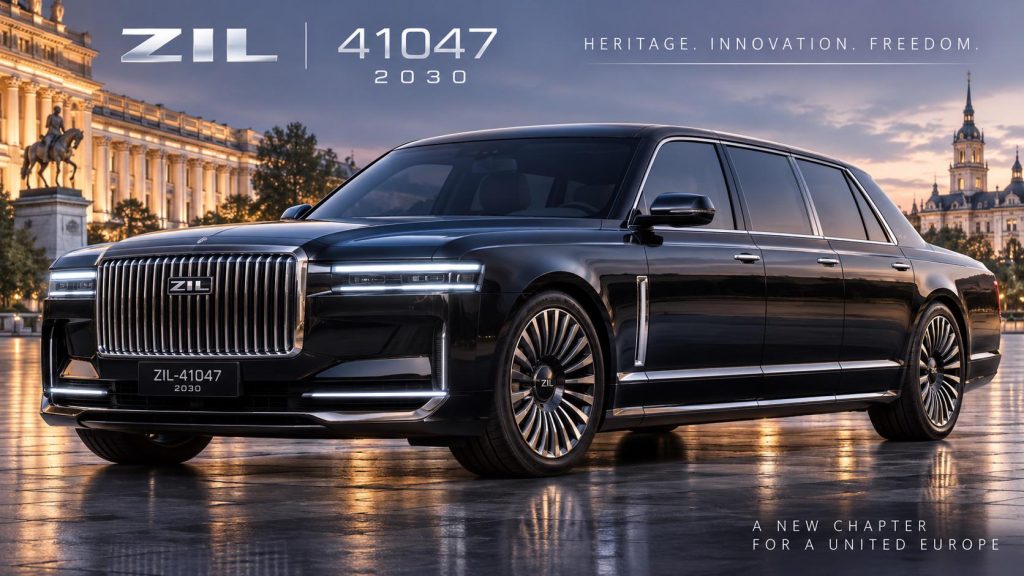
But what would an official Soviet government car have looked like in 2030? Would it still have been the same enormous black limousine with a gas-guzzling eight-cylinder engine and a design rooted in the 1970s? Hardly. Over the intervening decades, the automotive industry has undergone a genuine technological revolution, and Soviet designers would have had to incorporate its achievements. At the same time, there would have been no need to abandon the recognizable appearance of the classic ZiL. Let us imagine that the Moscow factory continued producing luxury executive cars and, by 2030, had developed the next generation of the legendary ZiL-41047. Externally, it would have remained faithful to tradition, but technically, it would have become an entirely different vehicle.
From Gorbachev to 2030. How Could the ZiL Have Evolved?
The real ZiL-41047 appeared in 1985 as a further development of the ZiL-4104 family. It was one of the largest production passenger cars of its time: it measured 6,330 mm in length, had a wheelbase of 3,880 mm, and was powered by a 7.7-liter V8 gasoline engine producing 315 hp.
The car featured an automatic transmission, a spacious seven-seat interior, and was assembled almost entirely by hand.
In actual history, the collapse of the USSR put an end to the full-scale development of such vehicles. Production gradually declined, and the final attempts at modernization culminated in the experimental ZiL-4112R.
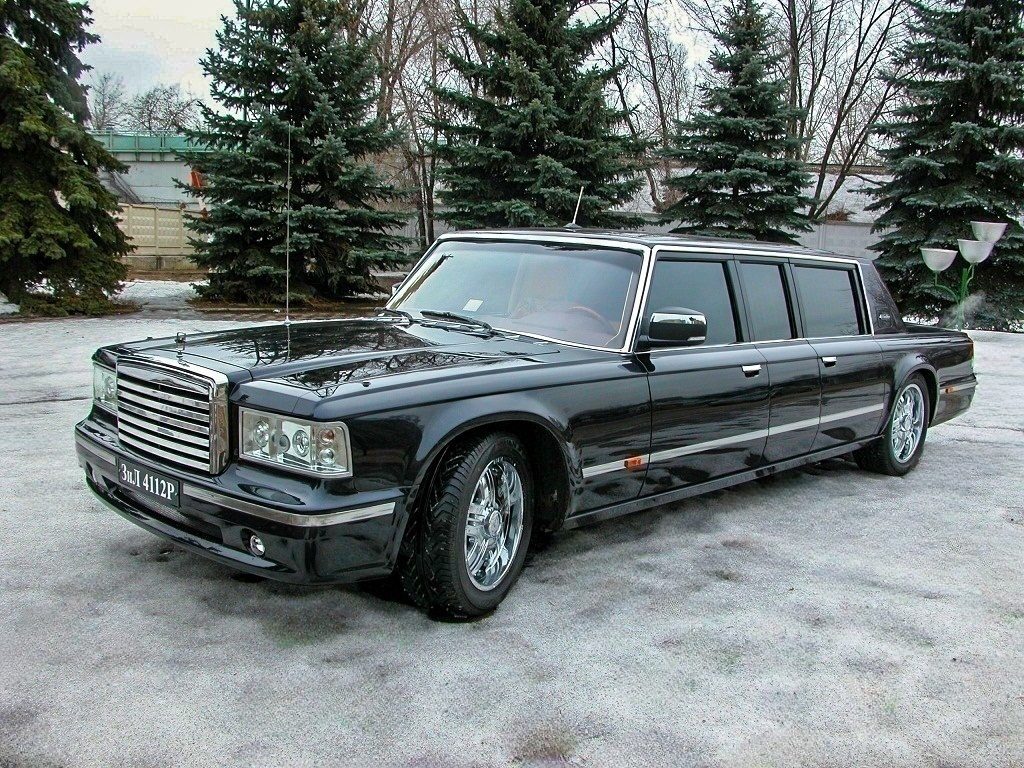
ZiL-4112R
But in our alternative reality, everything unfolds differently.
During the 1990s, the Moscow factory retains its government orders. In the early 21st century, it produces a modernized family of luxury limousines, and by the 2020s, it begins developing an entirely new platform.
At the same time, the country’s leadership makes a fundamental decision: the vehicle’s appearance must preserve continuity with the classic ZiL limousines.
Thus, the 2030 model of the ZiL-41047 is born.
Soviet Luxury with a Modern Twist
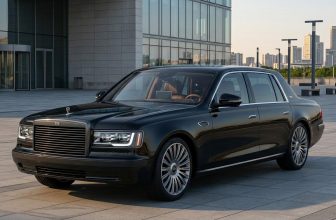
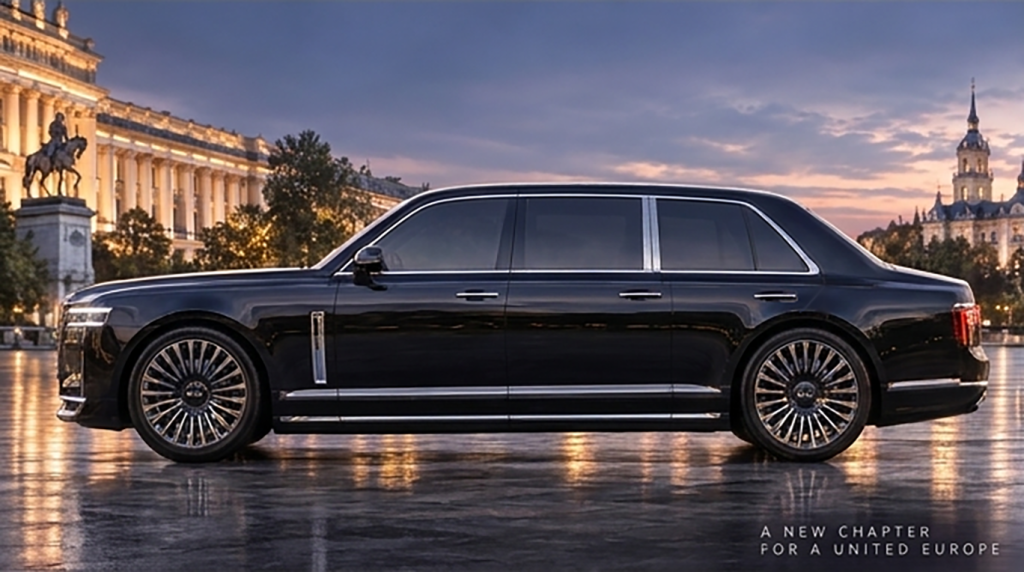
The most distinctive feature of the new limousine is its appearance.
Unlike most modern luxury executive cars, ZiL’s designers do not attempt to give the vehicle a streamlined, sporty silhouette.
Instead, they retain the long hood, almost vertical radiator grille, strict body lines, and massive rear section.
However, this is no longer a direct copy of the 1985 model.
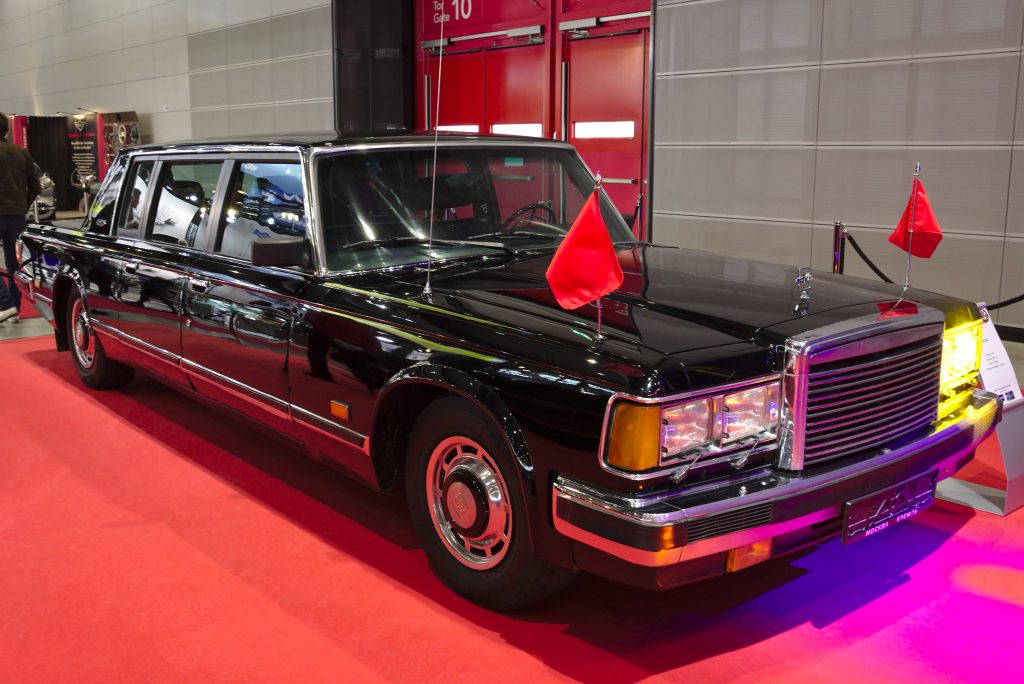
The original ZiL-41047 from the 1980s
The body features improved aerodynamics, rectangular headlights give way to narrow LED units, and the traditional radiator grille conceals modern cooling systems and electronic sensors.
At the same time, the chrome details and characteristic proportions make the car instantly recognizable as a Soviet government limousine.
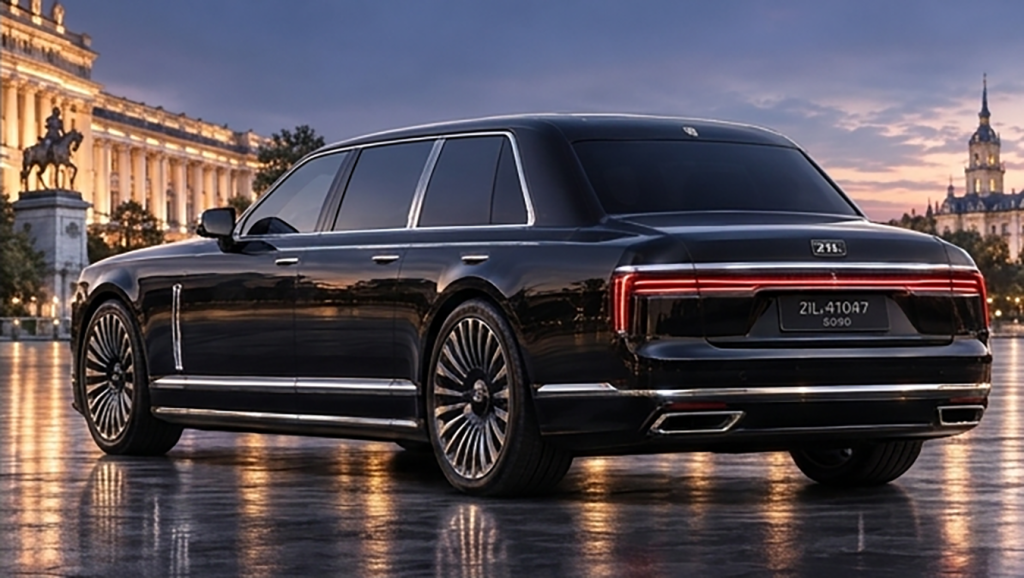
This is precisely the concept demonstrated in a fictional illustration published by Reddit user PsychologicalTea1888 in the AiCarArt community.
In essence, we are looking at a car that might have existed if the Soviet tradition of building luxury executive vehicles had continued uninterrupted.
A Gasoline V8 and Electric Power. Why Does a Limousine Need a Hybrid?
The most important technical feature of the new ZiL is its plug-in hybrid powertrain.
In our alternative history, the designers retain the traditional eight-cylinder gasoline engine but completely redesign it.
Instead of the old carbureted unit, the vehicle uses a modern 7.7-liter V8 with electronic fuel injection, variable valve timing, and significantly improved fuel efficiency.
Its projected output reaches 450 hp.
However, during everyday journeys, the internal combustion engine is hardly used at all.
The vehicle is also powered by an electric motor and a traction battery with a capacity of approximately 45 kWh.
The estimated range on electric power alone is approximately 100 kilometers.
That is sufficient for most daily journeys around Moscow: from a government residence to the Kremlin, to government offices, or to official events.
Thus, this enormous luxury limousine can travel through the capital almost silently, without consuming any gasoline.
When a longer journey is required, the eight-cylinder engine starts automatically.
The combined output of the hybrid powertrain could reach approximately 550 hp.
Adaptive Suspension. Comfort Matters More Than Speed
Ride comfort has always been one of the most important qualities of any government limousine.
The original ZiL-41047 had a fairly soft suspension, but its design was based on technical solutions developed decades earlier.
In the new car, the designers completely abandon the traditional leaf-sprung rear axle.
All four wheels now feature independent suspension with pneumatic springs and electronically controlled shock absorbers.
Road-monitoring cameras and special sensors continuously assess the condition of the road surface, allowing the electronics to adjust the suspension settings before a wheel even encounters a bump.
In addition, the active system suppresses body roll in corners and longitudinal pitching during acceleration and braking.
As a result, even an enormous limousine weighing several tons can deliver an exceptionally smooth ride.
For passengers in the rear compartment, this is probably far more important than accelerating from zero to 100 km/h in just a few seconds.
An Armored Office on Wheels
Naturally, a luxury ZiL limousine of 2030 would have to meet modern security requirements.
In our alternative USSR, a special protected version is developed for the country’s highest-ranking officials.
Unlike the standard limousine, this version incorporates armored protection into the body structure from the very beginning of the design process.
It uses multilayer ballistic glass, reinforced panels, a protected fuel system, and special run-flat tires that allow the vehicle to continue moving after losing tire pressure.
The hybrid powertrain also receives additional redundancy. If the gasoline engine fails, the vehicle retains the ability to operate on electric power.
The reverse situation is also taken into account: if the traction battery is damaged, the car can continue moving using its internal combustion engine, provided that conditions and the remaining equipment allow it.
Particular attention is paid to secure communications.
The rear compartment contains encrypted communications equipment, allowing passengers to maintain contact with government institutions and escort vehicles.
In effect, the ZiL becomes a small mobile office for the head of state.
What Would the Interior of a Government ZiL Look Like?
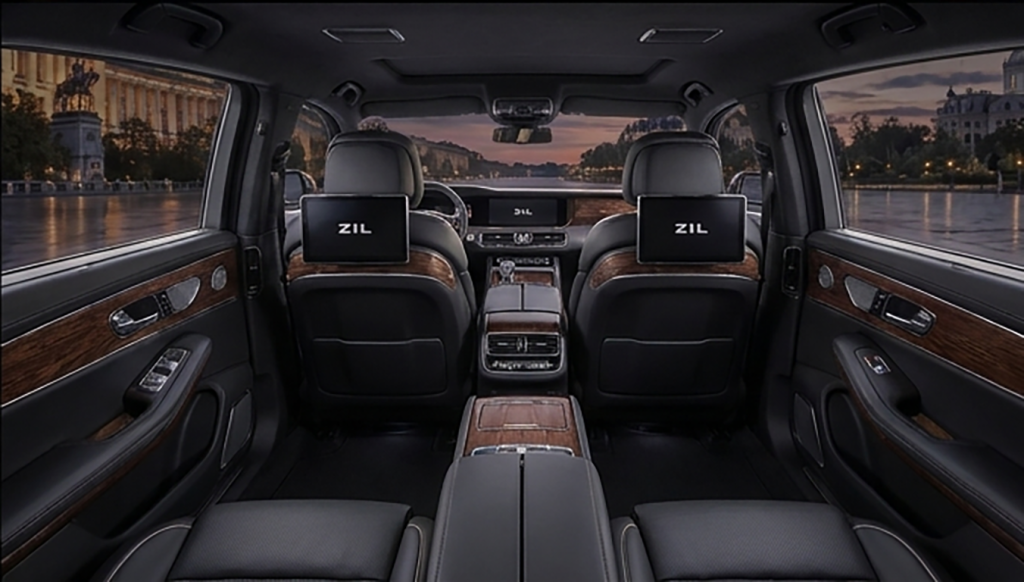
Inside the vehicle, the designers preserve the traditions of Soviet luxury executive cars.
There is no excessive enthusiasm for touchscreens or decorative lighting. The main materials are genuine leather, wood, high-quality fabrics, and polished metal.
However, beneath this classic trim lies thoroughly modern equipment.
The rear passenger seats feature electric adjustment, ventilation, heating, and massage functions.
The climate control system maintains an individually selected temperature for each passenger.
A partition with electrochromic glass separates the front and rear sections of the cabin, becoming opaque whenever necessary.
Naturally, the vehicle is equipped with a multimedia system, access to secure information channels, and videoconferencing capabilities.
But its greatest advantage remains silence.
Thanks to electric propulsion, multilayer glass, and active noise cancellation, passengers can barely hear the powertrain operating.
In terms of comfort, such a vehicle could easily compete with modern Rolls-Royce and Mercedes-Maybach models.
Main Specifications of the Alternative 2030 ZiL-41047
- Country: USSR (alternative history).
- Manufacturer: Likhachev Automobile Plant, Moscow.
- Type: Full-size luxury executive limousine.
- Production start: 2030.
- Length: Approximately 6,400 mm.
- Width: Approximately 2,050 mm.
- Wheelbase: Approximately 3,900 mm.
- Seating capacity: 5–7, depending on the version.
- Engine: 7.7-liter V8 gasoline engine.
- Gasoline engine output: 450 hp.
- Hybrid system: Plug-in hybrid with an electric traction motor.
- Combined output: Approximately 550 hp.
- Battery capacity: Approximately 45 kWh.
- Electric-only range: Approximately 100 km.
- Transmission: Automatic hybrid transmission.
- Drive: Rear-wheel drive.
- Suspension: Independent adaptive air suspension.
- Maximum speed: Electronically limited to 220 km/h.
- Curb weight: Approximately 3.2 metric tons without additional armor.
- Special versions: Armored limousine, escort vehicle, ceremonial convertible.
All specifications are the author’s hypothetical estimates rather than data from an actual factory development program.
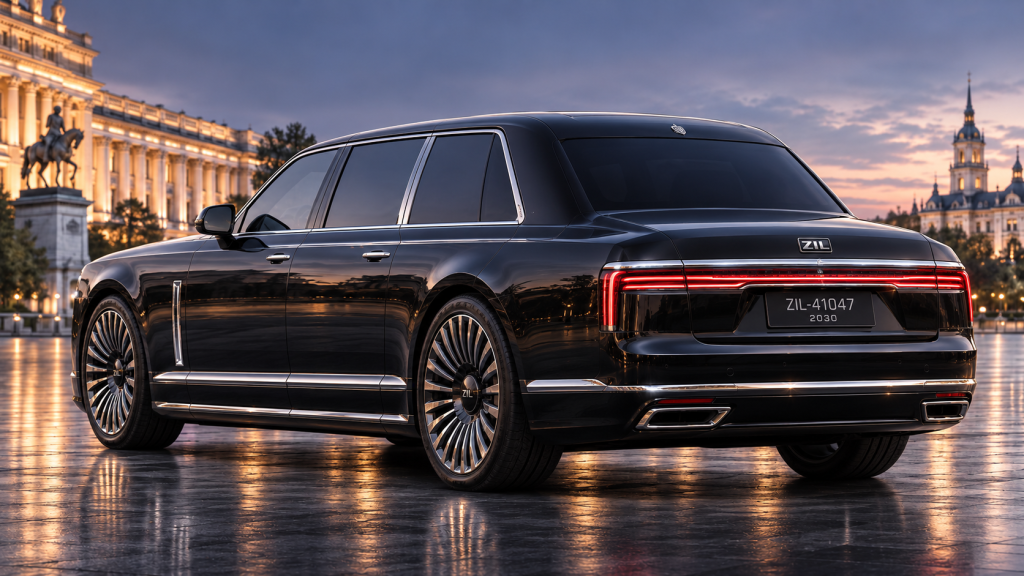
4-door version of the limousine
Why Could the USSR Have Preserved Production of Such Vehicles?
A perfectly reasonable question arises: how realistic would the existence of such a car have been in the Soviet Union?
In my opinion, there would have been no insurmountable technical obstacles.
The main requirement would have been preserving the factory itself, its design expertise, and a stable flow of government orders.
After all, such limousines were never intended for mass production. They were manufactured in small batches, with many components made by hand.
Therefore, even a relatively modest government fleet renewal program would have been enough to maintain specialized production.
Of course, mastering modern hybrid systems, batteries, electronic control units, and active suspension would have required substantial investment.
It is also possible that certain components would have been developed by other Soviet enterprises or obtained through international technological cooperation.
But such an approach would hardly have been unusual. In actual history, Soviet government limousines also used certain foreign-made components.
Ultimately, the main question would have been not so much technical feasibility as political will and funding.
An Afterword. The Last Soviet Limousine That Could Have Become the First
The story of the real ZiL-41047 ended along with the era for which it had been created.
The enormous black car with its almost eight-liter engine became one of the symbols of the late Soviet Union.
But it would be a mistake to assume that the very concept of a Soviet-designed luxury executive limousine had exhausted its potential for development.
Had the USSR survived, the Moscow factory could easily have continued evolving its vehicles, gradually introducing new materials, electronics, and modern powertrains.
And hybrid technology seems particularly well suited to a government limousine.
It combines the necessary power reserve, long driving range, and virtually silent urban operation.
Adaptive suspension and modern safety systems would also have made the vehicle considerably more comfortable and technologically advanced than its predecessors.
Of course, a real ZiL from 2030 would not necessarily have looked exactly like the fictional illustration created by our Western colleague.
Nevertheless, the very idea of preserving classic Soviet styling while completely modernizing the technology beneath it is extremely interesting.
And who knows? Perhaps, if the Soviet Union had survived, enormous black ZiL limousines really would have been driving through the streets of Moscow in 2030, capable of silently covering 100 kilometers on electric power and delivering more than 500 horsepower whenever necessary.
After all, it is entirely possible that the famous ZiL-41047 could have become not the final chapter in the history of Soviet luxury executive cars, but merely the beginning of an entirely new family of vehicles.