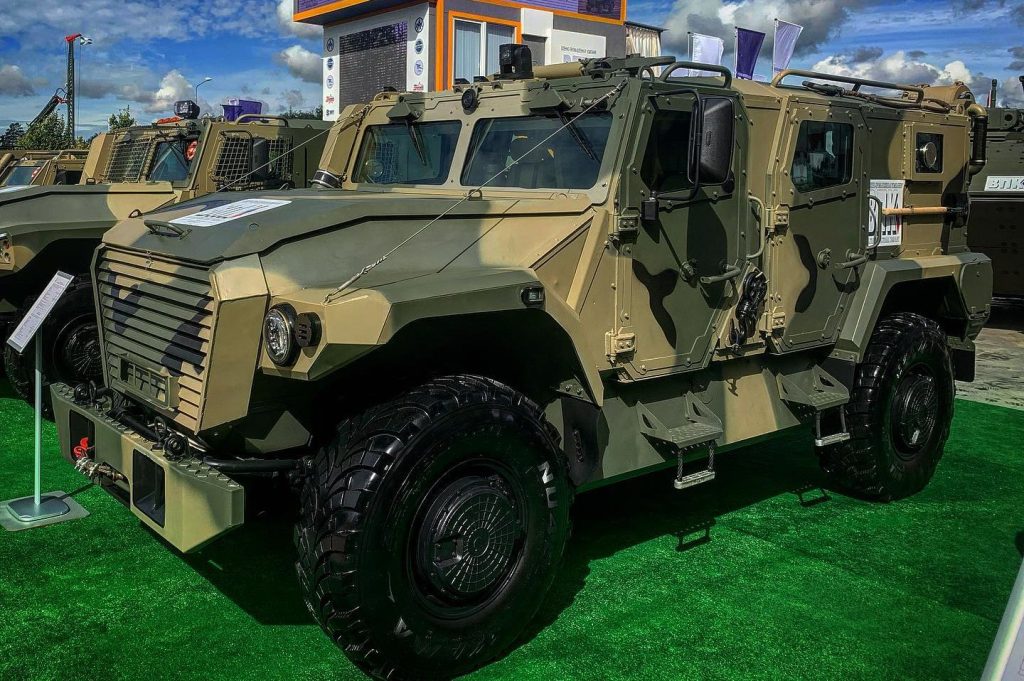
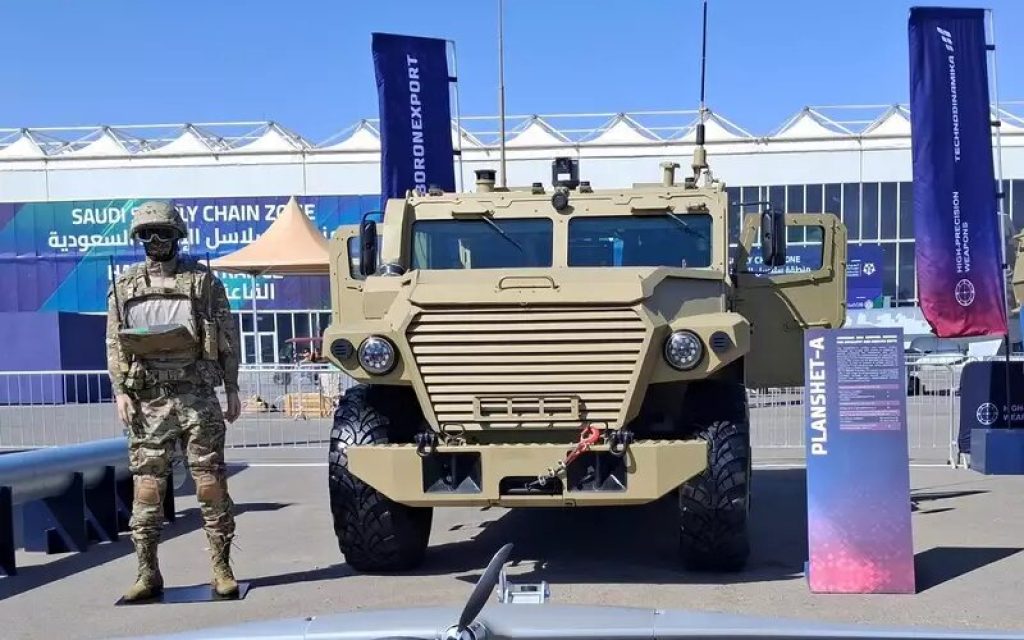
At the World Defense Show 2026 in Saudi Arabia, Russia displayed its Planshet-A artillery fire-control system on an unfamiliar chassis. Instead of the well-known Tigr-M, the equipment was installed inside an AMN-2 Atlet armored vehicle. The two machines look similar enough for the newcomer to be mistaken for another member of the Tigr family. Yet behind its larger body and almost three additional tons of weight lies an attempt to solve the Tigr’s greatest weakness: its limited ability to protect the crew from mine blasts.
The Atlet’s appearance in Riyadh does not mean that the vehicle has only just completed testing. State trials ended in late 2021, after which the government commission recommended the vehicle for acceptance into service. Its latest public appearance is significant for a different reason: Atlet is now being promoted not as an experimental design, but as a production-ready platform for artillery-control, command and reconnaissance systems.
When the Tigr Was No Longer Enough
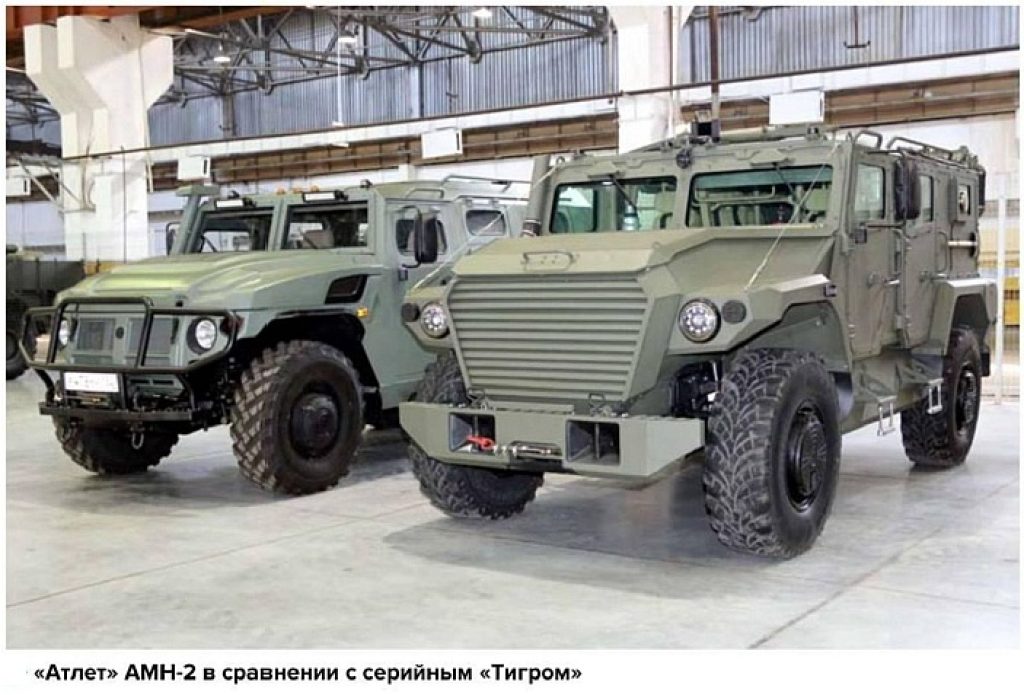
The Tigr-M was designed as a fast and relatively light military off-road vehicle. With a gross weight of approximately 6.6–6.9 tons, it can carry up to ten people, tow a trailer and reach 120 km/h on paved roads. Its chassis has been used for command vehicles, anti-tank missile systems, communications equipment and reconnaissance platforms. It is a successful vehicle for its class, but the laws of physics cannot be avoided: a limited weight reserve restricts the amount of armor and mine protection that can be added.
The Atlet’s gross weight has increased to nine tons. It is roughly one-third heavier than the Tigr-M and has a larger armored body, a V-shaped hull floor, blast-attenuating seats and an aramid spall liner. The principle is straightforward: the sloped floor redirects part of the blast away from the passenger compartment, while the suspended seats reduce the shock transmitted through the floor to the occupants’ spines.
The added protection came at the price of greater weight. To prevent the nine-ton vehicle from becoming a slow armored box, engine power was increased from 215 to 240 hp. Payload rose from approximately 1.2–1.3 tons to 1.6 tons. Despite the additional mass, the stated maximum road speed remains 120 km/h, while the range reaches 1,000 kilometers.
The result is less a new version of the Tigr than a vehicle in the next weight category, built around the same general concept: high mobility, relatively compact dimensions and the ability to carry a wide range of weapons and specialized equipment.
How Much Explosive Can the Atlet Withstand?
The vehicle’s mine protection has become a source of confusion. Early exhibition materials and some publications mentioned resistance to a blast equivalent to six kilograms of TNT. That would place the Atlet in the same general protection category as some foreign protected vehicles, including the Mowag Eagle IV.
However, reports concerning the test program and published specifications for the export-oriented Atlet-E gave a guaranteed figure of two kilograms of explosive. The difference may reflect separate protection configurations: a basic version and an upgraded package fitted with additional armor and blast-protection modules. Without access to official test reports, however, it would be misleading to claim that every production AMN-2 can withstand a six-kilogram charge detonating beneath the hull or a wheel.
The Atlet is therefore better described as a light armored vehicle with significantly improved mine protection rather than a full-scale MRAP.
The distinction matters. Purpose-built MRAP vehicles are usually heavier, taller and equipped with a more pronounced V-shaped hull. Their design is dominated by one requirement: keeping their occupants alive after a powerful explosion. The price is a high silhouette, substantial weight, reduced mobility and greater operating costs.
The Atlet occupies the space between those extremes. It offers better protection than the Tigr while remaining compact and fast enough to serve as a command, patrol or special-purpose vehicle.
Eight People, a Machine Gun or a Headquarters on Wheels
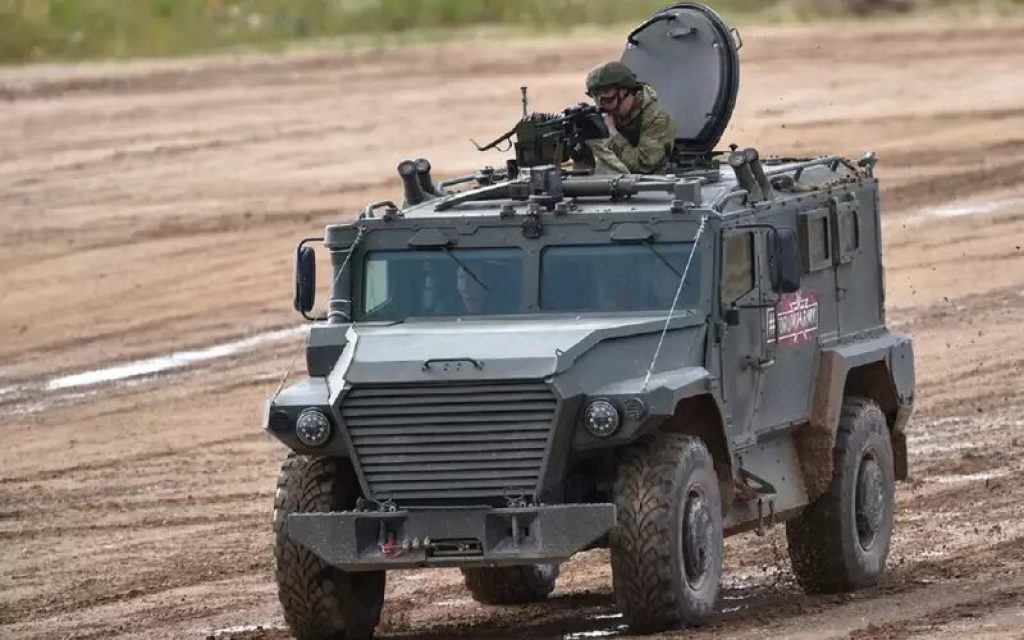
The Atlet family includes several configurations. The five-door AMN-2 can carry up to eight people, including the driver. Four side doors allow the crew and passengers to leave the vehicle more quickly, while a separate single-piece door is installed at the rear.
A shorter special-purpose version with two side doors can be fitted with a large roof hatch and a rotating weapons mount. Depending on the mission, it may carry a 7.62 mm or 12.7 mm machine gun or a 30 mm automatic grenade launcher.
An armed patrol vehicle, however, is only one possible role. The 1.6-ton payload allows the installation of radios, computerized operator stations, reconnaissance equipment and fire-control systems. This explains why the Atlet appeared at the international exhibition as part of the Planshet-A complex. For such a system, the number of passengers is less important than the internal space available for operators, electronics, communications equipment and an independent power supply.
The vehicle can also carry cargo and tow trailers weighing up to 2.5 tons. Its independent torsion-bar suspension and approximately 400 mm of ground clearance preserve its off-road capability, although the additional three tons inevitably increase ground pressure. On soft terrain where the lighter Tigr may continue moving, the Atlet could encounter greater difficulty.
Improved protection always requires a compromise, and the new vehicle is no exception.
Russia’s Answer to the Mowag Eagle?
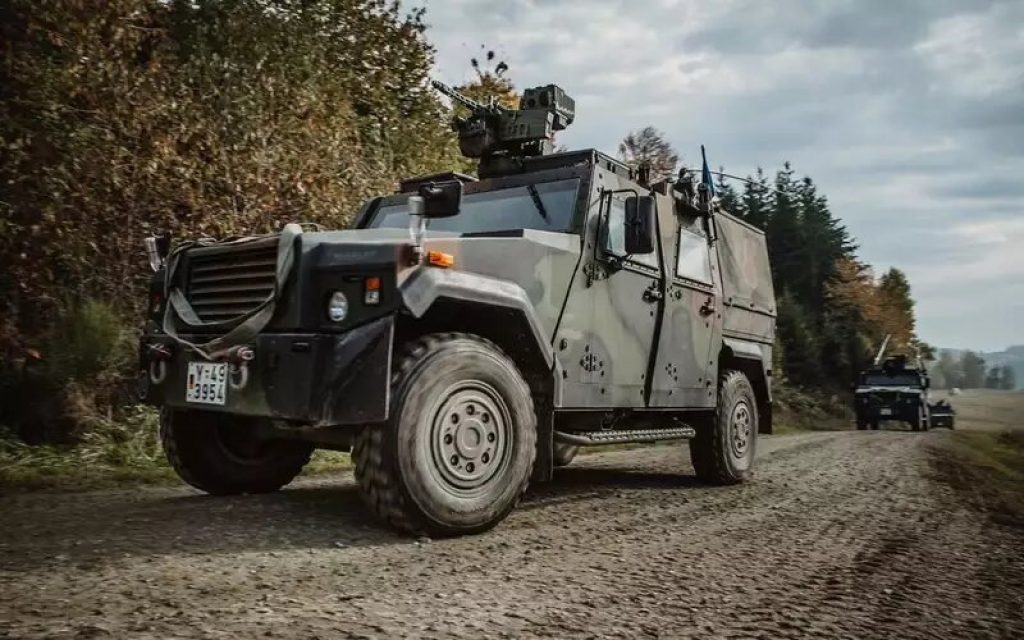
In dimensions and weight, the Atlet is broadly comparable to the Swiss Mowag Eagle IV. The European vehicle weighs around eight tons, is powered by a diesel engine producing approximately 250 hp and can carry a remotely operated machine gun. Its protected cabin meets STANAG 4569 Level 2a mine-protection requirements, including the detonation of six kilograms of TNT beneath a wheel. The Eagle IV has been purchased by Germany and several other European countries.
It would nevertheless be premature to describe the Atlet as a direct Russian equivalent or to assume that the vehicles offer identical capabilities. The Eagle’s protection rating is publicly confirmed, while specifications for the Russian vehicle vary between sources.
Their passenger capacities are also different. The Eagle IV normally carries four or five people, while the AMN-2 accommodates up to eight. The Swiss vehicle is closer to a protected patrol platform, whereas the Russian design is intended as a more flexible base for troop transport, command posts and specialized equipment.
A Heavier Companion, Not a Replacement
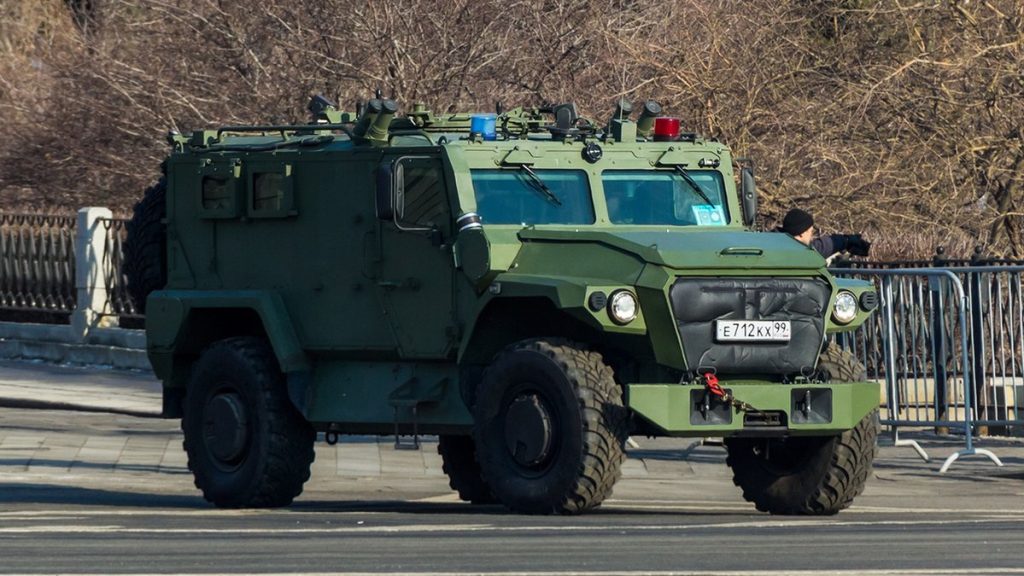
The Atlet is unlikely to replace the Tigr-M completely. For many missions, additional mine protection does not justify almost three tons of extra weight and the higher purchase and operating costs. The Tigr remains more practical where carrying capacity, speed and cross-country mobility matter more than protection against a substantial explosive charge.
The newer vehicle is intended for a different range of missions: transporting small teams and carrying command posts, artillery-control systems and reconnaissance equipment in areas where an ordinary armored utility vehicle may no longer provide sufficient protection, but a large MRAP would be too heavy and cumbersome.
This explains the Atlet’s appearance. It resembles an enlarged Tigr not because its designers lacked imagination. Almost three additional tons were required to provide what the previous generation lacked: a stronger hull, a protected floor, blast-attenuating seats and enough payload capacity for heavy equipment.
The result is not a revolutionary armored vehicle. It is a pragmatic attempt to preserve the Tigr’s mobility while giving its occupants a better chance of surviving an explosion.