A Third Panzer II Luchs Has Been Found on the Baltic Spit: Why Germany Built Only About a Hundred of Its Best Reconnaissance Tanks

An event that looks almost unbelievable from the standpoint of armored warfare history has taken place on the Baltic Spit in Russia’s Kaliningrad Region. Border security personnel working together with historians have discovered a German Panzerkampfwagen II Ausführung L Luchs — “Lynx” light reconnaissance tank. And this is not merely a collection of road wheels, fragments of armor, or a detached turret. According to preliminary reports, the vehicle has survived largely intact, with its turret, armament, and turret ring still in place. Specialists have already identified its production number and military unit.
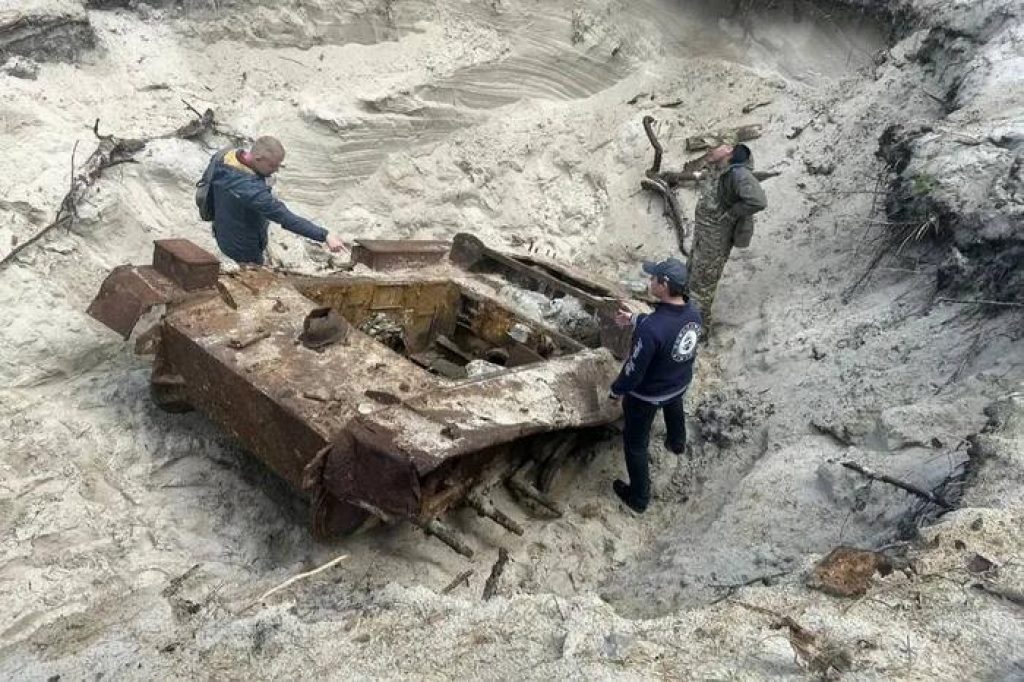
A penetration was found in the hull, together with a Soviet projectile reportedly still lodged inside. Initial reports suggested that the vehicle may have been hit by a T-34-85, while researchers are also examining whether its destruction was connected with the Soviet fighting on the Baltic Spit in the spring of 1945. Definitive conclusions, however, should be left until the vehicle has been recovered and properly examined.
The important point for now is different.
If its identification and state of preservation are confirmed, this will become the third known surviving complete Panzer II Luchs in the world. Until now, only two substantially complete examples were known: one at The Tank Museum in Bovington, Britain, and another at the Musée des Blindés in Saumur, France. The French vehicle is even maintained in running condition.
The authorities in the Kaliningrad Region have already announced plans to eventually display the newly discovered tank as part of the captured-vehicle exhibition at Fort No. 5.
But the rarity of the Luchs cannot simply be explained by the eight decades that have passed since World War II.
Only around a hundred were built in the first place.
And that is considerably more interesting than the discovery itself.
Because the “Lynx” appeared at the moment when the German Army had finally worked out what a proper tracked reconnaissance tank should look like. It was fast, relatively quiet, highly mobile, equipped with a four-man crew and powerful radio equipment.
Then Germany discovered that it barely needed such a tank at all.
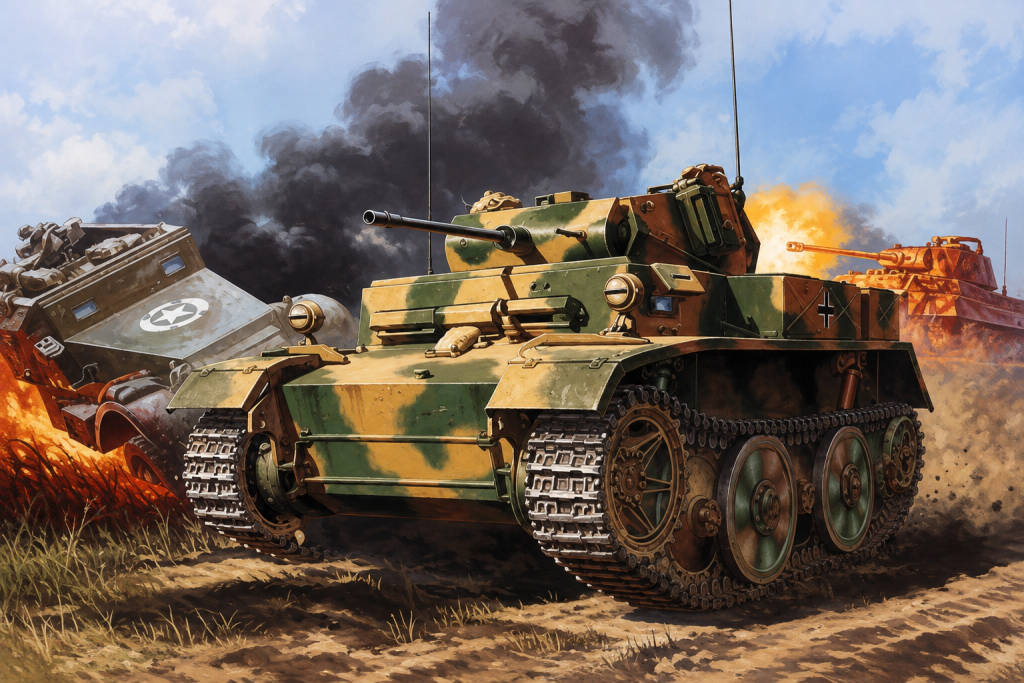
A Reconnaissance Tank Is a Rather Strange Machine
To understand the Luchs, we first have to forget the conventional idea of a light tank.
Its job was not to destroy T-34s.
It was not primarily intended to support infantry.
And it certainly was not supposed to lead armored assaults.
The Luchs was designed first and foremost for reconnaissance.
And a reconnaissance vehicle follows a very different logic.
It has to move quickly across difficult terrain, find the enemy, transmit that information, and disappear before the enemy can react effectively.
Its most important weapon is therefore not necessarily its gun.
It is speed.
Mobility.
Observation.
Radio communications.
And the ability to avoid a fight.
This is why the Luchs looks somewhat strange among German tanks of 1943. At a time when Tigers carried 88 mm guns and Panthers were entering service with high-velocity 75 mm weapons, Germany’s newest reconnaissance tank arrived with nothing more than a 20 mm KwK 38 automatic cannon.
At first glance, that looks hopelessly obsolete.
In reality, its designers were simply solving a different problem.
Why Did Germany Return to the Panzer II?
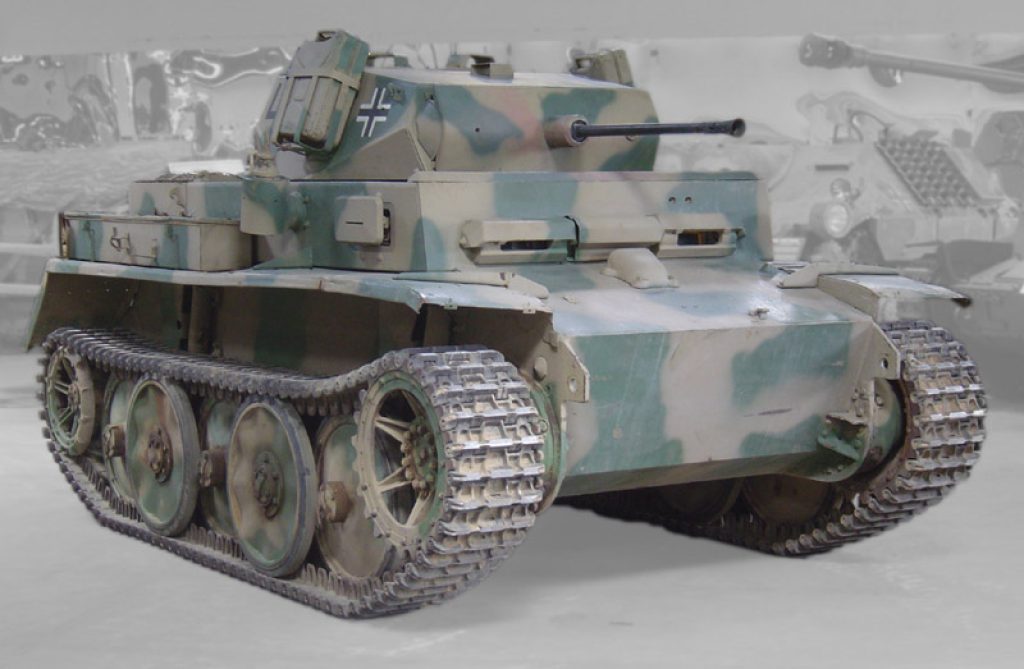
The designation Panzer II Ausf.L is somewhat misleading.
It suggests that the Luchs was simply another modification of the old Panzer II with which the Wehrmacht entered World War II.
In practical terms, it was essentially a new vehicle.
Development of what would eventually become the Luchs grew out of a long series of German attempts to create a high-speed reconnaissance tank. The final project carried the designation VK 13.03, with MAN and Daimler-Benz playing major roles in its development.
By this point, the original Panzer II was rapidly becoming obsolete.
In Poland and France it could still function as a conventional tank, although even then its 20 mm cannon was relatively weak. Once German forces began encountering heavier armored vehicles, further development of the Panzer II as a frontline battle tank made increasingly little sense.
But its general size category remained attractive for reconnaissance.
The reconnaissance troops simply needed a very different Panzer II.
Faster.
More mobile.
Roomier.
With a proper crew and effective communications.
That was what the Luchs became.
It Was Small Only When Parked Next to a Panther
The production Luchs weighed approximately 11.8 tons.
Its length was around 4.63 meters.
Width was 2.48 meters.
Height was approximately 2.21 meters.
For comparison, early Panzer IIs weighed roughly eight to nine tons and carried a crew of three. The Luchs had grown substantially in almost every respect.
But the most important change was inside.
The crew increased to four men.
The driver controlled the vehicle.
The radio operator handled communications.
Two men occupied the turret, allowing duties to be distributed much more efficiently than in earlier light tanks.
For a reconnaissance vehicle, this was particularly important.
The commander needed to observe his surroundings and make decisions rather than simultaneously operate half the vehicle’s equipment.
The Germans were gradually arriving at a simple conclusion: the effectiveness of a tank was determined by more than armor thickness and gun caliber.
Sometimes an additional crewman was more valuable than additional millimeters of armor.
The Suspension Had Almost Nothing in Common With the Old Panzer II
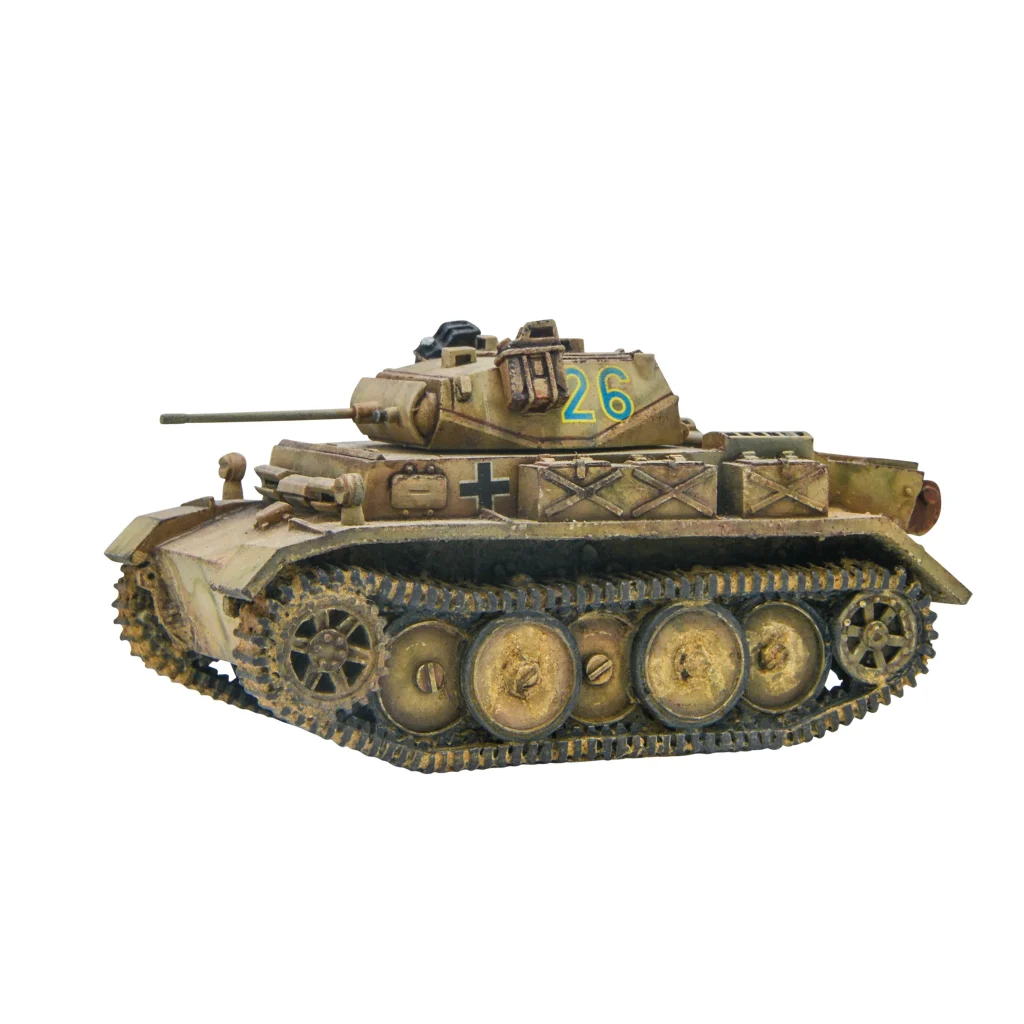
This is where the Luchs becomes particularly interesting from an engineering standpoint.
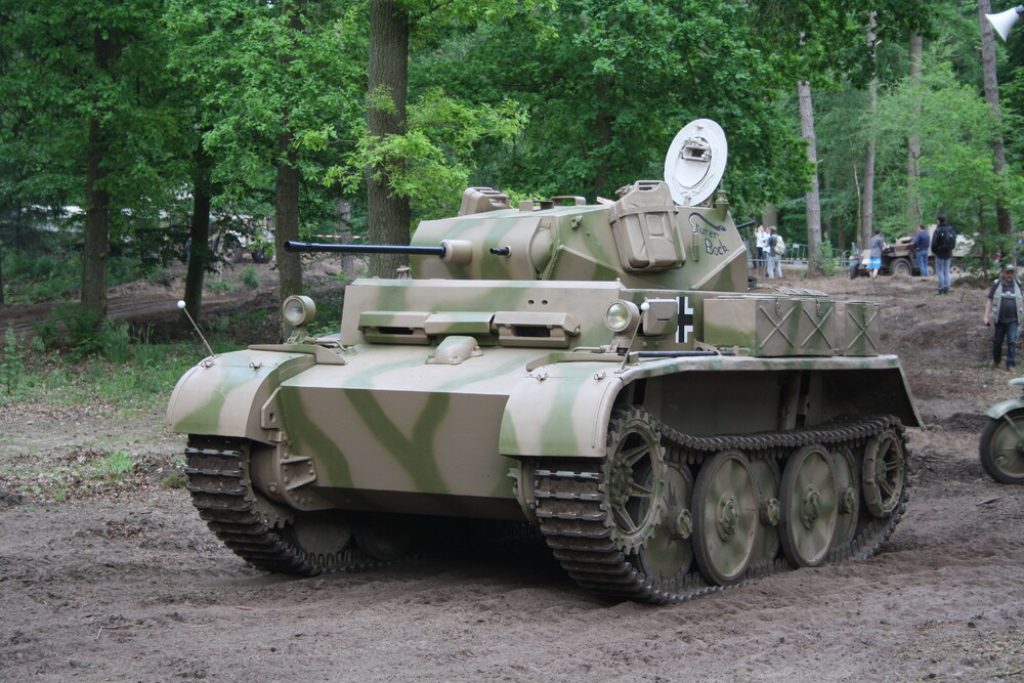
The tank received the characteristic German overlapping road-wheel arrangement known as Schachtellaufwerk.
Five large road wheels on each side were arranged in an overlapping pattern.
The concept is familiar from Panthers and Tigers, although on the Luchs it appeared on a much smaller scale.
Why make a light tank so complicated?
Ride quality.
Large road wheels and their arrangement distributed loads effectively and provided excellent performance over rough terrain. For a reconnaissance tank expected to move rapidly away from roads, that was a serious advantage.
But there was a price.
Mud could accumulate between the wheels and freeze.
Replacing an inner wheel could require the removal of several outer ones.
Manufacturing the suspension was more complicated than with a conventional arrangement.
On a heavy tank, compromises like these could perhaps be justified.
On a relatively inexpensive reconnaissance vehicle, the equation became much less attractive.
But 180 Horsepower Made a Difference
The Luchs was powered by a six-cylinder Maybach HL 66 P gasoline engine producing 180 hp.
With a combat weight of around 11.8 tons, that gave it roughly 15.3 hp per ton.
Maximum road speed reached approximately 60 km/h, while operational range was around 260–290 km, depending on conditions and how the figure was calculated.
For the early 1940s, those were respectable numbers.
More important than maximum road speed, however, was its ability to maintain relatively high speeds across poor terrain.
This was where a tracked reconnaissance vehicle had a fundamental advantage over an armored car.
A wheeled vehicle was faster and cheaper on roads.
Once the road disappeared, the equation changed.
The Luchs could follow roughly the same routes as the tanks of the main armored formation.
That meant reconnaissance elements could operate directly ahead of a Panzer division without being tightly constrained by the road network.
Its Armor Was Supposed to Save the Crew, Not Win a Battle
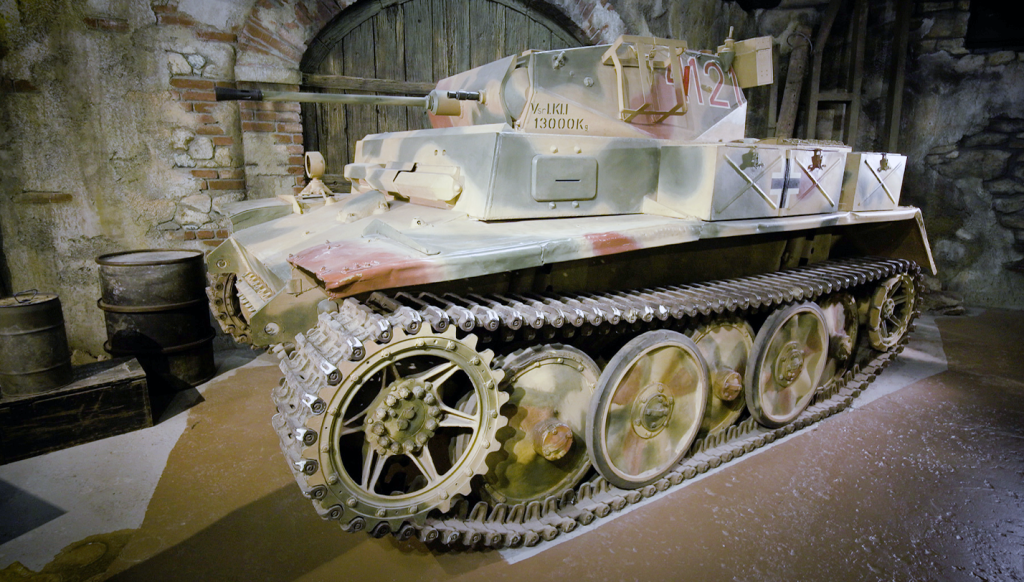
German engineers also resisted turning their reconnaissance vehicle into a miniature heavy tank.
Frontal armor on the hull and turret reached approximately 30 mm.
The sides and rear were around 20 mm thick.
That was sufficient to provide protection against small arms, fragments, and some light weapons, but it was never intended to withstand serious anti-tank guns or medium tank cannon fire.
And that was perfectly reasonable.
If a reconnaissance tank found itself facing an anti-tank gun and decided to test the strength of its frontal armor, something had already gone wrong with the reconnaissance mission.
The Luchs was supposed to see the enemy first.
And leave.
The 20 mm Cannon Was Both Sufficient and Already Obsolete
The main armament was the automatic 2 cm KwK 38.
A 7.92 mm MG 34 machine gun was mounted alongside it.
The tank carried approximately 330 rounds for the cannon and 2,250 machine-gun rounds.
Against infantry, trucks, motorcycles, gun crews, unarmored vehicles, and light armor, that was sufficient.
Against a medium tank, it was not.
And this was where the Luchs became trapped by the technological development of the war.
When the project began, a 20 mm automatic cannon seemed perfectly reasonable for a reconnaissance tank.
By the time the vehicle entered production, the battlefield had changed.
In 1943, the Red Army was fielding the T-34 in huge numbers. The United States was producing Shermans. Even light armored vehicles were becoming better protected.
There were plans for an improved Luchs carrying the 50 mm KwK 39 L/60.
It never entered series production.
And this raises an interesting question: did a reconnaissance tank actually need a larger gun?
Because a Bigger Gun Could Have Ruined the Entire Concept
Installing a 50 mm cannon sounds logical.
The Luchs would finally have been able to fight more heavily armored opponents.
But then a familiar engineering chain begins.
The larger gun is heavier.
It requires a larger turret.
Vehicle weight increases.
The suspension comes under greater strain.
More ammunition has to be carried.
Internal space becomes tighter.
And most dangerously of all, crews and commanders become tempted to use the reconnaissance vehicle as a tank.
That creates a paradox.
The better armed a reconnaissance vehicle becomes, the greater the temptation to make it fight.
And once it is fighting, it is no longer performing its primary mission.
The Germans had encountered a problem armies still face today: how heavily should you arm a vehicle whose main protection is its ability to avoid combat?
The Luchs’ Real Weapon Was Its Radio
This part of light-tank design is often underestimated.
The Luchs carried sophisticated radio equipment for a vehicle of its size, including FuG-series sets that allowed reconnaissance units not merely to spot the enemy, but to rapidly transmit information back to higher command.
And that is the entire point of reconnaissance.
Finding an enemy armored column without being able to report it is of limited value.
Finding it, transmitting its location, and escaping unnoticed is something very different.
This is why the four-man crew, high mobility, and extensive radio equipment tell us much more about the Luchs than its 20 mm cannon.
It was not simply a small tank for small battles.
It was a mobile observation post on tracks.
So Why Were Only About a Hundred Built?
This is where the story of the “Lynx” becomes particularly revealing.
Initial plans were much larger. Sources commonly mention an intended order of roughly 800 vehicles, but actual production stopped at approximately one hundred. Series production at MAN ran from 1942/43 until January 1944.
The reason was not that the Luchs was a bad tank.
Quite the opposite.
It was arguably too specialized for Germany in 1943.
German industry was already operating under enormous pressure. The Wehrmacht needed Panthers, assault guns, tank destroyers, trucks, artillery tractors, and huge quantities of spare parts.
And into this industrial environment came a small reconnaissance tank with a specialized suspension and a relatively complicated design.
From the reconnaissance commander’s perspective, it was an excellent machine.
From the perspective of wartime industrial economics, it was another production headache.
Especially when a cheaper alternative existed.
Eight Wheels Instead of Tracks
The German Army had long relied heavily on armored cars for reconnaissance.
And in 1943–1944, one of the finest representatives of this tradition appeared — the Sd.Kfz.234 family, particularly the famous Sd.Kfz.234/2 Puma.
This was a dangerous competitor for the Luchs.
The wheeled vehicle was easier to operate over long distances, extremely fast on roads, and could carry a 50 mm cannon.
The tracked Luchs still had a clear advantage in difficult terrain.
But war is always about compromise.
If most reconnaissance missions can be completed by a simpler wheeled vehicle, a specialized tracked reconnaissance tank begins to look like a luxury.
Especially for a country that is already losing the industrial war.
The Luchs Was a Good Vehicle That Arrived at a Very Bad Time
That is probably the best explanation for its unusual fate.
Had a tank like the Luchs appeared several years earlier, it might have been produced in much greater numbers.
But by 1943, Germany needed something else.
Thousands of medium tanks.
Thousands of self-propelled guns.
Tens of thousands of trucks.
And replacements for enormous battlefield losses.
Under those conditions, manufacturing hundreds of highly specialized reconnaissance tanks became increasingly difficult to justify.
The Luchs therefore became one of those rare vehicles that disappeared from production not because the underlying concept had failed.
The war around it had changed.
The “Lynx” Still Saw Combat
Two units are particularly well documented as Luchs operators.
Vehicles belonging to the 4th Panzer Division fought on the Eastern Front.
Luchs tanks of the 9th Panzer Division later operated in the West, including combat in France.
And the tiny production run explains why the vehicle is so exceptionally rare today.
Around a hundred tanks is almost nothing by World War II standards.
Panzer IV production ran into the thousands. Roughly six thousand Panthers were built. T-34 production was measured in tens of thousands.
The Luchs was rare even when it was brand new.
After more than eighty years, only two substantially complete examples were known to have survived.
Until the discovery on the Baltic Spit.
And This Is Where the Baltic Spit Vehicle Becomes Especially Interesting
If the newly discovered tank really belonged to a formation that fought in this area in 1945, researchers have found more than another museum exhibit.
They have found a kind of time capsule.
The vehicle did not undergo postwar museum restoration.
It was not assembled from components belonging to several different tanks.
It apparently remained close to where its war ended.
The damage to the hull, the positions of internal components, ammunition, markings, serial numbers, and even the projectile reportedly lodged inside could help reconstruct the history of one specific vehicle.
That is why it is particularly important not to rush to dramatic conclusions about exactly who destroyed it.
Archaeological battlefield finds like this are most valuable when examined layer by layer.
If specialists confirm the information already announced, it may become possible to reconstruct not only the tank’s production identity and military unit.
Its final battle might also be identified.
The Third Luchs Could Tell a Different Story From the First Two
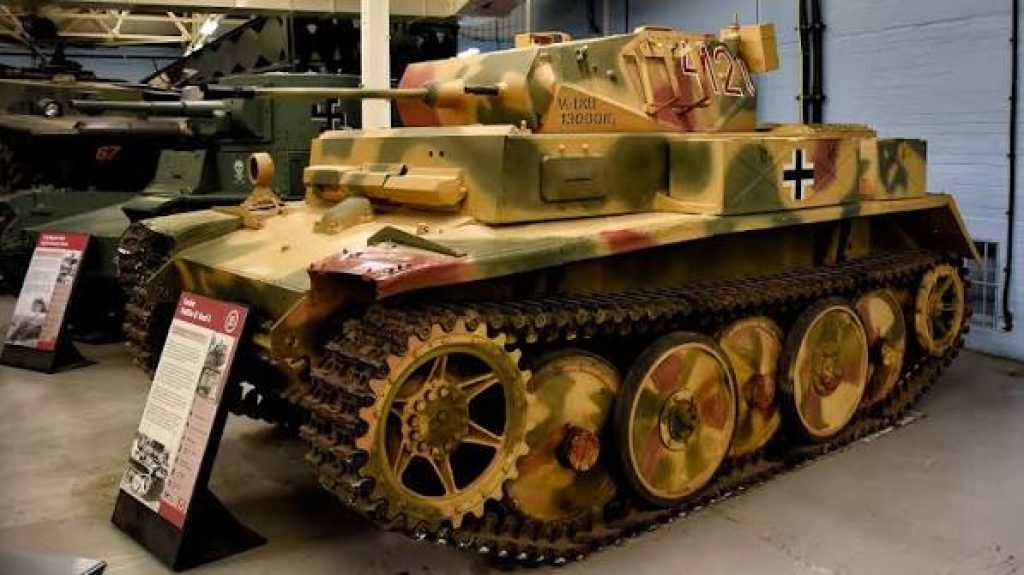
One Panzer II Luchs is preserved at The Tank Museum in Bovington. It carries chassis number 200117 and retains a significant amount of its original interior.
The second is held by the Musée des Blindés in Saumur. Its chassis number is 200164, and the French vehicle has been restored to running condition.
Now a third may join them.
But its historical value could be quite different.
The British vehicle shows us how the Luchs was built.
The French vehicle shows us how the Luchs moved.
The Baltic Spit discovery could potentially show us how one particular Luchs was destroyed.
And That Is Why the Luchs Is More Interesting Than Its Rarity Suggests
It is easy to treat the Panzer II Ausf.L as just another exotic German armored vehicle of World War II — rare, complicated, and produced in tiny numbers.
That interpretation is too simple.
The Luchs was actually a remarkably rational machine.
Its designers correctly identified the basic requirements of a tracked reconnaissance vehicle: high speed, good cross-country mobility, a proper crew, effective radio communications, and armament light enough to avoid turning the reconnaissance tank into a frontline battle tank.
The problem was not necessarily the vehicle.
The problem was when it appeared.
By the time the Luchs was finally mature enough for mass production, Germany could no longer afford the luxury of manufacturing an ideal specialized tank for every individual battlefield role. Industry increasingly needed standardization and mass production of equipment that was absolutely essential to keeping the army fighting.
A potential order for hundreds of reconnaissance tanks therefore ended with only about a hundred being built.
Most disappeared on the battlefields of World War II.
Two survived into museum collections.
And a third, it now appears, spent more than eighty years hidden on the Baltic Spit.
The irony is that the Panzer II Luchs had already become a rarity before its production even ended. That is why the newly discovered “Lynx” is more than simply a rare German tank. It is a surviving representative of a class of combat vehicle that Germany had refined to an unusually high level at precisely the moment when it could no longer afford to build it in meaningful numbers.