another parts
Part I. When the Bread Ran Out
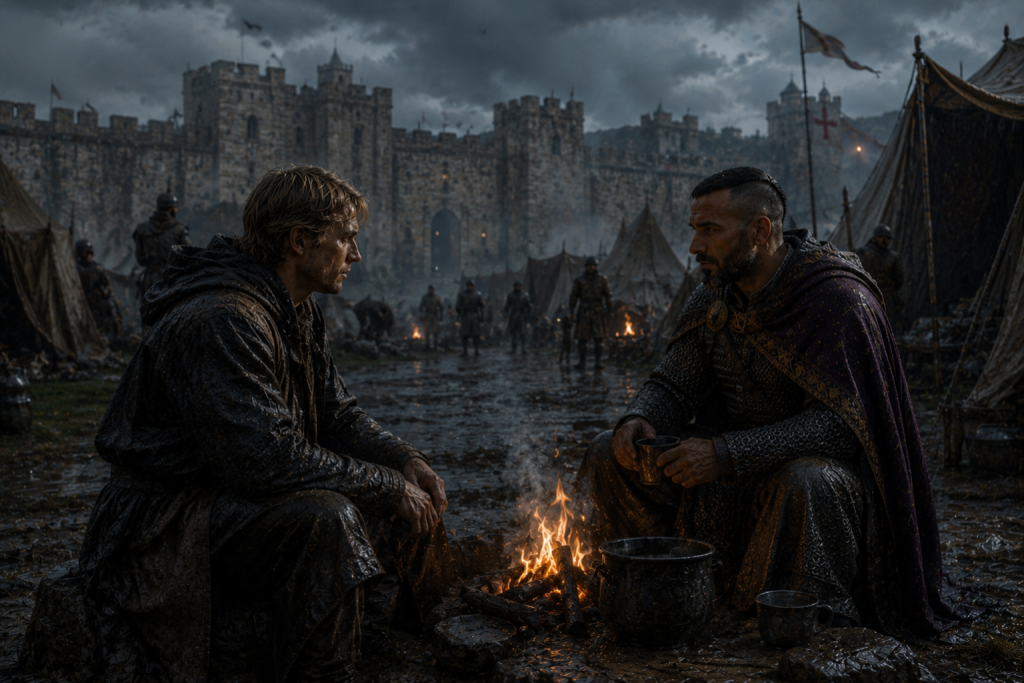
Antioch had yielded neither to ladders, nor towers, nor mangonels. December arrived, and the city chose a different ally: time.
At first, no one understood what was happening. One morning, a convoy arriving from the port of St Symeon simply brought fewer sacks of grain than usual. A few days later, fresh vegetables disappeared. Then oats for the horses became difficult to find. No one was alarmed. Men in the camp still joked that half of Europe was following behind them and would soon bring enough supplies to bury the walls of Antioch beneath them. But the jokes died away sooner than anyone had expected.
Winter in Syria was nothing like the Franks had imagined back in Normandy. Instead of snow came cold, driving rain. The ground, so recently hard and dusty, turned into an endless expanse of clinging mud. Whole lakes of murky water formed between the tents, roads vanished, and the camp, stretching for miles, began slowly sinking into its own filth. At night, the wind carried an icy chill down from the mountains, easily penetrating woollen cloaks and mail shirts. By morning, men woke not to the sound of trumpets but to their own shivering.
The horses suffered even more than the men.
Every day, fresh carcasses appeared near the camp. At first, it was the old horses that fell, animals that had travelled halfway across the world from the shores of Normandy. Then young stallions began collapsing too, horses that had carried knights into battle at Dorylaeum only months before. They were no longer buried. A few weeks earlier, such a thing would have seemed sacrilegious, but now men with knives gathered almost immediately around every fallen horse. Its meat was no longer considered fit only for dogs.
Ansel had never witnessed anything like it and for a long time could not bring himself to approach. At the monastery, he had been taught that a knight’s horse was almost a brother to its master. In Normandy, old horses were allowed to live out their days in pasture. Here, everything had changed. One sergeant silently severed the tendons, another butchered the carcass, and a third was already building a fire. No one said a word. No one even crossed himself. Hunger changes a man faster than any sermon.
“In another week, they’ll be eating the mules,” Hakon said quietly as he watched.
Ansel turned to him.
“How do you know?”
The Varangian shrugged.
“I’ve seen it.”
“Where?”
“Outside Bari. Then in Armenia. Then near Edessa. Every long siege begins the same way.”
He spoke without cruelty, as though describing the changing seasons.
“Then the dogs will disappear. After that, the cats. Then men will start fighting over every handful of grain.”
Ansel wanted to object, but remained silent. In all the weeks they had spent together, Hakon had not been wrong once.
A few days later, the dogs disappeared.
The camp changed almost imperceptibly. In the evenings, dozens of mongrels had once run between the tents, begging scraps from the soldiers. Now not a single one remained. Their absence could be felt in a strange silence. Even the rats, which had previously been everywhere, seemed to have grown more cautious.
Rations were reduced gradually. First, the second flatbread was no longer issued. Then the daily portion of meat was cut. Finally, the meat disappeared altogether. Each warrior received only as much bread as would fit in the palm of one hand. Where men had once eaten while talking and laughing, they now ate in silence, chewing each mouthful slowly, as though hoping to deceive their own stomachs.
Drogo, now commanding a ten of his own, made the rounds of his men every evening. He counted out the bread as carefully as a monastery cellarer. One day, Ansel noticed his friend quietly break his flatbread in half and slip one piece to a very young sergeant who could barely stand. The lad tried to refuse, but Drogo merely frowned.
“That’s an order.”
“And what about you?”
“I’ve already eaten today.”
It was a lie. Ansel had seen that Drogo had not touched his bread since morning.
Geoffroi still tried to keep everyone’s spirits up.
“When we get home,” he said one evening, examining his thin flatbread, “I’m marrying a miller’s daughter. No one else.”
Someone chuckled.
“Why a miller’s daughter?”
“Because everyone else is too poor.”
A few men even laughed.
Geoffroi triumphantly raised his miserable piece of bread.
“Just imagine it. You wake up in the morning and there’s flour everywhere. Real flour. Whole sacks of it. You can bake bread if you like, or make porridge. Whatever takes your fancy.”
“And what if she doesn’t wait for you?” one of the sergeants asked.
Geoffroi considered this for a moment.
“Then I’ll find another miller’s daughter.”
This time, the laughter was louder. Even Drogo smiled despite himself.
Ansel found himself thinking that they were laughing for too long. Not because the joke was particularly good, but because every man wanted, if only for a few moments, to forget where he was.
That same evening, they sat beside a small fire. There was almost no firewood left, and the flames were so feeble that they did less to warm the men than to remind them of home. Rain drummed once again upon the taut canvas of the tents, while somewhere beyond the city’s black walls, the watchmen of Antioch called to one another.
Hakon studied the city for a long time before breaking the silence.
“We made a mistake.”
Ansel looked up in surprise.
“What mistake?”
“We came here to besiege a city.”
He paused.
“But no one considered that the city might lay siege to us instead.”
No one answered.
Hundreds of lights still burned beyond the walls of Antioch. The people inside were rationing bread too, burying their dead, and waiting for help. But unlike the crusaders, they had roofs over their heads, their own wells, and their own storehouses. The Franks, meanwhile, were slowly coming to understand a terrible truth: they themselves had become prisoners of the vast camp surrounding those impregnable walls.
And the real battle for Antioch was only beginning.
Part II. In Search of Bread
By Christmas, it had become clear that we could wait no longer. The land around Antioch had been stripped bare during the first weeks of the siege. Everything that could be gathered from the nearby villages had long since disappeared. The fields lay empty, the vineyards had been picked clean, and the few remaining peasants had either taken refuge behind the city walls or fled far into the mountains, driving their last livestock with them.
Food still arrived by sea through the port of St Symeon, but winter storms were delaying the ships more and more often. Sometimes no convoys appeared for several days, and the camp began living on rumours. Some insisted that the Genoese were already on their way. Others claimed that the Seljuks had cut the road. Still others swore that the Byzantine ships had stopped putting to sea altogether. No one knew the truth.
At the council of princes, the decision was made quickly. If bread could not be brought to us, we would have to go and find it.
Bohemond of Taranto and Robert of Flanders volunteered to lead a large expedition southward. They would search villages, monasteries, and caravan routes, gather whatever food the Muslims had not yet removed, and return before Antioch’s garrison could take advantage of the absence of so many soldiers.
Since the provisions they hoped to find were intended for the entire camp, every prince contributed men to the expedition. Duke Robert was no exception.
That evening, he assembled the surviving veterans of his army.
“Hunger makes no distinction between a Norman, a Fleming, and a Provençal,” he said. “If we don’t find bread, there’ll be no one left to besiege Antioch come spring.”
His gaze moved to Drogo and Geoffroi.
“You’ll lead your tens. For the duration of the expedition, you’ll serve under Count Robert of Flanders. Obey his orders as you would mine.”
No one argued. We all understood that this was not a venture in search of plunder or glory. We were going out to find food for the entire army.
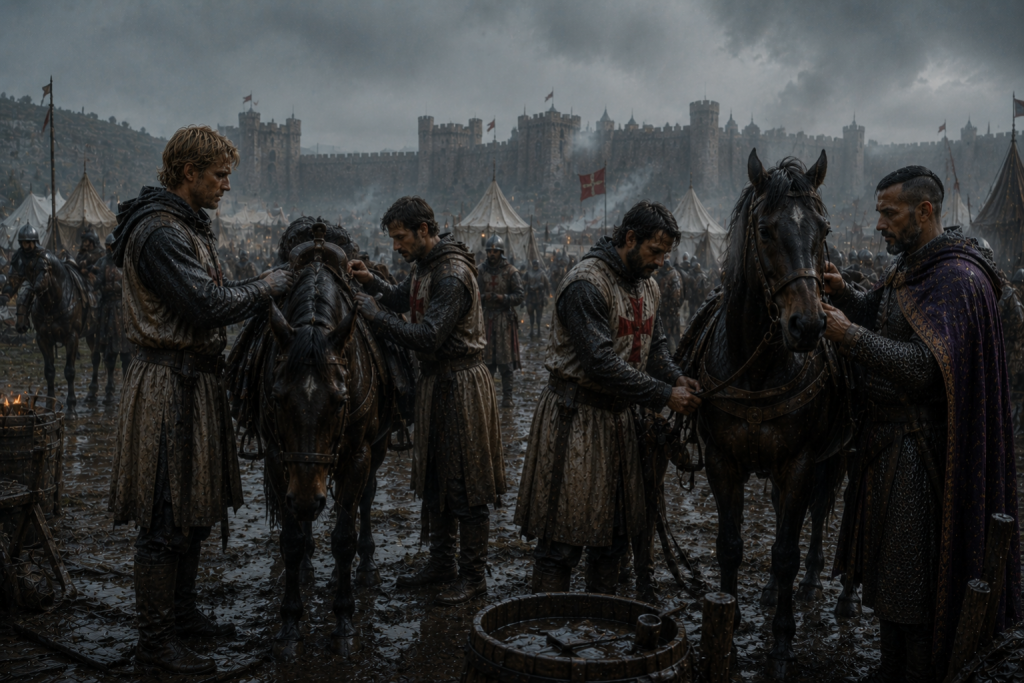
The detachment began assembling before dawn. There were considerably fewer men than in the first months of the crusade. Many lay sick, many had already been buried, and many had lost their horses and could no longer accompany the knights. Ansel noted bitterly that of the twenty-odd horsemen who had once ridden out of Caen with Duke Robert, fewer than half remained in the ranks. The others had fallen in battle, died of disease, or disappeared forever among the countless camps, cities, and roads of the East.
“Back in the saddle,” Geoffroi said cheerfully, tightening his horse’s girth. “I was beginning to forget what it felt like to ride instead of wading through mud.”
“Don’t tempt fate,” Drogo grumbled.
“You’re too gloomy.”
“And you talk too much.”
Geoffroi laughed.
“So everything’s as it should be.”
Even Ansel felt the change in mood. After weeks in the cold, damp camp, the mere chance to leave the walls of Antioch behind seemed a gift. The cold wind struck their faces, and beneath the horses’ hooves there was once again a road instead of the camp’s sticky mud. Men unconsciously straightened their backs. It seemed as though life itself was returning with movement.
But the good spirits vanished within two days.
The first villages greeted them with empty courtyards and doors hanging open. Only straw remained in the barns. Wells had been filled with stones, and not a single sheep could be found in the pastures. The inhabitants had learned of the Franks’ approach and fled, taking everything they could carry. In several places, the scouts discovered fresh tracks left by large caravans heading south. It was as though the land itself were warning the Muslims of every step the crusaders took.
“They’re expecting us,” Hakon said quietly, dismounting beside another deserted courtyard.
He picked up a charred wooden ladle.
“See?”
Ansel nodded.
“They burned their own supplies.”
“No.”
The Varangian dropped the ladle.
“They simply left us nothing they could carry away.”
Bohemond understood this too. He ordered the detachment to press on without delay, moving ever deeper into the emirate’s territory. The farther they advanced, the more cautious the patrols became. Scouts increasingly spotted lightly armed horsemen on distant hills. They kept their distance, neither attacking nor loosing arrows, merely watching, as though passing news of every Frankish movement from one group to another.
“They’re counting us,” Hakon said.
“Let them count,” Geoffroi replied.
The Varangian shook his head.
“When an enemy starts counting your men, it means he’s already decided to fight.”
On the third day, the scouts reported a large body of cavalry moving ahead of them. Bohemond immediately ordered the troops into formation. The knights’ expressions changed. During the past few weeks, they had almost forgotten the familiar feeling that came before a battle. Now it returned, together with the clink of mail, the smell of horse sweat, and the heavy anticipation of what was to come.
Ansel tightened his helmet strap and looked at his companions. Drogo silently checked his spear. Geoffroi, despite everything, was smiling.
“If we’re lucky,” he said, “we’ll be eating mutton tonight.”
“If we’re lucky,” Drogo replied, “we’ll still be alive tonight.”
The first green banners appeared beyond a low hill. More and more followed. Light Seljuk cavalry spread across the plain like water, taking up positions on the flanks and attempting to envelop the Franks from both sides. Somewhere ahead, horns were already sounding, and above Bohemond’s formation a red banner bearing the golden lions of Normandy was unfurled.
Ansel suddenly understood that this would be nothing like Dorylaeum or Nicaea.
There, they had fought for victory.
Now they were fighting for bread.
Part III. The Battle for Empty Wagons
The morning mist had not yet lifted when the Seljuks began to move.
They did not charge forward in a single mass, as the Normans would have done. Their formation seemed to come alive. Separate squadrons spread outward, disappeared behind the folds of the hills, and reappeared in entirely different places. It seemed that the enemy was surrounding the Franks from every direction, although the main forces of Duqaq had not yet entered the battle.
Bohemond watched their movements carefully. He had already encountered such tactics at Dorylaeum and had no intention of repeating the mistakes made there.
“Do not pursue!” His order rang along the line. “Hold formation!”
The first arrows struck the shields almost simultaneously. The air filled with the dry crack of shafts, the clang of iron, and the cries of wounded horses. Several knights instinctively surged forward, but the sergeants immediately brought them back into line.
Ansel crouched behind his kite shield. An arrow struck the wood with a sharp crack, pierced its outer layer, and lodged close to his hand. He pulled out the shaft, tossed it aside, and found himself smiling faintly. Only a few months earlier, such a blow would have set his heart pounding so violently that he could scarcely have held his sword. Now he had barely had time to feel afraid.
“Getting used to it,” Hakon muttered, noticing his expression.
Ansel said nothing.
A few minutes later, Bohemond raised his sword.
“Forward!”
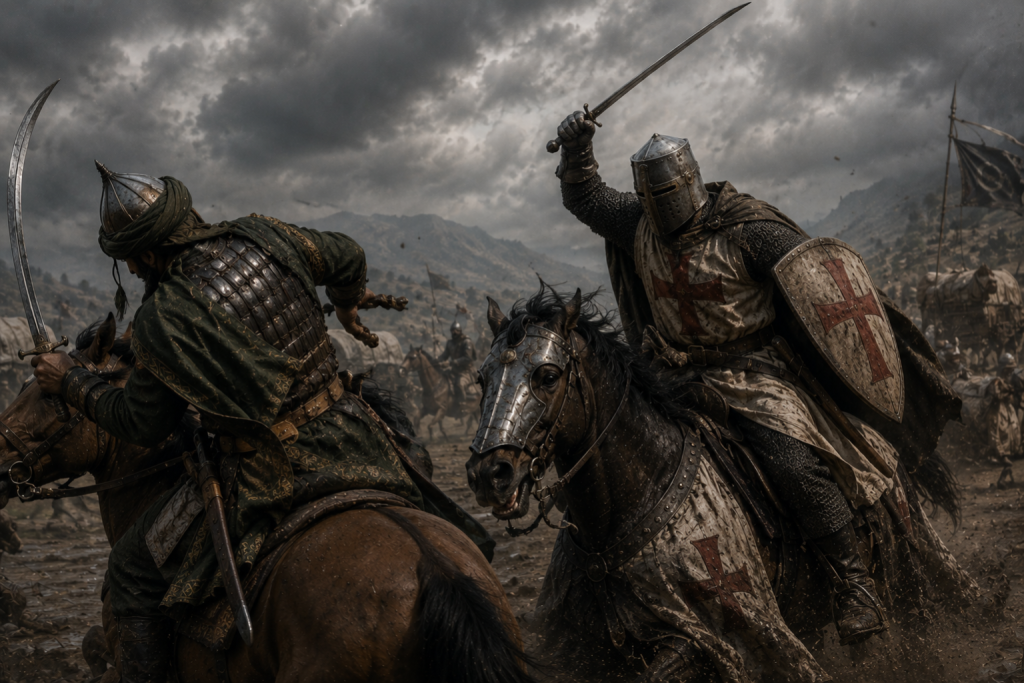
The Norman cavalry advanced in a heavy wave. The earth trembled beneath the hooves. As usual, the Seljuks began to withdraw, showering the Franks with arrows, but this time they retreated too slowly.
It was a trap.
Fresh horsemen appeared on the flanks.
Robert of Flanders was the first to recognize the danger.
“Left! Close the ranks!”
His knights managed to meet the attack almost head-on. The two masses of cavalry collided with such a crash that even the archers seemed to stop shooting for an instant.
After that, the battle dissolved into dozens of separate struggles.
Ansel could no longer see either Bohemond or Robert. There were only men and horses before him. Everything merged into an endless whirl of blows, shouting, and mud. He caught a sabre stroke on his shield, slashed downward, and felt his sword bite through an enemy’s shoulder with a sickening crunch. The Turk fell from his saddle, but another horseman was already charging from the right.
Hakon intercepted him first.
The heavy Varangian axe swept through a broad arc. The horse shied sideways, and its rider lost his balance and fell beneath the hooves.
“Keep moving!” the Varangian shouted.
Ansel spurred his horse forward.
A little farther ahead, Drogo was fighting two opponents at once. One was trying to get behind him, while the other kept thrusting with a short spear. Drogo struggled to hold them at bay until Geoffroi appeared.
“Started without me again?” he shouted cheerfully.
He charged into one of the Seljuks, almost knocking him from the saddle. The second immediately turned his horse to escape, but Geoffroi was faster. He caught up with the man at full gallop, brought his sword down from above, and knocked him to the ground.
For a moment, the struggle seemed over.
But as he fell, the Seljuk managed to draw a long dagger.
Ansel saw it too late.
The blade flashed briefly between the horses’ hindquarters and drove upward into Geoffroi beneath the edge of his mail, just above the thigh.
Geoffroi jerked violently.
“Damn it…”
Instinctively, he struck his opponent across the face with the pommel of his sword. The Turk collapsed into the mud and did not rise again.
Drogo was the first to reach his friend.
“Geoffroi!”
“I’m alive, aren’t I…”
Geoffroi winced, looked down, and cautiously touched his mail.
A little blood appeared on his fingers.
“See? Haven’t even dirtied my boots.”
He tried to smile.
“If the miller’s daughter finds out I nearly got myself killed by some little knife, she’ll never let me hear the end of it.”
Drogo breathed a sigh of relief.
“You idiot.”
“A handsome idiot.”
Even Ansel could not help smiling.
Hakon rode up quickly, made Geoffroi lift his mail, and examined the wound carefully.
The dagger had not gone deep.
The bleeding had almost stopped.
Without a word, the Varangian took out a clean linen bandage, bound the wound tightly, and only then spoke.
“Leave that on for several days.”
“Is it bad?”
“No.”
Hakon tightened the knot.
“If you’re lucky, in a week you’ll have forgotten you were wounded at all.”
Geoffroi clapped him on the shoulder.
“There, you see, Drogo? Even the Roman says I’ll live.”
Hakon did not answer.
For just a moment, Ansel noticed that the Varangian’s gaze lingered on the bloodstained linen a little longer than it should have.
But the next instant, horns sounded again somewhere ahead.
The Seljuks were beginning to withdraw.
The Franks did not pursue them.
When the fighting ended, there were no victors.
Duqaq’s army turned back toward Damascus, having failed to break through to Antioch. Bohemond held the field, but the wagons for which the expedition had left the camp were almost empty. A few dozen sacks of grain, some dried dates, a handful of sheep and goats—it would scarcely be enough to feed the army for more than a few days.
When the detachment turned back toward Antioch that evening, the men were silent.
They were returning alive.
But every one of them understood one simple truth.
Three days on the road, dozens of dead men, and an entire battle had bought them only a few days’ reprieve.
And the whole winter still lay ahead.