Foreword
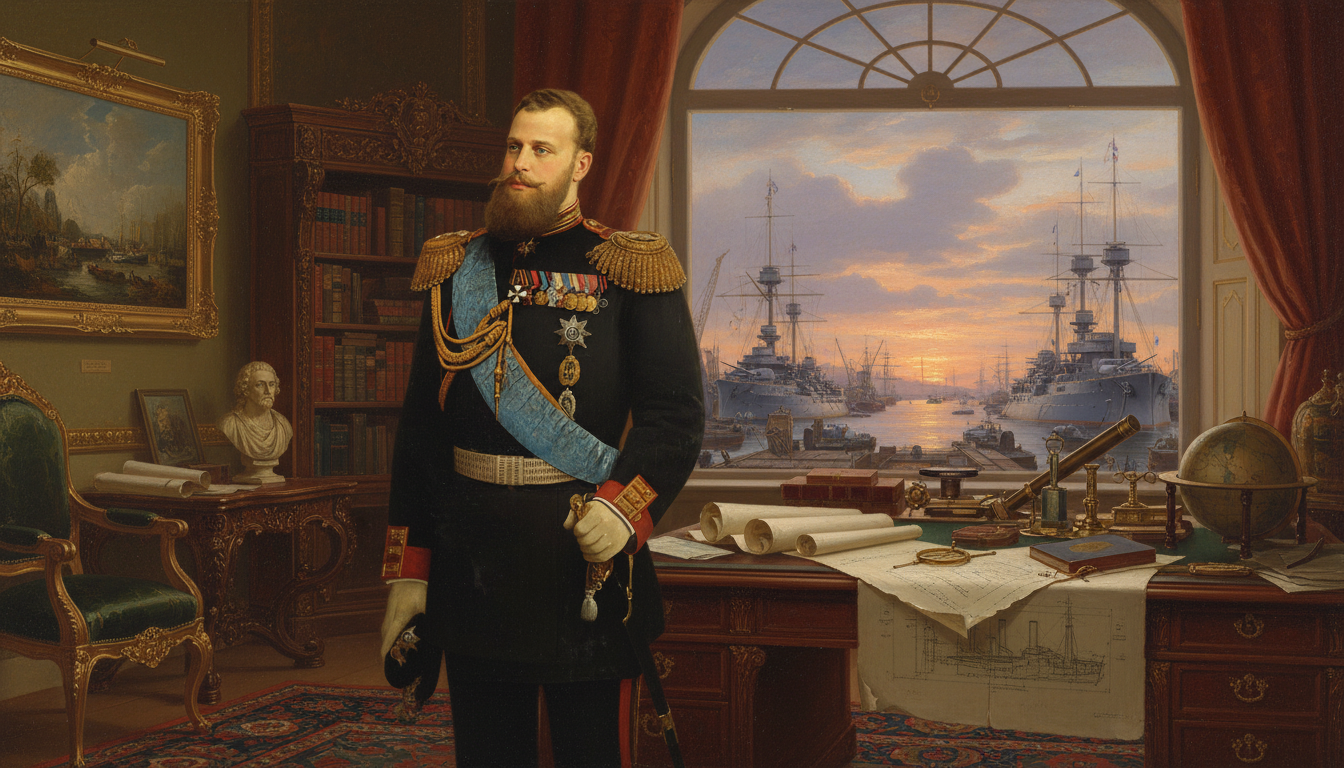
Now I think it’s time to introduce you, dear reader, to Akido. So who is he, exactly? Let’s start with the fact that Akido will appear constantly in my articles, since he is the god of the multiverse and is constantly traveling through different worlds—some he annexes to his empire, some he burns to the ground just to be safe, and others he leaves completely untouched. He was once a man who served his country faithfully, but the leaders of that country brought it to ruin, and then they kicked Akido out of service. After weathering the trials of turbulent times, he managed to build a home, earn several advanced degrees, get married, bring five children into the world, and die while working in his garden. All in all, a good life—but then it began… His soul, in the form of a crystal, found itself in the arena of the gods, where—after absorbing their energy over many years—he was reborn as the strongest and most neutral god. The ruler of the light and the ruler of the dark handed over their thrones to him, finally retiring to the peace they had so longed for. And Akido, having defeated a group of gods who sought to overthrow him, began to build his own realm with all that entailed. As he traveled, he acquired children—some naturally, others through adoption—and bestowed upon them a portion of his power so that they might help him maintain peace and order in the multiverse. But he is not alone; Fate, the only one his equal, was able to help him overcome his sense of loneliness. Actually, that’s all there is to say about him for now…

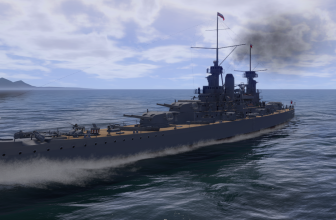
This is how Aikido usually appears to mortals.
By the spring of 1886, everything was ready. The four-year strict moratorium on the laying of keels for large warships had expired, and Russia had emerged from this period as a completely different power. Where, just yesterday, shabby ironworks had been belching smoke from foreign coal, the open-hearth furnaces of Zlatoust and Yuzovka were now in operation, producing domestic armor steel every bit as good as Krupp’s. Nikolaev, St. Petersburg, and, following suit, the new shipyards of the Far East were laying down series of ships based on standardized blueprints—time and again tested in the Experimental Basin and through mathematical calculations—by a certain Chernykhovsky.
It was Chernykhovsky—who by that time had already acquired abroad everything European science had to offer—who, together with Alexei Alexandrovich, personally approved every sketch. At the Naval Technical Committee, which had moved into a new, spacious building on the embankment, debates raged until everyone was hoarse. The Grand Duke, who now understood ship theory as well as any engineer, settled the matter with icy resolve.
“These ships, gentlemen, will have to serve for more than five or ten years. They represent the future of the fleet. No eclectic mix, no ‘just like everyone else.’ Everything must be our own, and everything must be the best.”
In the spring of 1886, three series were laid down simultaneously at thirteen shipyards throughout the empire.
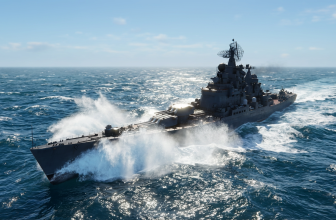
The first were the “Rurik”-class armored cruisers — swift ships, heavily armed with 152-mm guns in four elevated turrets, featuring excellent armor along the waterline and a Krupp deck. The series of eight ships bore names that made any Russian sailor’s eyes light up: “Rurik,” “Gromoboy,” “Rossiya,” “Vityaz,” “Diana,” “Pallada,” “Athena,” and—at the personal insistence of the Grand Duke himself—“Aurora.”
“May this ‘Aurora’ never fire on its own people,” — he said at the keel-laying ceremony, and few understood the strange bitterness in his words, except, perhaps, his ever-present secretary—a young man with an inquisitive gaze, whose grandfather was a baptized Jew, and whose mother bore the surname Blank.
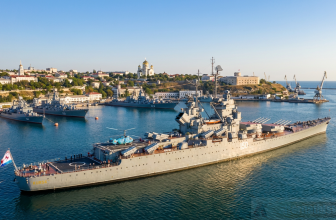
The second series consisted of “Koreets” class coastal defense monitors or battleships. With a displacement of 6,500 metric tons, a 200-millimeter armor belt, and a gun turret with three 305-mm guns, capable of reducing to splinters any enemy battleship that dared to venture into the Russian skerries. Eight ships—the “Koreets,” “Vogul,” “Sibiryak,” “Bobr,” “Sivuch,” “Gilyak,” “Kazak,” and “Manchur”—were meant to become an unbreakable shield for the Baltic Sea and the Pacific Ocean.
Finally, the third class—the mainstay of the revitalized empire—was the “Poltava”-class squadron battleships. Fifteen thousand metric tons, full armor belt from bow to stern, four 305-mm guns in two turrets, a secondary battery of eight 203-mm guns, and a rapid-fire battery. “Poltava,” “Bayazet,” “Sevastopol,” “Petropavlovsk”—their names rang out like battle bells. Following them were the “Ezel,” “Azov,” “Kinburn,” and “Grenham”—symbols that Russia remembers its victories and intends to build upon them.
At the same time that ships were being laid down, a second, far more profound wave of transformation swept over the country. The funds coming in from African and—more recently—Alaskan gold mines were already amounting to tens of metric tons of the precious metal per year. The Grand Duke discovered the gold in Alaska in the same way he had discovered the gold in the Witwatersrand: he simply knew where to look. Geological expeditions sent to the Klondike Valley and the banks of the Yukon as early as 1883 uncovered riches that would send shockwaves through the world. But, unlike in the future, when news of the gold would spark chaos and anarchy, here the development proceeded systematically and quietly. All promising plots had been purchased in advance from local tribes and American authorities through front companies, and now thousands of Cossacks and volunteer settlers were panning for gold under the protection of a security service modeled after the Flark Service.
This influx of money allowed the Grand Duke to launch construction projects throughout the empire on a truly Petrine scale. He had no intention of relying on the generosity of private capital—the state itself was becoming the leading industrialist. Plants and factories sprang up like mushrooms, with an emphasis on locating industry deep within the country, beyond the Urals, far from the borders and fleets of a potential enemy.
In 1887, Alexei Alexandrovich traveled to Tsaritsyn for the first time—a dusty, chaotic little merchant town with only one indisputable advantage: it stood at the crossroads of waterways and land routes, in the strategic heart of the Russian plain. The Grand Duke surveyed the banks of the Volga and, standing on a high embankment, declared:
— This city will become a city of steel. Not Tsaritsyn—that’s a peasant’s name, a dark one. But Stalingrad—the city of steel, the city of machines, the city of our industrial might. So it shall be.
No one dared to object, since the emperor himself had approved the name. The strange word “Stalingrad” seemed to have slipped from the Grand Duke’s lips, but it caught on instantly. Soon, right there on the banks of the Volga, the structures of one of Europe’s largest machine-tool factories, tractor plants, steel-melting furnaces, and locomotive assembly shops began to rise. Ten years later, Stalingrad had become a symbol of the Russian industrial miracle, and its name would be spoken with respect from Chicago to Osaka.
Special attention was paid to education and science. Real schools, commercial institutes, and polytechnic colleges were opened throughout the country. In 1886, Alexei Alexandrovich, overcoming resistance from conservatives, the Holy Synod, and Alexander III, secured the signing of a decree on freedom of religion and the complete repeal of discriminatory laws. Old Believers, sectarians, Jews, and Muslims—all could now enroll in any educational institution and hold government positions on an equal footing with Orthodox Christians. “The state is strengthened not by uniformity, but by unity of mind in serving it,” — this is how the Grand Duke himself phrased the idea behind the decree in a conversation with Pobedonostsev, and the Chief Prosecutor, with a heavy heart, was forced to agree, seeing the unprecedented economic growth.
Around that same time, in 1886, a dossier on a young man—a former student in the Natural Sciences Department at St. Petersburg University who was involved in Narodnaya Volya circles—landed on the Grand Duke’s desk. The file was alarming: Alexander Ilyich Ulyanov—a gold medalist with brilliant aptitude for chemistry and mathematics—was planning an assassination attempt on the tsar.
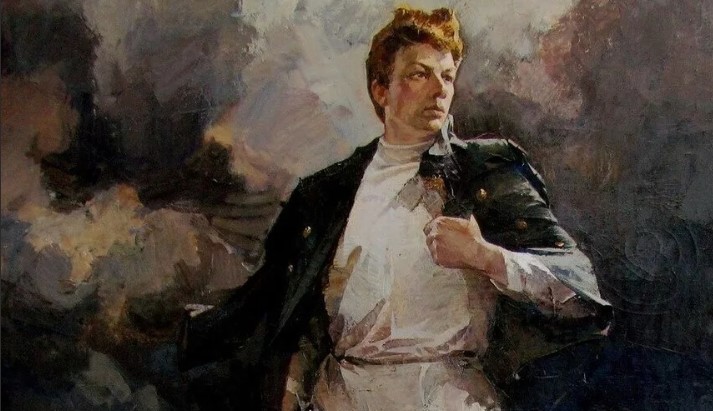
Alexander Ilyich Ulyanov-Blank
In another story, this young man would have faced the gallows, while his younger brother would have faced a long journey through exile and revolutions. Here, however, the Grand Duke, barely glancing at the photograph, felt a familiar jolt of memory sent by Akido. A slender face, a stubborn brow, burning eyes. “Volodya,” a distant voice whispered in his head, but he shook off the vision.
Instead of signing the arrest warrant—since he had been temporarily serving as head of the Security Department since 1885—Alexei Alexandrovich personally traveled to St. Petersburg and arranged a secret meeting in an inconspicuous apartment on Litayny Prospekt. The conversation was long and difficult. Ulyanov Sr., pale but unbroken, was ready to die for his cause.
“I have no intention of executing you, Alexander Ilyich,” the Grand Duke said calmly. “I propose that you build—the very new Russia you dream of—but not with bombs, terror, or other methods that violate the law, but with factories, schools, and hospitals. You have been blessed with a rare intellect; so use it for creation, not destruction. Agree to serve me—and you will see how, in ten years, it is possible to change the country more than a hundred years of underground rhetoric ever could.”
Ulyanov was silent for almost a minute. Then he nodded slowly.
And so Midshipman Blank joined the fleet—under this surname, Alexander Ilyich was assigned to the Admiral General’s office as a personal secretary and was granted a military rank. His organizational talent, ability to grasp the essence of economic problems on the fly, background in chemistry, and boundless energy very quickly made him an indispensable assistant. It was Blank, having gained access to secret African and Alaskan accounts, who introduced a system of double-entry bookkeeping for all government projects. It was he who arranged for the purchase of European factories and their transport beyond the Urals, where new industrial giants were assembled from Belgian, German, and French machinery.
Somewhere in Tiflis, in 1895, a sixteen-year-old boy with thick eyebrows and a serious gaze enrolled in the Tiflis Theological Seminary. His name was Joseph Dzhugashvili, and the Grand Duke knew absolutely nothing about him. But that name, like a seed, had already been sown in history, and its time had not yet come.
Events unfolded rapidly. In 1888, thanks to the fact that the strategically important Kursk–Kharkiv–Azov Railroad—on which the Borkovo train wreck had occurred in another world—had been purchased and rebuilt by a joint-stock company, controlled personally by the Grand Duke, the imperial train passed through the dangerous stretch without incident. Alexander III remained alive and unharmed, and his robust health—which had been undermined by injuries in another timeline—was preserved here for another decade. And most importantly for Alexei Alexandrovich personally, the emperor never met Witte, which proved beneficial for the empire’s finances. He did not die until 1898, leaving the throne strengthened and bequeathing to his son an empire that was no longer a “colossus with feet of clay.”
In 1887, when the heir to the throne, Nikolai Alexandrovich, turned nineteen, the Grand Duke took him away from the palaces and balls and sent him to the navy—not to headquarters, nor as an aide-de-camp for show, but to the engine room crew. “If you want to rule the empire, learn what sustains it, how it thinks, and how it survives. Feel the coal and oil yourself; understand how your future subjects work.” And the Tsarevich, to his credit, did not complain. He rose through the ranks from assistant stoker on the cruiser *Pamyat Azova* to commander of a gunboat, and by the time he ascended the throne in 1898, he was already a captain 1st rank, commander of the squadron battleship “Petropavlovsk.” He was a completely different man—calm, confident, technically knowledgeable, far removed from idealistic daydreaming, and surrounded by naval officers who had seen real combat service rather than merely served in the front offices.
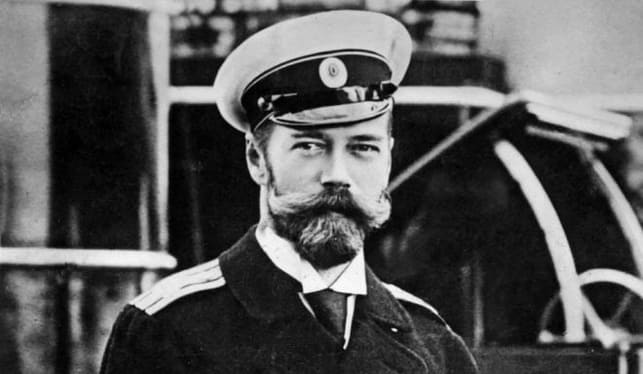
The commander of the gunboat “Koreets” was Captain 3rd Rank Tsarevich Nikolai Alexandrovich Romanov.
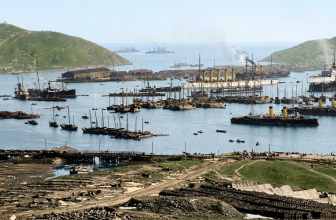
By 1895, the establishment of new port cities and industrial cities had been fully completed. In the north, on the shores of the ice-free Kola Bay, the port of Murmansk emerged—the base for the future Northern Fleet and the terminus of the railroad laid through forests and rocks from Petrozavodsk. Severodvinsk, with its colossal shipbuilding slipways, was established at the mouth of the Northern Dvina River. On the site of the tiny town of Nikolaevsk-on-Amur, Vladitikhokeansk flourished—Russia’s gateway to the Pacific Ocean, with docks capable of accommodating the largest battleships. Even further on, in a most convenient bay—which in another reality had been Sovgavan—the docks, workshops, houses, cranes, and warehouses of Tikhigorsk rose up—the future stronghold of the Pacific Fleet.
In Siberia, amid recently discovered coal and ore deposits, and in tandem with the construction of the Kuzbass Railway, the city of Stalnogorsk was being built—a center for the production of armor, tractors, steam locomotives, railcars, artillery barrels, optical sights, steam engines, and much more. Nearby, Magnitogorsk was growing, its blast furnaces destined to supply metal for all of Russia. Between the Volga and Oka rivers, the buildings of Derzhavinsk—a gigantic chemical complex producing gunpowder, fertilizers, and the first synthetic dyes—rose up.
All these cities were connected by railroads, which were being built at an unprecedented pace. The construction sites utilized steam excavators and the labor of contract workers, who were paid three times the usual rate in Europe or America. Peasants from all over Russia flocked there in search of work, and engineers, doctors, and teachers traveled with them—the Grand Duke personally signed decrees providing for free housing for employees, as well as schools and hospitals, at every new factory.
It was in 1895 that another landmark event took place. In St. Petersburg, in a specially constructed building featuring a new, enormous test basin, a wind tunnel, and laboratories, the “Laboratory for the Study of Ship Seaworthiness” opened under the leadership of Captain 1st Rank Stepan Osipovich Makarov and Engineer-Colonels Dmitry Vasilyevich Skvortsov and Alexei Nikolaevich Krylov. It was the world’s first research institution entirely dedicated to shipbuilding, with such an extensive array of equipment and industrial capabilities. Here, models of future ships were tested, buoyancy was calculated, and hull strength was studied. The Grand Duke allocated so much funding to the laboratory that he could have built two more cruisers, but he knew for certain that this money would pay for itself a hundredfold.

Alexey Nikolaevich Krylov

Stepan Osipovich Makarov

Dmitry Vasilyevich Skvortsov
And they paid off. By 1897, the Russian fleet was not merely in existence—it had become a force to be reckoned with. The “Poltava”-class squadron battleships undertook long-range cruises, demonstrating impeccable seaworthiness and the power of their artillery. “Rurik”-class cruisers patrolled trade routes from the Baltic Sea to the Pacific Ocean, while “Koreets”-class monitors made the Gulf of Finland, the Kola Bay, the Gulf of Riga, and the mouths of the Kola and Amur Rivers virtually impregnable.
Foreign powers, which until recently had viewed Russia as a giant, backward patient, began to grow nervous. The British Admiralty sounded the alarm: the Russians are building the latest types of ships, have an abundance of superior Krupp armor, and—according to intelligence reports—possess colossal gold reserves, the origin of which remains a mystery. The German Reichstag debated a bill to expand the fleet, citing the “Russian threat.” And Japanese General-in-Chief Marquis Itō Hirobumi, having reviewed data on the construction of Vladivostok and the Pacific Squadron, remarked grimly:
— If we don’t rethink our policy toward Russia, then in a possible war, it will speak to us through the language of guns, while we’ll be left with nothing but wooden swords.

Ito Hirabumi
But in St. Petersburg, no one was thinking about war just yet. Grand Duke Alexei Alexandrovich was preoccupied with matters of greater significance. In the offices of his chancellery, under the watchful eye of Midshipman Blanc and Major General Afanasyev, plans were being drawn up to electrify all the provinces, build the world’s first icebreaker fleet, and open the Northern Sea Route. The empire, which just fifteen years earlier had seemed hopelessly backward, was now setting the pace itself and striking fear into its neighbors with its rapid progress.
And no one—not even the Grand Duke himself—knew that somewhere in the Tiflis Seminary, in a smoke-filled room with a low ceiling, a young man with a freckled face was reading a banned pamphlet, and thoughts were taking shape in his mind that would one day bring the whole world to its knees. But that would not happen for a very, very long time. In the meantime, the hammers of the Stalnogorsk open-hearth furnaces clanged, the horns of the Murmansk icebreakers blared, and the keels of battleships of a new, as yet unseen class were being laid down on the shipyards of Nikolaev. Russia was moving forward, driven by the iron will of a man who, on New Year’s Eve 1882, dared to look God in the eye and say, “I agree.”
Technical Specifications of the Ships Under Construction:
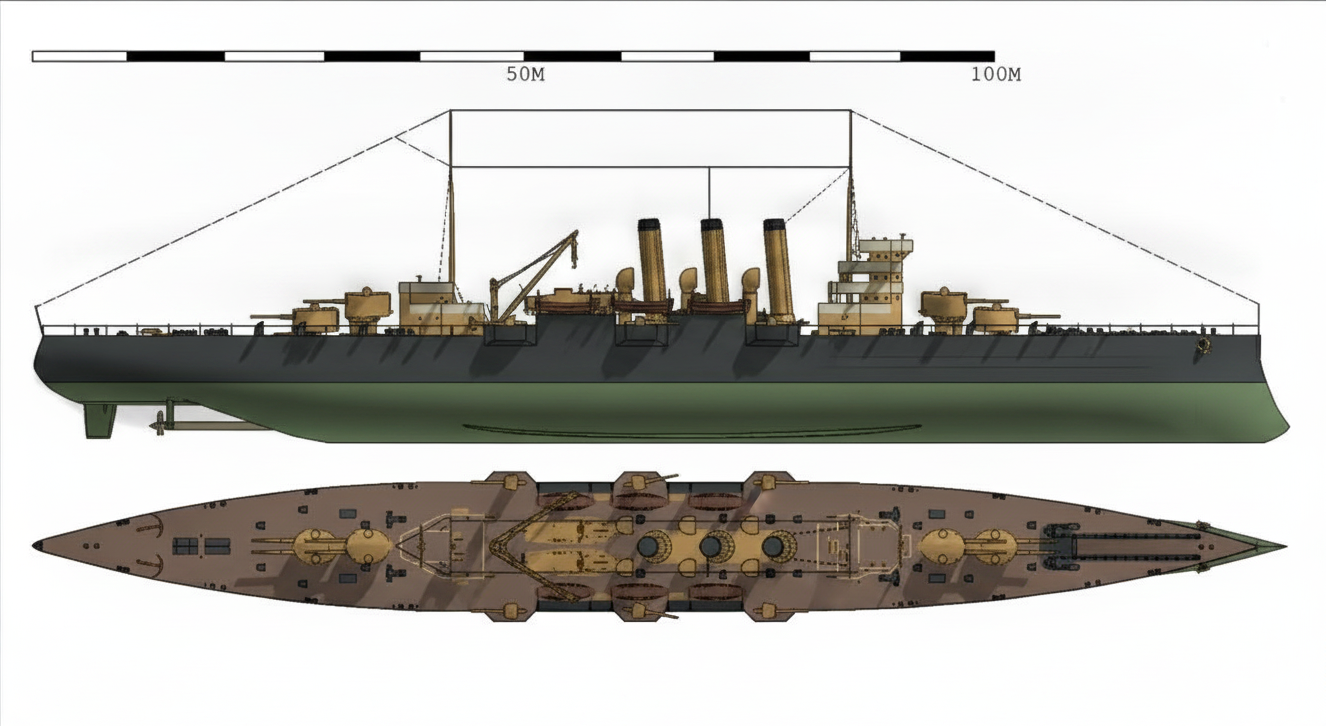
“Rurik”-class armored cruisers
Eight ships were built (1886–1992):
“Rurik”
“Thunderbreaker”
“Russia”
“Vityaz”
“Diana”
Pallas
“Athena”
“Aurora”
Displacement:
Standard — 9,500 metric tons;
Total: 10,900 metric tons.
Dimensions:
Length — 142 m;
Width — 16 m;
Draft: 6.5 m.
Armament:
4×2 152/50-mm guns in turrets arranged in a linear elevated configuration;
6×1 152/50-mm guns.
Control System and Power Plant:
36 boilers from the Mtsensk Plant;
Total power: 36,000 l. s.;
Propulsion system — 4 propellers (2.9 m in diameter);
Maximum speed: 25 knots;
Cruising range: 5,000 miles at a speed of 12 knots.
Reservations:
Towers:
Forehead: 75 mm
Stern and sides: 40 mm
Barbet: 60 mm
An armored deck with beveled edges made of 80-mm-thick Krupp steel on a 10-mm-thick shipbuilding steel backing.
80 mm cut
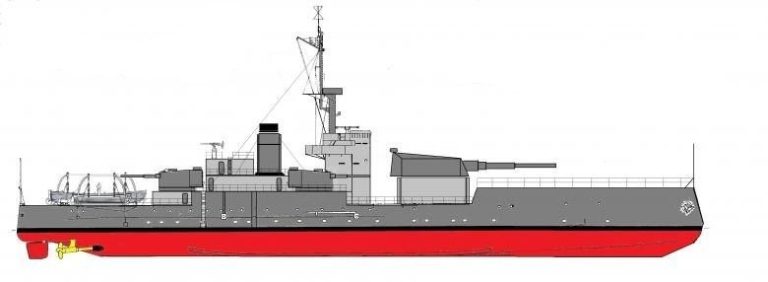
“Koreets” Class Coastal Defense Monitor/Armored Ship
Eight ships were built (1886–1892):
“The Korean,”
“Wagool,”
“Sibiryak,”
Beaver
“Sivuch”
“Gilyak,”
Cowboy
“Manchur.”
Displacement: 6,500 metric tons.
Dimensions: maximum length 104 m, width 25 m, draft 4.5 m.
Power plant: 4 triple-expansion steam engines with a combined capacity of 4,800 l. s.
Speed: 12 knots.
Armor: 200 mm along the hull; up to 130 mm at the ends; up to 200 mm on the conning tower and turret; and up to 50 mm on the deck.
Armament: three 305-mm/45-caliber guns in a triple-gun turret, three 2×130/55-mm turret mounts, and two 76-mm guns.
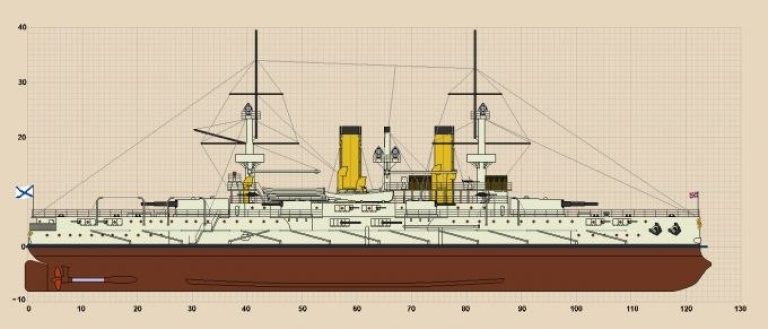
“Poltava”-class battleships
Eight ships were built (1886–1892):
“Poltava”
Glory
“Sevastopol”
“Petropavlovsk”
Donkey
“Azov”
Kincburn
“Grenham”
Displacement:
15,100 metric tons
Mechanisms:
2 shafts, 2 VTR steam engines, 20 Belville boilers, 13,300 l. s.
Speed:
17 nodes.
Reservations:
Full armor belt: 254–102 mm; turrets: 254 mm; barbettes: 178 mm; casemates: 152–102 mm; armor deck: 51–76 mm.
Armament:
2×2 305-mm/45-caliber guns,
4×2 + 4×1 203 mm/45-caliber guns,
16×1 75-mm/50-caliber guns,
2 Maxim machine guns.
Note:
Poltava was taken from here: https://alternathistory.ru/eskadrennye-bronenostsy-tipa-poltava-fan/
Rurik is taken from here: https://www.reddit.com/r/NavalArt/comments/1rx7x94/the_rienclass_a_very_anachronistic_protected/
This Korean is from here: https://alternathistory.ru/karmannye-linkory-russkogo-flota/