The History of the Soviet Navy That Never Was: The Large “Poltava”-Class Cruisers and Their Successors

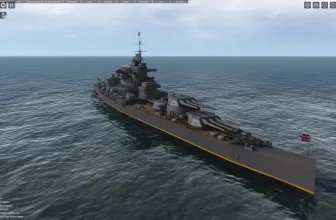
Continuing the story about the Soviet “X” heavy cruisers, I’d like to present an alternative scenario in which the 240-mm main-caliber guns were, in fact, put into mass production. The model was created by our Western colleague, Ogiveplunger664.

The Bifurcation Point: Choosing a 240-mm Caliber
1932 — In our reality, the USSR begins designing large cruisers armed with 305-mm guns. However, in the alternate timeline, a key change occurs:
At a meeting of the Revolutionary Military Council of the USSR on March 15, 1932, Admiral Orlov (Commander of the Naval Forces of the Red Army) presented a report in which he argued that 305-mm guns were too heavy for cruisers (the B-37 turret weighs 1,100 metric tons), require battleship-sized vessels, and are unreasonably expensive. Instead, he proposed the 240-mm B-38 gun—an evolution of the successful 180-mm B-1-P guns, but with increased range and shell power.
The technical justification seemed convincing: a 240-mm shell weighs 188 kg (compared to 128 kg for the 180-mm and 467 kg for the 305-mm), its range is 42 km (compared to 37 km for the 180-mm and 42 km for the 305-mm), the rate of fire reaches 3 rounds per minute (compared to 2 for the 305-mm), and the turret weighs 650 metric tons (compared to 1,100 metric tons for the 305-mm).
1933 — Project 82 is approved with 240-mm guns as the main armament.
Construction of the First Series (1935–1941)
1935 — The keels of the first three ships were laid. The *Poltava* was built at Shipyard No. 194 in Leningrad and launched on May 25, 1937. The Sevastopol was laid down at Shipyard No. 200 in Mykolaiv and launched on September 12, 1937. The Borodino was also built at Shipyard No. 194 in Leningrad and launched on April 30, 1938.
Specifications of the Project 82 (first series):
- Displacement: 22,500 metric tons (standard), 26,200 metric tons (full load)
- Length: 212 m
- Width: 23.5 m
- Draft: 8.2 m
- Armament: 3×3 240-mm B-38 (9 barrels), 6×2 100-mm B-34 (air defense), 10×1 37-mm 70-K, 2×3 533-mm torpedo tubes, 2 KOR-2 seaplanes
- Armor: belt 120 mm, deck 60 mm, turrets 150 mm
- Power: 4 TZA units at 37,500 l.s. each = 150,000 l.s.
- Speed: 35.5 knots
- Crew: 850 people
1939 — The *Poltava* was commissioned on September 15, 1939, and became the flagship of the Baltic Fleet.
1940 — The *Sevastopol* was commissioned on June 22, 1940 (symbolically, exactly one year before the outbreak of the war) and was transferred to the Black Sea. The *Borodino* was 85% complete.
Chapter II. The Great Patriotic War (1941–1945)
The Sinking of the “Poltava”
June 23, 1941 — The *Poltava*, under the command of Captain 1st Rank Ivan Petrovich Yermolaev, received orders to sail from Kronstadt to Tallinn to reinforce the defenses of Moonsund.
June 28, 1941—at 4:30 a.m., while located 15 miles west of Gogland Island, the *Poltava* spotted a German formation: the battleship *Scharnhorst*, the heavy cruiser *Admiral Hipper*, and four destroyers.
The battle in the Gulf of Finland began at 4:45 a.m., when the *Poltava* opened fire from a range of 18,000 m. At 04:52, the first shell from the Scharnhorst (283 mm) struck the bow of the Poltava, putting its 100-mm battery out of action. At 05:03, the *Poltava* scored a hit with a 240-mm shell on the *Hipper*, putting its stern turret out of action.
At 5:15 a.m., the fateful moment arrives: a 283-mm shell fired by the *Scharnhorst* pierces the armor belt near the second main gun turret and strikes the ammunition magazine. At 5:16 a.m., a massive explosion tore the cruiser in two.
The *Poltava* sank in 8 minutes. Of the 850 crew members, 623 perished (including Captain Yermolaev); 227 were rescued by the destroyers *Gordy* and *Grozyashchy*. The *Scharnhorst* sustained damage (hit by three shells) but remained operational, while the *Hipper* was forced to withdraw for repairs.
Poltava has become a symbol of heroism—despite suffering heavy losses, it held off a German unit for four hours, allowing Soviet transports to leave Tallinn.
The Combat History of the “Sevastopol”
July 1941 — The *Sevastopol*, under the command of Captain 1st Rank Nikolai Mikhailovich Kulakov, actively participated in the defense of Odessa. On August 8, Romanian positions near Odessa were shelled (240 240-mm shells were fired), and on August 15, an attack by Italian torpedo boats was repelled (two boats were destroyed).
September–October 1941 — Defense of Sevastopol. On October 30, the first artillery barrage against the advancing German forces takes place (3 batteries and 2 ammunition depots are destroyed). On November 7, a battle took place with German coastal batteries (the ship was hit three times by 150-mm shells and sustained minor damage). On December 22, a heroic raid on Yalta took place: the *Sevastopol* single-handedly shelled German positions while fending off attacks by Ju-87 dive bombers.
1942. On January 5, during yet another shelling of the positions of Manstein’s 11th Army, the *Sevastopol* was hit by a 280-mm shell fired from a coastal battery (a captured French-made gun). The shell pierced the deck and exploded in Engine Room No. 2. The cruiser lost propulsion but continued to fire from its bow turrets. It was towed to Sevastopol Bay, where it was used as an unsinkable battery.
June–July 1942. On June 3, the *Sevastopol* fired its final salvo (with 12 shells remaining). On June 4, on orders from the command, the guns were taken out of service, and the crew (420 men remaining) was incorporated into a naval regiment and participated in the defense until the very end. On July 9, the Sevastopol was captured by the Germans, but was in a deplorable condition.
1944 — After the liberation of Sevastopol, the *Sevastopol* was raised and towed to Mykolaiv. An inspection revealed that the ship could not be restored as a combat vessel. However, the three 240-mm turrets survived (though they required repairs), the hull was used as a source of spare parts for new ships, and some of the guns were mounted on TM-1-240 railway transporters.
The Fate of the “Borodino”
June 1941 — The “Borodino” is 92% complete at Plant No. 194 in Leningrad.
September 1941—the start of the Siege of Leningrad. Construction was halted.
1941–1944 — The ship was used as a floating battery (equipped with 4 × 100-mm and 6 × 37-mm guns), the command post for the defense of Kronstadt, and a base for marine landings.
1944—After the blockade was broken, the *Borodino* was completed on an accelerated schedule and entered service on May 9, 1945 (Victory Day!). However, the war had ended, and the ship did not have a chance to see combat.
Chapter III. Postwar Recovery (1945–1955)
Lessons from the War and a New Project
1946 — At a meeting of the Technical Council of the Soviet Navy, the lessons learned from the war were analyzed.
The conclusions were as follows. The B-38’s 240-mm guns performed excellently: high rate of fire (3 rounds per minute), good accuracy, a powerful shell (188 kg), and a reliable design.
The main problem with Project 82 is the insufficient number of gun barrels: 9 barrels (3×3) is not enough for artillery combat against heavy cruisers; the Germans have 8×203-mm guns on the “Hipper,” while the Japanese have 10 × 203-mm guns on their heavy cruisers. A salvo with greater firepower is needed.
The Future of Missiles: The work of Korolev and Chelomei shows that in 10 to 15 years, missiles will become the primary weapon.
1947 — A historic decision was made: Project 82-U (improved) was to be equipped with 4×3 240-mm guns (12 barrels instead of 9), increased displacement to accommodate additional turrets, space reserved for future missile systems, and reinforced air defense.
Construction of the Second Series (1948–1956)
1948 — Project 82-U, “Poltava-II,” was approved.
Features:
- Displacement: 26,800 metric tons (standard), 31,200 metric tons (full load)
- Length: 228 m
- Width: 24.8 m
- Draft: 8.9 m
- Armament: 4×3 240-mm B-38U (12 barrels, improved version with a range of 45 km), 8×2 100-mm B-34B, 12×2 37-mm V-11, 2×3 533-mm torpedo tubes, 3 Be-8 seaplanes
- Armor: belt 150 mm, deck 80 mm, turrets 175 mm
- Power: 4 TZA units at 42,500 l.s. each = 170,000 l.s.
- Speed: 34 knots
- Crew: 1,050 people
Launching ships:
- “Poltava-II” (Plant No. 194, Leningrad) — November 5, 1948
- “Sevastopol-II” (Plant No. 200, Mykolaiv) — May 1, 1949
- “Borodino-II” (Plant No. 194, Leningrad) — August 15, 1949
- “Gangut” (Plant No. 402, Molotovsk) — February 22, 1950
1952 — The “Poltava-II” was launched on May 25, 1952 (in honor of a fallen comrade).
1954 — The “Poltava-II” entered service on November 7, 1954.
1955–1956 — The remaining three ships were commissioned.
Chapter IV. The Missile Revolution (1955–1965)
Modernization of Project 82-U
1955 — Khrushchev, just as in our reality, is betting on missiles. But unlike in our reality, the large cruisers are not being decommissioned but rather modernized.
The reasons were as follows: Four ships had already been built—it would be a shame to decommission them. The 240-mm guns can fire special projectiles: a projectile with a nuclear warhead (the “Groz” project, 5 kT) and a guided projectile with radio command guidance. Missiles complement artillery; they do not replace it.
Project 82-UR (missile) — first modernization (1957–1962).
The modifications included the removal of the stern turret of Main Gun No. 4 (freeing up 650 metric tons of space); in its place, four P-6 anti-ship missile launchers (in reloadable containers) were installed. A “Hercules” radar system was installed for missile control. The seaplanes were removed, and a helipad for the Ka-15 was constructed. Air defense capabilities were enhanced: 4×2 57-mm ZIF-75 guns replaced some of the 37-mm guns.
Armament after modernization: 3×3 240-mm (9 barrels), 4 P-6 anti-ship missiles (range 300 km, warhead 1,000 kg), 6×2 100-mm, 4×2 57-mm guns, 1 Ka-15 helicopter.
1960 — The “Poltava-II” undergoes its first modernization.
1962 — All four ships were modernized.
Development of Project 82-RA (Rocket-Artillery)
1963 — A program of comprehensive modernization was adopted.
Project 82-RA combines the retention of heavy artillery (9 240-mm barrels) with the installation of 16 P-35 “Progress” anti-ship missiles (instead of 4 P-6 missiles), the installation of the M-2 “Volkhov” air defense system (the ship-based version of the S-75) and the modernization of the 240-mm guns to the B-38RA version with the “Groz-240” fire control system.
Technical Solutions:
To accommodate 16 P-35 missiles (each 10 m long and weighing 4,600 kg), it is necessary to remove the second turret from Gun Mount No. 2, modify the superstructure, and install KT-16 rotating launchers (8×2).
But the admirals insist: at least three turrets must be preserved for artillery combat.
The 1964 compromise: only one tower (aft tower No. 4) is removed, and 8 P-35 launchers are installed in its place. Another 8 launchers are installed in front of the bow superstructure (where the seaplanes used to be). Total: 16 P-35 anti-ship missiles + 3×3 240-mm guns.
1965 — The “Poltava-II” begins modernization under Project 82-RA.
Chapter V. The Era of the “Granites” and the Atom (1965–1985)
The Introduction of Project 82-RAE (Nuclear)
1968 — The success of Project 1144 (“Kirov”) raises the question: Should Project 82-RA be converted to nuclear power?
Arguments “FOR”: unlimited range, more space for fuel and missiles (no need for huge fuel tanks), less smoke (important for stealth), and more electrical power for radar and control systems.
Arguments “AGAINST”: cost (a nuclear cruiser is three times more expensive), maintenance complexity, and the need for special infrastructure.
1969 — A compromise decision was reached: The “Poltava-II” and “Sevastopol-II” would retain their steam turbine power plants (modernization), while the “Borodino-II” and “Gangut” would be rebuilt according to Project 82-RAE (nuclear).
Project 82-RAE “Poltava-III” (nuclear-powered missile and artillery cruiser)
1970 — The 82-RAE project was approved:
Features:
Power plant:
- 2 KN-3 nuclear reactors (as on the “Kirov”)
- Thermal power: 300 MW each
- Electrical output: 90 MW
- 2 M-21 gas turbine engines, each rated at 20,000 l.s. (for afterburner)
- Total power: 300,000 l.s. (continuous) + 40,000 l.s. (boost)
- Speed: 32 knots (cruising), 35 knots (full throttle)
- Range: unlimited at cruising speed (18 knots)
Displacement:
- Standard: 28,500 metric tons
- Full load: 33,800 metric tons (a record for Soviet cruisers!)
- Reason: nuclear reactors + biosafety + additional systems
Dimensions:
- Length: 236.2 m
- Width: 26.4 m
- Draft: 9.7 m
Armament (final configuration as of 1980):
Highlight:
- 3×3 240-mm AK-240 (upgraded guns):
- OFS range: 52 km
- Guided rocket projectile (GRP) range: 110 km
- Rate of fire: 3.5 rounds/min
- Ammunition capacity: 120 rounds per barrel (1,080 total)
- 16 P-700 “Granit” (SS-N-19 Shipwreck) anti-ship missiles:
- SM-225 vertical launchers
- Range: 500–625 km
- Warhead: 750 kg high-explosive or 500 kT nuclear
- Salvo firing system (all 16 missiles simultaneously)
- 8 3M55 “Oniks” (SS-N-26 Oniks) anti-ship missiles:
- 3S14 multi-purpose vertical launchers
- Range: 300 km
- Speed: 2.6 Mach
- Warhead: 200 kg
Air Defense
- 4 S-300F “Fort” air defense systems (equivalent to the S-300P):
- 96 5V55RM missiles (24 per launcher)
- Range: 150 km
- Ceiling: 27,000 m
- Simultaneous engagement of 12 targets
- 4 “Osa-M” (SA-N-4 Gecko) air defense systems:
- 128 9M33 missiles (32 per launcher)
- Range: 12 km
- For repelling close-range attacks
- 4 “Tor-M1” (SA-N-9 Gauntlet) air defense systems:
- 128 9M330 missiles (32 per launcher)
- Range: 12 km
- Interception of highly maneuverable targets
- 4 “Pantsir-M” air defense missile systems (ship-based version):
- 96 57E6 missiles
- 24,000 rounds of 30-mm ammunition (2A38M)
- For protection against massive attacks
Medium-caliber artillery:
- 2×2 130-mm AK-130:
- Range: 23 km
- Rate of fire: 40 rounds/min per barrel
- Multi-purpose weapon (ships, shore, air)
Anti-submarine:
- 2 × 10 533-mm torpedo tubes for the “Vodopad”/“Veter” anti-submarine missile systems:
- Range: 50 km
- Warhead: torpedo or nuclear depth charge
- 2 RBU-6000 “Smerch-2” (12 tubes each):
- Range: 6,000 m
- Warhead: 250 kg depth charge
- 2 RBU-1000 “Zmey” (6 tubes):
- Range: 1,000 m
- For close-range anti-submarine warfare
- “Udav-1M” anti-torpedo devices:
- 2×12 launchers
- Torpedo interception at a range of 1,500 m
Aviation:
- 2 Ka-27PL/Ka-31RLD helicopters
- A 2-car garage
- Airstrip
Crew: 1,250 (including 80 Air Force officers for aviation)
Construction and Modernization
1972 — The *Borodino-II* was taken into dry dock for conversion to nuclear propulsion.
1975 — The “Borodino-II” (now Project 82-RAE) begins testing.
1977 — The “Gangut” completes its refit.
1980 — The “Poltava-II” and “Sevastopol-II” undergo a mid-life modernization (without converting to nuclear power): “Granit” and “Onyx” anti-ship missiles were installed, air defense systems were modernized (S-300F, “Pantsir-M”), and radar and control systems were upgraded.
1982 — all four ships were in service: the “Poltava-II” in the Black Sea Fleet (Sevastopol), “Sevastopol-II” in the Pacific Fleet (Vladivostok), “Borodino-II” in the Northern Fleet (Severomorsk), and “Gangut” in the Baltic Fleet (Baltiysk).
Chapter VI. Strategic Role and Operational Use
Doctrine of Application
The 1980s—the “Poltava-III”-class cruisers became the backbone of the Soviet Navy.
The main objectives included the destruction of NATO aircraft carrier strike groups, where a salvo of 16 “Granit” missiles plus 10 “Onyx” missiles is capable of destroying 2–3 aircraft carriers, while 240-mm guns firing nuclear shells serve as the “final resort” at ranges of up to 50 km. The S-300F provides air defense for the formation within a 150-km radius.
Support for amphibious operations was provided by nine 240-mm guns, firing 30 rounds per minute. In 10 minutes, that amounts to 300 shells with a total weight of 56,400 kg. By comparison, a battery of 18 2S3 “Acacia” howitzers fires 108 shells per minute.
Gunboat diplomacy included visits to Third World countries (Angola, Mozambique, Vietnam, Cuba), a show of force in the Mediterranean Sea, and a presence in the Indian Ocean.
Missile defense was provided by a layered air defense system: S-300F (150 km) → “Osa-M” (12 km) → “Tor-M1” (12 km) → “Pantsir-M” (4 km), protecting the formations from air and sea attacks.
Exercises and Incidents
1983 — “Ocean-83” exercises: The “Borodino-II,” part of the Northern Fleet, repels an attack by a simulated aircraft carrier task force. Eight “Granit” missiles (training rounds) were fired at targets; all eight hit their targets on the first salvo. Western observers were shocked: NATO’s surface fleet does not possess such firepower.
1985 — An incident in the Mediterranean Sea: The *Poltava-II* is sailing from Sevastopol to Libya (for a visit to Tripoli). Fifty miles from Crete, it was intercepted by the American aircraft carrier “America” and two destroyers. The Americans demanded that the ship change course. The commander of the “Poltava-II,” Captain 1st Rank Viktor Sergeyevich Morozov, replied: “I am in international waters. I will not change course.” For 6 hours, the ships sail on parallel courses at a distance of 5,000 meters. The Americans refrain from provocation: 16 “Granit” launchers are visible on the deck of the “Poltava.” The “Poltava” successfully arrives in Tripoli.
1987 — Exercises in the Sea of Japan: The *Sevastopol-II*, together with three Project 956 destroyers, practices the destruction of a simulated carrier strike group. A new tactic was employed: a distributed salvo—the Sevastopol fired eight Granit missiles, while the destroyers fired 12 Moskit anti-ship missiles, resulting in a simultaneous strike from different directions. Result: the simulated sinking of an aircraft carrier and two cruisers.
Chapter VII. After the Collapse of the USSR (1991–2026)
The Crisis of the 1990s
1991 — The collapse of the Soviet Union threatens the ships’ very existence.
The problems were serious. Funding: Russia does not have enough money to maintain four such ships. Infrastructure: The “Sevastopol-II” is located in Ukraine (in Sevastopol). Crews: Mass dismissals of officers. Repairs: The shipyards in Mykolaiv and Leningrad are now in different countries.
1992 — The Black Sea Fleet is divided between Russia and Ukraine: the “Poltava-II” is transferred to Russia (relocated to Novorossiysk), while the “Sevastopol-II” remains in Sevastopol and is transferred to Ukraine.
1993 — Ukraine cannot afford to maintain such a ship: it offers to sell it to Russia, but Russia refuses (due to a lack of funds), and the “Sevastopol-II” is mothballed in Sevastopol.
1995 — Russia adopts a program to preserve the core of the Navy: the *Borodino-II* (Northern Fleet) — Priority No. 1, the *Gangut* (Baltic Fleet)—Priority No. 2, “Poltava-II” (Black Sea Fleet)—Priority No. 3 (requires repairs).
Modernization in the 2000s
2000 — With Putin’s arrival, the restoration of the Navy begins.
The “Poltava-2010” Program (2000–2010):
“Borodino-II” (2002–2006): reactor replacement (25-year service life expired), radar modernization: “Fregat-MA” → “Fregat-M2M,” replacement of “Granit” anti-ship missiles with 3M22 “Zircon” (hypersonic, Mach 6), installation of “Sigma-82RAE” fire control system, and upgrade of air defense systems: S-300F → S-300FM (range: 200 km). Cost: $850 million.
2006 — “Borodino-II” returns to service.
“Poltava-II” (2005–2009): medium-scale overhaul of the steam turbine plant, replacement of anti-ship missiles with “Zircon” (8 units, down from 16—reduction due to obsolescence of the launchers), modernization of 240-mm guns: “Groz-240M” system with GPS-guided shells, installation of 2 “Pantsir-M” air defense missile systems (instead of 4). Cost: $420 million.
2009 — The “Poltava-II” returns to service.
“Gangut” (2008–2012): a modernization similar to that of the “Borodino-II.” Additionally: replacement of the 240-mm guns with 2×3 240-mm guns (the middle turret was removed to accommodate a new-generation radar), installation of the “Peresvet” laser system for missile defense. Cost: $920 million.
2012 — The “Gangut” returns to service.
The Fate of Ukrainian Ships
“Sevastopol-II” (1993–2014): 1993–2014 — mothballed in Sevastopol. 2014 — following Crimea’s return to Russia, the ship was brought out of mothballing. 2015–2020 — extensive modernization under Project 82-RAE-M: complete replacement of weapon systems, installation of a 3S14 launch system with 32 cells (for “Kalibr,” “Onyx,” “Zircon” missiles), 240-mm guns retained (3×3), S-350 “Vityaz” air defense system (8 launchers for 128 missiles), “Redut” air defense system (2 launchers for 32 missiles), “Pantsir-M” air defense vehicle (4 units), and hypersonic “Zircon” missiles (16 units).
2020 — The “Sevastopol-II” returns to service as the flagship of the Black Sea Fleet.
Current Status (2026)
As of 2026, the Russian Navy has four “Poltava-III”-class cruisers in service:
- “Borodino” (Project 82-RAE-M):
- Fleet: Northern
- Homeport: Severomorsk
- Year of modernization: 2006
- Condition: Excellent
- Planned service life: through 2035
- “Gangut” (Project 82-RAE-M):
- Fleet: Baltic
- Homeport: Baltiysk
- Year of modernization: 2012
- Condition: good
- Planned service life: until 2040
- “Poltava” (Project 82-RA-P):
- Fleet: Black Sea Fleet
- Home Port: Sevastopol
- Year of modernization: 2009
- Condition: satisfactory (steam turbine unit requires replacement)
- Planned service life: until 2030 (then to be placed in reserve)
- “Sevastopol” (Project 82-RAE-M):
- Fleet: Black Sea Fleet
- Homeport: Sevastopol
- Year of modernization: 2020
- Condition: Excellent (most recent modernization)
- Planned service life: through 2045
Outlook
2025–2030 — the “Poltava-2030” program:
The “Poltava” will be decommissioned in 2030 and replaced by a new Project 82-N (new) cruiser: fully electric propulsion system, 240-mm guns replaced with electromagnetic cannons (the “Peresvet-M” project), 32 hypersonic “Zircon” missiles, 4 “Peresvet” laser systems, UAVs and unmanned surface vehicles, and a displacement of 35,000 metric tons.
2030–2040 — Gradual replacement of the remaining ships with Project 82-N vessels.
2045 — The last “Poltava-III”-class cruiser (“Sevastopol”) was placed in reserve.
2050 — all four ships have been transferred to museums: the Borodino to a museum in Severomorsk, the Gangut to a museum in Kronstadt, the Poltava to a museum in Novorossiysk, and the Sevastopol to a museum in Sevastopol.
Epilogue: Legacy
In an alternate universe where the USSR had opted for missile-artillery cruisers instead of pure missile cruisers, the Navy acquired a unique class of ships combining the firepower of World War II battleships (9–12 240-mm guns), missile-era technology (“Granit,” “Onyx,” “Zircons”), the unlimited range of nuclear propulsion, and multifunctionality (air defense, anti-submarine warfare, and strikes against coastal and naval targets).
These ships became a symbol of Soviet naval power and a deterrent to NATO for 40 years.
Their legacy lives on in modern Russian cruiser designs, which continue to combine missile and artillery armament, proving that the gun is not dead—it has evolved.
P.S. Fellow AI users, this is a rough draft written by AI, so naturally, no matter how you look at it, it hasn’t been thoroughly proofread—so please point out any mistakes. I’ll correct them as I go.