Admiral General. A Stranger Among His Own. Chapter 3.

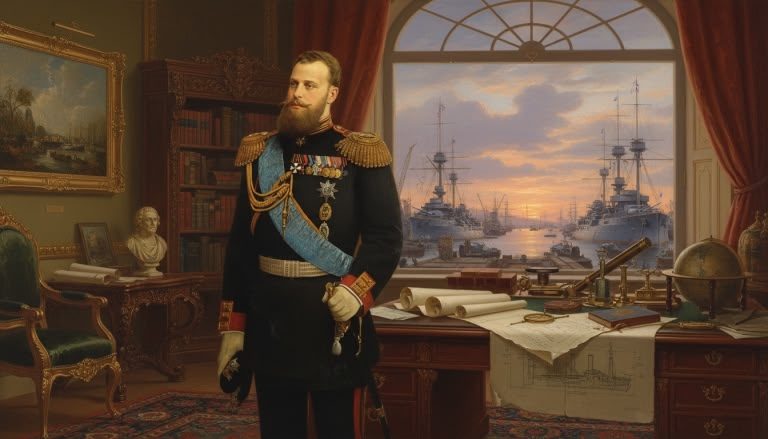
Foreword
Well then, friends, here is the third chapter of this work. I’d like to go over a few points from the previous chapters.
First, regarding Alexander III. I do not believe that feudalism died out completely under his reign; for the most part, it had already died out during the reign of his grandfather, Emperor Nicholas I. Under Alexander III, capitalism began to take root in full force in the Russian Empire; under his son, Nicholas II, it began to descend into the unbridled capitalism of Victorian England, with all that this entailed for the proletariat.
Second, regarding the ships’ technical specifications. This chapter features ships designed by many respected colleagues, such as the Russian “Michigan”-class battleship of the “Kremlin” type, or the “Admiral Ushakov.” So what if I increased their displacement and range? After all, in my setting, these ships are the first dreadnoughts—or rather, “Borodins,” as this class of ships would be called in this world. I won’t even mention that their armor is slightly different and their main dimensions differ from the original. But it’s worth answering the question, “Why didn’t anyone follow the Russians’ lead with this concept before the war?” The answer is simple. Officially, through all channels, and in the newspapers, behind the scenes, and in intelligence reports, it was said that these ships were crap, that they had problems with their turrets, that they were too expensive and temperamental, and so on and so forth—even though all of this was a lie, at least 90% of it. After all, the world’s first dreadnought was the battleship Navarin, which was largely experimental. It was built at the Grand Ducal Shipyards in Novonikolaevsk to test the optimal placement of main-caliber artillery. And so, all these problems were present on it at first, but by 1894 they had been resolved, and ultimately the “platter with music” or “upside-down table” (the ship earned both of these nicknames, and for practically the same reasons—this is especially true of “the upside-down table”) became the flagship of the Black Sea Fleet, and the battleships Knyaz Potemkin-Tavrichesky were laid down based on its plans, but with 343-mm/45 guns from the Obukhov Plant as their main caliber—also, incidentally, as an experiment; the third ship in the series, the Rostislav was actually equipped with 356-mm/45 guns from the Obukhov Plant; it was followed by the fourth ship in the series, the 12 Apostles, armed with 283-mm/50 guns from the Stalingrad Plant in three gun turrets, and finally, the Three Saints, equipped with 240-mm/50 guns from the Stalingrad Plant in four gun turrets. But I’ll write about that—and how it all came to be—later, in a separate article. Let’s get back to the matter at hand. Seeing this, the European powers concluded that something was wrong here, though they didn’t fully understand it yet; on top of that, the Americans, with their Connecticut-class battleship, added fuel to the fire, which convinced the British that the linear-elevated layout was a dead end, whereas the Germans began working in this direction and were proven right… I think I’ve covered everything. Enjoy the read!
The year 1892 marked the moment when the Russian Empire finally and irrevocably broke with its feudal past. Redemption payments and all accumulated arrears on them were abolished by a single imperial manifesto signed by Alexander III at the insistence of his younger brother. “Enough of the peasants’ tears,” the Admiral General said at a meeting of the State Council. “We want loyal subjects, not perpetual debtors. The land must belong to those who work it, and the treasury will receive its share of the harvest, and that share will be fair.”
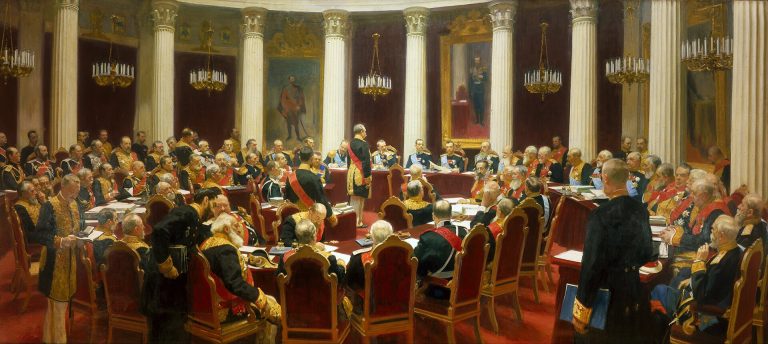
The State Council. I.E. Repin.
And the land began to flow. In the European provinces, in Siberia, in the Far East, and in Central Asia, peasant families were allotted 100 desiatinas per household—complete with farm implements, seed stock, and a three-year deferral on the first payments. The only condition was a tax in kind: one-third of the harvest to the treasury. For the starving villages, which had been destitute for centuries, this was an unprecedented act of generosity. Convoys of settlers streamed eastward in a continuous flow—toward the place where the chimneys of Derzhavinsk’s new chemical plants were already smoking, producing enough fertilizer to cover all the arable land in the empire. Russia no longer feared crop failures. For the first time in its history, the country was fully self-sufficient in food and even exported grain without shortchanging its own population.
In that same year, 1892, a rather unusual cadet—Vladimir Ilyich Blank—entered the Naval Cadet Corps. The twenty-two-year-old law school graduate, who had already been placed under police surveillance for his ties to disreputable circles, chose to join the navy rather than join the revolution. The example set by his older brother, who had become the right-hand man of the Admiral General himself, had a sobering effect. “If Sasha was able to build a new country through service rather than through bombs, then so can I,” he wrote to his mother before enrolling. And he did get in—not through the “back door” of patronage, but by passing the full entrance exam, having won a spot in a competition with four applicants vying for one position. His aptitude for languages and mathematics, combined with his iron will and perseverance, made him one of the best cadets in his class.
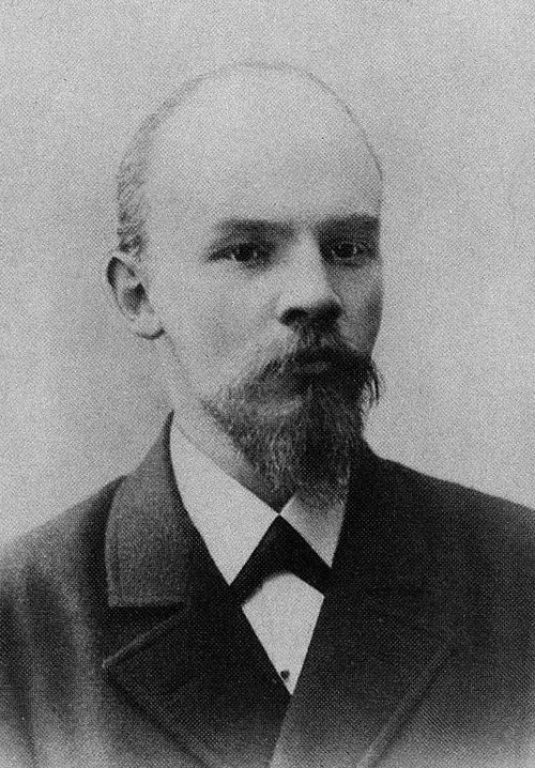
Lieutenant Commander V. I. Blank, dressed in civilian clothes while visiting his parents’ home.
Meanwhile, as the younger Blank was grappling with the complexities of naval science, the empire continued to flex its muscles. From 1892 to 1902, Russian shipyards laid down and launched several series of ships at once, each of which marked a new era in naval affairs.
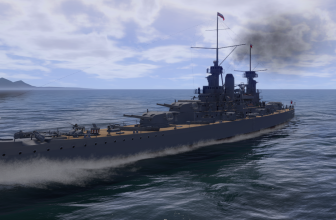
The first to set sail were the “Admiral Ushakov”-class battleships—eight powerful ships with a displacement of 16,000 metric tons, armed with eight 254-mm main-caliber guns and a full belt of armor. They were followed by the swift “Bayan”-class armored cruisers—the pride and joy of the cruiser fleet, capable of single-handedly paralyzing enemy trade and outrunning any battleship. The “Borodino”-class battleships were equipped with eight 305-mm guns and reinforced armor, becoming the prototype for future “Borodino-class” ships — as ships were called in this world that, in another history, would have been named “dreadnoughts.” The “Peresvet”-class cruisers, with their eight 254-mm guns in turrets and a speed of twenty-four knots, blurred the line between cruiser and squadron combat. And to replace the “Rurik” class, which had been sold to the Spanish, a new, improved series was laid down—the “Alyosha Popovich” cruisers, armed with ten 180-mm guns in four turrets and twenty-four 105-mm rapid-fire guns in casemates.
But the “Besheny” class squadron destroyers represented the most significant revolution. Forty-eight ships, laid down beginning in 1902—turbine-powered, equipped with Shukhov’s 42,000-force power plant, carrying four 130-mm guns and twelve torpedo tubes each. A top speed of 37 knots made them impossible to catch for any existing gunboat, and a salvo from four “Besheny” destroyers could sink an entire battleship.
This entire fleet required infrastructure, and it was built. By 1894, the double-track Trans-Siberian Railway stretched from Murmansk to Vladivostok, with branches to Vladitikhokansk, Stalnogorsk, Tyumen, Yakutsk, Sevastopol, and Tiflis. The Grand Duke, who had invested the lion’s share of his African and Alaskan capital in it, called this railroad “the backbone of Russian power.” Now it was possible to travel from the White Sea to the Pacific Ocean in two weeks, and cargo flowed in a steady stream: coal from Kuzbass, ore from the Urals, grain from Siberia, machine tools from Stalingrad—and the Baikal-Amur Mainline was still on the way.
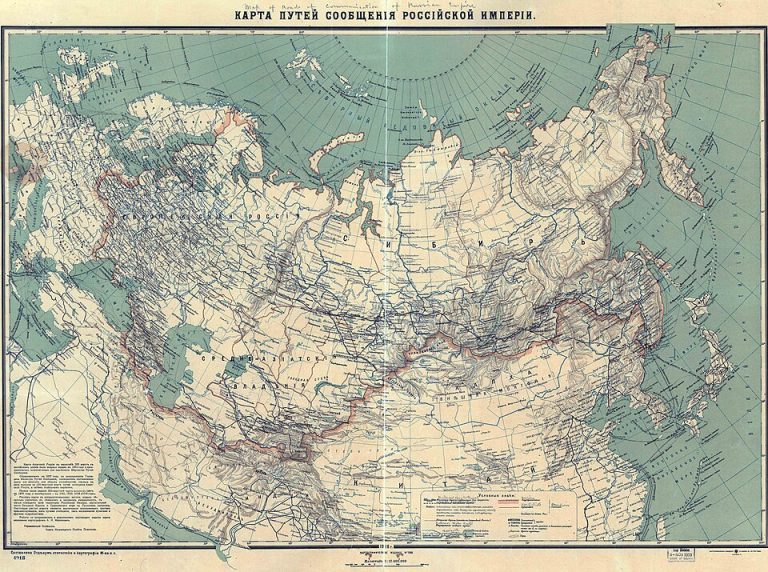
Railroad Map for the Year 1900
The “Golden River,” which had fueled all this construction, did not run dry until the very end of the century. But in 1899, the Second Anglo-Boer War broke out, and Russia’s presence in the Transvaal became untenable. British troops advancing on Pretoria were bound to encounter the mysterious Russian mining sites, and that could have sparked a direct conflict with London. This could not be allowed to happen.
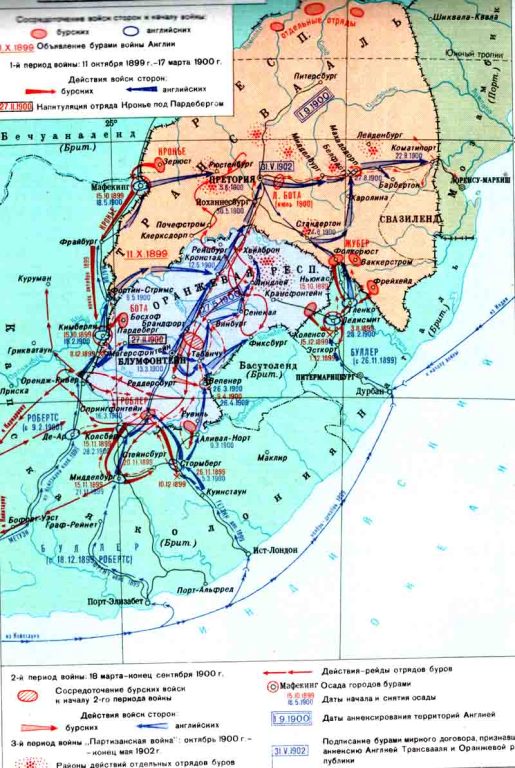
The Course of the Anglo-Boer War
The Grand Duke made his decision quickly and calmly, just as he had done with everything else over the past seventeen years. Within three months, the entire population of Flark, all the machinery, all the equipment, and the entire gold reserve were evacuated via Laurens-Markish onto Russian transport ships under the cover of a squadron of new ships that were conducting long-range navigation exercises. But Alexei Alexandrovich went further: he opened his doors to all Boers who wished to escape British rule. Fifty-six thousand people—farmers, artisans, women, and children—accepted the offer to resettle within Russian borders. They were settled in compact communities in the Far East, in the Vladivostok area and along the Amur River, where the Boers quickly found common ground with the Russian Cossacks and peasant settlers. They were settled there following the Cossacks’ example, with all the rights and obligations that entailed—such as service in the Amur Cossack Army. The two peoples—equally stubborn, equally accustomed to working freely on the land and with weapons in hand—became close-knit surprisingly quickly.
The Flark Security Service was not disbanded. On the contrary, Pyotr Sergeyevich Afanasyev, who had long since been promoted to major general, received a new assignment: to head the Security Service of the Grand Ducal Holding—a massive industrial conglomerate comprising all the enterprises, factories, shipyards, mines, and railroads built with Alexei Alexandrovich’s funds. Officially, it was the Grand Duke’s private property. In reality, it was the nervous system of Russian industry, protected from embezzlement and sabotage by the best internal security service in the world.
Almost simultaneously with the Boer War, the Spanish-American War of 1898 broke out. Here, too, the General-Admiral’s influence made itself felt in the most unexpected way. A year before the conflict, anticipating a clash, he pulled off a brilliant deal: four “Poltava”-class battleships and six “Rurik”-class cruisers, already under construction for the Russian Navy, were urgently sold to Madrid. The Spanish renamed these ships “Felipe II,” “Jaime I,” “Almirante Gravina,” “San Fernando,” “Don Juan de Austria,” “Hernán Cortés,” “Ciudad de Barcelona,” “Príncipe de Asturias,” “Isla de Panay,” and “Infanta Isabel.” The names that became available were immediately assigned to the new “Alesha Popovich”-class cruisers that were being laid down.
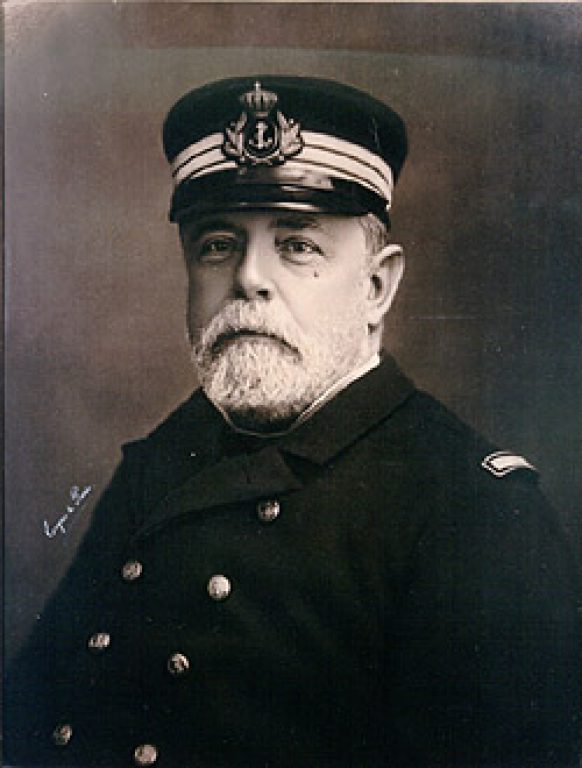
Admiral Pasquale Servera y Topete.
Admiral Servera, having modern Russian ships at his disposal, put the Americans through a bloody ordeal. He did not destroy the American fleet—the forces were too unequal, and the Yankees were building and purchasing ships, commissioning more and more of them—but he gave it a thorough beating. Communications along the U.S. East Coast were paralyzed for six months. American battleships chased the fast Russian-Spanish cruisers across the Atlantic, running out of coal, wearing down their engines, and fraying their nerves. In the end, the war still ended in Spain’s defeat: Cuba came under Washington’s control, while the Philippines remained with Spain. But it was a defeat faced with heads held high, without the surrender of any fleets or national disgrace. The Spaniards preserved their fleet, their dignity, and their honor—and never forgot who had given them that opportunity. Subsequently, in 1900, King Alfonso XIII of Spain, in gratitude for Russian assistance (the ships had been sold below market value and on favorable credit terms), gifted the islands of Cebu and Palawan to the Russian monarch, Nicholas II, as payment for the loan. Russia, in turn, helped Spain withdraw from the war. Over time, Russia and Spain grew much closer, and in 1904—a month before the start of the Russo-Japanese War—Spain and Russia signed a treaty of alliance, and Alfonso XIII became engaged to Grand Duchess Olga Alexandrovna. This marriage became one of the happiest in the history of both royal houses; to fast-forward a bit, let’s say that the Spanish monarchy never fell—having weathered two major wars in alliance with Russia, it only grew stronger and regained some of its territories, and Alfonso XIII would go down in history as the “Unifier of the Lands.” They had four children: three sons—Pedro, Alexey, and Nikolay—and a daughter, Catalina.
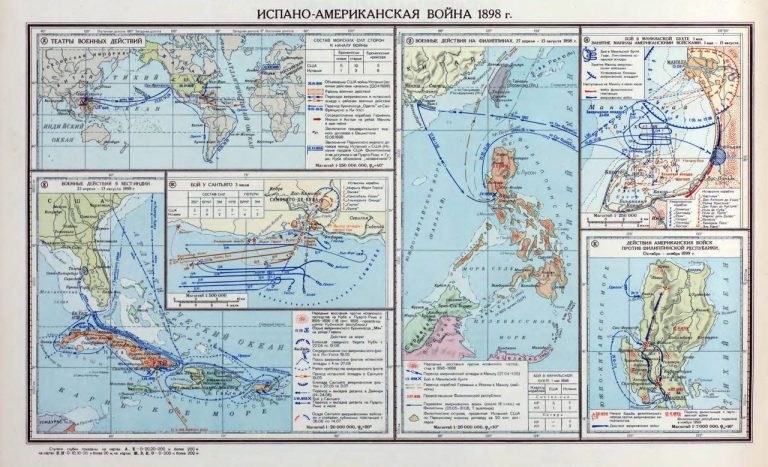
The Course of the Spanish-American War.
In America, however, this sparked a powerful wave of anti-Slavic sentiment. Slavic immigrants—Poles, Rusyns, Serbs, and Croats—found themselves on the receiving end of sidelong glances and outright hostility. Many of them, especially those in science and technology, returned to the Russian Empire, where they were welcomed with open arms. Among the returnees were figures whose names are inscribed in gold letters in the history of technology: Nikola Tesla, a Serb and a genius of electricity; Michał Dolowy-Dobrowolski, a Pole and the inventor of three-phase current; Pavel Yablochkov, a Russian inventor who returned to his homeland after many years abroad. All of them were provided with laboratories, funding, and carte blanche by the Grand Ducal holding company.
The death of Alexander III in 1898 did not take the empire by surprise. The tsar’s death was a long and painful one, but he passed away peacefully, knowing that he was leaving his son not a crumbling state, but a mighty power. The heir, Captain 1st Rank Nikolai Alexandrovich, ascended the throne not just anywhere, but in Moscow—the ancient capital, which Alexei Alexandrovich had convinced him to make the sovereign’s permanent residence. “St. Petersburg is too vulnerable from the sea and too close to the border,” the Admiral General had told the late emperor. “Moscow, however, is the heart of Russia. If Moscow is strong, the entire empire will be strong.” And Alexander III, after some thought, agreed.
By the start of the new century, Russia presented a spectacle that was both frightening and mesmerizing. On the one hand, there was unprecedented growth, factories, railroads, schools, and universities. On the other, there was mounting tension on its European and Far Eastern borders. Japan, which was modernizing at a breakneck pace, was casting increasingly aggressive eyes on Korea and Manchuria, while England feared Russia’s growing influence. Realizing that a clash was inevitable, the Grand Duke began preparing for war long before it formally began.
Starting in 1898, the main forces of the Pacific Fleet were transferred to Vladivostok, Vladitikhokiansk, and Tikhigorsk. Port Arthur, which was too vulnerable and prone to blockade, was left only for light forces and torpedo boats. To ensure year-round navigation through the ice of the Far East, a series of eleven “Ermak”-class icebreakers was laid down—seven more of the same type were under construction for the Baltic Sea. On the Pacific shipyards, construction was nearing completion on the latest ships: the “Borodino-class” (battleships), the “Alyosha Popovich-class,” and the elusive “mad” destroyers. The Black Sea Fleet, which found itself deep in the strategic rear, was gradually being transformed into a training and experimental base — all obsolete and experimental equipment was transferred there, and personnel were trained for the active fleets, although the Black Sea Fleet itself could have dealt a serious blow, since it included all five Navarino-class ships.
In November 1903, when snow had already blanketed the hills of Primorye, aboard the battleship *Slava*, which had just entered service with the Pacific Squadron, a young hieromonk of Georgian descent, a graduate of the Tiflis Seminary, took up his post as ship’s chaplain. His name was Father Joseph; in civilian life, he was Joseph Vissarionovich Dzhugashvili. He was taciturn and stern, understood the sailors’ souls perfectly, and knew how to speak to the lower ranks in such a way that they listened to him with bated breath. The officers kept their distance from the priest to some extent, but respected him for his intelligence and impeccable service.
That same day, at the same time as the chaplain, a new commander arrived on the ship—Captain 1st Rank Vladimir Ilyich Blank. He was the very same man who had once been a promising lawyer and was now one of the fleet’s finest commanders, having risen through all the ranks and earned his epaulets not through his brother’s influence but through his own achievements. He took command of the battleship calmly, with the air of a master, and his first act was to go down to the engine room—he had not forgotten the lessons taught by his uncle, the Admiral General, to the Crown Prince Nicholas, a figure known throughout the empire.
The third new member of the *Slava*’s crew that same fall was the chief artillery officer, Felix Edmundovich Dzerzhinsky, a Polish nobleman from the Minsk Governorate and a 1898 graduate of the Naval Academy. He was meticulous to a fault, knew artillery like no one else, and within two years had brought the battleship’s gunnery to such a high level that the *Slava* consistently won first prizes in squadron firing competitions.
And Grand Duke Alexei Alexandrovich and his long-time secretary, Lieutenant Commander Alexander Ilyich Blank, sat by the fireplace in the Admiralty office that November evening. The firewood crackled in the fireplace, and the Baltic wind howled outside the windows. Both were silent. Both knew what no one else knew: according to intelligence reports, war would break out in the Far East in two months. Not like the one in that other story—the one involving Tsushima, Makarov’s death, and the surrender of Port Arthur. A completely different war. A war for which Russia had been preparing for twenty-two years. A war in which the Russian fleet would have every chance of success.
“Is the fleet ready, Alexander Ilyich?” the Grand Duke asked quietly, without taking his eyes off the fire.
— The fleet is ready, Your Imperial Highness. The commanders are the best. The ships are state-of-the-art. The sailors are well-trained. We have plenty of ammunition and coal. Firing at maximum range has proven effective. Our crews are just as well-trained as the German and Japanese ones. I think our enemies will come to regret having crossed paths with us.
Alexei Alexandrovich nodded, but his smile was a sad one.
“War is war, Sasha. People always die—good people. But if we did everything we could to save as many lives as possible and make our homeland stronger, then our lives weren’t lived in vain. Go get some rest. We have a lot of work to do tomorrow.”
He was left alone. In the red glow of the flames, his face looked as if it had been carved from stone. The god Akido no longer appeared to him—he had said everything on that first night. Now everything depended on the people—on these Russians, Georgians, Poles, Boers, Germans, and Tatars who were building a new country together; on the sailor aboard the destroyer *Beshenyi*; on the priest aboard the *Slava*; and on the tsar in the Moscow Kremlin.
The new year of 1904 was destined to be a year of war. And Russia was more prepared for it than ever before.
Technical Specifications of the Ships Under Construction:
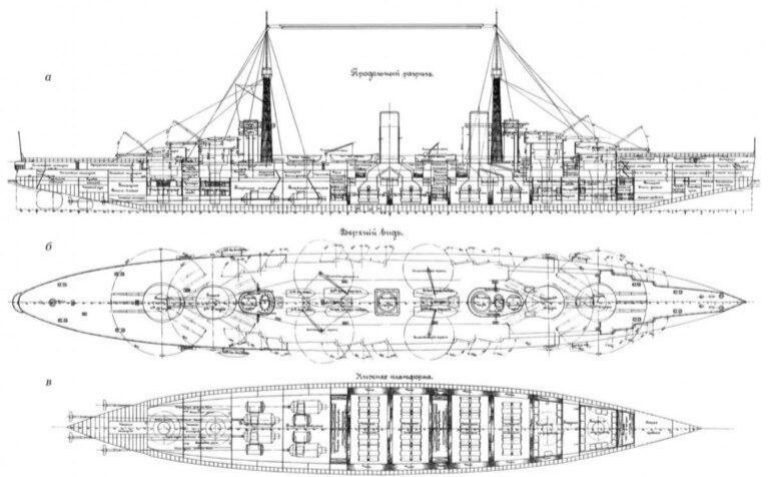
Alesha Popovich-class armored cruisers, the second, improved series of Rurik-class cruisers
Eight ships were built (1898–1903):
Psyche
Aphrodite
Venus
Mars
Alesha Popovich
Dobrynya Nikitich
Ilya Muromets
Svyatogor
Displacement:
Standard — 9,500 metric tons;
Total — 10,400 metric tons.
Dimensions:
Length — 172 m;
Width — 19 m;
Draft — 7.2 m.
Armament:
3×2 + 2×2 180/50-mm guns;
24 × 1 105/50-mm guns in casemates.
Control System and Power Plant:
12 boilers at the Baku plant;
Total power: 42,000 l. s.;
Propulsion system — 4 propellers (3 m in diameter);
Maximum speed: 25 knots;
Cruising range: 5,000 miles at a speed of 12 knots.
Armor (Krupp steel):
Main belt — 100 mm
Crossbar — 65 mi
Deck — 90 mm
GK towers — 150 mm in diameter
Barbets — 150 mm
Cutting width — 200 mm
Casemates – 90 mm
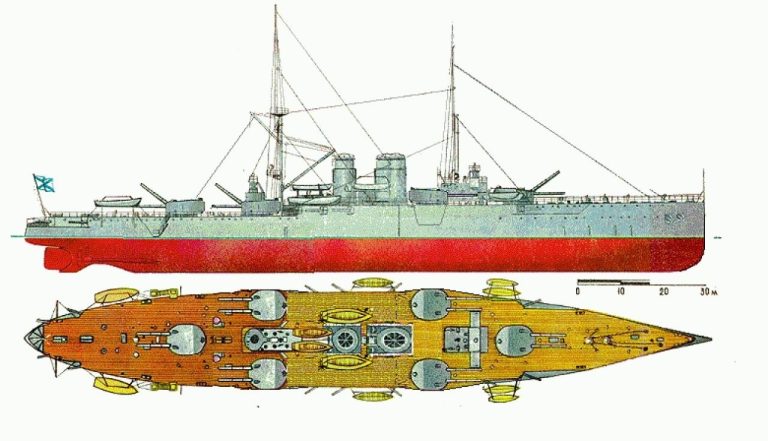
“Bayan”-class armored cruisers
Eight ships were built (1896–1900):
“Bayan”
“Boyarin,”
“Askold,”
“Varyag”
“Novik”
“Bogatyr”
“Ochakov”
“Kagul”
Displacement:
15,600 metric tons
Power plant:
24 “Yarrow” steam boilers, 2 triple-expansion steam engines with a total maximum power of 25,000 liters of force. Speed: 24.5 knots. When the engines are overboosted to 27,826 liters per second for three to four hours, the speed is approximately 25.5 knots.
Dimensions:
Length — 166.2 m,
Width — 22.9 m,
Draft — 7.9 m.
Reservations:
belt — 76–180 mm,
deck — 38 mm,
Casemates — 76 mm,
towers — 178–203 mm,
combat compartment — 127–203 mm.
Armament:
6×2 — 203 mm,
12×1 — 152 mm.
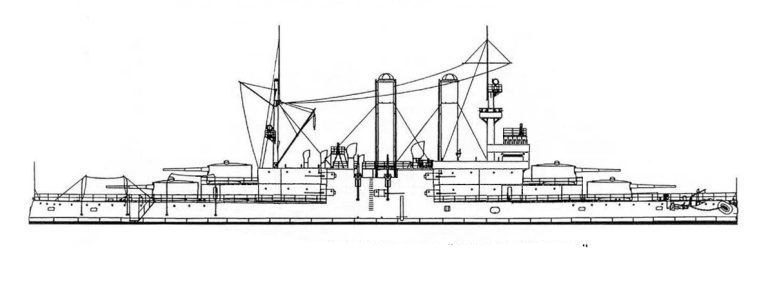
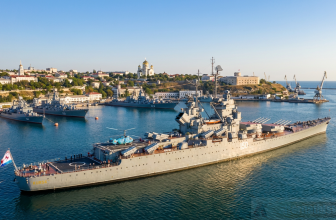
“Admiral Ushakov”-class battleships
Eight ships were built (1892–1897):
“Admiral Ushakov”
“Admiral Nakhimov”
“Admiral Apraksin”
“Admiral Lazarev”
“Yaroslav the Wise”
“The Governor of Bobrok”
“Alexander Nevsky”
“Vladimir Monomakh”
Technical Specifications
Displacement and dimensions:
displacement: 16,000 metric tons;
length — 126.4 m;
width — 17 m;
draft — 7.2 m
Reservations:
armor belt (53 × 2.14 m): 203–254 mm (bow—203 mm, midship—254 mm, stern—203 mm);
bow crossbeam — 203 mm;
rear crossmember — 152 mm;
turret barbettes — 152 mm;
towers — 178 mm;
cutting width — 178 mm;
deck — 25–51 mm (above the belt — 25 mm, at the ends — 51 mm).
Armament:
Main armament: 8 × 254-mm/50 guns;
Medium caliber: 8 × 120-mm/45 guns;
Anti-mine artillery: 6 × 47 mm/43, 18 × 37 mm/23
Power plant:
6 vertical triple-expansion steam engines;
power: 25,000 l. s.;
3rd wave
Speed: 18 knots.
Cruising range: 3,400 nautical miles at a speed of 12 knots.
Crew: 424 people.
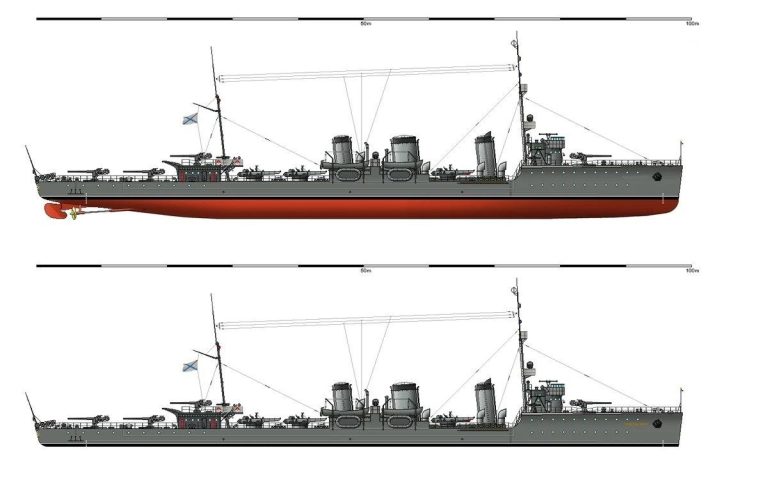
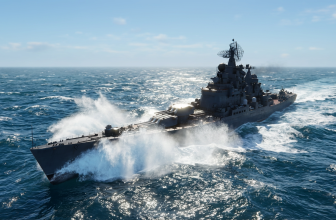
“Besheny” Class Destroyers
48 ships were built (1902–1908)
Displacement: 2,500 metric tons
Length: 102.43 m
Width: 9.53 m
Draft: 3.53 m
Engines: 3 Shukhov steam turbines
Power: 42,000 l. s. (29.44 MW)
Propulsion: 3 propellers
Travel speed:
— Maximum: 37.3 knots
— Full: 36 nodes
— Economic: 21 nodes
Cruising range: 740 miles (at 32 knots), 1,800 miles (at 16 knots)
Crew: 168 people
Armament:
Artillery: 4 × 130/55-mm guns from the Obukhov Plant; “Geisler” gun mount
Anti-aircraft artillery: 4 × 12.7-mm machine guns
Anti-submarine weapons: 28 BB-1 bomb launchers and 20 BM-1 bomb launchers
Mine and torpedo armament: 4 triple 533-mm torpedo tubes; 50 sea anchor mines
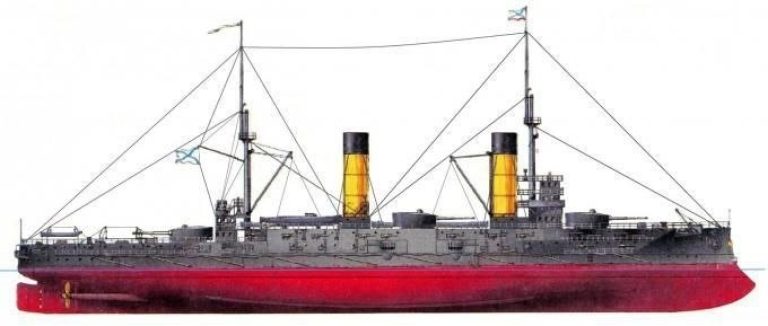
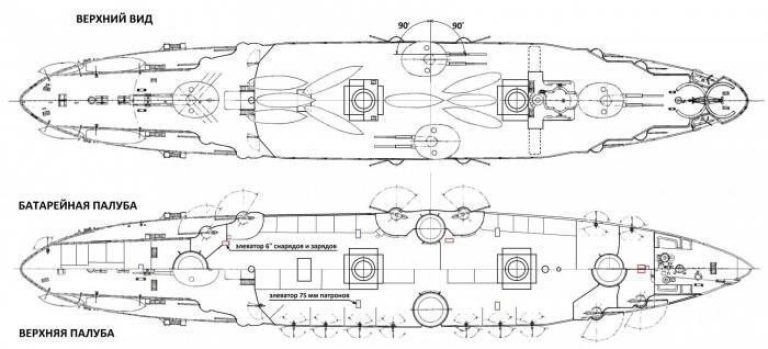
“Peresvet”-class armored cruisers (battlecruisers)
Eight ships were built (1897–1903):
“Peresvet”
“Oslyabya”
“Sergei of Radonezh”
“St. George the Victorious”
“Sisoy the Great”
“Eustace”
“Cesma”
“Synop”
Dimensions:
130 × 22.34 × 7.8 m
Mechanisms:
2 shafts, 2 VTR steam turbines, 20 Belville boilers, 25,000 l. s. = 24 knots
Fuel capacity:
3,000 metric tons of coal
Range:
6,000 miles (at 10 knots)
Armor (Krupp steel):
main belt — 152–343 mm,
lower crossbars — 203–229 mm,
upper belt — 178 mm,
upper crossbars — 127 mm,
battery — 102 mm,
GK turrets — 254 mm,
roofs of the GK towers — 51 mm,
GK barbets — 254 mm,
SK turrets — 127 mm,
SK tower roofs — 25 mm,
SK turret barbettes — 127 mm,
cutting length — 229 mm,
deck — 51–76 mm
Armament:
4×2×254/50 mm,
12×1×152/45 mm,
16×1×75/50 mm
Crew:
680 people
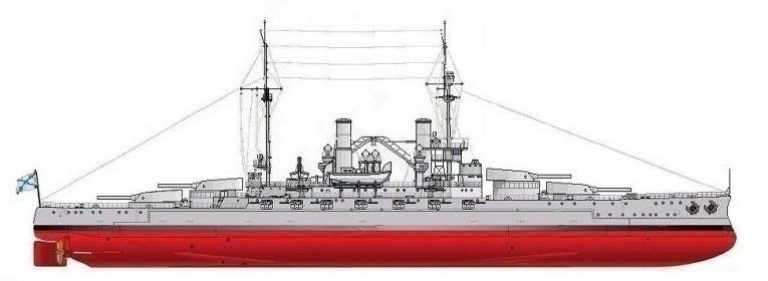
“Borodino”-class battleships
Eight ships were built (1899–1905):
“Borodino”
“Glory”
“Eagle”
“The Kremlin”
“Prince Suvorov”
“Prince Kutuzov”
“Prince Barclay de Tolly”
“Prince Wittgenstein”
Displacement:
standard — 17,950 metric tons;
Total: 19,100 metric tons.
Dimensions:
136 × 23.25 × 7.4 meters.
SU:
PM – 2;
PC — 12
power — 19,500 l. s.;
speed — 19 knots;
coal reserves — 1,700 metric tons;
Cruising range: 4,200 miles.
Armor (Krupp steel):
Housing:
width along the waterline: 51 mm at the ends, 254 mm in the hold area, 229 mm in the engine and boiler room areas;
crossbars — 229 mm;
upper belt — 152 mm.
Towers:
forehead — 254 mm;
side — 203 mm;
roof — 64 mm;
combat compartment — 229 and 51 mm, respectively.
Deck:
51 mm above the cellars;
38 mm above the Cabinet of Ministers;
outside the citadel — 76 mm.
Crossbeams:
top — 152 mm;
lower — 229 mm.
Crew:
810 people.
Armament:
4×2×305/45 guns from the Obukhov Plant, Model 1900 (90 shells per barrel);
20×1×130 mm guns manufactured by the Obukhov Plant.
The image of Borodino was taken from here: https://alternathistory.ru/kreml-imya-naritsatelnoe/
The bayan was taken from here: https://www.alternathistory.ru/bolshe-ryurikov-vtoryh-horoshih-i-raznyh/
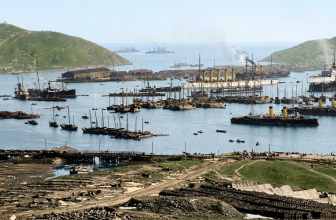
The screenshot was taken from here: https://alternathistory.ru/alternativniy-bronenosets-pobeda-ili-kak-v-1903-godu-oderzhat-pobedu-nad-yaponiey-bez-edinogo-vystrela/
Alesha Popovich is from here: https://alternathistory.ru/konkurs-na-proekt-bronenosnogo-krejsera-dlya-baltijskogo-morya/
Бешенный взят отсюда: https://althistory.fandom.com/ru/wiki/%D0%AD%D1%81%D0%BC%D0%B8%D0%BD%D0%B5%D1%86_%C2%AB%D0%9D%D0%BE%D0%B2%D0%B8%D0%BA%C2%BB_(%D0%9C%D0%B8%D1%80_%D0%B4%D1%80%D1%83%D0%B3%D0%BE%D0%B9_%D0%A0%D0%BE%D1%81%D1%81%D0%B8%D0%B8)
Admiral Ushakov is from here: https://alternathistory.ru/drednout-beregovoj-oborony-admiral-ushakov/
https://stvolar.livejournal.com/246660.html