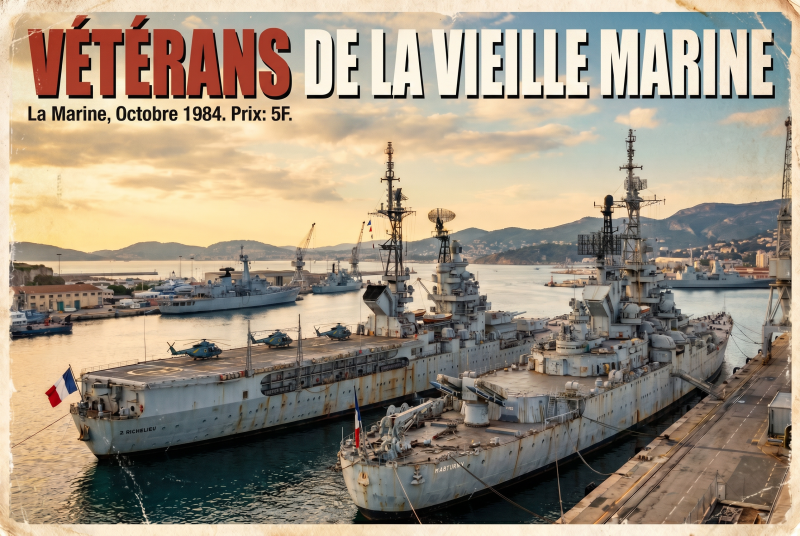
In this alternate history, Operation Catapult—the destruction of French warships at Mers-el-Kébir by the British fleet—did not take place. As a result, Admiral Darlan, commander of French forces in North Africa, was much more favorably disposed toward the British and officially joined the Allies in late 1941.
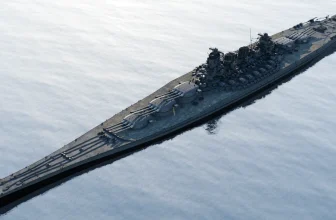
After the end of World War II, battleships still formed the backbone of the French Navy’s combat power. Four relatively modern, high-speed battleships—the small battleships “Dunkirk” and “Strasbourg,” the large battleship “Richelieu,” and the new (unfinished) battleship “Jean Bart”—constituted an impressive and modern force, particularly well-suited to the confined waters of the Mediterranean Sea.
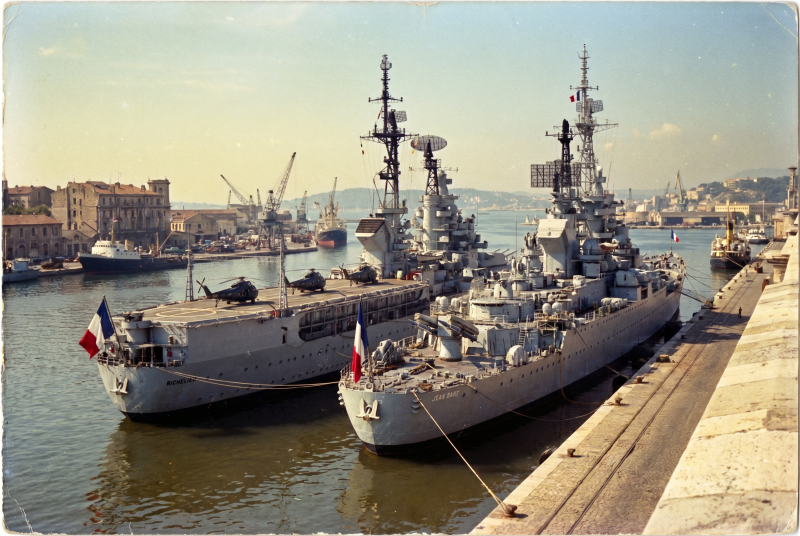
However, from the perspective of the French admirals, this state of affairs was far from ideal. Their main headache was that the Italian Republican Navy (Repubblicana Marina) had six fast battleships at its disposal after the war—the new “Roma,” “Vittorio Veneto,” and “Italia,” as well as the extensively modernized “Conte di Cavour,” “Andrea Doria,” and “Cayo Duilio.” And although Italy’s resources did not allow it to keep more than two battleships in combat-ready condition, this balance of power still irritated the French to no end.
The devastated state of postwar French industry simply made it impossible to even consider building new battleships—even if the funds had been available. Plans to restore and complete the hull of the battleship *Clémenceau* (launched by the Germans in 1941 to free up the slipway) remained on paper due to their obvious impracticality. Plans to acquire the high-speed battleships “Washington” and “North Carolina” from the U.S. Navy ran into a critical shortage of funds and a lack of interest on the part of the Americans; the most the Americans were willing to seriously discuss was the sale to the French of old “Tennessee”-class superdreadnoughts, which were obsolete and slow. Attempts to obtain heavy ships from the Germans and Italians as reparations also failed: the sole surviving German battleship, the *Gneisenau*, went to the USSR by lot, and the Italians were prepared to give the French, at most, the old battleship *Cayo Duilio* (which the French had no interest in).
Therefore, we had to make do with the forces at our disposal. Moreover, there were neither the funds nor the resources to maintain them. The 1946 plans to maintain two divisions of battleships to escort aircraft carriers had to be radically revised: there was neither the money nor the resources to do so.
Two French light battleships—the *Dunkirk* and the *Strasbourg*—underwent only minimal modernization after the war, which consisted mainly of replacing their radar and communications systems. The “Dunkirk” served as a training ship beginning in 1948. The “Strasbourg” remained in active service until 1955 (when the “Jean Bart” entered service), after which it was also converted into a training ship. Although both remained in the fleet reserve until the early 1960s, this was mainly because the French navy did not wish to concede, even formally, to the Italian navy in terms of the number of battleships.
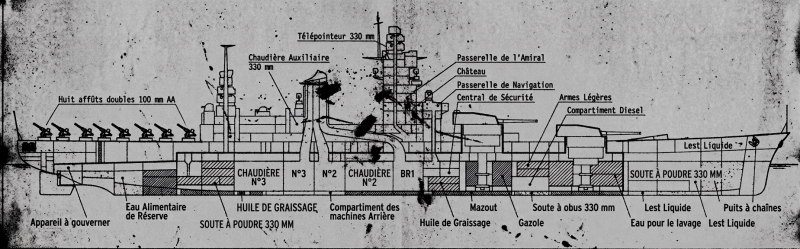
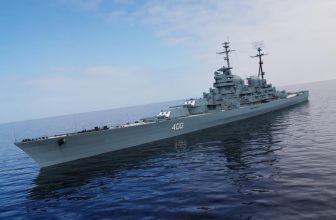
There was a brief resurgence of interest in small battleships in 1955–1956, when the lead heavy cruiser of Project 82, the *Stalingrad*, joined the Soviet Navy. The high speed and powerful armament of the new Soviet heavy cruiser prompted the French Navy to seriously consider a countermeasure—and to that end, it was proposed to carry out a major modernization of the *Dunkirk* and the *Strasbourg*.
The modernization plan was based on increasing speed so that the upgraded ships could confidently counter the Soviet “Stalingrad”-class battleships. The hulls of the small battleships were to be lengthened by 20 meters by modifying the bow, and the propulsion system would be supplemented by installing a pair of SIGMA GS-34 free-piston gasification engines on each shaft (in addition to the Rato steam turbines):
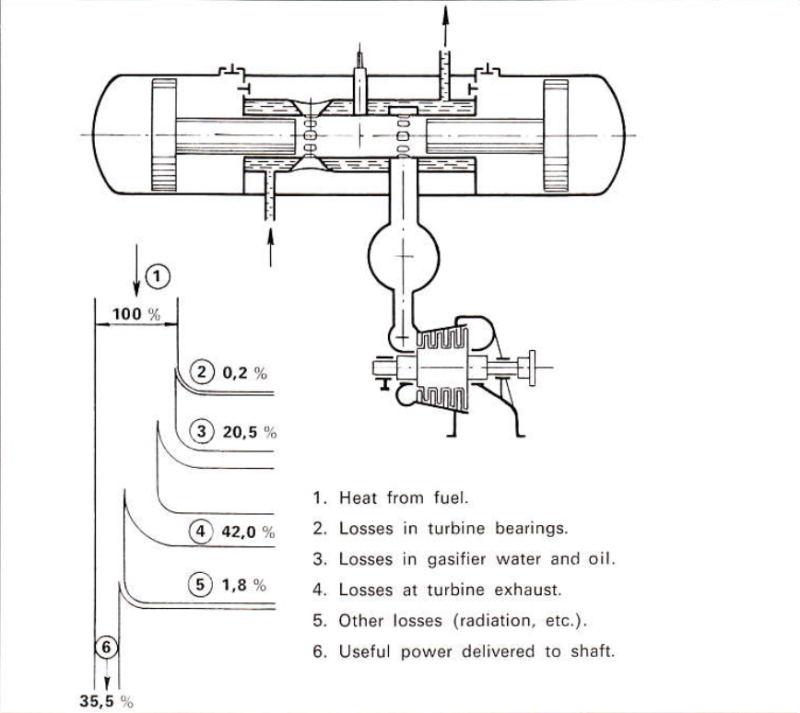
The total power increase from the four pairs of gas engines was expected to be approximately 64,000 l.s.—which, combined with the steam turbines, could have enabled the light battleships to reach a speed of over 33 knots. Both battleships were also to receive a new anti-aircraft battery consisting of six twin 100-mm/55 multi-purpose guns of the 1945 model and twelve twin 57-mm automatic cannons “Bofors” model 1951. However, the cost of modernizing the “Dunkirk” and “Strasbourg” was deemed completely prohibitive for the budget, and the project ultimately remained only on paper.
All attention once again focused on two large new battleships. The “Richelieu” and the “Jean Bart,” two enormous, high-speed ships armed with 380-mm guns, constituted a significant portion of the French Navy’s firepower even in the era of aircraft carriers and jet aircraft. Their importance in combat operations in enclosed bodies of water—such as the Mediterranean Sea—was never in doubt. However, with the advent of the missile era, the role of their heavy artillery diminished significantly, and the French government began to increasingly discuss whether to “replace the battleships with cheaper missile-carrying ships.”
The French admirals were not satisfied with this approach. And they already had a solution ready. In the second half of the 1950s, the French Navy was actively developing the MARUCA (French: Marine Ruelle Contre Avion — Naval Anti-Aircraft Guided Missile) and MASURCA (French: MArine SURface Contre-Avions — Naval Surface Anti-Aircraft Missile); and while work on the former was discontinued in 1959 due to obsolescence and technical limitations, the MASURCA project appeared to have much greater potential.
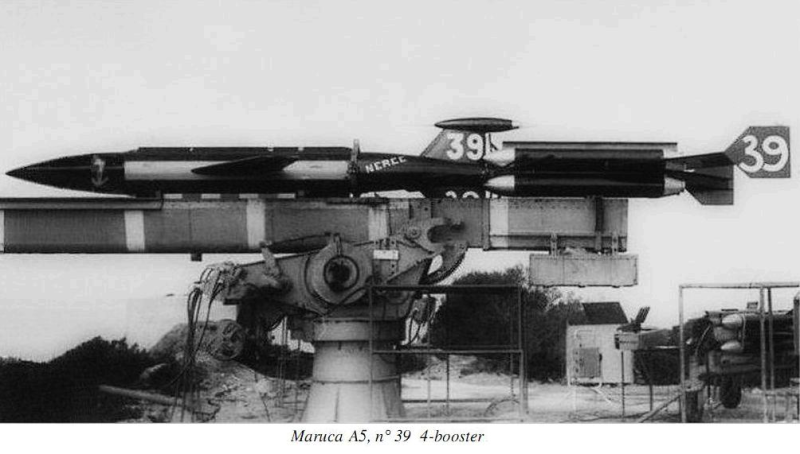
At the same time, it was already clear that the new anti-aircraft systems would be large and heavy—making them ideally suited for installation on large ships. And the French battleships, with all their main-caliber turrets concentrated in the bow, were ideally suited for “missile conversion.” Preliminary estimates showed that to equip the “Richelieu”-class battleships with anti-aircraft missiles, it would be sufficient to remove their 152-mm anti-submarine artillery turrets, thereby freeing up space in the stern.
In the early 1960s, the French Naval Command outlined a detailed plan for the modernization of the battleship fleet. According to this plan, the *Jean Bart* was to be the first ship to undergo “missile conversion” in 1962; The modernization was estimated to take four years, with the ship returning to service in 1966. In 1966, work was scheduled to begin on modernizing the “Richelieu,” a process that was expected to last until 1970. After modernization, the battleships, equipped with missile armament, were to form the French Navy’s combat line at least until the late 1980s.
There is life
The battleship “Jean Bar” was the first to undergo modernization. As a newer vessel (which was not fully commissioned until 1955), it was believed to have great potential and could remain in service longer.
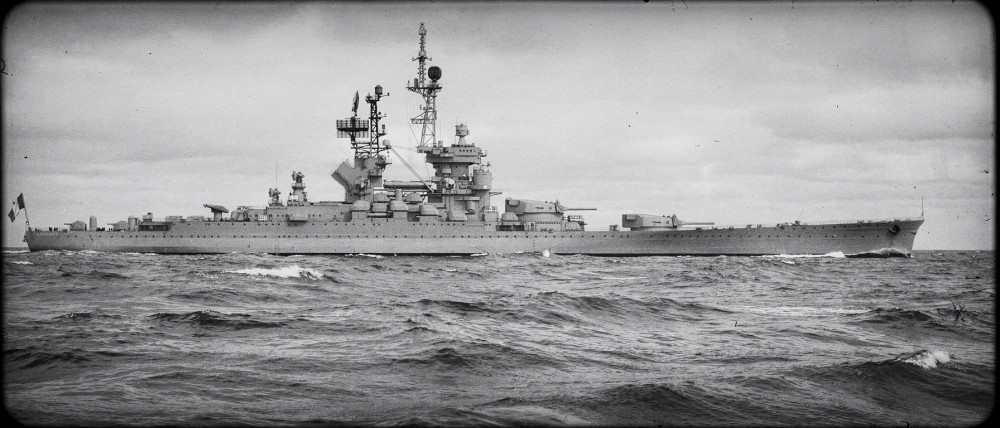
The initial modernization plan called for the installation of two anti-aircraft missile systems in a linear, elevated configuration at the stern of the battleship. However, as the tactical and technical specifications of the future MASURCA were refined, it became clear that the final system would be significantly heavier than anticipated. It proved simply impossible to fit two MASURCA systems—each weighing more than 400 metric tons!—into the weight allowance freed up by dismantling the anti-submarine gun turrets (a total of about 650 metric tons). Since the admirals would not agree to remove one of the main-caliber turrets, the modernization project for the “Jean Barre” had to be revised, leaving only one anti-aircraft missile system—albeit with a double supply of missiles.
Ultimately, the modernization of the battleship “Jean Bar” proceeded as follows: All three anti-mine-caliber turrets (152-mm/50 Model 36) and the associated ACAE fire control system were removed from the ship. Each dismantled turret weighed 224 metric tons, and their removal collectively freed up approximately 652 metric tons of upper deck weight. Some of the 100-mm multi-purpose and 57-mm anti-aircraft guns were also removed—mainly because their mounts were too close to the planned location of the missile system and could have caused problems.
To replace the dismantled artillery, a MASURCA Mk 2 Mod 2 medium-range anti-aircraft missile system was installed at the ship’s stern. Developed with American technical assistance, the system bore a striking resemblance to the American RIM-2 “Terrier” (albeit a decade late); the two-stage solid-fuel missiles were guided to the target using the “saddle beam” method; later models were equipped with semi-active radar homing.
The MASURCA anti-aircraft missile system consisted of a twin-tube launcher, an ammunition magazine (with a pre-launch preparation bay) equipped with storage drums, a command post featuring a programmable IBM-France electronic computer and two control consoles, and two DRBC-51B missile guidance radars.
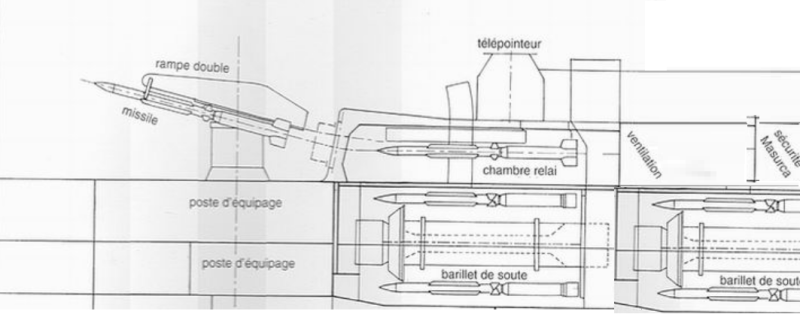
The MASURCA ammunition load on the *Jean Barre* was stored in four rotating drums, each with compartments for 18 missiles. The drums were arranged in sequence, in two pairs; the pair closest to the launcher was considered the “ready-to-fire ammunition,” and the pair following it was considered the “storage ammunition.” A special rail system transferred the missiles from the storage drums to the ready-to-fire drums (or vice versa, if necessary). Before being fed to the launcher, the missiles from the ready-to-fire drums were lifted into the pre-launch preparation room located above them—where control surfaces and stabilizers were manually installed on them.
To ensure the operation of the zone defense air defense system, the battleship’s electronic equipment underwent a major modernization. On the aft superstructure (where the auxiliary-caliber rangefinder had been located), a DRBV-20C two-coordinate radar was installed above the ship’s funnel; it was used to detect targets at long range. A DRBV-23B three-coordinate radar for the search and tracking of air targets was installed on the ship’s foremast (data from which was used to guide the DRBC-51B target-designation radar toward selected targets), and a DRBV-10 altimeter radar (operating in conjunction with the long-range detection radar).
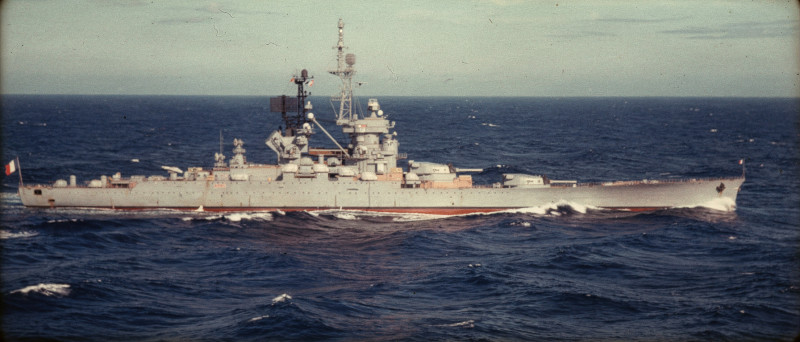
In addition to its anti-aircraft missile armament, the “Jean Bar” was also equipped with strike capabilities. On both sides of the anti-aircraft missile system in the stern, two narrow hangar-galleries were installed to house R-25 tactical cruise missiles (a nuclear-tipped version of the R-20 unmanned reconnaissance aircraft). They were launched from inclined launch rails. For guidance, DRBC-51B radars were used, which tracked the launched missiles via transponders; a special computer connected to the radars kept the missiles on a preset azimuth and, upon reaching the required distance, issued a command to dive. Up to eight R-25 missiles could be stored on board the battleship at any one time, but in practice, this subsonic cruise missile was already considered obsolete and was deployed only for short periods.
RICHELIEU
It was originally planned that the *Richelieu* would undergo the same full-scale modernization as the *Jean Barre*, and that both ships would finally become identical sister ships with the same configuration. However, the modernization of the “Jean Barre” took much longer—and cost significantly more!—than originally planned. As early as 1966, it became clear that the Navy’s budget would not provide for a modernization of similar scale for the older “Richelieu.”
Nevertheless, the French admirals were reluctant to part with their second battleship. In addition to purely practical considerations, national pride also played a role: the Italian navy, France’s traditional rival allié (French: “allied rival”), had just completed (with American assistance) a major modernization of the battleships *Vittorio Veneto* and *Italia* and was working on a new-generation missile battleship. French pride would not allow them to fall behind the Italians in the informal competition for the title of “the strongest fleet in the Mediterranean.”
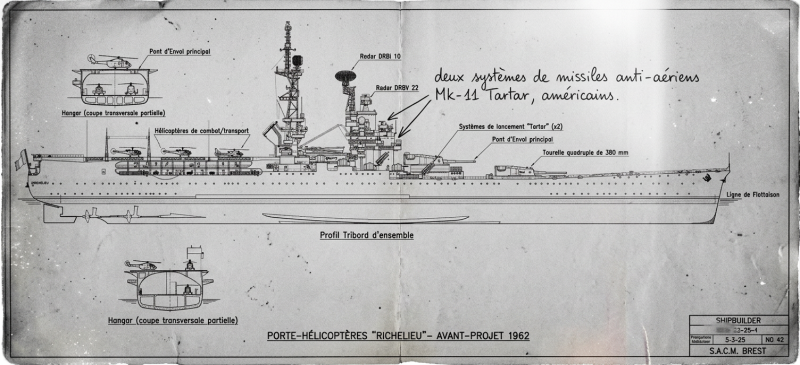
And so, a plan was developed for the “Richelieu” to undergo a less expensive modernization — a conversion into a battleship-class helicopter carrier capable of serving both as an amphibious assault ship with heavy artillery for fire support and as a large ocean-going escort helicopter carrier.
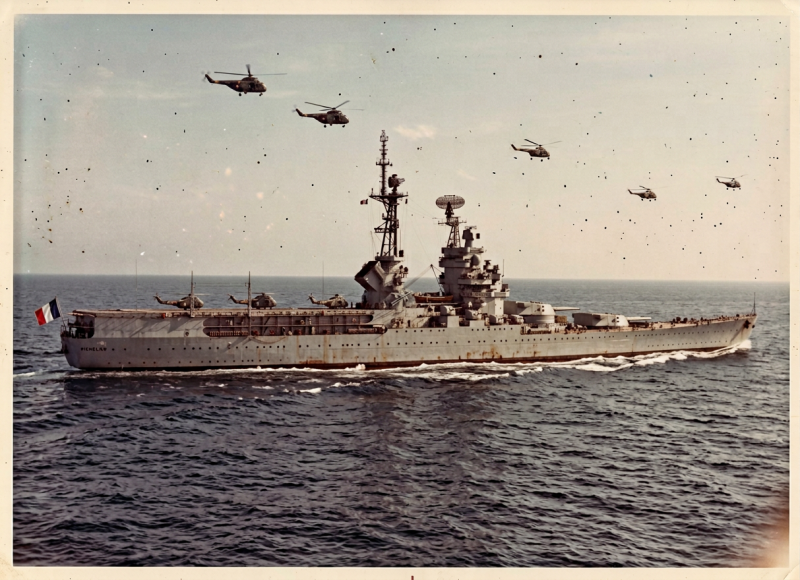
The battleship’s hull behind the funnel was stripped down to the main deck, and a new, massive superstructure, crowned by a wide flight deck, was erected above it. Two elevators—one at the forward end and one at the aft end of the flight deck—connected it to the hangar below. The hangar extended the full length of the aft superstructure; on either side of it were living quarters intended to house a Marine Corps contingent. If the battleship were used as an ocean-going anti-submarine helicopter carrier, these compartments could be quickly converted into auxiliary workshops. The battleship’s former 152-mm shell magazines were converted to store aviation fuel and helicopter ammunition.
The battleship’s main armament remained unchanged, with only the main-caliber gun directors being replaced with more modern ones (similar to those on the *Jean Barre*). To save on personnel and resources, only one main turret was manned (the second was mothballed), and even then, only one of its two gun crews. It was believed that, in peacetime, two 380-mm guns would be quite sufficient for fire support purposes.
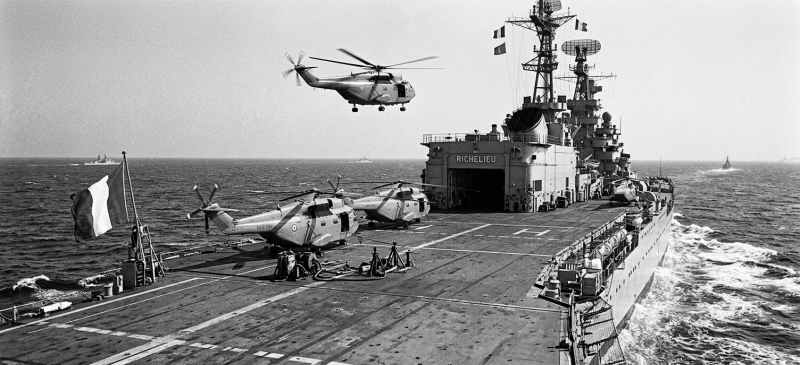
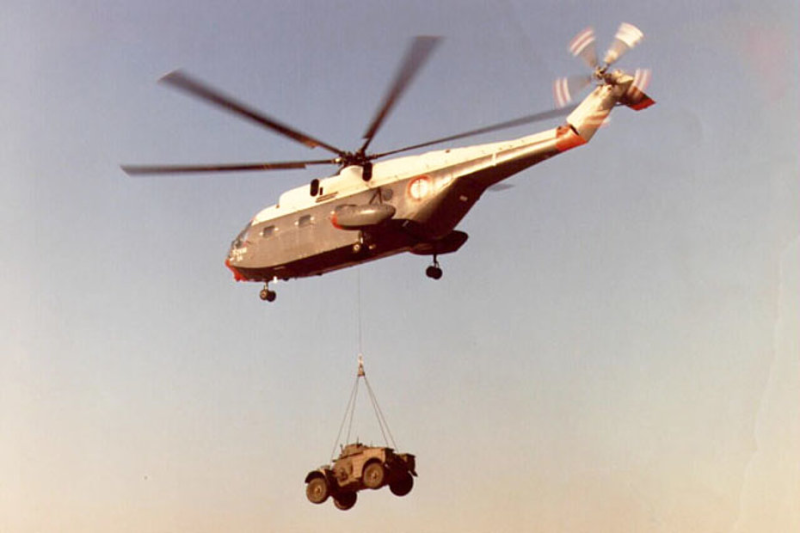
The ship could carry up to 10 SA 321G “Super Frelon” heavy transport helicopters (including the lighter SA 321GB version, specially modified for the air transport of “Panhard” AML-90), which allowed the “Richelieu” to land up to 300 marines in a single wave and then airlift artillery and light armored vehicles. The ship’s standard complement, however, consisted of six SA 321G helicopters (including two SA321GBs) and eight SA 316 “Aérospatiale Alouette III” light attack helicopters. In its anti-submarine configuration, the ship carried up to 12 anti-submarine helicopters.
Initially, it was planned that the *Richelieu* would be equipped with an all-artillery anti-aircraft armament consisting of 100-mm and 57-mm automatic guns. But by the early 1960s, the effectiveness of purely artillery-based air defense for a large warship was already being seriously questioned. As a result, the French Navy ultimately decided to equip the “Richelieu” with anti-aircraft missiles—but American ones.
As part of a technical assistance program, two sets of the RIM-24 “Tartar” short-range air defense missile system (GMLS Mk-11 version) were procured from the United States. They were installed on either side of the battleship’s funnel, with the AN/SPG-51 target-acquisition radar mounted on “balconies” on the stern superstructure (in place of the former heavy anti-aircraft gun directors). The 100-mm artillery was completely phased out, and the number of 57-mm anti-aircraft mounts was reduced to eight.
SERVICE
After a protracted modernization, the *Jean Bart* returned to the French Navy in 1968. The trials, however, took even longer, and the battleship was not actually declared operational until 1969. By that time, the work on the *Richelieu*—which was significantly more modest in scale—had also been practically completed; the ship returned to active service in 1971.
The refurbished French battleships spent most of their service in the Mediterranean Sea. In the 1970s and 1980s, the region was plagued by virtually continuous crises, and the presence of these powerful, imposing-looking ships was a key factor in ensuring French influence. During the Lebanese Civil War, both battleships had the opportunity to use their weapons once again: The “Jean Bart” shelled and destroyed several militant positions along the coast in support of Lebanese Army forces, while the “Richelieu” used its 380-mm guns to support a tactical landing by French naval helicopter crews.
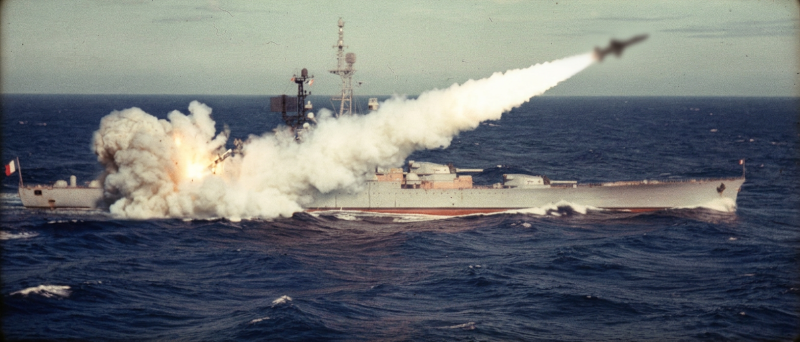
In the second half of the 1970s, the “Jean Bar” underwent maintenance and modernization, during which its MASURCA system was upgraded to the Mark 2 Mod 3 version (with semi-active radar homing). Four 57-mm gun mounts were also removed from the ship and replaced with four R440 “Crotale” self-defense air defense systems. The battleship’s electronic warfare systems were upgraded with new radar and electronic countermeasure systems, as well as decoy launchers. The obsolete hangars for nuclear cruise missiles were dismantled, and in their place, eight containerized launchers for “Exocet” anti-ship missiles were installed at the stern. The older “Richelieu” did not undergo a large-scale modernization, limiting itself to the installation of two R440 “Crotale” self-defense air defense systems in the early 1980s.
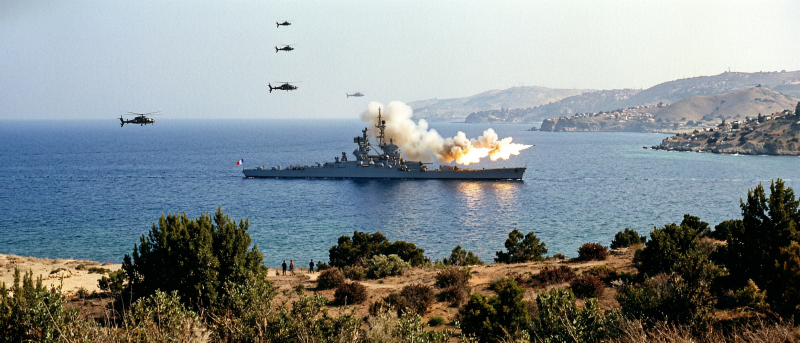
The 1991 operation in the Persian Gulf marked the heyday of the old battleships. Both ships played an active role in it as part of the French contingent. The aging “Richelieu,” though heavily worn and in poor technical condition, transported and rapidly deployed two battalions of the French Airmobile Marine Corps—and provided fire support for operations on shore, for which, for the first time since 1966, both of its gun turrets were brought back into service and made operational. The “Jean Bar” served as a forward radar outpost, protecting the French aircraft carrier strike group from Iraqi air attacks; its MASURCA system finally scored its first combat success, shooting down two Iraqi cruise missiles launched from bombers at coalition ships.
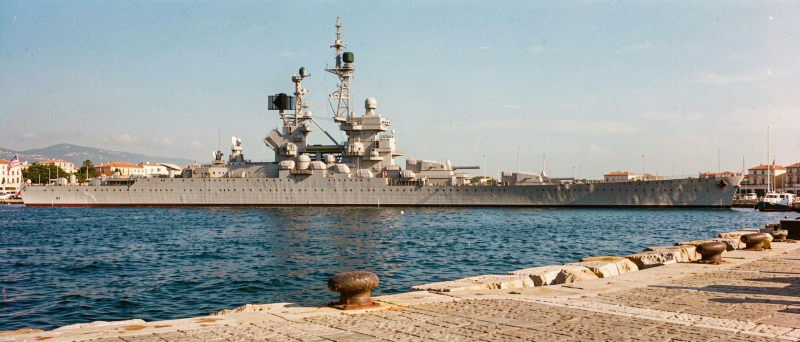
Shortly after that campaign, in 1992, the old *Richelieu* was placed in reserve and decommissioned almost immediately. The “Jean Bar” remained in service until 2001, after which it was also placed in reserve, and in 2011 it was converted into a museum ship in Toulon.