Once upon a time, this entire series of articles under the general title “Super-Battleship or Impractical Madness” began with fantasies about the Japanese Yamato. Since then, we have explored German, British, American, and even Russian designs for ships beside which ordinary World War II battleships would have looked almost like cruisers. And now, thanks to our colleague Fox_Matroska, we have finally come full circle. We are returning to where it all began — Japan, and an attempt to imagine what Yamato might have looked like if Japanese designers had been allowed to completely forget about common sense, shipyard limitations, and the cost of the program.
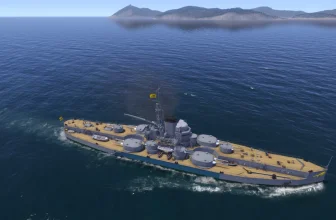
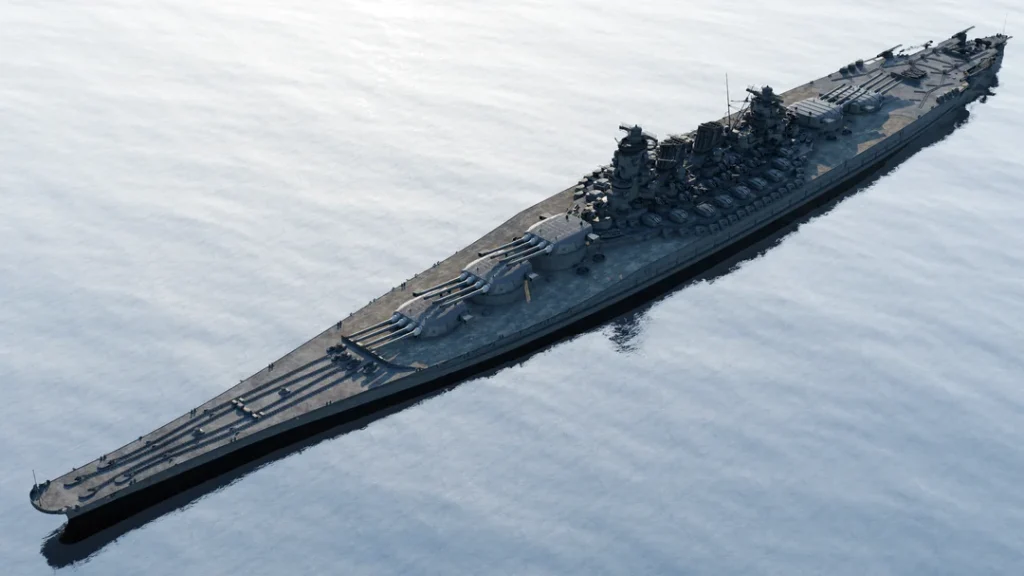
What we have before us is a fictional Japanese super-battleship of the 1940s with a displacement of up to 500,000 tons. Not 100,000, not even 150,000 — half a million tons. It is 500 meters long and armed with 533 mm main guns. Against such a monster, the real Yamato, once regarded as the ultimate expression of battleship gigantomania, begins to look almost like an escort vessel.
And the most interesting thing is that today, constructing a floating object of such dimensions is no longer pure fantasy. The real question is something else entirely: could half a million tons of steel be turned not merely into a floating platform, but into a fully operational high-speed warship?
A Yamato That Outgrew the Yamato
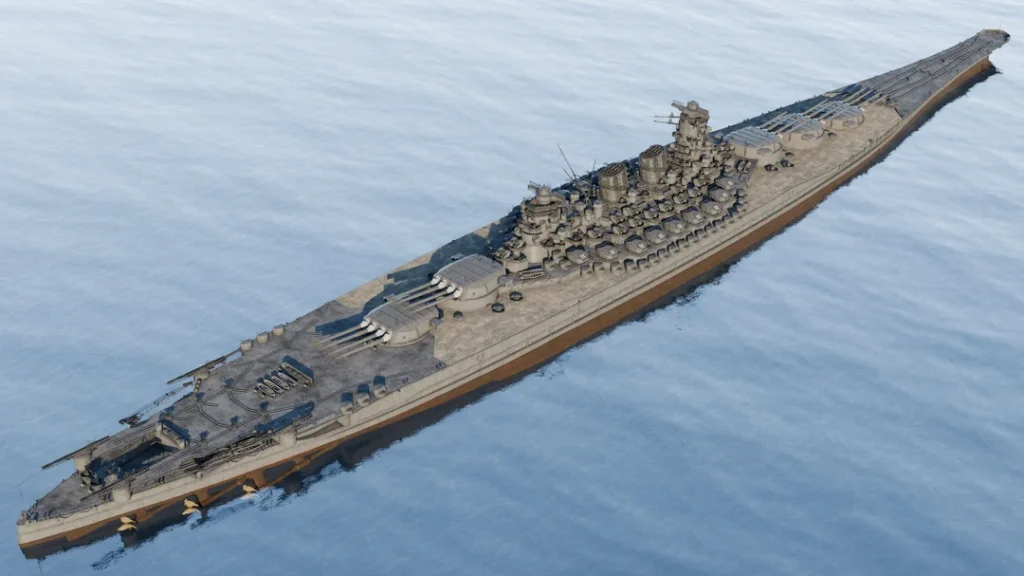
The author of the project makes no attempt to hide the monster’s origins. The bow and central sections of the hull clearly develop the architecture of Yamato, although the stern has smoother and more tapered lines. The overall length is approximately 500 meters, the beam 61 meters, and the draft up to 14 meters.
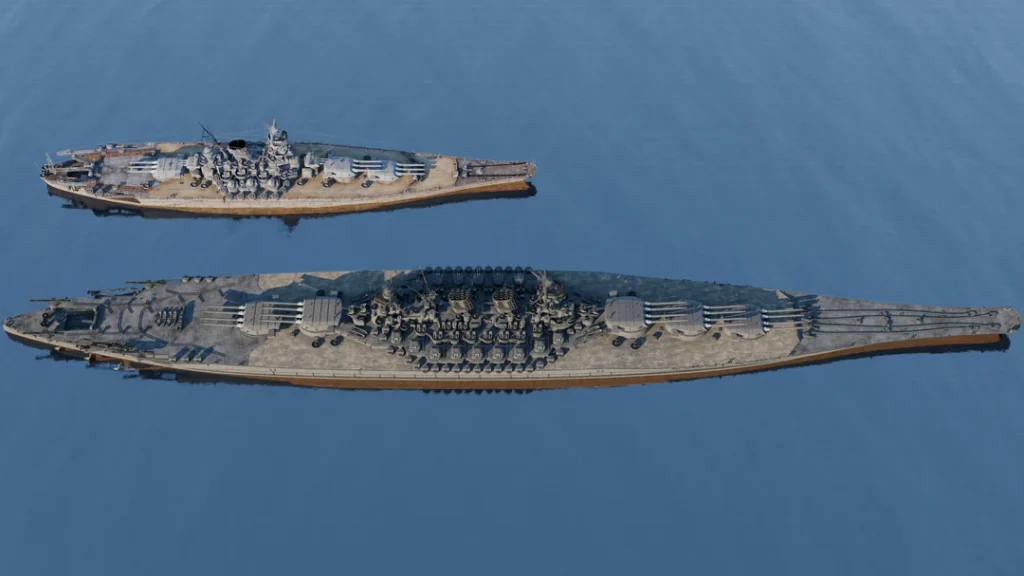
For comparison, the real Yamato was approximately 263 meters long. In other words, this fictional ship is almost twice as long as Japan’s largest battleship of World War II. Its displacement, meanwhile, belongs to an entirely different category.
Its protection is even more impressive.
The main external armor belt is 483 mm thick. Behind it lies a void several meters deep, followed by another internal armor belt 203 mm thick. Only beyond that do we reach the numerous internal compartments protecting the machinery spaces.
Horizontal protection is equally astonishing. The upper armored deck is 310 mm thick, followed by another void, then a lower armored deck 152 mm thick, with additional compartments beneath it. The sides are also protected by an extensive anti-torpedo system incorporating bulges.
In other words, the designer attempted to take the Yamato principle and effectively square it: not simply extremely thick armor, but an enormous depth of protection throughout the ship.
Three Million Horsepower
Perhaps the most astonishing aspect is that this floating island is supposed to achieve a perfectly respectable battleship speed.
Maximum speed is given as 28 knots, requiring a propulsion system developing between 2.5 and 3 million horsepower, driving six propeller shafts.
The scale of such a power plant is difficult to imagine. We are talking about output an order of magnitude greater than the propulsion systems of most World War II battleships. The boiler and engine rooms alone would constitute an enormous industrial complex.
Three centrally mounted rudders are provided for steering — one for every two shafts. In theory, this arrangement was intended to give the ship acceptable maneuverability for something of its size.
But the word “acceptable” needs to be understood correctly.
A 500-meter hull displacing half a million tons would hardly be performing anti-torpedo zigzags. Its turning circle would probably be measured in kilometers, while its response to rudder movements would be completely different from that of an ordinary battleship. Even the project’s creator warns that nobody should expect this giant to dodge torpedoes or make tight turns.
Twenty 533 mm Guns
But why build a half-million-ton battleship in the first place?
For the artillery, of course.
The main battery consists of twenty 53.3 cm/50 guns. That figure alone puts the ship into an entirely different realm. The real Yamato carried nine 460 mm guns, and even those were the largest naval guns ever fitted to an operational battleship.
Here we have twenty guns with a caliber of more than half a meter.
One can only imagine the weight of the turrets, barbettes, magazines, ammunition-handling equipment, and shells themselves. If Yamato’s 460 mm armor-piercing shell weighed roughly one and a half tons, a 533 mm weapon would have required ammunition on an entirely different scale.
The broadside of such a vessel would have been spectacular. Even near misses from shells of this size could pose a serious threat to an ordinary warship.
The secondary and anti-aircraft batteries are equally appropriate for a ship of this scale. The design features 36 140 mm guns, based on the Japanese 14 cm 3rd Year Type gun, 52 76 mm guns derived from the Type 98, 104 Type 5 40 mm automatic guns, and another 72 Type 96 25 mm guns.
Main Estimated Specifications:
- Displacement: up to 500,000 tons
- Length: 500 m
- Beam: 61 m
- Draft: up to 14 m
- Maximum speed: 28 knots
- Propulsion output: 2.5–3 million hp
- Propeller shafts: 6
- Rudders: 3
- Main battery: 20 × 533 mm/50 guns
- Secondary battery: 36 × 140 mm/50 guns
- Dual-purpose/AA artillery: 52 × 76 mm/65 guns
- Light AA artillery: 104 × 40 mm Type 5 and 72 × 25 mm Type 96 guns
- Aircraft: up to 32 floatplanes
- Catapults: 4
- Aircraft cranes: 2
- Side armor: 483 mm external belt + 203 mm internal belt
- Deck armor: 310 mm upper armored deck + 152 mm lower armored deck
Almost an Aircraft Carrier’s Air Group
The aviation component is interesting as well.
Up to 32 floatplanes were to be carried in a below-deck hangar. Four catapults were provided for launching them, while two cranes would recover the aircraft from the water.
In effect, the battleship would possess a substantial reconnaissance air group of its own. These aircraft could search vast areas of ocean, spot and correct artillery fire, and conduct reconnaissance ahead of the task force.
For fire control, the designer equipped the ship with numerous directors resembling those carried by the real Yamato, while its electronic equipment includes Japanese Type 13 and Type 21 radars.
The result is no longer simply a battleship, but something resembling a self-contained ocean-going fortress.
Why Were Ships Like This Never Built?
And this is where fantasy collides with reality.
The first and most obvious obstacle is the shipyard.
In the 1930s and 1940s, there was practically nowhere capable of building a 500-meter warship. Before construction could even begin, an enormous dry dock would have to be built, along with suitable cranes. Harbors and channels would have to be deepened and port infrastructure extensively rebuilt simply to allow the completed vessel to reach the sea.
And the shipyard would only be the beginning.
Industry would have to manufacture armor plates of extraordinary dimensions, enormous structural components, shafts, propellers, steering machinery, boilers, and turbines producing a combined output of up to three million horsepower. Manufacturing twenty 533 mm guns, along with their turrets and ammunition, would constitute a major industrial program in its own right.
Finally, there is the fundamental question of hull strength.
A 500-meter warship would have to withstand colossal bending stresses while operating in ocean waves. A tanker or floating industrial plant distributes much of its mass differently. A battleship, by contrast, concentrates enormous weights of armor, turrets, barbettes, magazines, and machinery in particular areas of the hull.
In other words, creating a floating object weighing 500,000–600,000 tons is possible. Turning it into a 28-knot armored artillery ship is an entirely different engineering challenge.
But Half a Million Tons Can Float Today
There is, however, a fascinating detail behind this fantasy.
Modern industry has demonstrated that a displacement of around half a million tons is no longer an insurmountable technical barrier in itself.
Perhaps the best example is Prelude FLNG, the enormous floating liquefied natural gas facility. It is 488 meters long, 74 meters wide, and has a fully loaded displacement of roughly 600,000 tons. Moreover, Prelude does not have a conventional self-propulsion system and is primarily intended to remain stationed at one gas field for long-term operations.
In length, it is almost identical to our fictional super-battleship.
This comparison is extremely important. It demonstrates that size itself is not impossible. Modern metallurgy, shipbuilding, and infrastructure make it possible to construct floating structures on such a scale.
But that certainly does not mean that a “Prelude with guns” could simply have been built in 1940.
A warship must travel at high speed, maneuver, survive artillery and torpedo hits, carry enormous quantities of armor, operate a propulsion plant of tremendous power, and maintain sufficient longitudinal hull strength.
That is where the real fantasy begins.
Could It Even Be Sunk?
This is perhaps the most interesting question of all.
The real Yamato survived an extraordinarily intense air attack on April 7, 1945. Estimates of the exact number of hits vary somewhat. Historical accounts generally credit the ship with absorbing around ten torpedoes as well as several bombs before progressive flooding caused it to capsize, followed by a catastrophic magazine explosion.
It is tempting to apply simple arithmetic: if a roughly 70,000-ton Yamato required around ten torpedoes, perhaps a 500,000-ton ship would require something approaching a hundred.
But naval damage does not work that way.
Ships do not sink after reaching some fixed quota of “torpedoes per thousand tons of displacement.” Everything depends on where the weapons hit, the size and location of the resulting holes, damage to bulkheads, the effectiveness of counter-flooding, electrical power, pumping capacity, and the development of list and trim.
A handful of exceptionally well-placed torpedo hits can be more dangerous than ten hits spread along an enormous hull.
But the opposite is also true. A gigantic hull would provide room for an extraordinarily deep torpedo-defense system, several longitudinal bulkheads, and hundreds of isolated compartments. The designer has indeed provided huge bulges, external and internal armor belts, and tremendous structural depth.
Destroying such a monster with torpedoes would therefore be extraordinarily difficult.
But Its AA Defenses Would Not Make It Invulnerable
Here we encounter another paradox.
At first glance, hundreds of anti-aircraft guns should create an impenetrable umbrella around the ship. Yet the experience of the real Yamato suggests caution. During its final battle, the Japanese battleship opened fire with every available weapon, but American aircraft were nevertheless able to penetrate its defenses, while fighters attacked and suppressed exposed anti-aircraft positions.
And a 500-meter battleship would suffer from another problem — its enormous target area.
Hitting such a vessel with bombs or torpedoes would be considerably easier than attacking an ordinary battleship. More importantly, the attackers would not necessarily have to sink it immediately. It would be enough to knock out the radars and fire-control directors, damage the steering gear and propellers, wreck the superstructure, and disable parts of the propulsion plant.
This creates an interesting paradox: actually sinking the ship might be extraordinarily difficult, but achieving a mission kill — depriving it of the ability to perform its combat mission effectively — could be much easier.
The half-million-ton ocean fortress might then become a half-million-ton stationary target.
How Much Would This Monster Cost?
Now we reach the painful part — money.
Once again, a simple linear comparison with Yamato is practically meaningless.
The hull itself would represent only part of the total cost. Entire new industrial facilities might have to be created specifically for this super-battleship. The 533 mm artillery would require its own development program. The turrets would require another. The armor another. The propulsion system yet another.
The main battery alone consists of twenty gigantic guns. It is reasonable to imagine that the development and production cost of each weapon, together with its share of turret equipment, barbette, ammunition-handling machinery, and magazines, might have approached the cost of a small warship.
And there would be twenty of them.
It is therefore quite possible that the entire program would have cost not merely the equivalent of several Yamatos, but a substantial portion of Japan’s entire naval construction program.
And this is where the alternative-history scenario becomes particularly interesting.
Imagine that the Japanese leadership actually makes the decision:
“We are building one unsinkable ship.”
Japan gets something resembling a naval Death Star — but to build it, the country has to sacrifice aircraft carriers, cruisers, battleships, a substantial number of submarines, and perhaps even destroyers.
The Pacific War very quickly demonstrated just how dangerous it was to trade a large, balanced fleet for a handful of extraordinarily expensive capital ships.
Destroyers as Lifeboats?
Still, the sheer dimensions of the ship open the door to some wonderfully absurd ideas.
Its decks and internal spaces could theoretically accommodate much more than 32 floatplanes. With sufficient imagination, one could envisage special docking facilities for small vessels, motor boats, or midget submarines.
Using a full-size destroyer as a “lifeboat” would obviously be rather more difficult. The problem would not simply be finding enough internal space, but dealing with the destroyer’s weight, launching and recovery equipment, and the structural reinforcement necessary to carry it.
Nevertheless, the fact that such a question does not sound completely absurd when discussing a 500-meter battleship tells us a great deal about the sheer scale of this design.
What If Japan Had Actually Built It?
Let us assume the impossible.
Japan begins the program in the first half of the 1930s. A special dry dock is constructed. Metallurgical plants are expanded or created specifically for the project. The 533 mm guns, gigantic turbines, and enormous armor plates are developed. A huge proportion of the Empire’s resources is poured into a single ship.
And sometime around 1942–1943, the battleship finally puts to sea.
What happens next?
In an artillery engagement, it would have had practically no equal. A hit from a 533 mm shell would have been catastrophic for almost any existing battleship. Its own protection might allow it to survive hits that would prove fatal to ordinary warships. In a traditional battle between opposing battle lines, such a giant might genuinely have appeared almost unbeatable.
The problem is that by the time it entered service, the era of such battles was already ending.
Its main enemies would not be American Iowa-class battleships, but carrier task forces, submarines, and eventually land-based aircraft.
And the Americans would have no need to sink the monster in a single day.
Damage the propellers. Disable the rudders. Destroy the radar. Eliminate the floatplanes. Wreck the superstructure. Flood several machinery compartments.
Then attack again.
And again.
Japan would only be able to repair its 500,000-ton battleship in the unique dock specifically built to accommodate it.
The Super-Battleship’s Greatest Weakness
The main problem with the project, therefore, is not whether such a structure could be made to float.
It could.
Modern vessels and offshore installations such as Prelude FLNG clearly demonstrate that a floating structure approximately half a kilometer long and displacing around 600,000 tons is entirely feasible.
The real question is:
Why turn it into a battleship?
The cost of such a vessel could be comparable to that of an entire fleet, while its loss — or even serious damage — would become a national catastrophe.
For the resources required to build one such giant, Japan could instead construct numerous aircraft carriers, cruisers, destroyers, submarines, and hundreds or even thousands of aircraft.
And that is precisely why Fox_Matroska’s project fits the title of this series so perfectly.
It is simultaneously a super-battleship and impractical madness.
From a purely technical standpoint, the concept of a half-million-ton floating structure no longer seems impossible. From a military and economic perspective, turning such a structure into a 28-knot battleship armed with twenty 533 mm guns borders on the absurd.
“Yamato II”?
Curiously enough, Fox_Matroska never gave his creation an actual name.
So, for convenience, we could call it “Yamato II,” “Super Yamato,” or simply Alternative-History Yamato.
The last name is perhaps the most appropriate.
Because this is not a development of the real A-150 project, nor is it some forgotten design discovered in Japanese archives. It is pure alternative history — an attempt to answer an old and fascinating question:
What happens if battleship designers are freed from virtually every limitation?
Here is the answer.
Half a kilometer of steel. Half a million tons of displacement. Three million horsepower. Twenty 533 mm guns.
And a ship beside which the real Yamato suddenly looks almost modest.
A Small Note About the Graphics
Finally, it is impossible not to notice an amusing feature of the images presented by the designer.
From certain angles, the propellers appear almost as though they are located above the waterline. Obviously, this would be impossible on a real ship.
Most likely, this is not an intentional design decision but an artifact of the visualization process. This kind of problem can occur when AI-generated images are based on a complete side-profile drawing of a ship: the model sees the propellers on the original diagram but fails to understand that they belong below the waterline, and consequently reproduces them as visible external components.
One simple way of avoiding this effect is to provide the image generator only with the above-water portion of the original drawing and allow it to construct the underwater geometry separately.
In any case, this has no real bearing on the concept itself.
What we have before us remains the same incredible Japanese super-battleship — a perfect illustration of just how far battleship gigantomania can go once you stop asking inconvenient questions about cost, shipyards, fuel, and common sense.
Link – https://www.reddit.com/r/WorldOfWarships/comments/1v043m0/japanese_500000_ton_super_battleship/