What if the cruiser “Stalingrad” had been built? What might Project 82-bis have looked like? We analyze the improved version of the «Stalingrad»

The history of the Soviet Navy has several “ghosts” — ships that were laid down but never raised their ensign from the gaff because they were never completed. The Sovetsky Soyuz-class battleships, the Kronshtadt-class heavy cruisers, and perhaps the most mysterious of them all — the Project 82 heavy cruiser Stalingrad.
It was Joseph Stalin’s personal project. A ship intended to become a symbol of the postwar revival of the Soviet Navy, a “Washington cruiser killer” and a raider capable of outrunning anything stronger and destroying anything faster. Three hulls were laid down in 1951–1952. None was completed: on April 18, 1953, less than two months after Stalin’s death, the Council of Ministers ordered all work on the project to cease.
But what if it had not been cancelled? And what if Soviet designers, having gained experience from building the lead ship, had developed the concept to its logical conclusion — an upgraded version known in our alternative reality as Project 82bis, whose lead ship bore the name Volgograd?
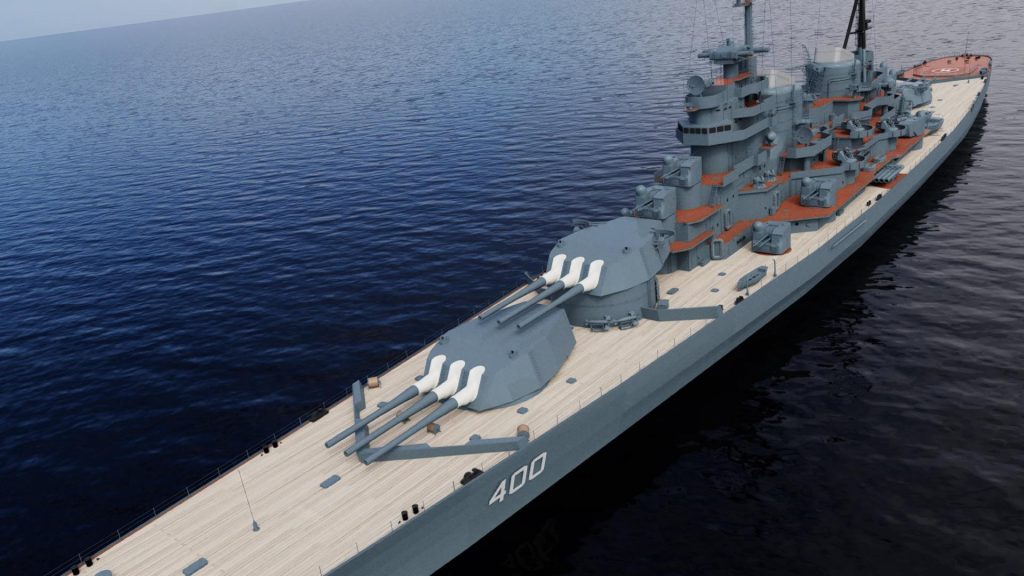
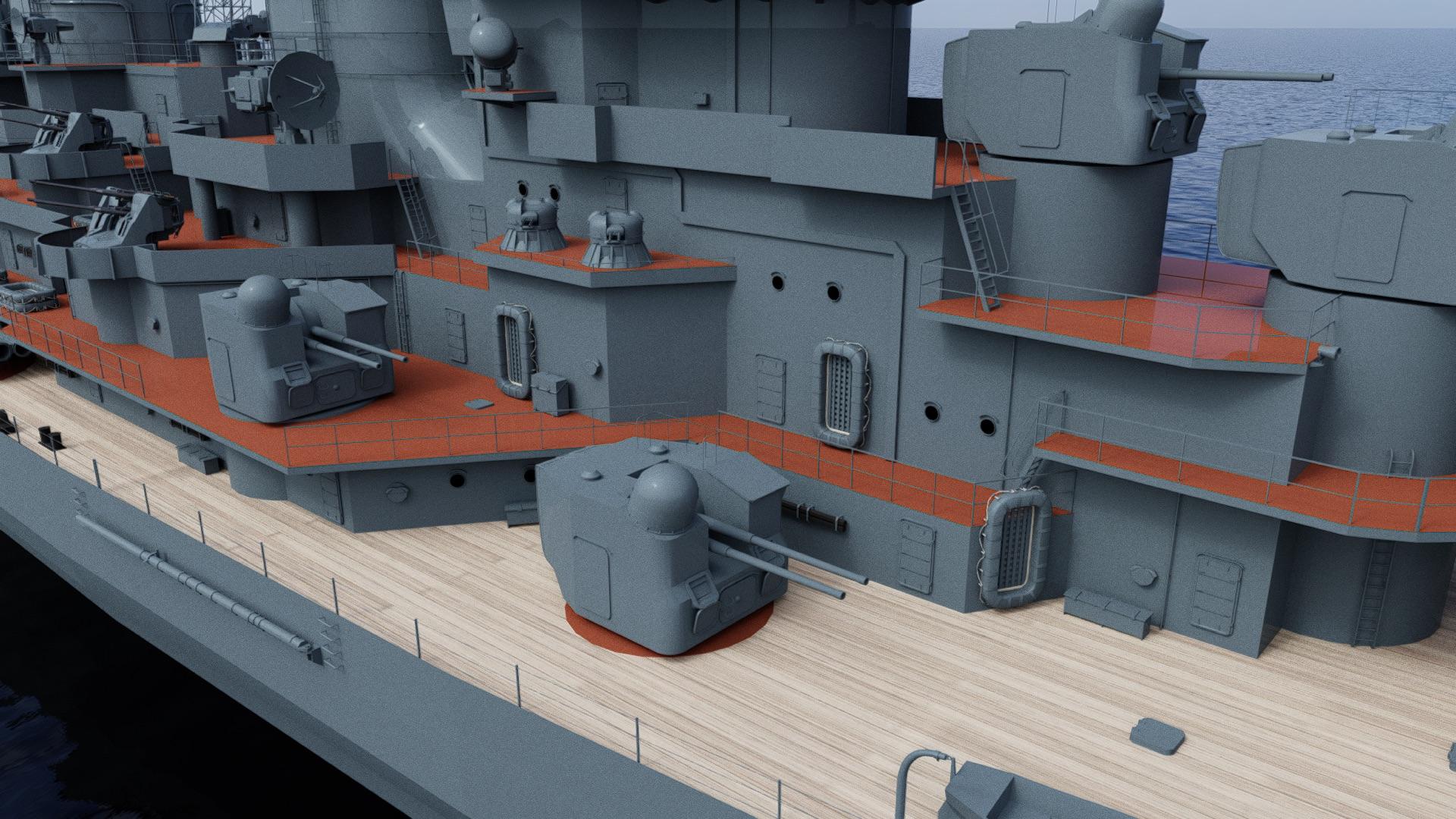
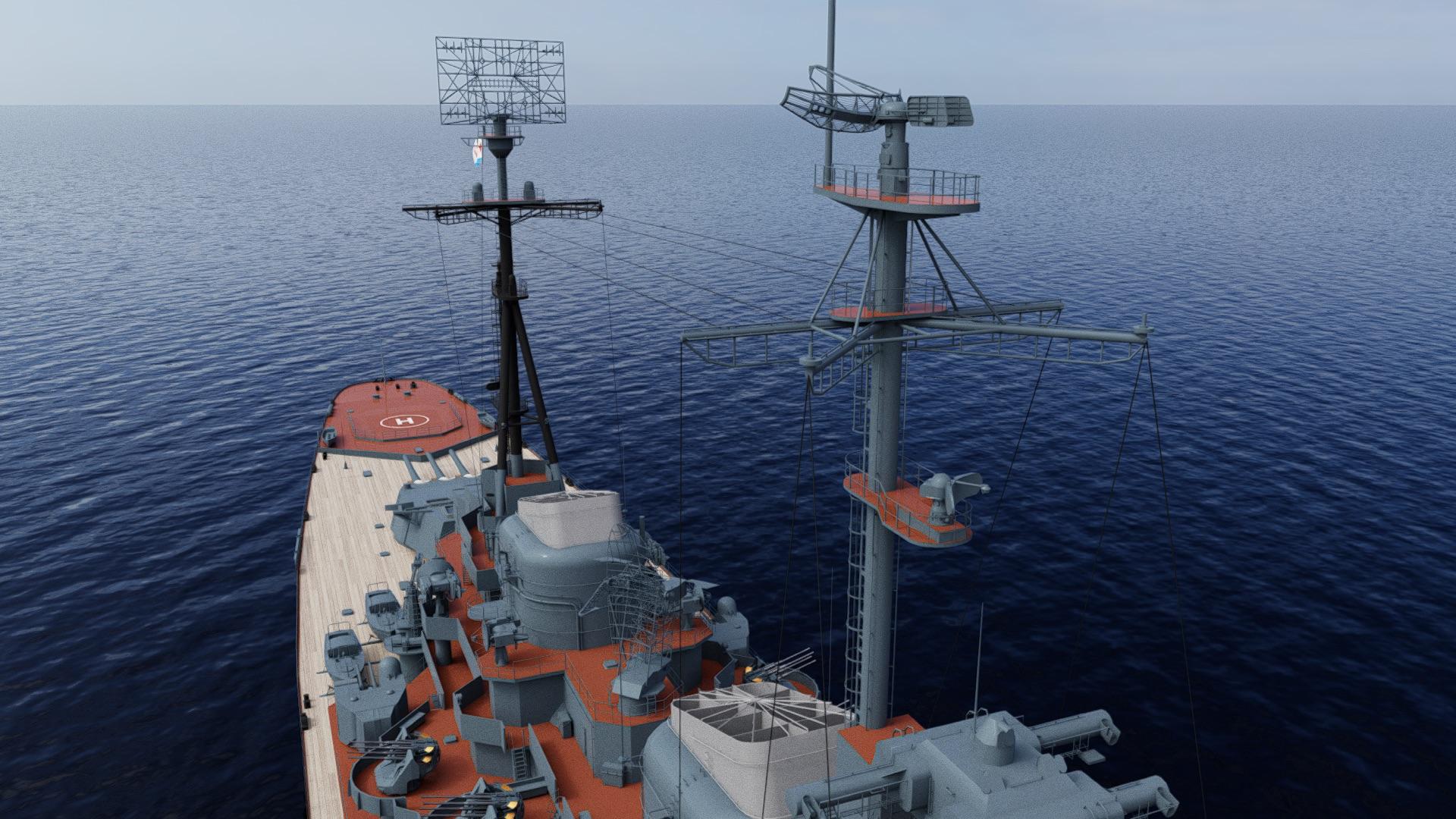
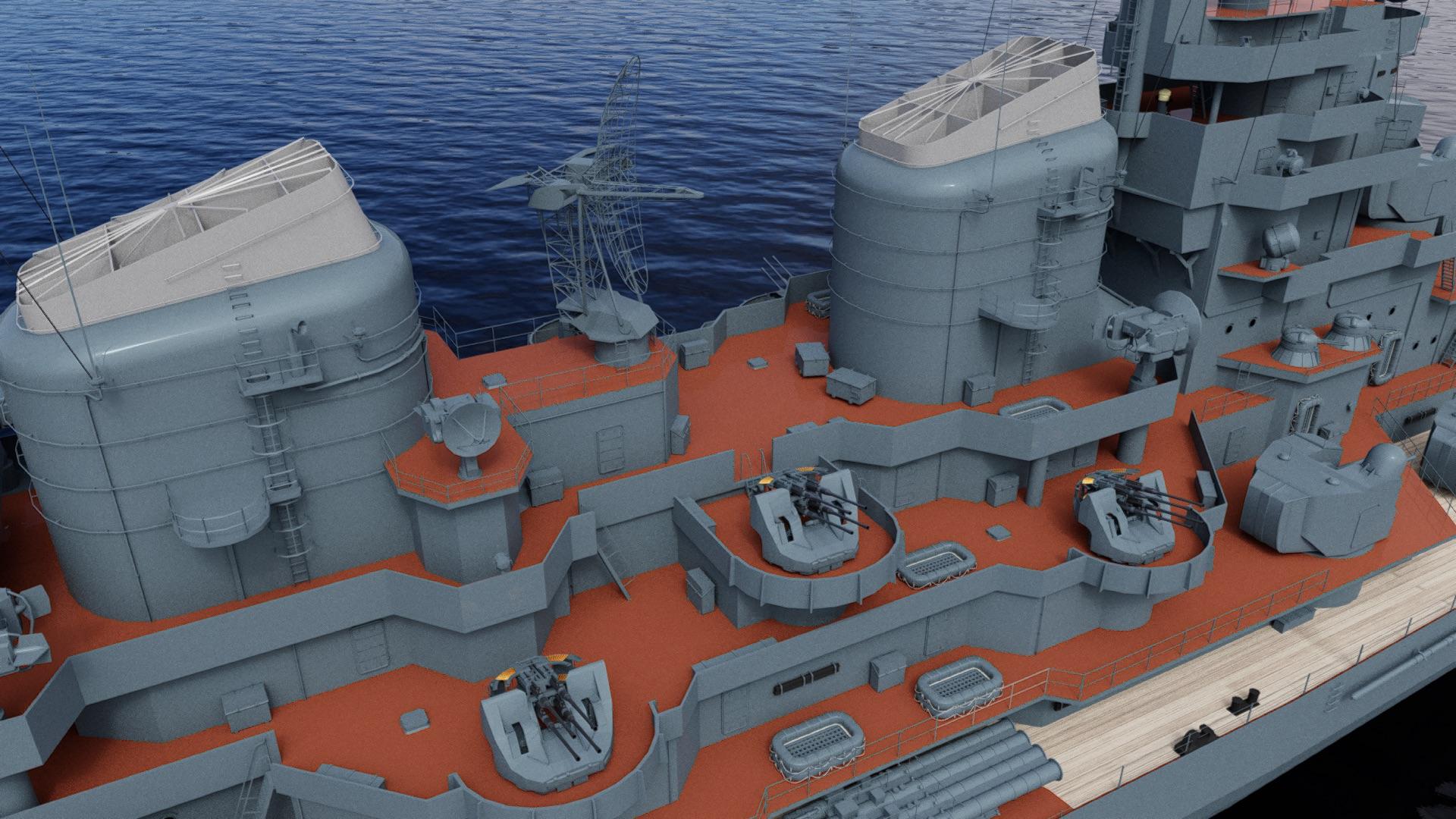
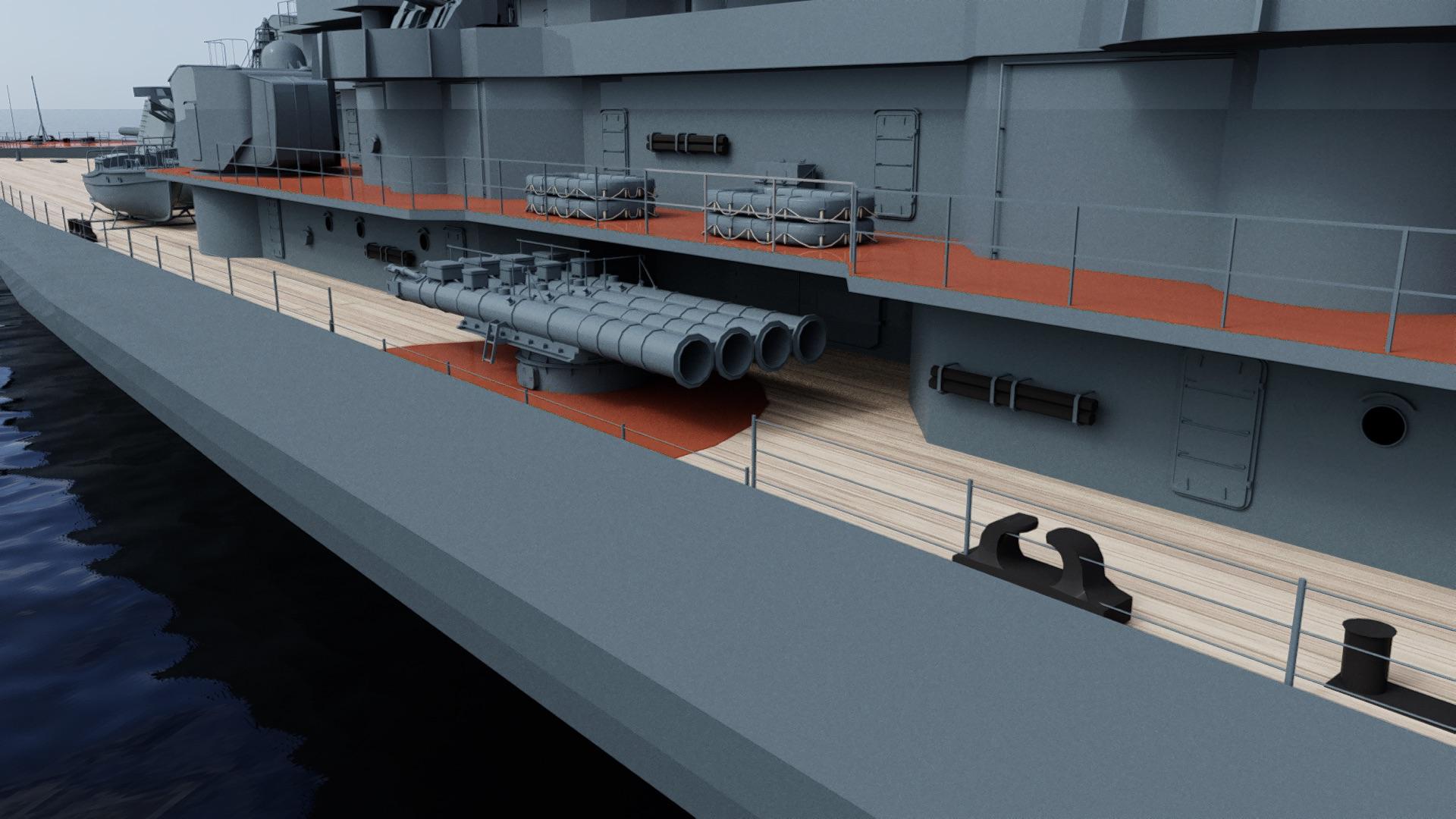
This is precisely the kind of ship reconstructed by the project’s author in NavalArt, and his work formed the basis for this article.
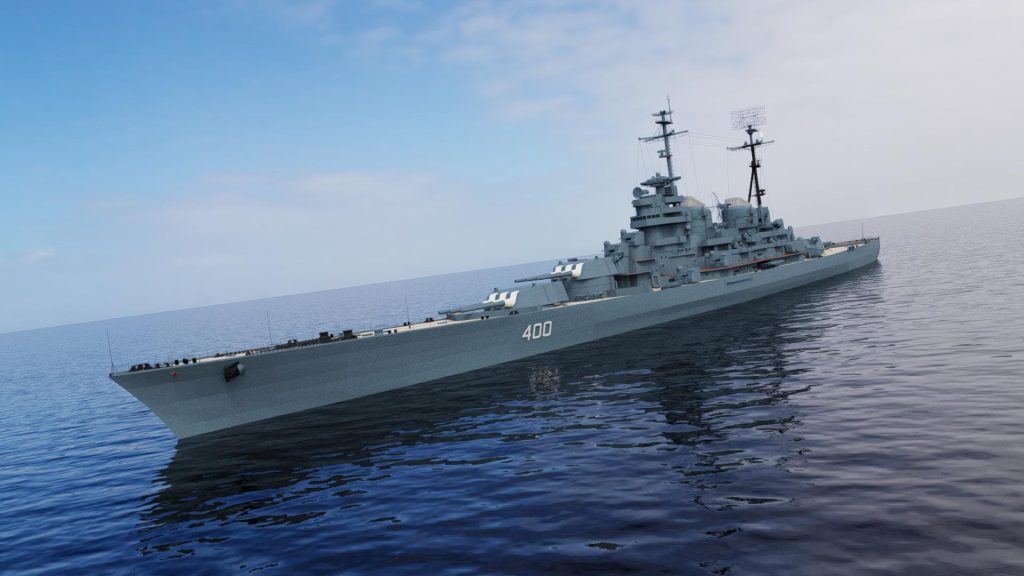
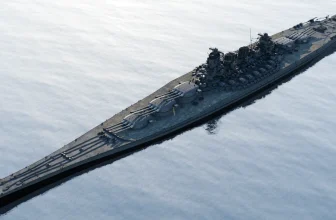
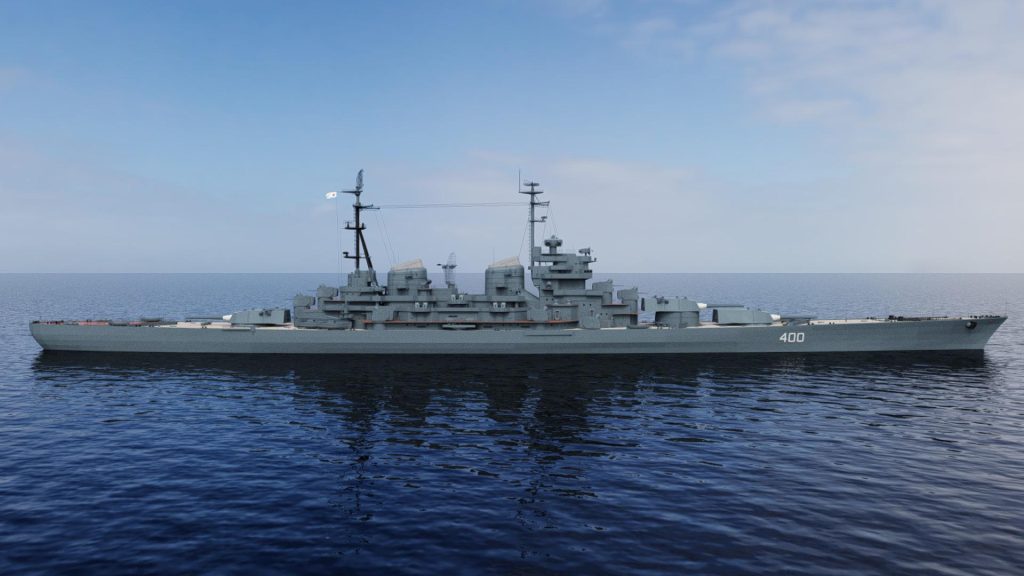
General view of the ship
Reality: What Was Project 82?
To understand what could have been improved, we first need to understand what actually existed.
Project 82 was developed by TsKB-17 under the overall supervision of L. V. Dikovich. The technical requirements changed several times, and each revision made the ship larger. Initially, the concept called for a 25,000-ton cruiser armed with 220 mm guns and capable of defeating German “pocket battleships.” By 1951, however, it had evolved into a monster with a standard displacement of approximately 36,500 tonnes and a full-load displacement exceeding 42,000 tonnes, armed with nine 305 mm guns.
The main battery consisted of SM-31 triple turrets mounting 305 mm/61 guns. These were extraordinary weapons: a 467 kg projectile could be accelerated to a muzzle velocity of 950 m/s and fired to a range of 53 kilometers. No other 305 mm naval gun in the world had comparable ballistic performance. The secondary and dual-purpose battery consisted of six twin 130 mm BL-109A mounts, while anti-aircraft armament comprised 45 mm and 25 mm automatic guns.
Armor protection, however, was decidedly “cruiser-like”: a 180 mm belt inclined at 15 degrees, deck protection totaling approximately 145 mm, and 240 mm turret faces. The ship was never intended to fight battleships — it was designed to run away from them. Its four-shaft powerplant produced 280,000 hp and gave the ship a speed of 35 knots — destroyer speed in a vessel with battleship displacement.
The traditional criticism of Project 82 comes down to three points. First, the ship was far too large and expensive for its intended missions. Second, its armor protection did not correspond to the power of its own guns — in practical terms, it could penetrate its own armor at almost any combat range. Third, and most importantly, by the time construction began, the era of the big-gun warship was already coming to an end. Missiles and carrier aviation were the future.
All of this is fair.
But for a moment, let us imagine that history took a different turn.
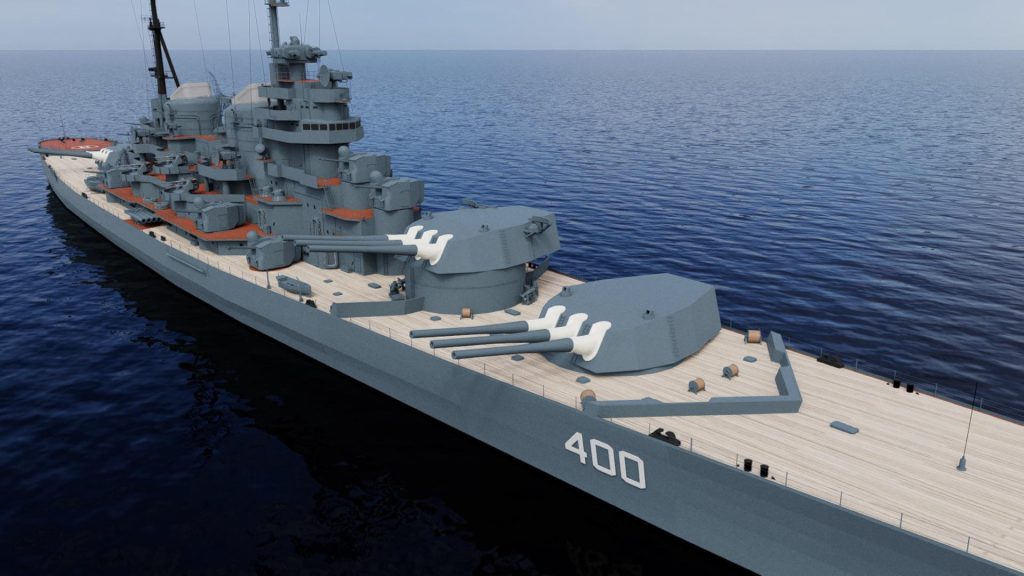
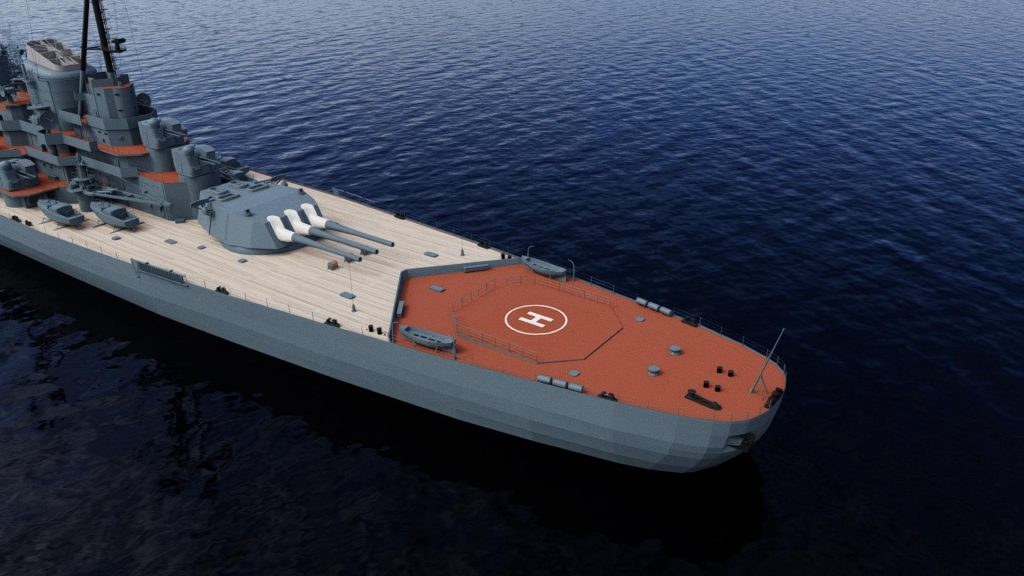
Close-up view of the forward main battery turrets
Point of Divergence: April 1953
In our alternative timeline, the decision to terminate Project 82 is not made immediately. By the spring of 1953, the lead ship Stalingrad, under construction on the slipway of Shipyard No. 444 in Nikolayev, was approximately 18 percent structurally complete. That was not much, but hull components had already been manufactured and partially assembled. More importantly, industrial cooperation had already been established for the SM-31 turrets, TV-4 turbines, and heavy armor plate.
The decisive argument in favor of continuing construction in our alternative reality is not ideology, but economics. The metallurgical industry had already mastered the production of thick armor plate, the Novokramatorsk plant had manufactured tooling for the turrets, and the Kirov Plant had assembled an experimental mount. Abandoning the program would mean writing off enormous investments.
A compromise is reached: only the lead ship will be completed, and it will be finished to a revised design, incorporating lessons from the Korean War, early information about nuclear weapons, and emerging requirements for nuclear protection. The second and third hulls are dismantled, with their armor and machinery used to complete the lead ship. The vessel itself is reclassified from a “heavy cruiser” to a “battlecruiser” — the first ship to carry that classification in the Soviet/Russian Navy since 1917.
In November 1961, following the renaming of the city of Stalingrad, the ship receives a new name — Volgograd.
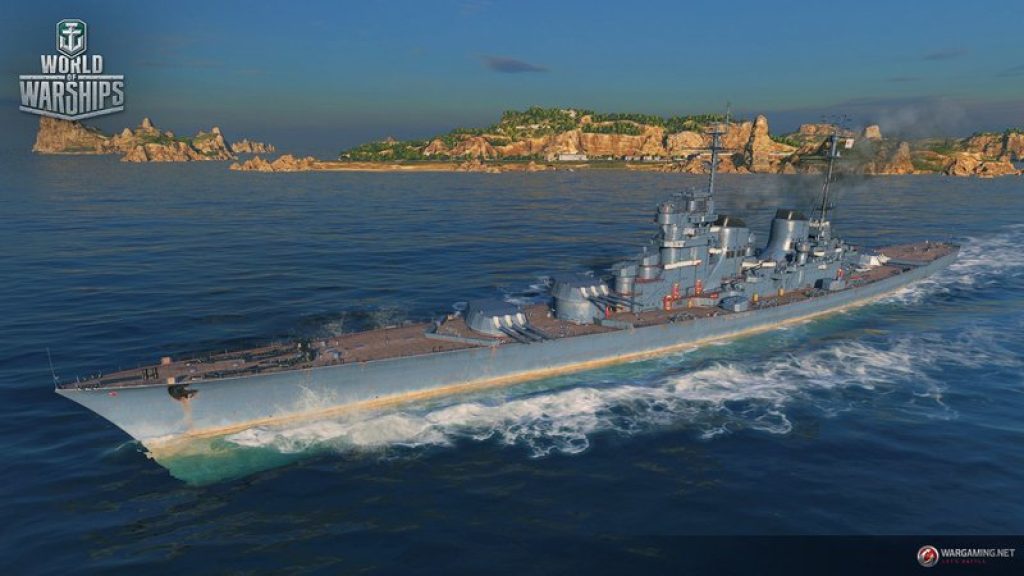
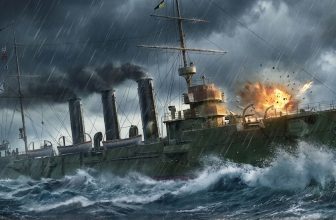
The cruiser Stalingrad from World of Warships
What Changed in Project 82bis?
Hull and General Arrangement
The first thing the designers did was lengthen the hull. The real Project 82 was 273.6 meters long with a beam of 32 meters; in Project 82bis, length increased to approximately 282 meters and beam to 33.5 meters. The reason was straightforward: the increased displacement caused by heavier armor and new anti-aircraft armament had to be compensated for without sacrificing too much speed. The length-to-beam ratio remained approximately 8.4, characteristic of high-speed warships.
The bow received greater flare and increased sheer. Stalingrad, with its relatively low freeboard, had been criticized for the likelihood of heavy water coming over the bow at high speed in rough seas. On Project 82bis, the forward bulwark was raised, while the dual-purpose mounts were shifted aft and positioned one deck higher.
Superstructure and Masts
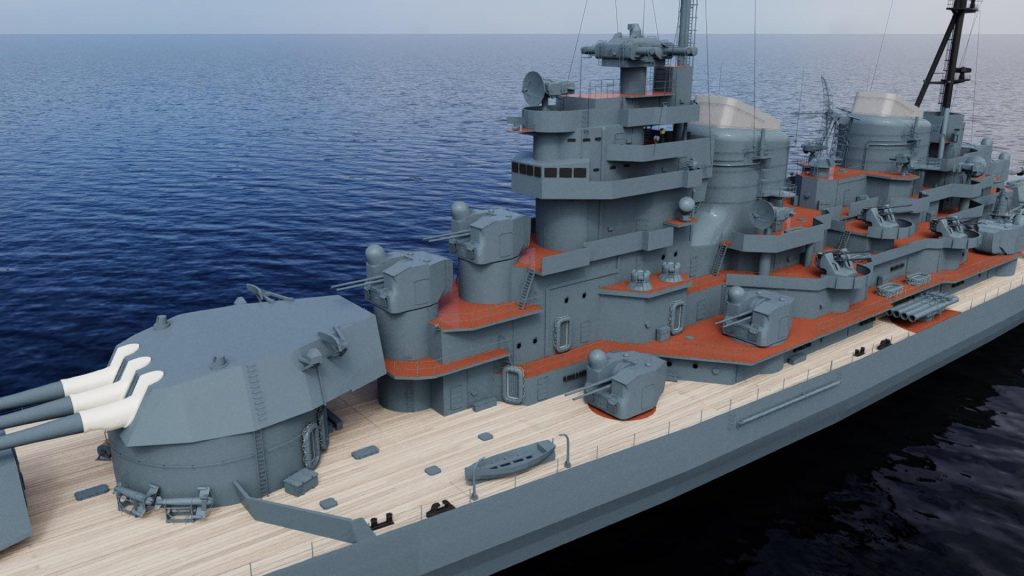
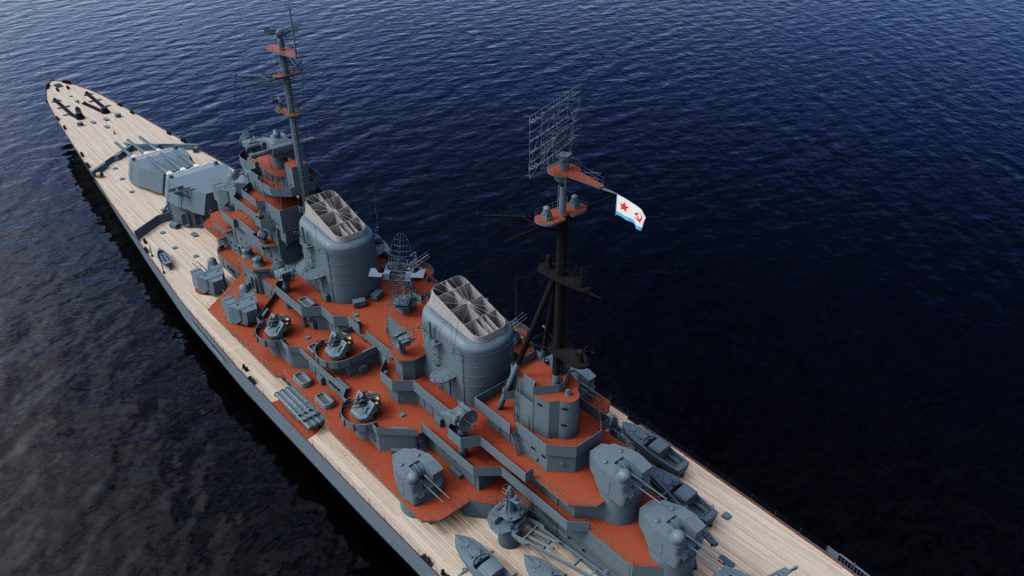
The most noticeable external difference of Project 82bis was its superstructure. Instead of the relatively modest bridge of the original Project 82, the ship received a massive tower-like forward superstructure integrated with the base of the foremast.
This solution was dictated not by aesthetics but by electronics. By the mid-1950s, a ship of this class required space for an air/surface search radar, two or three main-battery fire-control radars, dual-purpose battery directors, electronic warfare equipment, and navigation radars. Mounting all of this on lightweight masts was impractical. The equipment required rigid, stable foundations with considerable vertical separation.
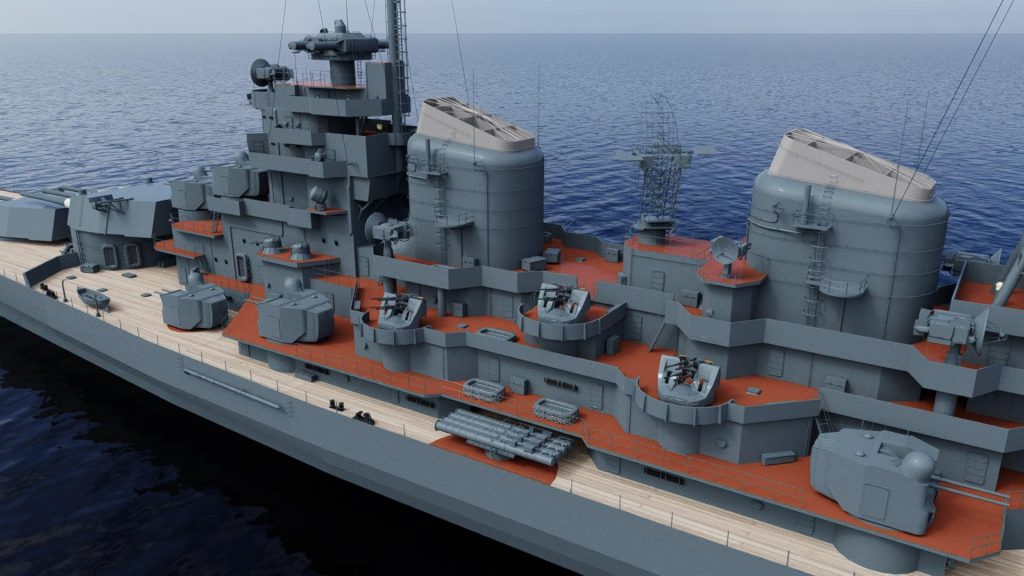
The funnels retained the characteristic separated and rearward-raked arrangement of Project 82, but the forward funnel was integrated into the after section of the forward superstructure — a solution reminiscent of the Project 68bis cruisers, only on a much larger scale.
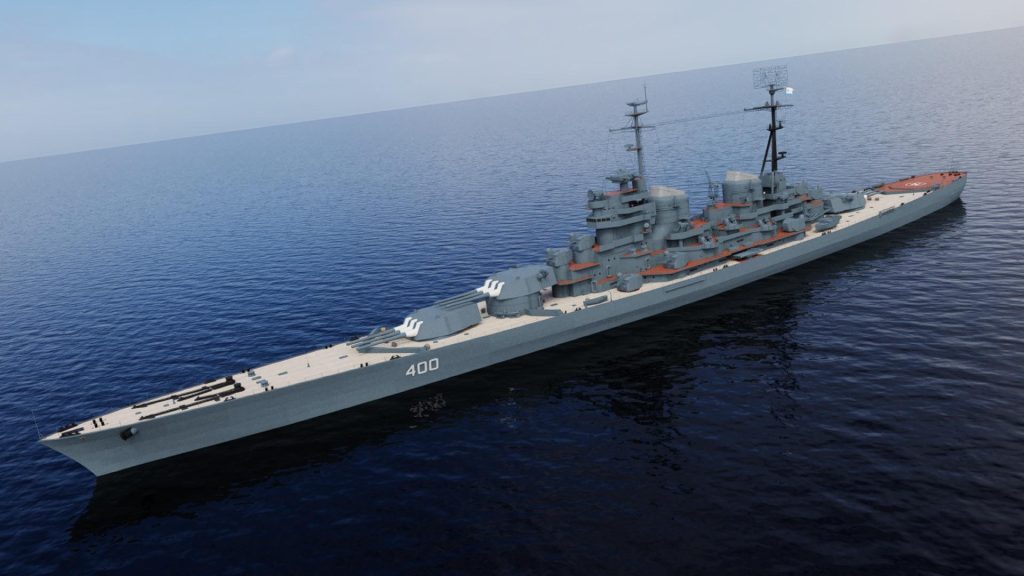
Nine Guns and New Electronics
The main battery remained unchanged in terms of the number of guns: three triple SM-31 turrets arranged with two forward and one aft. There was little reason to change it. The 305 mm/61 gun remained arguably the most powerful weapon of its caliber, and its ballistics theoretically allowed it to fire out to 53 kilometers — farther than any conventional shipboard optical rangefinder could see.
And therein lay the problem.
Being able to fire 53 kilometers was impressive, but largely useless if there was no way to correct the fire. Project 82bis addressed this problem in three ways.
The first was radar fire control. The Zalп fire-control system with the Shtag-B radar rangefinder allowed stable target tracking at 40–45 kilometers and, more importantly, observation of shell splashes. Fire could therefore be corrected by radar rather than by visual observation alone.
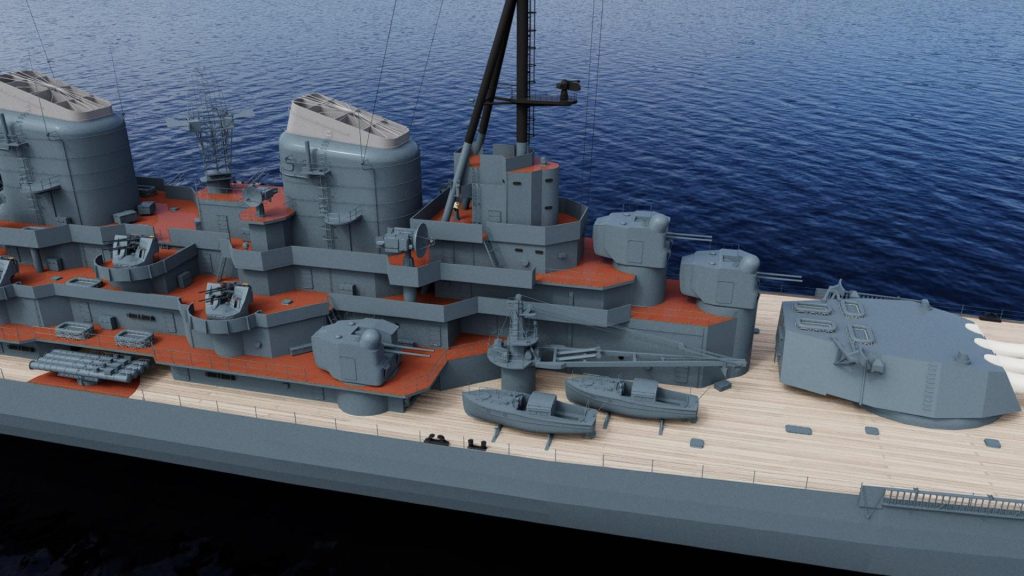
The second was shipborne aviation. A helicopter deck and hangar for two Ka-15 helicopters were installed on the quarterdeck behind the aft main-battery turret. For the mid-1950s this was a novel solution: a spotting helicopter made it possible to exploit the extreme range of the main battery while simultaneously providing anti-submarine patrol and search-and-rescue capabilities.
The third was rocket-assisted and guided ammunition. In our alternative timeline, development of a 305 mm rocket-assisted projectile with a range of 75 kilometers is successfully completed by 1961, transforming Volgograd into a platform carrying a weapon with an operational rather than merely tactical reach.
The rate of fire of the SM-31 turrets was increased from 3.26 to approximately four rounds per minute through improvements to the loading mechanisms and the introduction of semi-automated ammunition handling. Nine guns firing four rounds per minute meant 36 shells weighing 467 kg each every minute — almost 17 tonnes of steel and explosives.
Dual-Purpose and Anti-Aircraft Armament
This was where the most radical changes took place. The real Project 82 was intended to carry six twin 130 mm BL-109A mounts, weapons that by 1953 still existed primarily as designs and prototypes.
Project 82bis abandoned the BL-109A in favor of eight twin SM-5-1S mounts — the same family used on Project 68bis cruisers. This was not necessarily the optimal choice in terms of ballistic performance, but it made excellent industrial sense: the mount was already in series production and thoroughly tested, while its ammunition and Zenit-68 fire-control system were being mass-produced.
Sixteen 130 mm guns represented a formidable defense against contemporary aircraft and enemy destroyers.
The close-range anti-aircraft battery was completely redesigned. Instead of 45 mm SM-20-ZIF and 25 mm automatic guns, the ship received ten quadruple 57 mm ZIF-75 mounts with radar fire control provided by Fut-B stations. The 57 mm caliber was well suited to the 1950s: it offered sufficient effective range — around six kilometers — good rate of fire, and a projectile capable of carrying a proximity fuze. An additional twelve twin 25 mm 2M-3M mounts were distributed around the superstructure for the innermost defensive zone.
The resulting density of anti-aircraft fire made Volgograd one of the most heavily armed Soviet surface ships of its era and comparable, in sheer gun-based air-defense firepower, to American Iowa-class battleships after modernization.
Armor: An Attempt to Correct the Main Flaw
Project 82 was rightly criticized because its armor protection did not correspond to the power of its armament. Project 82bis partially corrected this imbalance — as far as possible without sacrificing its 35-knot design philosophy.
The main belt was increased to 200 mm while retaining a 15-degree inward inclination, producing an effective line-of-sight thickness of approximately 215–220 mm. This still would not protect the ship against 406 mm shells from an Iowa-class battleship — but virtually nothing capable of 35 knots could offer reliable protection against such weapons. On the other hand, the 200 mm sloped belt would provide substantial protection against 203 mm shells from American Des Moines-class heavy cruisers at practical battle ranges and against 305 mm projectiles at sufficiently long ranges.
Deck protection adopted a three-layer arrangement: a 25 mm upper “fuze-initiating” deck, a 130 mm main armored deck, and a 20 mm splinter deck. Total horizontal protection therefore reached 175 mm compared with approximately 145 mm in the original design. Main-battery turret faces were increased to 280 mm, barbettes to 240 mm, while the conning tower remained at 260 mm.
A fundamentally new feature was nuclear protection.
Following Soviet nuclear exercises and weapons tests, naval planners increasingly understood that a warship had to retain at least some fighting capability after a nearby nuclear detonation. Volgograd therefore received a sealed citadel with filtered ventilation and positive internal pressure, a water-washdown system for decks and superstructures to remove radioactive fallout, and remotely operated stations within the protected envelope that allowed the ship to maneuver and fight without exposing personnel outside.
The superstructure was also simplified and streamlined, removing as much equipment as possible that could be torn away by a blast wave.
The five-meter-deep torpedo defense system, incorporating three protective layers and a 30 mm torpedo bulkhead, was designed to withstand the equivalent of approximately 500 kg of TNT.
Powerplant and Performance
The main propulsion system remained a four-shaft arrangement based on TV-4 geared steam turbines, each producing 70,000 hp. Total output was 280,000 hp, rising to as much as 300,000 hp under forced conditions.
It was the most powerful propulsion plant ever designed in the Soviet Union for a surface warship. Its development alone represented a major technological achievement: the KV-76 boilers, operating at steam conditions of 66 kg/cm² and 470°C, were exceptionally advanced by Soviet naval standards of the period.
With full-load displacement increased to approximately 47,000 tonnes, maximum speed fell slightly to 33.5 knots instead of the original design figure of 35 knots.
The machinery spaces were arranged in an alternating echelon layout — boilers, turbines, boilers, turbines — to improve survivability. Damage disabling one machinery group would leave the ship with approximately half its power and two operational shafts.
Cruising range at an economical speed of 18 knots was approximately 6,000 nautical miles. This was insufficient for a true ocean-going raider, but acceptable for operations in the Norwegian Sea, Mediterranean, and Sea of Japan.
Project 82bis Volgograd Battlecruiser — Specifications
- Standard displacement: 40,200 tonnes
- Full-load displacement: 47,100 tonnes
- Overall length: 282.0 m
- Beam at waterline: 33.5 m
- Full-load draft: 9.8 m
- Main propulsion: 4 TV-4 geared steam turbine sets, 8 KV-76 boilers
- Power: 280,000 hp; 300,000 hp forced
- Maximum speed: 33.5 knots
- Cruising range: 6,000 nautical miles at 18 knots
- Endurance: 30 days
Armament:
- Main battery: 3×3 305 mm/61 SM-31
- Dual-purpose battery: 8×2 130 mm/58 SM-5-1S
- Anti-aircraft artillery: 10×4 57 mm ZIF-75; 12×2 25 mm 2M-3M
- Air group: 2 Ka-15 helicopters, hangar and flight deck
Armor protection:
- Main belt: 200 mm, inclined at 15°
- Decks: 25 + 130 + 20 mm
- Main-battery turrets: 280 mm front, 200 mm sides, 150 mm roof
- Barbettes: 240 mm
- Conning tower: 260 mm
- Torpedo defense: 5.0 m deep, 30 mm torpedo bulkhead, designed against a 500 kg TNT charge
- Radar: Rif, Zalp, Shtag-B, Fut-B, Yakor-M
- Crew: 1,780
Alternative Service History: Volgograd in the Cold War
The ship enters service with the Black Sea Fleet at the end of 1958. Its first two years are dominated by trials: maximum-range main-battery firing, development of radar fire correction procedures, and helicopter operations.
In 1961, following the renaming of Stalingrad, the battlecruiser becomes Volgograd. That same year it makes its first Mediterranean deployment, inevitably attracting the close attention of the U.S. Sixth Fleet. The appearance in the Mediterranean of a heavy artillery warship capable of firing hundreds of 305 mm shells in a matter of minutes forces NATO planners to take its shore-bombardment potential seriously.
And this is where the central paradox of our alternative history emerges.
Volgograd becomes less a battlefield weapon than a political instrument.
Using it to attack an aircraft carrier would be extremely difficult: carrier aircraft could strike the ship long before it entered effective gun range. But the presence of such a vessel in the harbor of a friendly country could have political significance far beyond its purely military value. Meanwhile, its ability to devastate a coastal bridgehead with 305 mm gunfire made it an ideal naval gunfire-support ship — essentially the same role in which the Americans later employed New Jersey off Vietnam.
The 1968–1971 Modernization
By the end of the 1960s, a purely gun-armed capital ship had become an anachronism.
During a major refit, Volgograd loses its aft main-battery turret and part of its 130 mm secondary armament. The vacated space is used for two twin launchers for the M-11 Shtorm surface-to-air missile system with a total ammunition allowance of 96 missiles, as well as eight P-35 anti-ship missiles carried in two quadruple launcher groups on the sides of the ship.
The result is a hybrid.
Six 305 mm guns remain forward for shore bombardment, while missile strike and anti-aircraft weapons dominate the aft section. From the standpoint of pure naval design logic, it is a chimera. From the standpoint of Cold War practice, however, it becomes a surprisingly useful vessel — the only ship in the Soviet Navy capable of simultaneously showing the flag, providing heavy naval gunfire support, delivering anti-ship missile strikes, and providing area air defense for a formation.
In this alternative reality, Volgograd’s service finally comes to an end in 1991. The ship is placed in reserve, proposals to preserve it as a museum are discussed for several years, and eventually — as so often happened — it is broken up for scrap in the late 1990s.
Did It Actually Make Sense?
The straightforward answer is no.
Project 82, in any form — including the hypothetical Project 82bis — was a ship that had missed its war.
Its fundamental concept, that of a high-speed artillery raider designed to destroy enemy cruisers, made sense in 1936, was debatable in 1945, and was effectively obsolete by 1955. The estimated cost of constructing Volgograd in 1958 prices would have been comparable to approximately thirty Project 56 destroyers or twelve Project 641 submarines. For the same investment, the Soviet Navy could have acquired substantially greater practical combat capability.
Moreover, the resources that would have been consumed by Project 82bis were, in reality, directed toward genuinely revolutionary programs — the first nuclear-powered submarines, Project 58 missile cruisers, and new anti-submarine warfare ships. Khrushchev’s attitude toward the traditional surface fleet may have been extremely harsh, but in this particular case the economic logic behind abandoning Stalingrad was difficult to dispute.
Alternative history, however, is not written to prove that the decisions of the past were correct.
It exists to ask one question:
What would it have looked like?
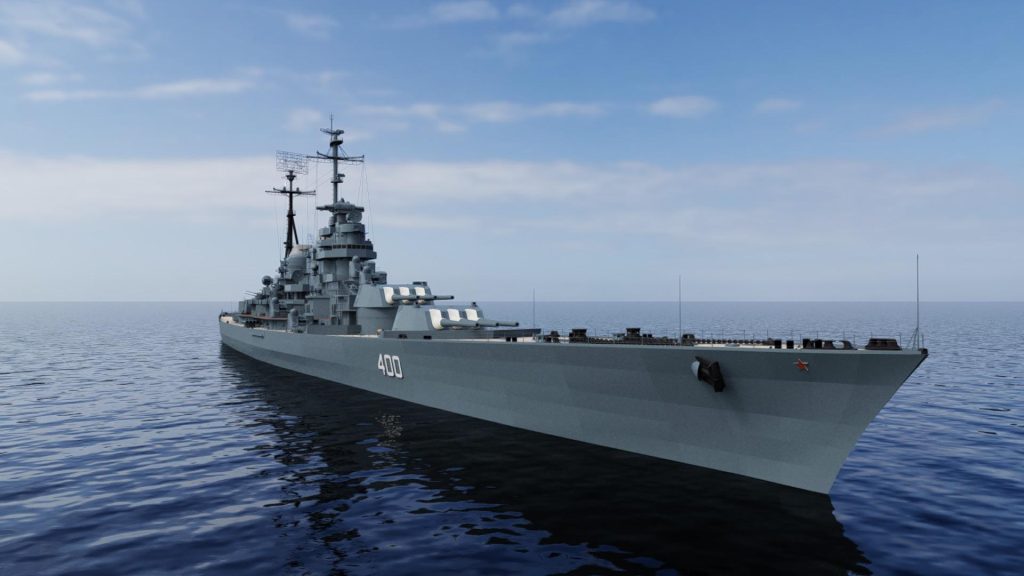
And Project 82bis would have looked magnificent — the last great artillery giant of Europe, a ship combining the prewar school of armored warship construction with the first generation of sophisticated naval electronics.
Beautiful, powerful, and ultimately unnecessary — like so many monuments to a disappearing era.
Perhaps that is precisely why Stalingrad continues to capture the imagination, and why enthusiasts continue to build it again and again: in three-dimensional editors, scale models, games, drawings, and alternative-history projects.
Where real history placed a full stop, alternative history adds an ellipsis…
Небольшая оговорка: я сохранил альтернативно-исторические утверждения именно как часть вашего сценария, а не превращал их при переводе в утверждения о реальном проекте 82.
Links – https://www.reddit.com/r/NavalArt/comments/1wnlnat/project_82bis_battlecruiser_volgograd/