For a long time, naval warfare remained the last bastion of “large platforms”—destroyer, frigates, and aircraft carriers. But recent years have shown that even at sea, the era of drones is dawning. And while earlier the focus was on small unmanned kamikaze boats, a completely different class of technology is now entering the scene—full-fledged unmanned ships. The Saildrone Spectre is precisely such a project—essentially a corvette-length unmanned ship capable not only of surveillance but also of carrying out strikes.
And this is no longer an experiment. It’s a proposal for a new fleet architecture.
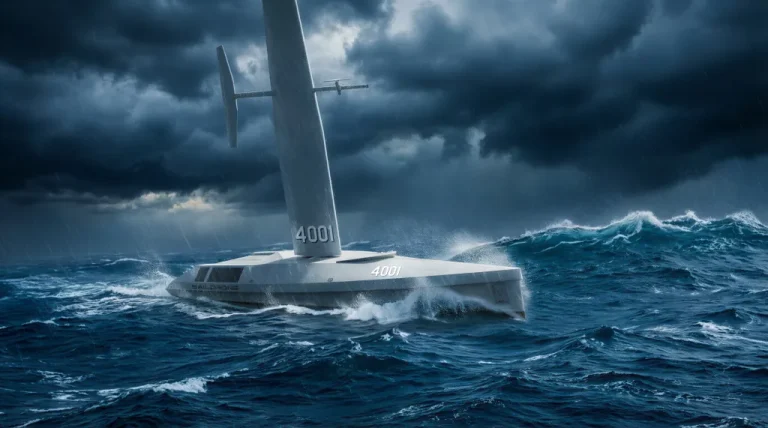
A drone the size of a ship
Spectre defies conventional notions of unmanned vessels. It is not a small boat, but a 52-meter vessel with a displacement of about 250 metric tons—larger than many patrol boats.
It is capable of reaching speeds of up to 30 knots and carrying tens of metric tons of payload.
In fact, this is not a “drone” but a full-fledged maritime platform—just one without a crew.
And that’s exactly what changes the game: the main limiting factor—the people on board—disappears.
From Reconnaissance to Strike
Saildrone was initially known for its autonomous ocean surveillance vehicles. But Spectre represents the next step. It is being developed as a multipurpose system: reconnaissance, anti-submarine warfare, and, most importantly, strike capabilities.
In a strike configuration, the ship can carry vertical launch systems—for example, missile containers.
In fact, this is an unmanned platform capable of performing tasks that previously required frigates or destroyers.
And all of this—without any risk to the crew.
A Container Instead of a Ship
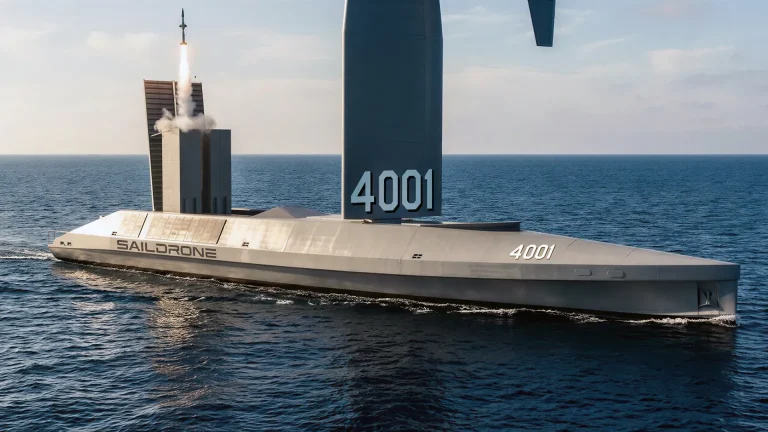
One of the Spectre’s key features is its modularity. Its internal architecture allows for the installation of standard equipment containers, including sensors, electronic warfare systems, missiles, and hydroacoustic stations.
The hull can accommodate up to several dozen metric tons of payload, including containers of various sizes.
This turns the ship into a versatile platform that can be “reconfigured” for any mission. Today—submarine hunting. Tomorrow—a strike mission. The day after tomorrow—reconnaissance.
No ship modifications. Just a module swap.
Underwater Hunting: Silent Mode
Anti-submarine warfare is becoming one of the Spectre’s primary missions. To this end, it is equipped with towed hydroacoustic systems and operates in a low-noise mode.
Some configurations use a hybrid propulsion system with a quiet running mode, which allows for submarine detection without generating any noise that could give away the vessel’s position.
This is an important point: an unmanned vessel can remain in the search area for days on end without requiring a crew change and without getting tired.
Why was this even necessary?
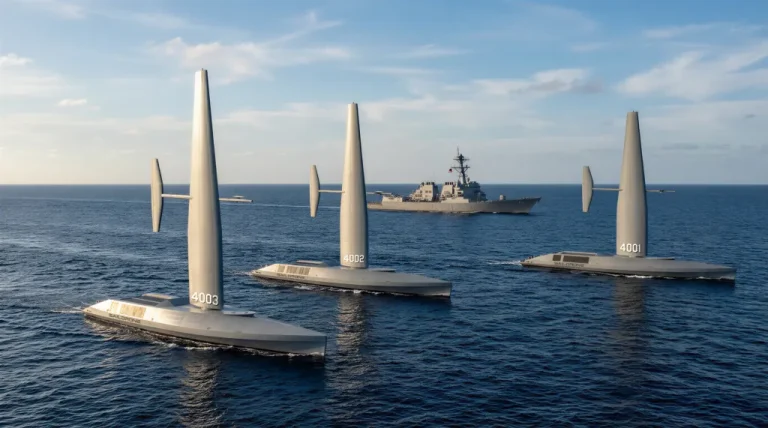
The emergence of such systems is directly linked to the changing nature of naval warfare.
On the one hand, there are expensive ships, the loss of which would be a political disaster.
On the other hand, there are inexpensive drones that have already proven their effectiveness in real conflicts.
Spectre is an attempt to bridge these two worlds:
to create a large platform, but without a crew and with potentially lower operating costs.
In addition, the U.S. Navy is actively seeking new solutions as part of the Medium Unmanned Surface Vessel (MUSV) program, and Spectre is, in fact, being developed to meet those requirements.
A Fleet Without People?
The most important issue raised by the Spectre isn’t its specifications, but its concept.
If a ship can carry out missions without a crew, why keep people on board?
If we can deploy dozens of such platforms without risking lives, the very logic of naval operations changes.
Unmanned vessels can:
— to remain on duty for months on end
— to operate in dangerous areas
— to saturate the area with sensors and weapons
— to serve as “disposable” elements of the fleet
And that is precisely what makes them particularly dangerous—not individually, but in large numbers.
Conclusion: The Dawn of a New Maritime Era
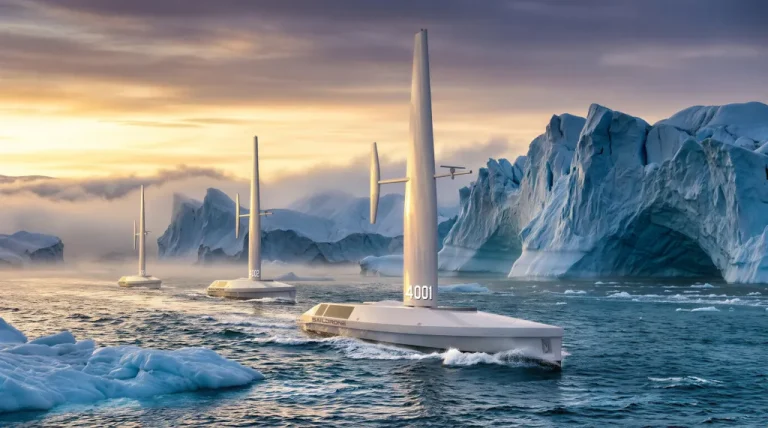
Spectre isn’t just a new drone. It’s a sign that the navy is beginning to change, just as the air force and the army have already changed.
Large ships aren’t going anywhere. But unmanned platforms will appear alongside them to take on some of the tasks—from reconnaissance to strikes.
And perhaps it is precisely these kinds of systems that will form the backbone of the fleet of the future.
Not because they’re better.
But because they’re cheaper, more flexible, and don’t require a crew on board.