While the whole world was eating tangerines, the Chinese navy was ROCKING:
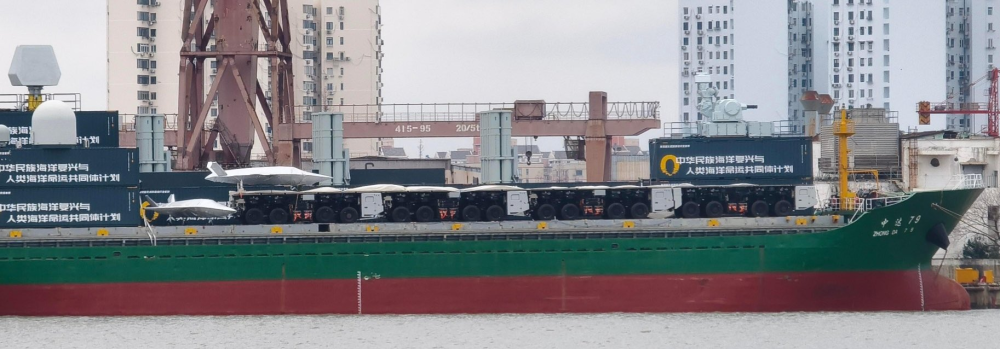
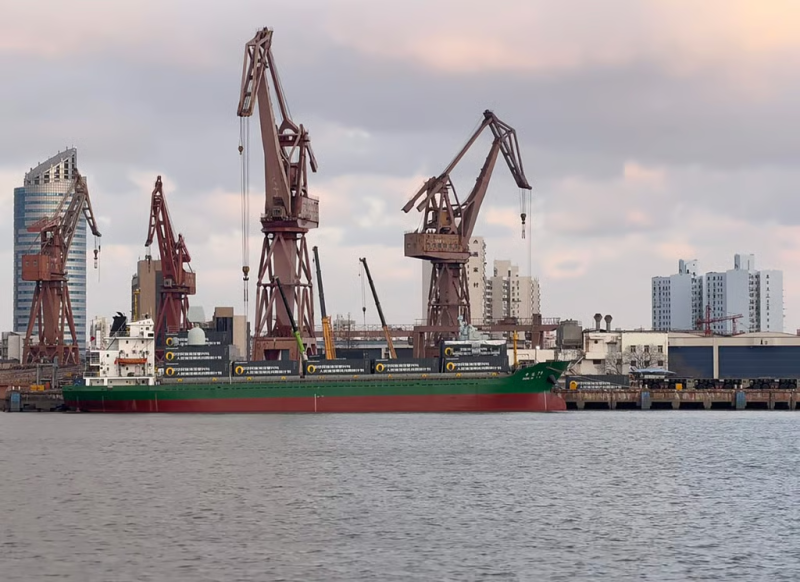
Here’s the situation: The Chinese auxiliary missile cruiser/frigate—based on the cargo ship “Zhong Da 79,” which we’re already familiar with—has now been equipped with a modular electromagnetic catapult for launching heavy drones.
This catapult—which is assembled from four sections, each of which moves on its own four-axle wheeled chassis—recently appeared in photographs taken at the very same port as the auxiliary launch vessel:
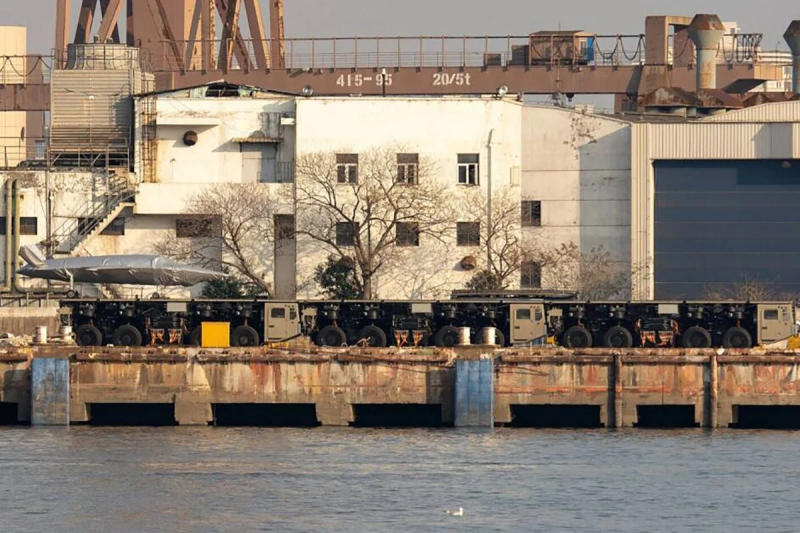
Officially, this system has not yet been classified, but virtually all OSINT analysts agree that it is a mobile catapult assembled from several self-propelled sections. This was indicated by the precise alignment of the carrier trucks with one another, forming a perfectly flat, continuous surface, as well as a complex system of hydraulic actuators that support this plane—apparently designed to compensate for possible ground irregularities at the deployment site. A heavy drone (or a mock-up thereof) numbered 53431—which had previously been glimpsed at the grand parade in Beijing—was mounted on the rear landing gear, while the landing gear in front of it carried something resembling a catapult shuttle.
The rocket carrier is on the left, and the catapult is on the right on the pier
The initial assumption was that the catapult was intended for the highly mobile deployment of squadrons of heavy UAVs in areas where the airfield network is underdeveloped—or too vulnerable to the enemy. The idea of a ground-based catapult, incidentally, is not new; it was first tested by the Americans during the Vietnam War at Chu Lai Air Base (where geographical constraints prevented the construction of a runway long enough for heavy strike aircraft to take off under their own power). But the concept of a mobile, modular catapult—capable of rapidly assembling, conducting launches, and then dispersing to evade enemy attacks—was a clear innovation.
However, no one thought to link it to “Zhong Da 79.” And that was a mistake.
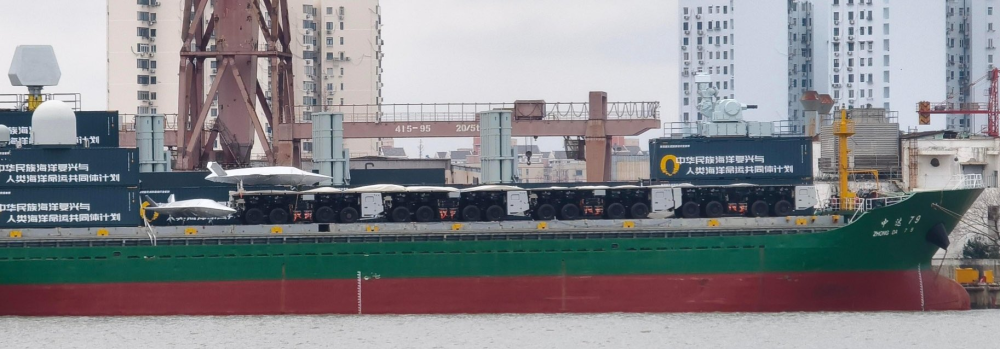
The catapult on the “Zhong Da 79” is mounted on the starboard side—replacing one CIWS automatic cannon (as it turned out, there were actually two, on the starboard and port sides) and some of the missile containers. It forms a full-fledged launch track pointing toward the ship’s bow. Although the trucks are covered with transport tarps, the fact that they were not simply loaded onto the ship but docked together suggests that this is not merely a transport operation.
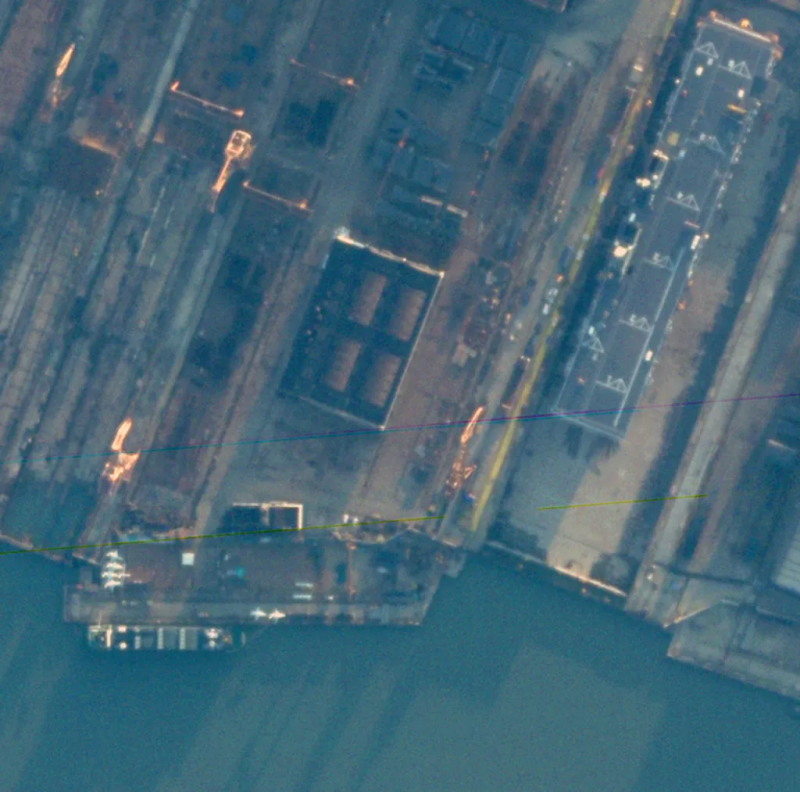
“Zhong Da 79” — at the bottom of the pier. Next to it on the dock is a catapult. In the dock on the left is a Type 076 amphibious assault ship with a built-in electromagnetic catapult.
All in all… the Chinese have once again sent shockwaves through the entire OSINT community. In effect, they have now demonstrated the ability to convert an auxiliary missile carrier into an auxiliary catapult ship—a more modern counterpart to the British CAM-ships (Catapult Aircraft Merchant); auxiliary escort vessels used by the British Navy in 1942–1943 as an improvised means of air defense for convoys (before the widespread introduction of escort aircraft carriers):
A Hurricane fighter takes off from a catapult ship. There was no plan for it to return—after completing its mission, the fighter would splash down nearby, and the pilot would be picked up by a motorboat. This “disposable” approach, however, made it possible to effectively intercept German reconnaissance aircraft—preventing the Germans from detecting and tracking the convoy from the air.
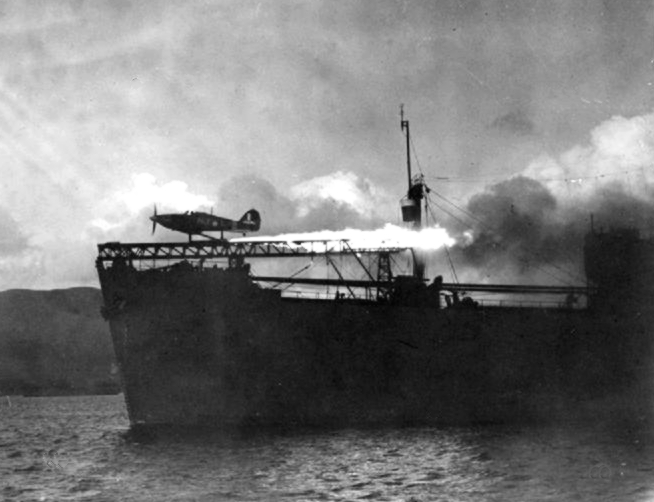
A Hurricane fighter takes off from a catapult ship. There was no plan for a return flight—after completing its mission, the fighter would splash down nearby, and the pilot would be picked up by a motorboat. This “disposable” approach, however, made it possible to effectively intercept German reconnaissance aircraft—preventing the Germans from detecting and tracking the convoy from the air.
A new iteration of the MAC ship, replacing the manned fighter with an unmanned drone, seems like a very… interesting idea. In effect, it gives an auxiliary combat vessel the ability to conduct reconnaissance, patrol, and strike moving and situational targets (which cannot be pre-designated for cruise missiles). In the future, it is quite possible that heavy drones could also be used for air combat and to contest enemy airspace. Landing is not currently planned, but a drone with a long range could easily make it back to a ground airfield after completing its mission. Besides, losing a drone isn’t a big loss.
So the USN now has yet another pressing headache.
P.S. I recently saw some statistics… for the year 2025, the U.S. Navy commissioned one Independence-class LCS (USS “Pierre,” LCS-38) and one Virginia-class nuclear submarine (USS “Iowa,” SSN-797).
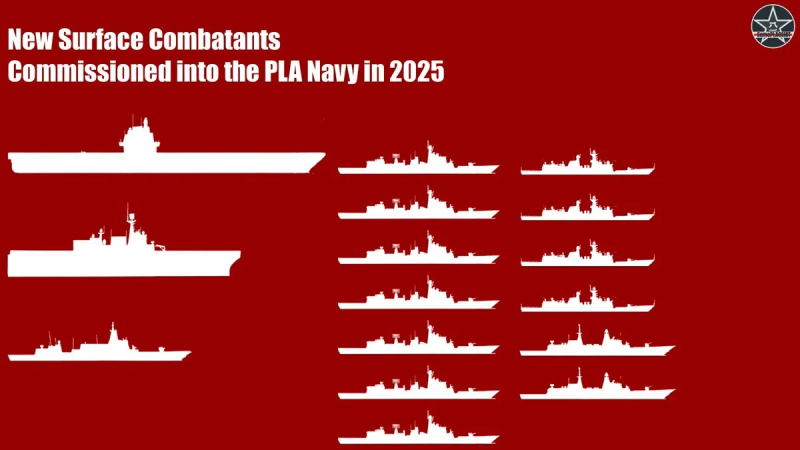
In that same year, 2025, the PLA Navy commissioned one Type 03 supercarrier, one Type 076 amphibious helicopter carrier/drone carrier, one Type 055 large destroyer/missile cruiser, seven Type 052D destroyers, six Type 054B frigates, and two nuclear submarines.
The gap in industrial capabilities is becoming increasingly apparent…