Consolidated's design for a 100-seat passenger flying boat. United States

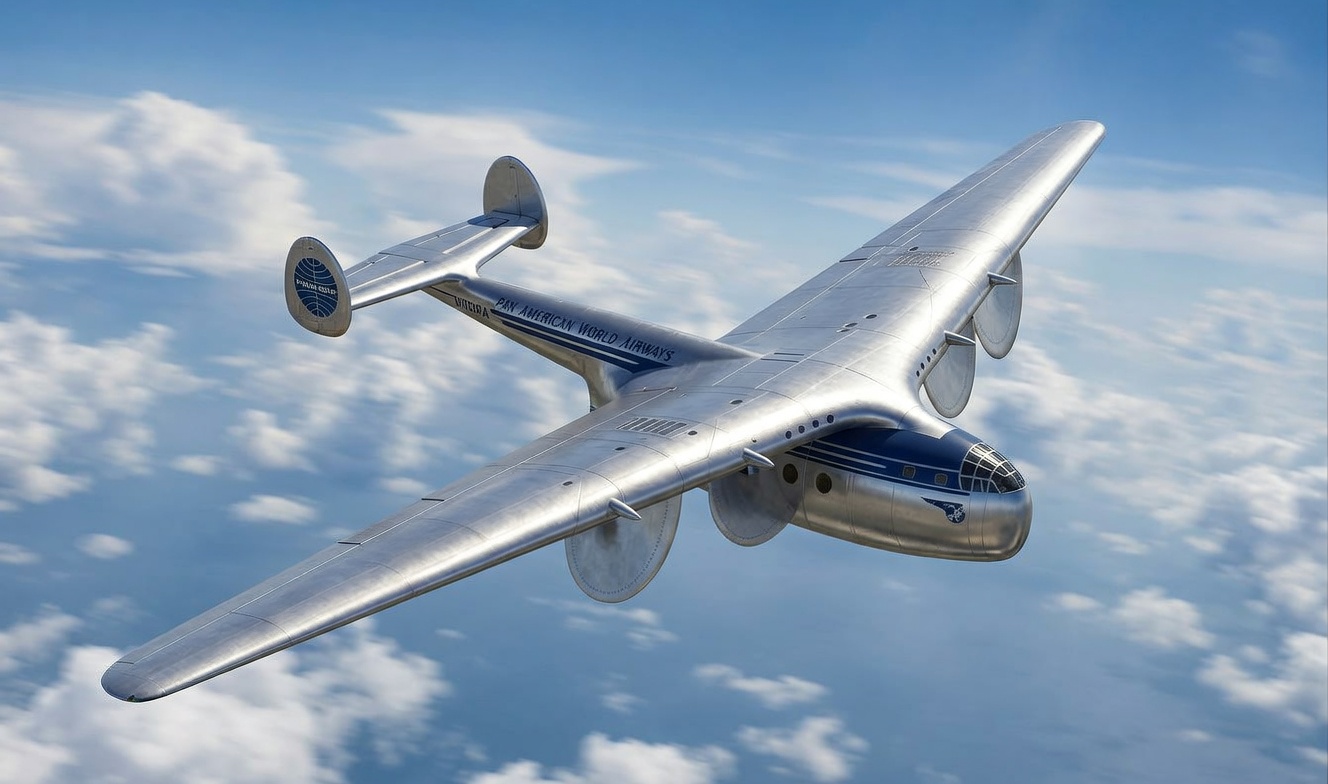
Here is a short vintage article from Consolidated’s corporate magazine, *Consolidator* (July 1938 issue), which I think will be of interest to readers and colleagues.
CONSOLIDATED’S 100-SEAT PASSENGER FLYING BOAT
Author: T. P. Hall
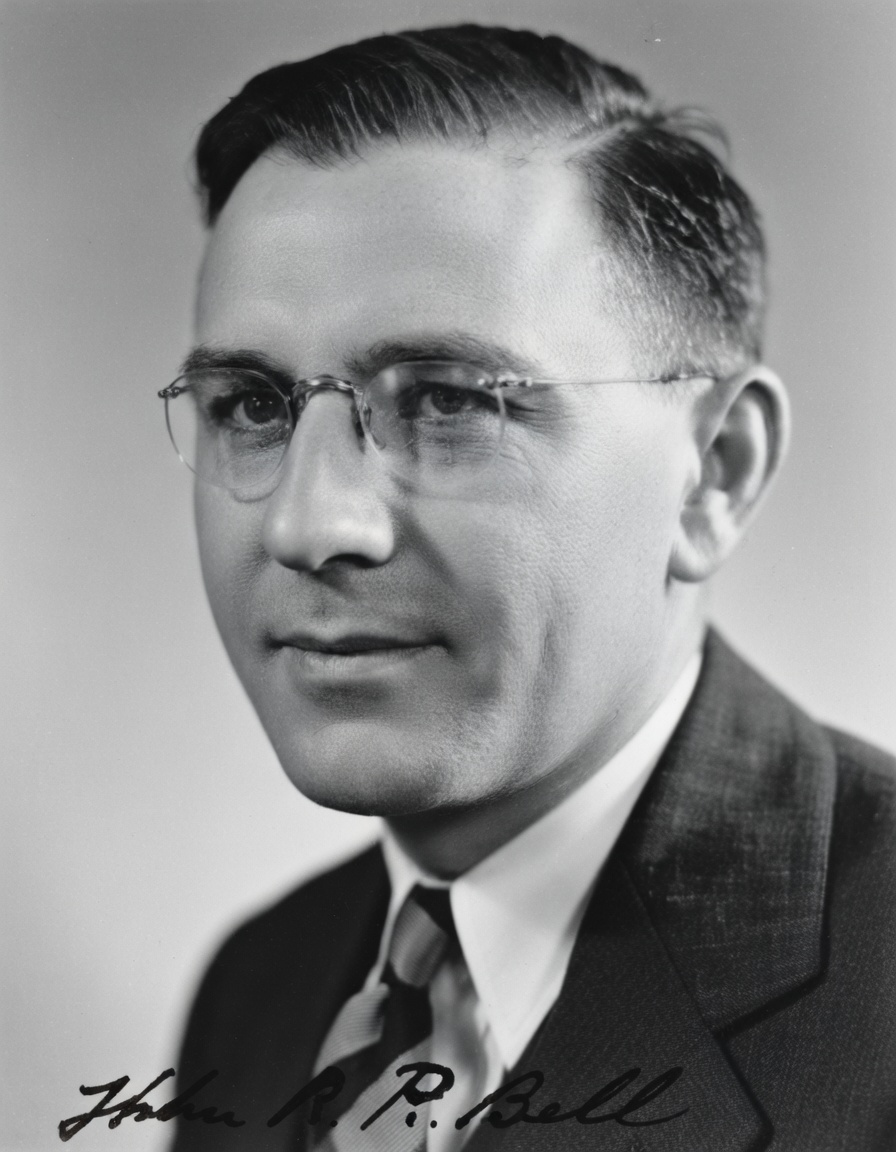
The author of the article is lead designer T. P. Hall. The image was processed by lmarena.ai.
Designed in accordance with the strict requirements of Pan-American Airlines’ specifications, Consolidated’s 100-seat flying boat provides its passengers not only with fast and economical long-distance travel, but also with comfort and convenience. The main requirements for this aircraft, designed to carry 100 passengers, were: a payload of 25,000 pounds (13,400 kg), a crew of 16, and a range of 5,000 miles (8,045 km). The flying boat’s engines were to be equipped with a supercharger system for cruising at an altitude of 20,000 feet (6,096 m), during which the passenger cabin must maintain a pressure equivalent to that at an altitude of 8,000 feet (2,438 m).
Early studies have shown that, given the engines currently in use or scheduled to be introduced in the very near future, the flying boat under development—with a total mass of more than 200,000 pounds (90,720 kg) would require a six-engine powerplant, unless methods are developed to improve efficiency and significantly reduce the size compared to the original concept. Such a reduction will automatically be accompanied by additional improvements, such as the elimination of inefficiencies caused by the large number of engines. This aircraft is fully in line with Consolidated’s design philosophy and incorporates features such as a high aspect ratio and high wing loading, blind-riveted outer surfaces, and auxiliary floats that rest against the underside of the wing
It was evident that this reduction in size was directly related to the need to accommodate 100 passengers and 16 crew members, as well as their living quarters. Analysis at this stage of the design showed that, with a slight thickening of the wing and a corresponding increase in drag, the wing could accommodate 36 of the 100 passengers. In addition, all engines could be fully housed within the wing, which would further improve flight performance.
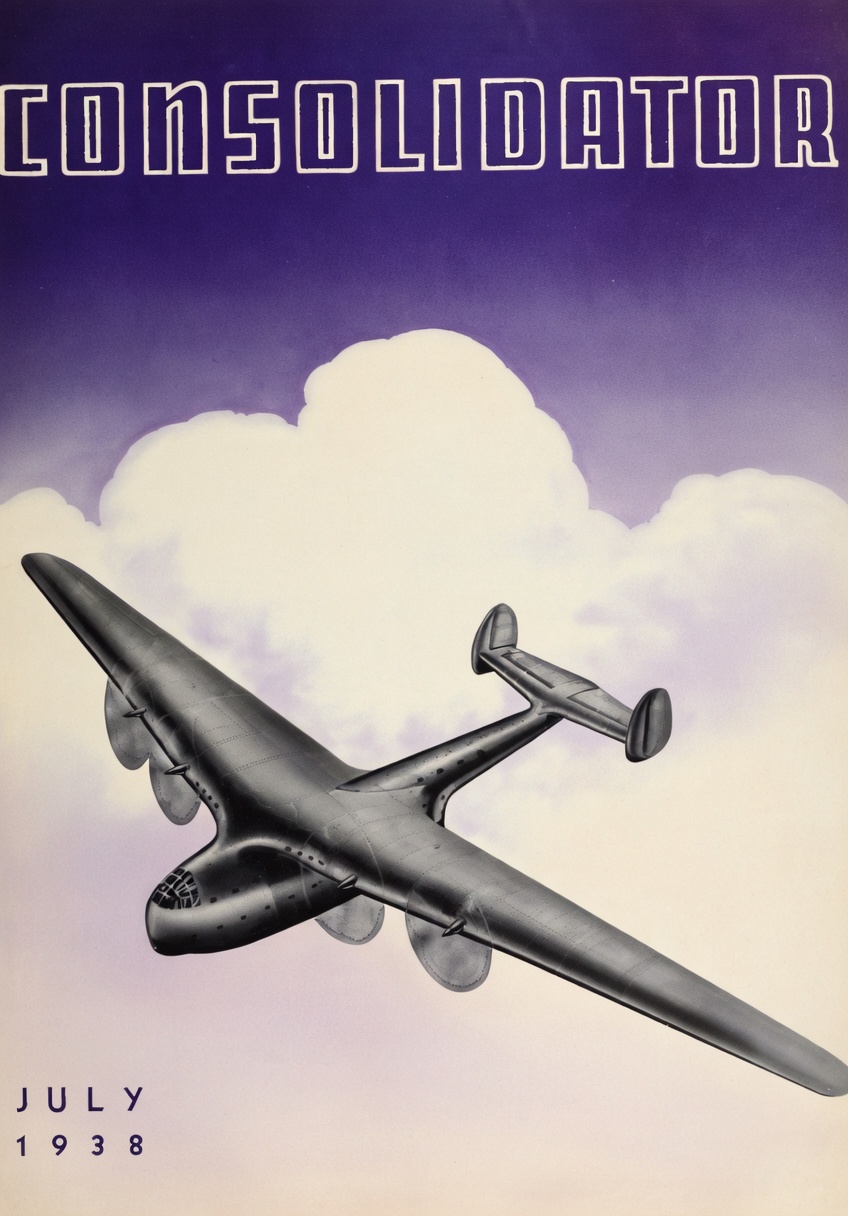
The cover of Consolidated’s corporate magazine *Consolidator* (July 1938 issue), featuring a rendering of Consolidated’s 100-seat flying boat. Image processed by lmarena.ai
The main problem that arose when accommodating passengers in the wing was the division of the cabins by the wing bulkheads. This was resolved by installing main bulkheads on either side of each compartment and using auxiliary ribs between them, which did not reduce the effective height of the compartment. Designing the wing to accommodate passengers inside it had another advantage. The skin used to resist the wing’s normal bending loads would be sufficient without additional reinforcement and would be capable of withstanding the pressure loads encountered during flight in the tropopause.
Thus, Consolidated developed a design for a 100-seat flying boat. This aircraft, equipped with four supercharged engines and having a total weight of 168,000 pounds (762,050 kg), was capable of meeting Pan American’s requirements, achieving a minimum average cruising speed of 240 miles per hour (386 km/h) on a 5,000-mile (8,045 km) flight. Four liquid-cooled engines, each rated at 2,150 l.s., are mounted between the wing spars, and their drive shafts rotate the propellers. These engines are accessible during flight for maintenance and minor repairs.
The interior of the flying boat is designed to accommodate 36 passengers in the wing and the remaining 64 passengers in the hull, in two- and four-person cabins. For daytime use, the boat features swivel seats with adjustable seating positions and comfortable upholstery. For nighttime use, these seats quickly convert into comfortable lower berths. The upper berths lower down from the wall like the upper bunks in Pullman cars. There is sufficient space between the upper and lower berths to sit upright. All two-person cabins are equipped with a convenient combination sink and toilet, while occupants of four-person cabins can use the twelve toilets located throughout the airship.
In addition to beautiful carpeting and decor, each cabin is fully soundproofed and equipped with air conditioning that ensures there are no drafts. The temperature, pressure, and humidity inside the entire flying boat are regulated from a central control panel.
The dining room, located in the center of the ship’s hull, with all passageways and staircases leading directly to it, can accommodate 18 people at a time. While dining, guests can enjoy a beautiful view from the window next to their seat. Amenities for relaxation, writing, and strolling further enhance passengers’ comfort.

Left: layout of a two-person cabin for night flights; center: four-person cabin equipped for daytime flights; right: dining room. Image processed by lmarena.ai
The crew is accommodated in two separate cabins. The larger of the two cabins is located in the stern of the flying boat and can accommodate seven people. In addition to seven large bunks, this cabin has a toilet and a sink. The cabin also has lockers for the crew members’ personal belongings. The other cabin, designed for two crew members and equipped with berths and lockers, is located in the bow of the flying boat.
The kitchen is located next to the dining room, closer to the bow of the seaplane, which makes it convenient to serve passengers. The kitchen is equipped with water tanks, a stove, a refrigerator, a sink, and numerous cabinets for storing food and kitchen utensils. These items are arranged in such a way as to provide maximum convenience for the crew members working in the kitchen and to avoid causing them confusion.
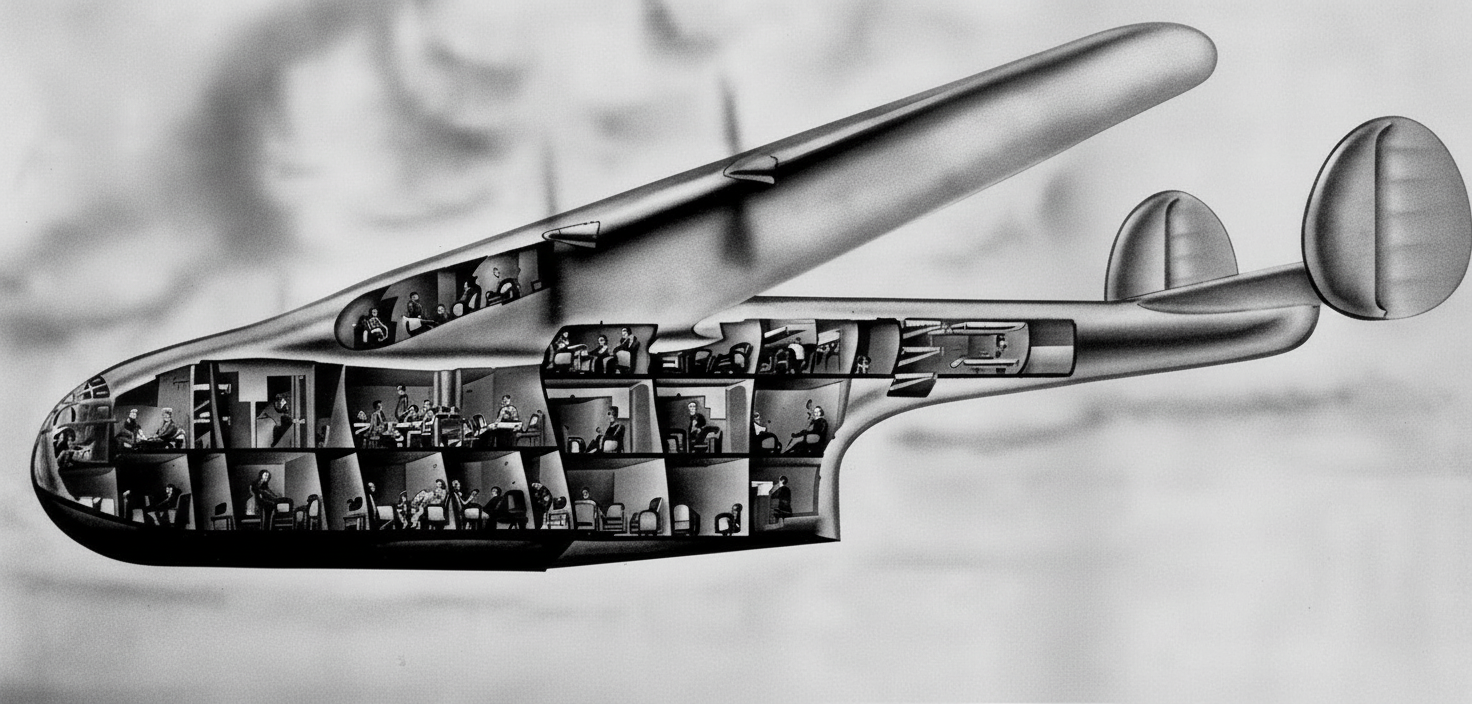
A partial cross-section showing the layout of the compartments inside Consolidated’s 100-seat flying boat design. Image processed by lmarena.ai
All standard carry-on luggage will be delivered to the passengers’ respective cabins on the aircraft. Heavier luggage, such as suitcases, will be placed in the mail and cargo compartments. There are three such compartments in the flying boat: the first in the nose, directly below the cockpit; the second in the left wing console; and the third in the tail section of the hull. All of these luggage compartments can be accessed both from the inside and from the exterior of the aircraft, which facilitates loading and ensures easy access even during flight. Mail and cargo can be arranged in such a way as to balance the flying boat under various loading conditions.
The flight deck occupies the entire upper deck in front of the crew cabin. The flight deck houses the workstations for the first pilot, second pilot, flight engineer, radio operator, and navigator. The pilot and co-pilot, located at the forward end of the hull, have an excellent view in all directions. The radio operator and navigator are positioned on either side immediately behind the pilots, while the flight engineer is located at the rear of the flight deck. This layout provides each crew member with sufficient space to perform their duties. The navigator has a large desk and can read instrument readings through the front and side windows. The radio operator has a full set of transmitting and receiving radio equipment at their disposal.
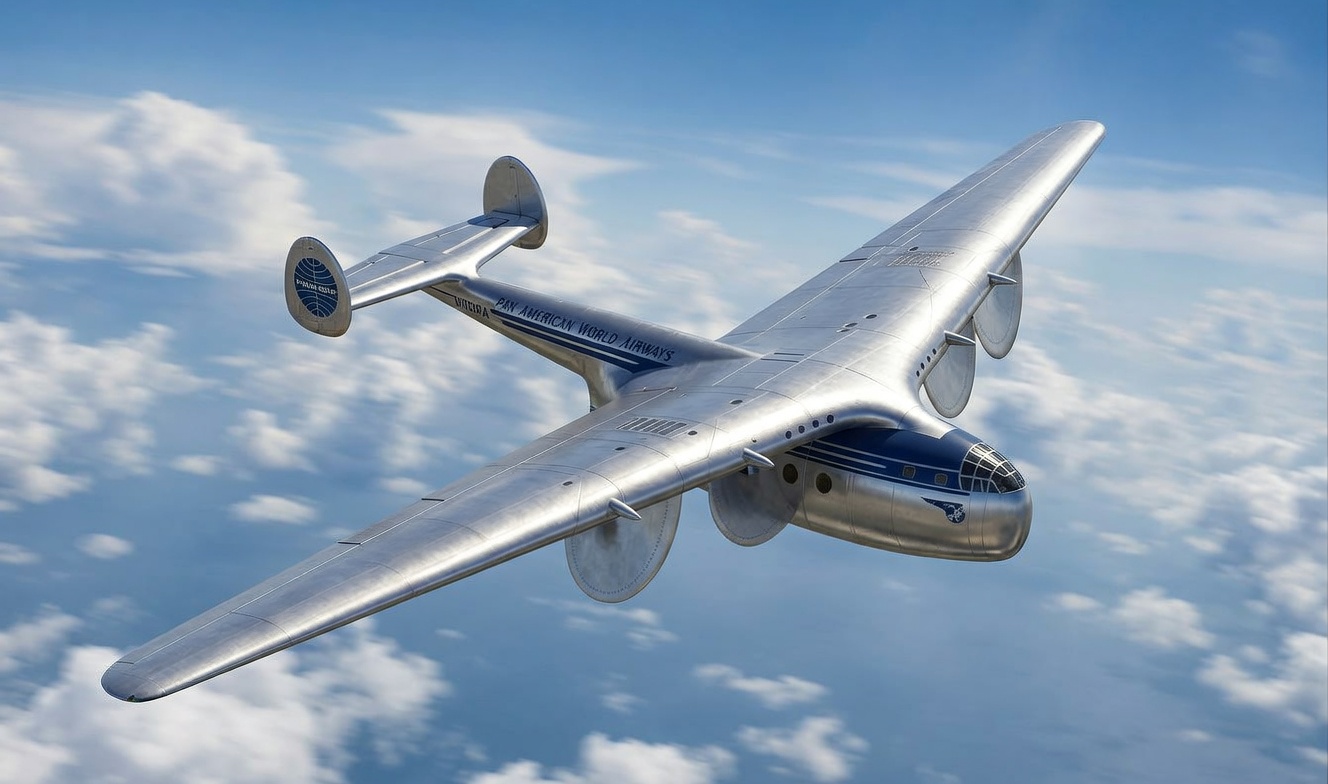
A 100-seat flying boat from Consolidated in flight. Image generated by lmarena.ai
Technical specifications of Consolidated’s 100-seat flying boat:
Total weight 168,000 pounds (76,205 kg)
Wingspan 194 feet (59.1 m)
Wing area 5,450 square feet (506.3 m²)
Overall height: 31 feet (9.5 m)
Overall length: 102½ feet (31.2 m)
Fuel capacity: 8,450 gallons (31,987 L)
Payload: 25,000 pounds (11,340 kg)
Maximum speed at 20,000 feet (6,096 m): 276 miles per hour (444 km/h)
Range at 20,000 feet (6,096 m) in still air: 5,000 miles (8,045 km)
Stall speed at sea level (½ fuel reserve, flaps extended, engines running): 78 miles per hour (126 km/h)
Service ceiling: 30,000 feet (9,144 m)
Time to climb to 20,000 feet (6,096 m): 54 min
Rate of climb at sea level: 680 feet per minute (207 m/min)
Power of each engine at an altitude of 25,000 feet (7,620 m): 2,150 l.s. (2,600 l.s. with turbocharging)
источник: T. P. Hall, Project Engineer «Consolidated 100-Passenger flying boat» «Consolidator» July, 1938
Translation first published at – https://vk.com/@710541705-consolidated-100-passenger-flying-boat