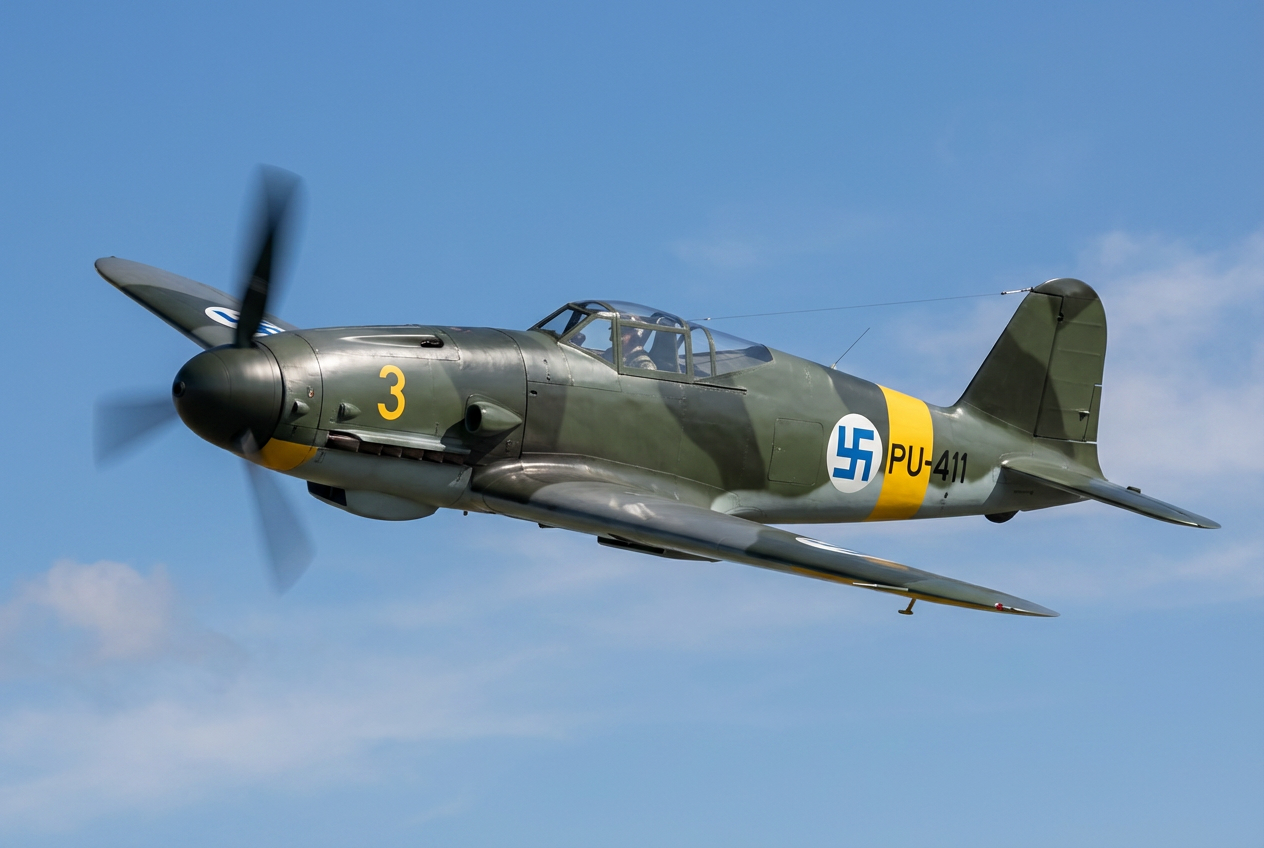
The Messerschmitt in Finnish. The VL Puuska fighter, which arrived too late for the war and was intended to be a low-cost alternative to the Bf-109

Quite some time ago—more than 10 years ago—we had an article on our website dedicated to Finland’s own fighter jet, the VL Pyörremyrsky. The aircraft described below was a logical successor to that fighter—a more affordable version of it. Just like the Pyörremyrsky, the aircraft was heavily influenced by the German school of aircraft design. But let’s take it one step at a time.
A Crisis in the Skies and Desperate Measures by Finnish Aviators
By the early 1940s, the Finnish Air Force was in the midst of a severe structural crisis. After the severe hardships of the Winter War and with the onset of the Continuation War, material losses were mounting at an accelerating rate, while foreign deliveries of new fighters were irregular and failed to meet combat requirements. The shortage of modern aircraft became a critical factor that directly affected the country’s ability to maintain air superiority over its own front lines. Under these circumstances, Finnish engineers, technicians, and pilots were forced to resort to extreme measures. Special search teams were organized on the battlefields to recover downed Soviet aircraft that appeared to be beyond repair. Charred fuselages, mangled wings, and damaged engines were dismantled, transported to repair shops, and subjected to lengthy restoration work. Finnish mechanics often assembled new aircraft from parts of several different planes, replaced missing components with homemade substitutes, and managed to return them to service. This practice clearly demonstrated just how desperately the country needed every airworthy aircraft and led the leadership to conclude that it was necessary to establish its own mass production capable of providing the Air Force with a source of military equipment independent of imports.
Valtion lentokonetehdas: The Birth of the State Aircraft Factory
The realization of the country’s strategic dependence on foreign supplies led to the decision to establish a full-cycle national enterprise. In the late 1930s, the company Valtion lentokonetehdas was founded, intended to serve as the foundation of Finland’s military aircraft industry. Initially, the plant was primarily engaged in assembling licensed models, repairing equipment imported from abroad, and producing training aircraft; however, it quickly became clear that the country needed a full-fledged design bureau and its own production lines. The company was located in Tampere, where a team of engineers capable of solving complex problems in aerodynamics, structural strength, and technological adaptation gradually took shape. The plant implemented advanced planning methods, built test stands, and established partnerships with local metallurgical and woodworking enterprises. It was this organization that was tasked with developing a lightweight, manufacturable, and relatively inexpensive fighter jet that could be produced with limited resources and replace costly foreign counterparts. The work of Valtion lentokonetehdas laid the foundation that enabled the Finnish aviation industry to attempt to build its own combat aircraft that met the demands of the time.
The Road to the Sky: The Development of a Fighter Jet and German Influence
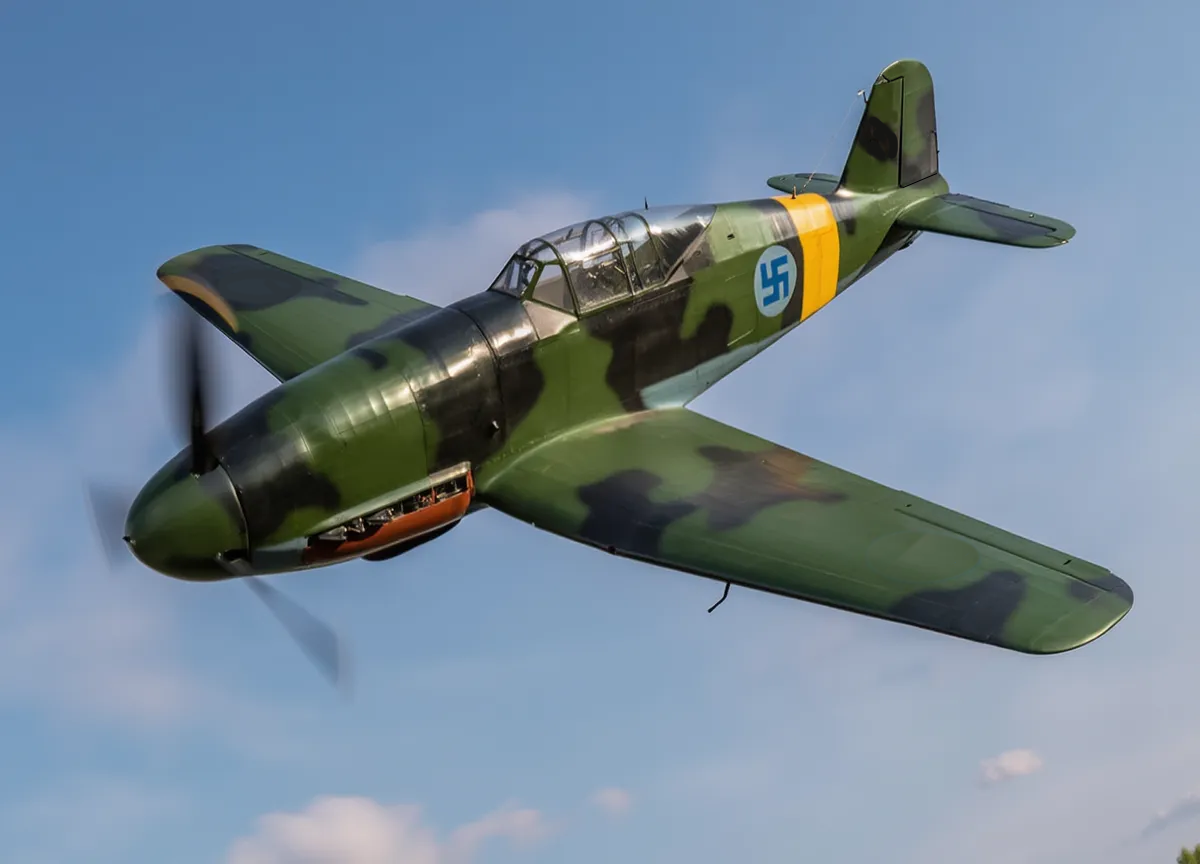
The design of the VL Puuska fighter began in the midst of combat operations, when the need for a modern front-line aircraft had reached its peak. The design bureau set itself the task of creating an aircraft whose flight characteristics would rival the leading models of the time, while remaining significantly cheaper to produce and easier to train pilots to fly. The German school of aircraft design was chosen as a technological and aerodynamic benchmark, specifically the solutions refined on the Bf 109 family of fighters. Finnish engineers carefully studied the layout, wing profile, engine placement, and landing gear configuration, striving to replicate proven successes while adapting them to local manufacturing realities. A significant portion of the metal frame was replaced with wooden spars and plywood skin, which drastically reduced the demands on the metallurgical infrastructure and simplified assembly at small factories. The powerplant was also selected with availability in mind: the project focused on using licensed or captured engines that could be repaired in Finnish workshops. Despite careful planning, the aircraft’s development was delayed due to interruptions in the supply of components, the need for retesting, and the gradual reduction of military orders toward the end of the conflict. The first flight took place after active hostilities had ceased, and the fighter remained a prototype that never made it into production. Nevertheless, the project demonstrated the Finnish industry’s ability to independently develop a modern combat aircraft and showed that, even under severe constraints, it is possible to create aircraft that are conceptually on par with the world’s leading counterparts.
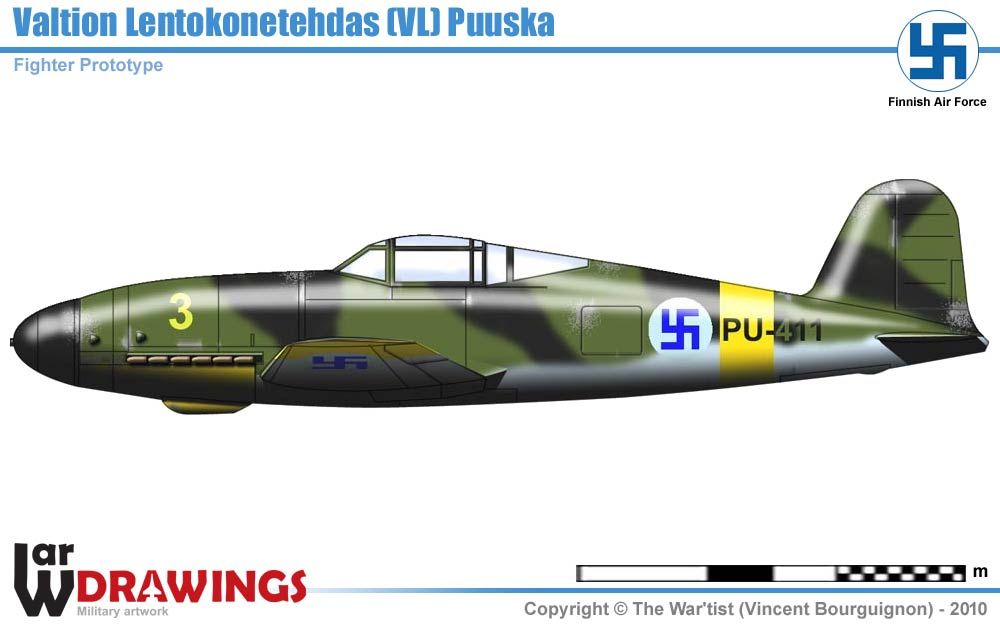
Tactical and Technical Specifications
- Engine: 12-cylinder inline, liquid-cooled, with 1,475 l.s. of power
- Maximum speed: 620 km/h at an altitude of 6,000 m
- Flight range: 850 km
- Practical ceiling: 11,500 m
- Crew: 1 person
- Armament: 2×20 mm aircraft cannons, 2×13.2 mm machine guns
- Length: 9.2 m
- Wingspan: 10.8 m
- Wing area: 18.5 m²
- Curb weight: 2,800 kg
- Maximum takeoff weight: 3,500 kg
Sources:
https://aircraft.fandom.com/wiki/VL_Puuska
https://www.secretprojects.co.uk/threads/vl-finnish-pre-1945-projects-and-prototypes.621/