The American-Style Golden Eagle: Why the Revolutionary F-16 FSW with a Reverse-Swept Wing Never Conquered the Skies

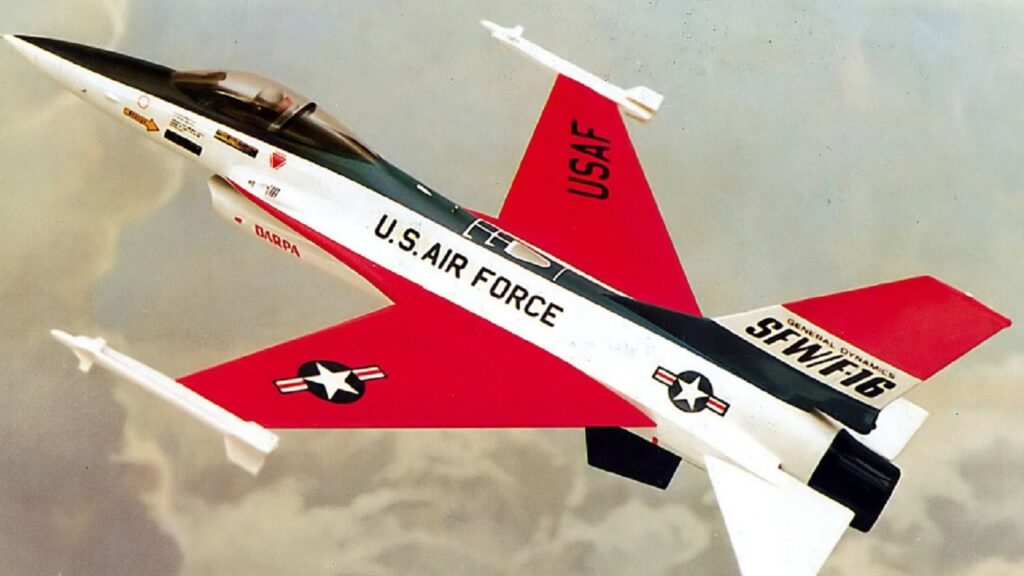
Typically, an aircraft’s aerodynamic configuration is an integral feature of the model. Engines may be replaced or additional equipment installed on an aircraft, but the wings and tail section always remain unchanged. However, the American F-16 fighter breaks this rule. All kinds of wings have been tested on it; there was even a variant with a reverse-swept wing, similar to that of the Russian Su-47 “Berkut.” That is the subject of this article.
Aerodynamic Experiment: The Birth of a Concept
In the early 1980s, American experts from NASA and General Dynamics set out to test the aerodynamic advantages of a reverse-swept wing in practice. The fourth-generation F-16 fighter jet was ideally suited for this purpose. Its digital remote control system already ensured flight stability despite the airframe’s inherently unstable configuration, making the platform a ready-made test bed for risky experiments. The standard wing with positive sweep was removed and replaced with an experimental version featuring a reverse sweep angle of approximately forty degrees. The first flights confirmed the theoretical calculations: the aircraft demonstrated outstanding maneuverability at high angles of attack and improved performance during takeoff and landing.
The Wing That Bent: Engineering Challenges
Aeroelasticity became the main obstacle to the transition to mass production. As speed and g-forces increase, the inverted wing under load tends to twist, which automatically increases the angle of attack and intensifies deformation. Without structural reinforcement, this leads to the failure of the wing’s load-bearing surface. In the 1980s, available aluminum alloys lacked the necessary specific stiffness, and composite materials were still in their infancy. Engineers had to compensate for the lack of strength by complicating the control system and adding extra kilograms to the structure, which negated the aerodynamic benefits. The program quickly shifted from the category of potential combat aircraft to that of purely research platforms.
Why “The Sky” Was Canceled: Reasons for the Series’ Cancellation
The decision to wind down this promising program was driven by a combination of technical and economic factors. Military customers demanded an immediate increase in combat effectiveness without the risks associated with untested materials. At the same time, the F-16XL project, featuring a “snipe-wing” design, was under development; it offered more predictable performance characteristics and lower modification costs. In addition, programs to reduce radar cross-section were already on the horizon, requiring a completely different aerodynamic architecture. The experimental F-16 FSW accomplished its objectives, gathering unique data on the aircraft’s behavior in non-standard flight conditions, but there was no practical reason to turn it into a production fighter. Budgets were redirected toward developing technologies that were guaranteed to enter service within the next decade.
The Legacy of the F-16 FSW and Its Connection to the “Berkut”
The concepts tested on an American experimental test bed found new life years later in the Russian aviation program. When designing the Su-47 “Berkut,” engineers at the Sukhoi Design Bureau relied on the same principles of reverse sweep, but now had access to modern carbon-fiber composites and automated systems for damping aeroelastic vibrations. The Russian aircraft proved the concept’s viability in flight, but it, too, remained a one-off due to shifting strategic priorities and economic realities. Both projects demonstrated that revolutionary aerodynamics require revolutionary materials, and that the industry’s readiness determines the fate of innovations more often than the aircraft’s flight performance itself.
Technical Specifications:
- Base model: F-16A Fighting Falcon (prototype)
- Wing type: reverse sweep, angle of approximately 40°
- Length: 15.06 m
- Wingspan: 9.45 m
- Maximum takeoff weight: approximately 16,500 kg
- Powerplant: one Pratt & Whitney F100-PW-200 turbojet engine
- Maximum speed: over 2,100 km/h (in experimental modes)
- First flight of this variant: 1983
- Status: research prototype; never entered mass production
Conclusion
The history of the F-16 FSW remains a notable chapter in the annals of experimental aviation. The aircraft failed to take to the skies not because of an aerodynamic flaw, but due to the objective technological limitations of its time. It served as a bridge between theory and practice, proving that reverse sweep can radically improve maneuverability and controllability. Today, the data collected by this aircraft is used in the design of unmanned systems and next-generation combat aircraft. A revolution in aerodynamics is always ahead of its time, but it is precisely such bold experiments that lay the foundation for future victories in the sky.