An article by Dmitry Mazarchuk from the WARSPOT website, dated June 8, 2019
Contents:
In April 1509, the 18-year-old Henry VIII Tudor ascended the English throne. Like many other young monarchs, he wished to make a name for himself through military exploits. A well-read and broadly educated prince, he dreamed of repeating the exploits of his ancestors—Edward III, who reigned from 1327 to 1377, and Henry V, who reigned from 1413 to 1422, whose victories on the battlefields of the Hundred Years’ War have gone down in history. Upon ascending the English throne, Henry VIII joined the anti-French alliance and, in 1512, led his fleet to the neighboring coast.
England in the Holy League
Less than two months after his accession to the throne, Henry VIII married the Spanish infanta, to whom he had long been betrothed and who had been living in London for several years. His marriage to Catherine of Aragon drew the young monarch into a complex political constellation, at the center of which stood his father-in-law, the highly experienced King Ferdinand II. Over the course of several decades, Ferdinand of Aragon had been building a network of marital alliances and treaties that would enable him to claim hegemony in Western Europe. The most obvious and most serious opponent of these plans was the Kingdom of France.
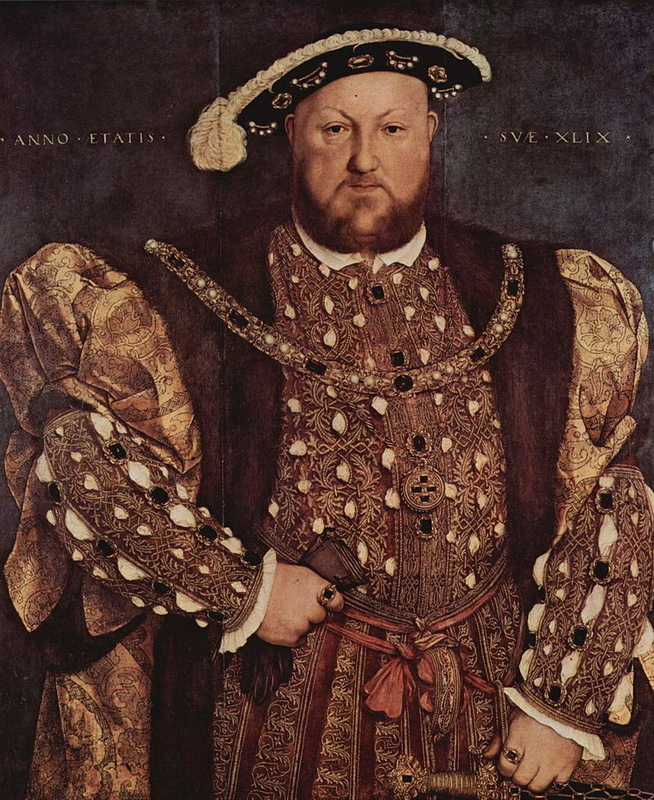
Henry VIII of England. Artist: Hans Holbein the Younger. commons.wikimedia.org
Despite some hesitation caused by the advice of the inexperienced king’s counselors, in May 1510 Henry signed an alliance treaty with Ferdinand, and in November 1511 he joined the Holy League. This alliance, which united several European states (Spain, Venice, and the Papal States), was aimed at driving France out of the Apennine Peninsula, where the Italian Wars—which had begun in 1494—were still raging at that time.
By joining the Holy League, Henry VIII was inevitably heading toward war with France, which he was bound to begin in April of the following year. The winter and spring of 1511–1512 were spent making preparations. One of the key roles in this endeavor was entrusted to Thomas Wolsey, the provost of the cathedrals in Lincoln and Hereford. Wolsey held the important court position of almoner, which allowed the clergyman to communicate directly with the monarch. In preparation for the 1512 campaign, it was Walsy who was tasked with equipping the fleet, which was particularly significant since the English fleet was to become the main instrument of warfare. By all accounts, the almoner proved himself capable. It was no coincidence that the chronicler Raphael Holinshed noted the extraordinary speed with which the necessary preparations were made in the navy and the army.
The ideological justification for the war against France was a breve (brief letter) sent by Pope Julius II on March 20, 1512. In this document, the Supreme Pontiff stripped Louis XII of Valois of the title of King of France, transferring it to Henry of England, and even promised to personally place the disputed crown upon the latter’s head. After that, there was no time to delay. In late April 1512, Thomas Wall, Herald of Lancaster, arrived in France with a declaration of war. This came as no surprise to Louis XII, as the continent had been closely monitoring his neighbor’s preparations. However, France was heavily engaged in military operations in Italy at the time, and England’s declaration of war was a bad sign for the French king: he now faced a two-front war.
Military Plans and Preparations of the British Navy
The 1512 plan of military operations called for a two-pronged attack. The first was the English Channel and the coasts of Brittany and Normandy (commander: Admiral Sir Edward Howard); the second was Aquitaine (commander: the Marquis of Dorset).
Howard was tasked with ensuring the safe passage of merchant ships in the waters surrounding the British Isles. The instructions he received required the ships to patrol between London and Calais in England and Brest in France.
Edward Howard’s fleet consisted of 18 ships, among which the flagship “Regent”—built in 1488 on the model of a French carrack—the 800-metric-ton “Sovereign” (Sovereign), and the new ships “Mary Rose” and “Peter Pomergranate.” The other vessels were chartered from merchants and were not specifically intended for military operations. Howard undertook to hire captains, 1,500 sailors and gunners, and 1,500 soldiers—a total of 3,000 men. In addition, his ships carried the so-called “King’s Spears”—a detachment of young gentlemen selected by the monarch to serve as his personal bodyguards. Six thousand pounds sterling were allocated from the treasury to supply the fleet with everything necessary.
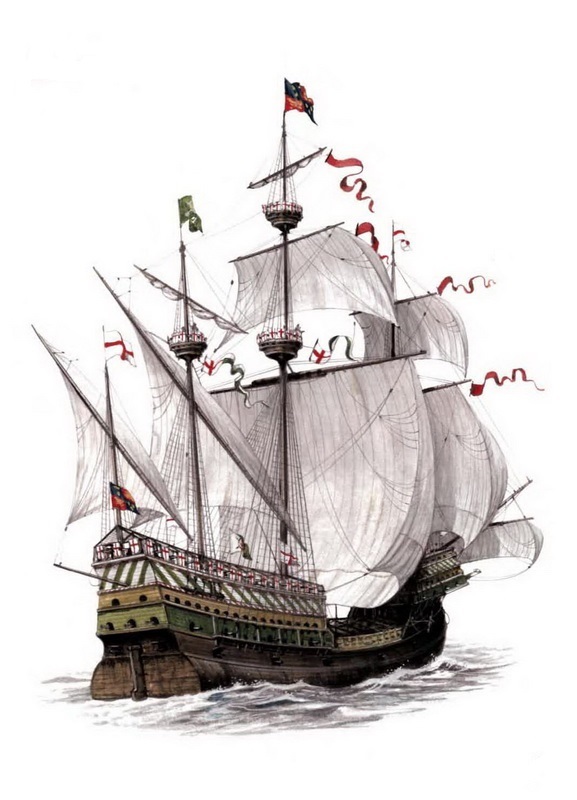
The English ship “Sovereign,” built in 1488. Displacement: 800 metric tons; length: 38 meters; beam: 12 meters. Armament: 100 firearms, including 69 cannons. At the Battle of Saint-Mathieu, it was under the command of King Charles’s closest friend, Brandon, and Henry Guildford. Source: Konstam, A. Tudor Warships (1). Henry VIII’s Navy (New Vanguard 142) / A. Konstam. — N.Y.: Osprey Publishing, 2008. — p. 11
In essence, equipping the fleet was a joint responsibility of the state and the commander (admiral). The latter was responsible for recruiting not only sailors and ship’s gunners, but also soldiers for the expeditionary corps. Captured prizes were to be divided equally between the king and the admiral. In addition, the monarch was entitled to the ransom for all prisoners of the rank of captain and above, as well as the artillery from all captured enemy ships.
Operations of the British Navy
Howard’s fleet spent the second half of April in the English Channel, seizing fishing boats and gathering intelligence on the French navy’s preparations. Since the French were not prepared for a naval battle, the British fleet remained virtually inactive. On only one occasion did the ships escort the Dorset Army to its landing in the Bay of Biscay, although there was no particular need to do so.
To keep the soldiers occupied in some way, the Lord Admiral launched two landings on French soil—at Bertume and Crozon, near Brest—where the English ravaged the surrounding settlements for several days. The soldiers “advanced 7 miles inland, burning and ravaging towns and villages,” but due to resistance from the Bretons, they were forced to return to their ships.
After this incident, the English fleet began patrolling the coast of Normandy, “clearing the sea so that no enemy could appear there.” According to Lorenzo Pasqualigo, the Venetian consul in London, Howard’s fleet captured 26 Flemish and about 40 Breton vessels—small craft used for fishing or transporting cargo. In effect, maritime trade in the region came to a temporary halt.
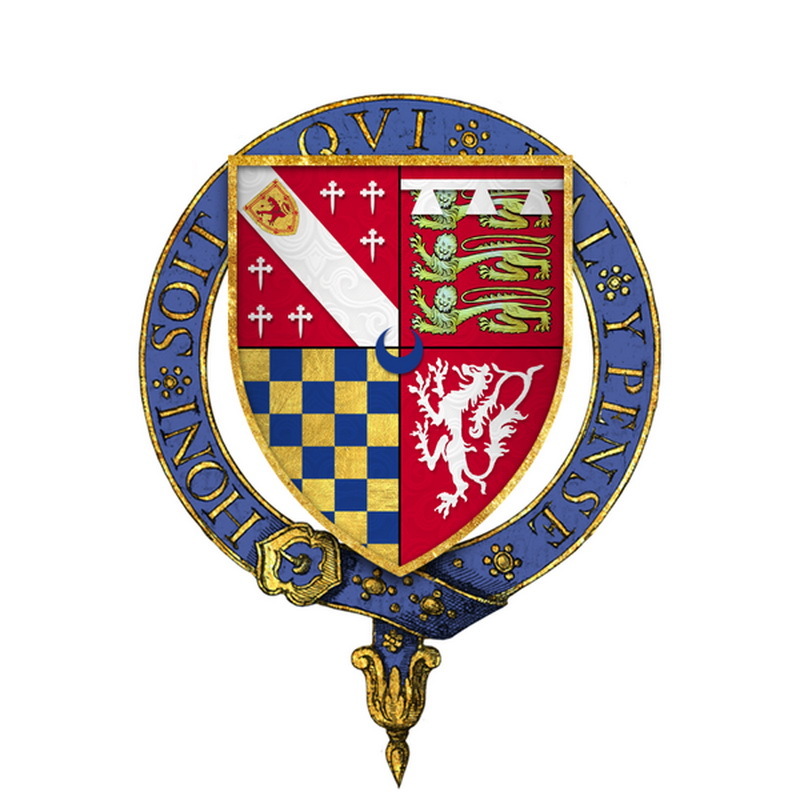
The coat of arms of Lord Admiral Edward Howard. en.wikipedia.org
The English attempts to land and establish a foothold on the coast of Brittany demonstrated the vulnerability of the French defenses in that area. The Duke de Tremouille, appointed by Louis XII as governor of Normandy, was to act with the utmost determination, as spies were reporting on the English military plans. According to these reports, Edward Howard’s fleet was to ravage the mouth of the Seine and land a substantial force there. This landing was part of a broader plan. The invasion of France was planned to be carried out from three directions: from Normandy (Howard), Fuenterrabia (Dorset), and La Rochelle. The delay was caused by the Spanish fleet’s lack of readiness. As for the English, their ships and army were ready to take decisive action at any moment. Brilliant young nobles, friends of the king, were appointed captains of several ships: Thomas Nayvet (the *Regent*), Charles Brandon, and Henry Guildford (the *Sovereign*).
Since the Spanish fleet was still not ready by the end of July, Henry VIII decided to proceed without its support. At a meeting with the ship captains in Portsmouth, the monarch hosted a farewell banquet for them before their departure. Meanwhile, preparations for war by the French fleet were in full swing. Fourteen Norman and eight Breton ships gathered in Brest under the command of Admiral René de Clermont. In addition, Louis XII ordered the recall of a galley flotilla from the Mediterranean Sea under the command of the experienced Admiral Préjan de Bidu.
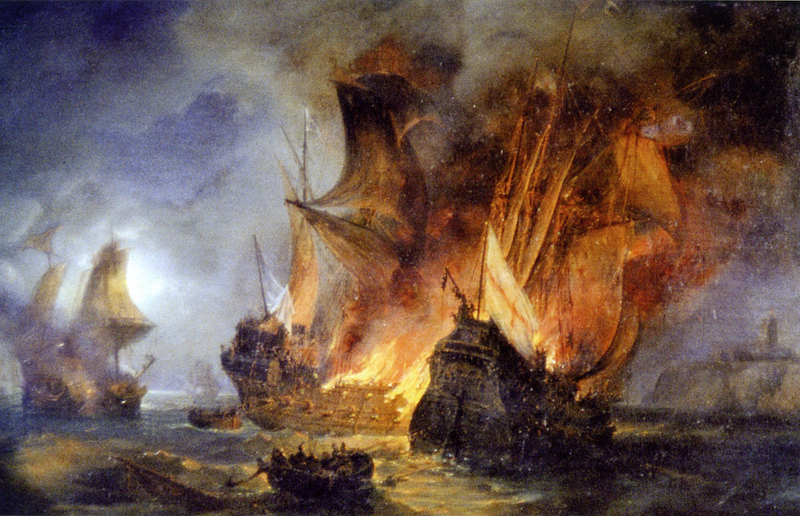
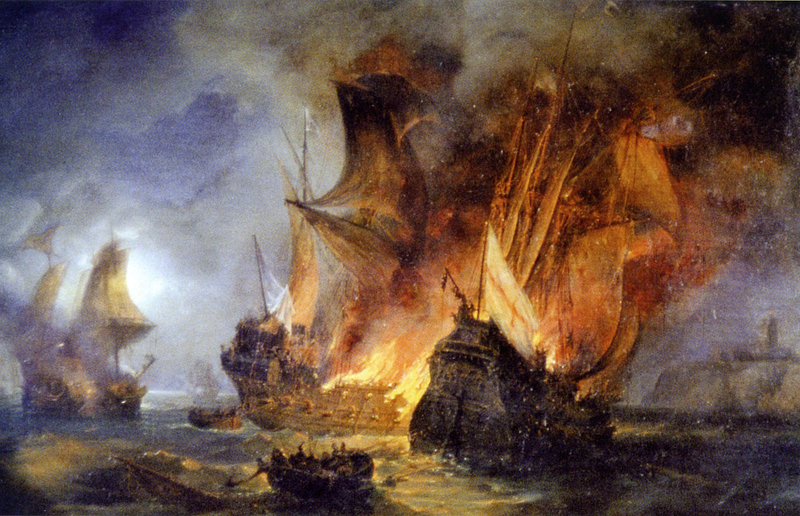
The Battle of the “Cordeliers” against the English Fleet. Painting by Pierre-Julien Gilbert, 1838. Museum of Fine Arts in Brest, France. commons.wikimedia.org
The Battle of Saint-Mathieu
Under the new circumstances, the British had to act decisively—which they did not fail to do. As early as August 10, Howard’s fleet of 25 ships approached Brest. The French ships were anchored outside the harbor, and their commanders, along with their families—a total of 300 people—were almost entirely aboard the *Marie de la Cordelière*, where they were preparing to celebrate St. Lawrence’s Day. Despite the sudden appearance of the English, the French quickly regained their composure and attempted to enter Brest Harbor under the protection of the fortress’s cannons. They succeeded. Only two enemy ships remained in plain sight of the English—the 600-metric-ton carrack *Marie de la Cordelière* and the small *Nef de Dieppe*—which were forced to engage in battle. Because of the nearby cape, it is often referred to as the Battle of Saint-Mathieu.
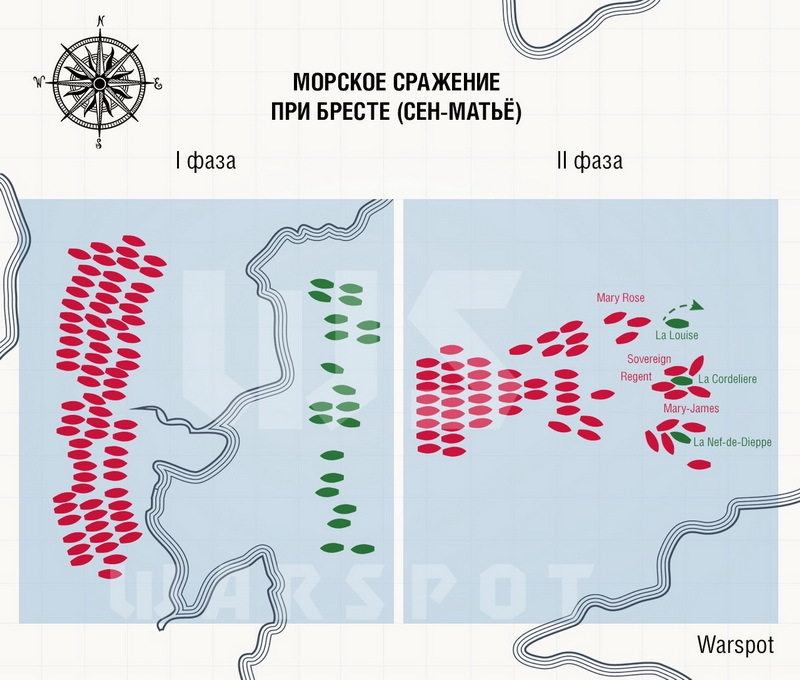
Map of the Battle of August 10, 1512
At around 11:00 a.m., the ships engaged in battle. While the *Regent* was firing on the *Louise*, which was retreating into the harbor, the French flagship, Captain Anthony Agtread of the “Mary James” attacked the “Cordellera,” firing a broadside of six courtes (large-caliber guns) at her. He was then joined by the *Regent* and the *Sovereign*. The ensuing artillery duel is considered the first instance in history of the use of gun ports. Meanwhile, the Dieppe fleet was engaged in battle with five English ships.
The artillery exchange continued for several hours until the *Regent*, under the command of T. Nayvet, boarded the *Cordelliera*. After bringing the two ships side by side, the English dropped anchor, preventing the French from escaping. Despite resistance from French crossbowmen, the English managed to board the “Cordellera.”

Hervé de Porzmoë, known as Primauguet, was a Breton sailor who fought valiantly against the English and died on St. Lawrence’s Day (August 10, 1512). Primauguet commanded the carrack “Marie la Cordelière,” built by order of Duchess Anne of Brittany (wife of the King of France) in 1498. The “Cordelière” was one of the largest warships of its time: with a displacement of 600 metric tons, 40 meters long, and 12 meters wide. The carrack was armed with up to 200 firearms. defense.gouv.fr
Suddenly, for some unknown reason, a fire broke out in its powder magazine. It is possible that the ship’s captain, the Breton Hervé Primogé, deliberately set it ablaze. According to legend, a desperate Primogé declared to his comrades: “Let us celebrate the feast day of Saint Lawrence, who perished by fire!” Soon, the *Cordelière* was engulfed in flames, which then spread to the *Regent*. The crews of both ships were almost entirely lost in the fire. Of the 1,500 on board, only 180 Englishmen and a mere six Frenchmen survived. Among the dead was the captain of the *Regent*, Sir Thomas Nayvet.
Campaign Results and Memories of the Campaign
Due to a shortage of food, the English could not remain far from home for long, so Admiral Howard decided to head back to his native shores. His ships raided the Normandy coast, burning every French vessel they encountered along the way. Meanwhile, Clermont’s fleet remained anchored in Brest and made no effort whatsoever to hold back the enemy. As a result of this “farewell” raid, the English captured several French ships and burned more than 20 boats. Moreover, after landing on the Breton coast, they took about 800 prisoners. Of course, this success was relative. After this “Pyrrhic victory” off the harbor of Brest in late August, Howard’s fleet returned to Dartmouth and Southampton.
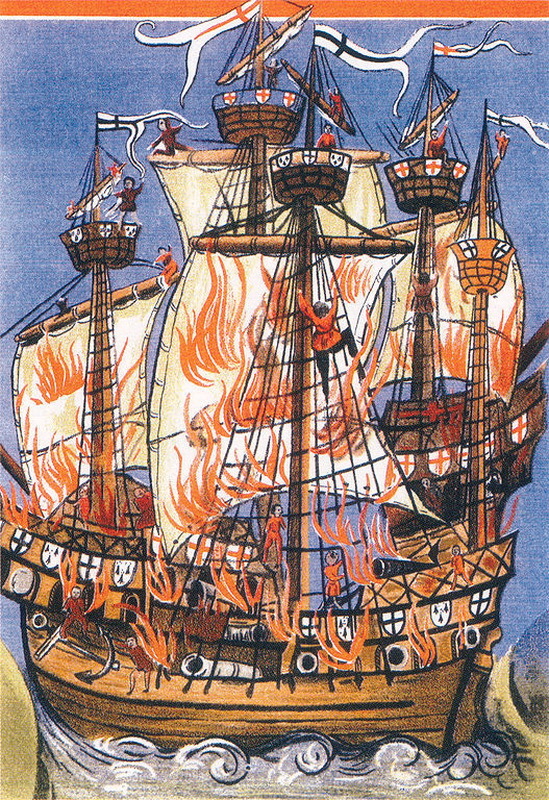
The Battle of “Marie la Cordelière” and “Regent.” Illustration for the poem by Germain de Brie. fr.wikipedia.org
During the naval campaign of 1512, Henry VIII gained neither glory nor new territories. However, the king was satisfied with the performance of the English fleet. Under the command of Edward Howard, the fleet carried out independent operations, not limiting itself to the role of merely escorting the land army. This was all the more noticeable against the backdrop of the Dorset Army’s setbacks in Spain. For his exploits, Howard was awarded the title of Lord Admiral of England, as well as a monetary reward.
In France, the sinking of the *Marie la Cordelière* is considered a symbol of the bravery of “Gallic” sailors, a sentiment that was already reflected in the 16th century in a Latin poem by the Frenchman Germain de Brie. However, his contemporary, the Englishman Thomas More, considered the poem biased and dedicated an entire series of scathing epigrams to it.
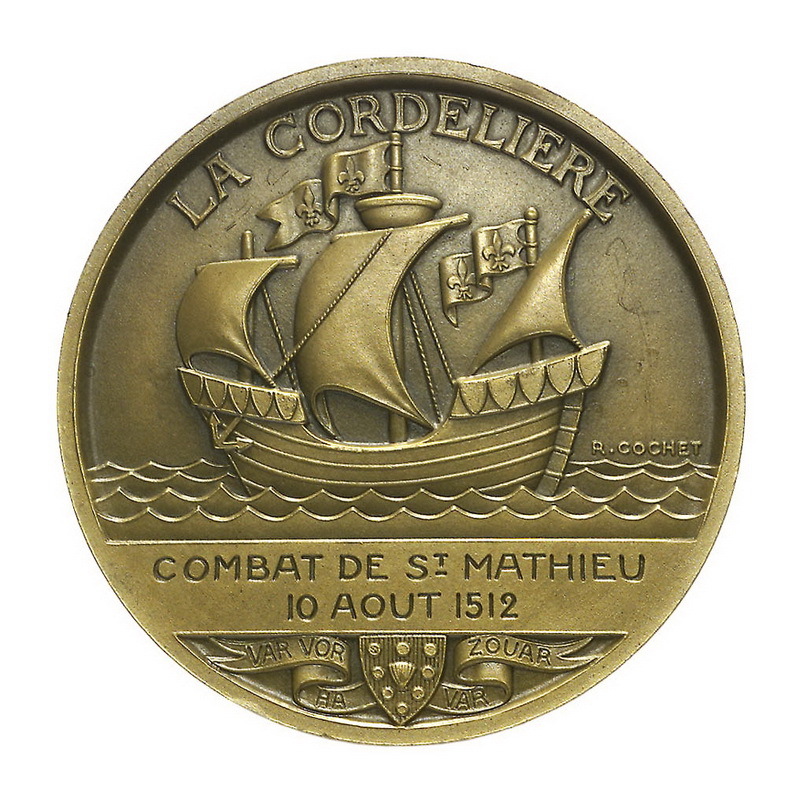
A French medal struck in commemoration of the heroic deed of the “Cordeliers.” 1924, bronze. The obverse depicts a stylized “medieval” ship. Inscription: “La Cordelière,” “Battle of Saint-Mathieu, August 10, 1512.” The reverse of the medal features an image of the French cruiser *Primogès*, launched in Brest in May 1924. collections.rmg.co.uk
Nevertheless, the memory of Primoga’s heroic deed and that of the French sailors aboard the *Cordelière* has not faded even in the 21st century. Alan Simon, a leading figure in the “Celtic Revival” in Brittany, included a story about the ship’s heroic sinking in his rock opera *Anne of Brittany* (2008). As for the sunken ship itself, a fundraising campaign is underway to raise the *Cordelière* from the seabed. More details about these plans can be found on the website lacordeliere.bzh.
Bibliography
-
-
- Ferrajoli, A. A Previously Unpublished Document by Julius II Concerning the Investiture of the Kingdom of France to Henry VIII of England / A. Ferrajoli // Archives of the Royal Roman Society of National History. — 1896. — Vol. 19.
- Hutchinson, R. Young Henry: The Rise to Power of Henry VIII / R. Hutchinson. — London, 2011.
- Jal, A. Marie-la-Cordelière (16th century). A Study for a History of the French Navy / A. Jal. — Paris, 1845.
- Letters and Papers Relating to the War with France, 1512–1513 / Ed. by A. Spont. — London, 1897.
- Loades, D. Henry VIII / D. Loades. — Stroud, 2011.
- Scarisbrick, J.J. *Henry VIII* / J.J. Scarisbrick. — Los Angeles, 1968.
- Stone, D. Jr. “The Herveus of Germanus Brixius” / D. Stone Jr. // Humanistica Lovaniensia. Journal of Neo-Latin Studies. — 1980. — Vol. 29.
- More, T. Utopia. Epigrams. The History of Richard III / Thomas More. — Moscow, 1998
-
Source: https://warspot.ru/14690-den-svyatogo-lavrentiya-po-frantsuzski