Latest Russian Aviation Patents: MAI Has Patented a Heavy Seaplane with a Box-Wing Design

An article about an alternative design concept for a box-wing aircraft was recently posted on our website. And here it is—a very real project for such an aircraft, discovered in the Russian Federation’s patent registry. We’ll discuss it below.
Introduction
Given the growing demand for transportation access to remote and hard-to-reach regions characterized by a lack of developed airport infrastructure, there is a pressing need to develop aircraft that combine high payload capacity with the ability to operate from the water’s surface. A team of engineers at the Moscow Aviation Institute (MAI) has proposed an innovative design for a heavy amphibious aircraft based on a closed-wing configuration with a diamond-shaped geometry. This design aims to achieve a balance between aerodynamic efficiency, payload capacity, and the aircraft’s hydrodynamic stability.
Aerodynamic Configuration of the Wing System
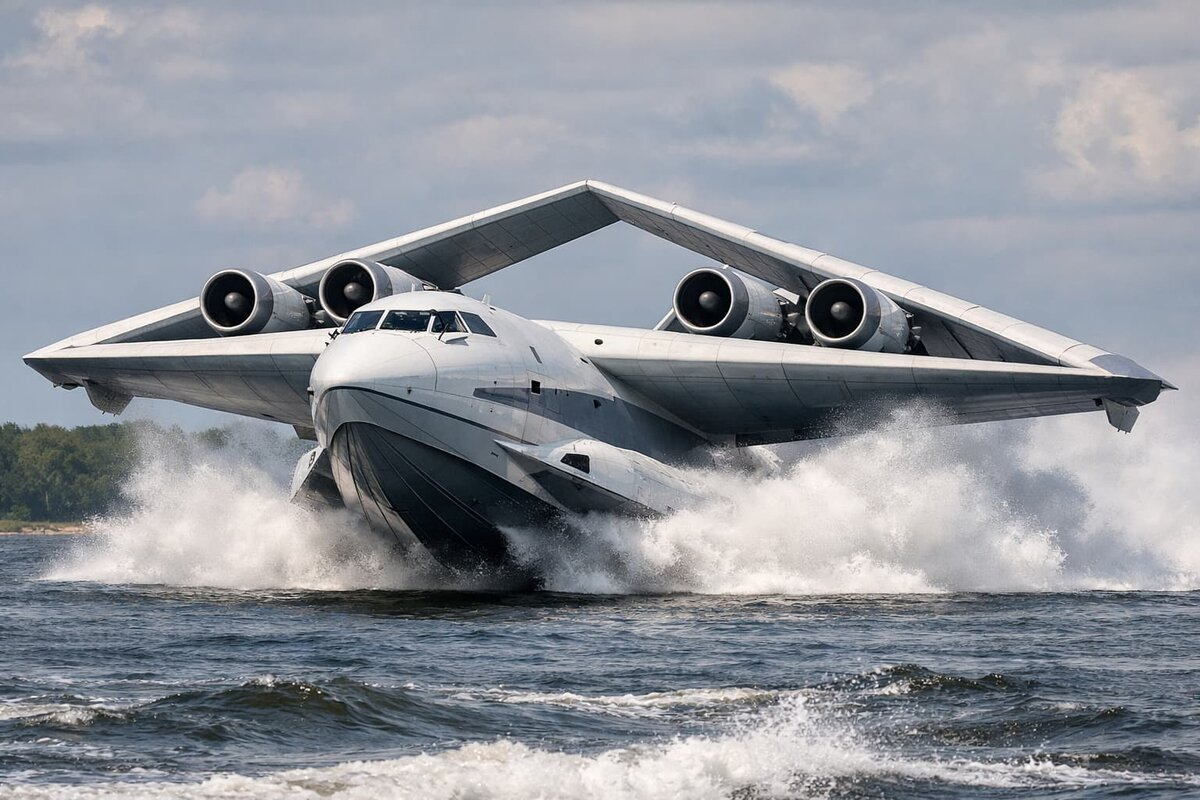
A key feature of the proposed configuration is the integration of the front and rear wing elements into a single, closed, diamond-shaped structure. This architecture helps minimize inductive drag by reducing energy losses in the tip vortices and optimizing the distribution of circulation velocity across the wingspan. Theoretical calculations and numerical simulation results indicate an improvement in the aerodynamic performance of the lifting system while maintaining compact overall dimensions.
The use of a closed-wing configuration makes it possible to achieve a payload capacity comparable to that of heavy transport aircraft with a conventional layout, while keeping the aircraft’s length under 50 meters. The estimated payload ranges from 100 to 120 metric tons, due to the synergistic effect of the wing system working in conjunction with the fuselage, which acts as an additional load-bearing element.
Hydrodynamic Characteristics of the Hull and Ensuring Stability on the Water’s Surface
The fuselage design was developed with a focus on ensuring the aircraft’s stability and controllability while moving on the water. The lower part of the hull features a steep V-shaped cross-section, which helps reduce hydrodynamic drag during takeoff and minimizes impact loads in rough seas. A special ledge—the redan—ensures controlled separation of the craft from the water surface by creating a low-pressure zone and reducing suction forces.
The decision to forgo the use of external floats, traditionally employed in amphibious aircraft designs, was made possible by the increased fuselage width, which provides sufficient lateral stability. The fuselage, which functions as a lifting surface, generates additional lift in both air and water, which has a positive effect on takeoff and landing performance.
Operational Aspects and Potential Applications
The proposed electronic design opens up new possibilities for operating the aircraft in regions with underdeveloped transportation infrastructure, including Arctic zones, coastal areas, and archipelagos. The ability to take off and land on both prepared airfields and natural bodies of water expands the operational capabilities of the transportation system.
Another factor contributing to increased efficiency is the use of the screen effect during flights at low altitudes over water or flat terrain. This physical phenomenon, caused by an increase in lift and a decrease in induced drag near the screen, makes it possible to reduce specific fuel consumption and increase flight range during cargo transport.
Tactical and Technical Specifications:
- Rated payload: 100–120 metric tons
- The aircraft is approximately 50 meters long
- Wing type – Closed, diamond-shaped
- Chassis type – Amphibious, capable of operating on the water’s surface,
- Aerodynamic Characteristics – Use of the screen effect; the fuselage as a lifting surface.
Conclusion
The concept of a heavy amphibious aircraft with a closed diamond-shaped wing system, developed at MAI, represents a promising direction in the field of air transport. The integration of advanced aerodynamic solutions with optimized hydrodynamic characteristics of the fuselage lays the groundwork for the creation of a versatile transport vehicle capable of operating effectively in areas lacking developed ground infrastructure. Further research, including full-scale model tests and a detailed analysis of structural characteristics, will allow us to verify the theoretical advantages of the proposed design and determine the optimal areas for its practical application.