Fired by Biting Down: Could a Helmet-Mounted Gun Stop an FPV Drone—or Break the Soldier’s Neck?

Imagine the final seconds of an attack. A soldier hears the unmistakable buzzing sound, looks up, and sees a small FPV drone approaching at an altitude of only a few meters. His hands are occupied with his rifle, and there is no time to reach for a specialized defensive weapon. All he can do is turn his head toward the target and bite down on a mouthpiece.
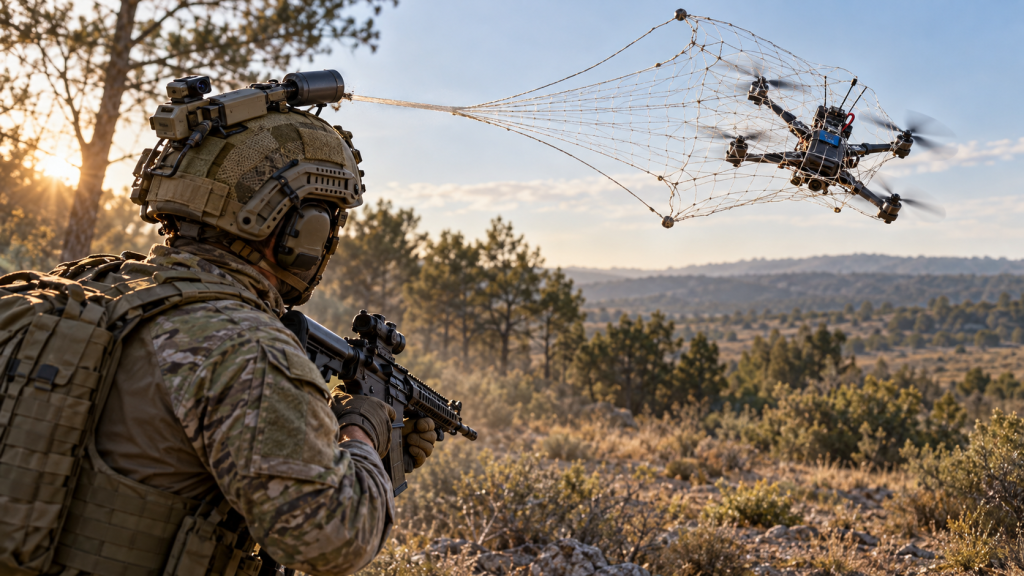
A short barrel mounted on his helmet fires a cloud of pellets—or launches a rapidly expanding net. In theory, the drone loses control and crashes at a safe distance.
That is the system proposed by Moscow-based inventors Yuri Ladyagin and Yuri Gabliya. Their published patent describes a helmet fitted with one or more launchers, a laser designator, and an electronic trigger. The wearer aims by turning his head and fires without using his hands: by biting down on a mouthpiece, issuing a voice command, or allowing a camera to recognize the target and fire automatically.
The proposed ammunition includes shot, buckshot, and entangling nets.
At first glance, the invention looks like something from a science-fiction comic. Yet behind its strange appearance lies a genuine engineering problem: how can an individual soldier receive one final opportunity to stop a drone after conventional detection, jamming, and interception measures have already failed?
The difficulty is that turning the human head into a weapon mount is considerably more complicated than drawing a barrel on a helmet.
The Final Twenty Meters
The system is reportedly intended for use at distances of approximately 10–20 meters. At such ranges, a shotgun-like charge may retain a sufficiently dense pattern, while an expanding net could theoretically envelop a small quadcopter.
Those same twenty meters, however, leave the soldier with almost no time to react.
A drone approaching at 60 km/h will cover 20 meters in approximately 1.2 seconds. At 100 km/h, it will cover the same distance in less than three-quarters of a second. Within that interval, the soldier must hear or see the aircraft, determine its direction, turn his head, align the weapon with the target, and decide whether to fire.
An FPV drone does not have to fly in a straight line. It may appear from behind a tree, building, or terrain feature, change altitude, move sideways, and then turn back toward the target. The closer it gets, the faster it appears to move across the observer’s field of view. A lateral displacement of only a few meters may force the soldier to turn his head sharply while attempting to keep the weapon aligned.
The most difficult component of the helmet is therefore not the gun but the detection system. If the soldier notices the threat only ten meters away, the mechanism may no longer be able to keep pace with events. The system must identify the drone in advance, estimate its trajectory, and display the correct aiming point before it enters firing range.
The Human Head Is a Poor Weapon Mount
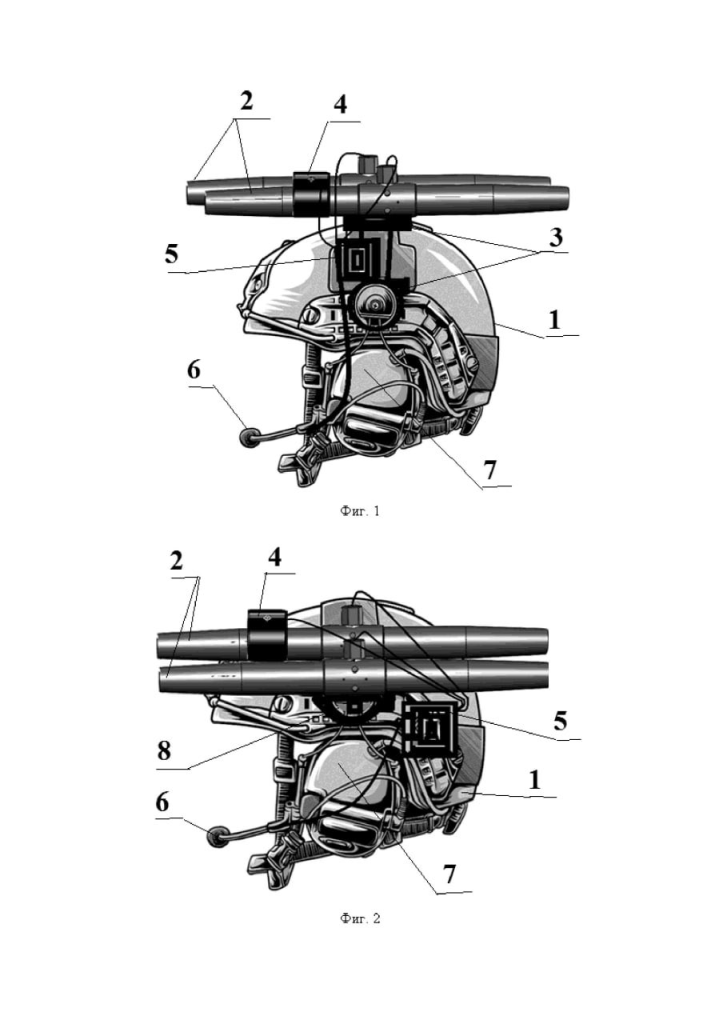
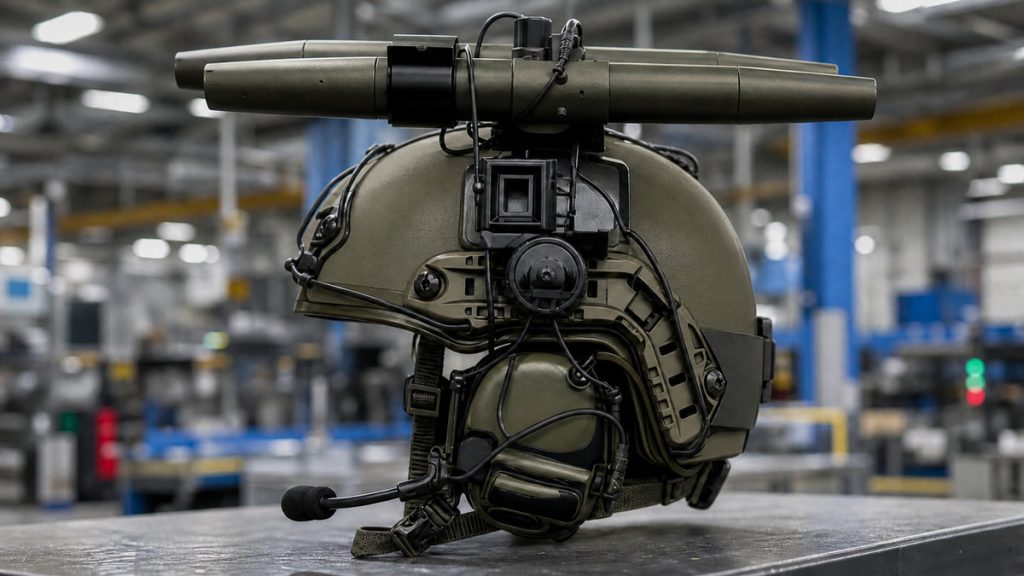
A conventional combat helmet protects the head, but the human neck was not designed to serve as the rotating mechanism of an anti-aircraft mount. Even a relatively small additional mass creates a substantial burden when it is positioned high above or forward of the head’s natural center of gravity.
Military personnel are already familiar with this problem from night-vision devices. Research indicates that helmet-mounted mass increases neck-muscle activation and accelerates fatigue. The location of the added weight matters as much as the weight itself. The farther the equipment is positioned from the head, the greater the moment that the neck muscles must resist.
A barrel, mounting bracket, ammunition, battery, camera, and sight would weigh considerably more than a typical flashlight or monocular. The soldier would have to carry that load while running, crawling, jumping, and making sudden movements. During a fall, the protruding mechanism could catch on an obstacle and transfer the resulting force directly to the neck.
Side-mounted weapons would be particularly problematic. If the gun is installed on only one side of the helmet, it will permanently disturb the balance. When fired, an asymmetrical system will produce not only a rearward impulse but also a rotational moment. Even a modest force applied above and to one side of the head could twist the helmet violently.
A shoulder-fired weapon transfers its recoil into a significant portion of the wearer’s body mass. A weapon attached to a helmet transfers its forces through the head and the small cervical vertebrae connecting it to the torso. These are fundamentally different conditions.
Recoilless Does Not Mean Harmless
The patent’s authors recognize the recoil problem and propose a recoilless arrangement. In one configuration, the forward impulse is balanced by a countermass ejected in the opposite direction. In another, propellant gases are vented through a rear-facing nozzle.
The physics is valid. If a certain amount of mass or gas moves backward, it can compensate for the momentum of the projectile moving forward. But the energy does not disappear—it is merely directed somewhere else.
The countermass version raises an obvious question: what exactly will be expelled backward, and where will it go? Another soldier, a wall, the side of a vehicle, or a tree may be directly behind the wearer. If the countermass remains inside the device and moves only along a short guide, it must eventually be stopped, transmitting at least part of its momentum back into the mechanism.
A gas nozzle creates a different problem: a jet of hot gases and a pressure wave immediately beside the soldier’s head. Even much larger recoilless weapons require a clear backblast area and protection from overpressure. Military safety manuals explicitly prohibit personnel from standing directly behind a loaded recoilless weapon. The hazardous area created by a miniature helmet-mounted launcher would be considerably smaller, but the physical principle would remain the same.
Perfect recoil cancellation is also possible only if the opposing impulses and their axes match precisely. Any asymmetry produces residual recoil or torque. Without data on the device’s mass, ammunition, remaining impulse, and test results, there is no way to determine whether it would be safe for the wearer’s neck.
Acoustic loading presents another problem. The weapon would fire only centimeters from the soldier’s ear. Active hearing protection might reduce the audible report, but it would not eliminate the pressure wave or vibrations transmitted through the helmet mounting. Research into weapon overpressure shows that the danger comes not only from noise but also from the brief pressure spike accompanying the shot.
Shot or Net?
Of the two proposed interception methods, the shotgun-like option is easier to understand. Disabling a quadcopter does not require its complete destruction. Damaging a propeller, motor, battery, or exposed wiring may be enough. The dispersion of the pellets also compensates to some extent for aiming errors.
Pellets, however, cannot distinguish the drone from people standing behind it. Firing upward in an open field is entirely different from firing inside a group, near a vehicle, or within a building. An automatic mode would increase the risk further: a camera error could trigger a shot toward a friendly drone, a bird, or a person.
A net appears safer because it requires less energy and could entangle the drone’s propellers. Yet it must expand before reaching the target. At a range of ten meters, there is very little space and time for this to happen. Wind may deflect the lightweight mesh, while incomplete deployment would turn the net launcher into a system that fires a single slow projectile.
Both approaches share another problem: a damaged drone does not stop instantly. It retains its velocity and continues moving through inertia. If intercepted at ten meters, it may still reach the soldier or crash close enough to cause injury. The presence of an explosive payload makes such a crash especially dangerous.
An individual defensive system must therefore do more than hit the drone. It must alter its trajectory early enough for the disabled aircraft to miss the intended target. Greater interception range improves the chances of this happening—but also requires a more accurate weapon and a considerably more sophisticated targeting system.
Firing by Biting Down
The patent’s most memorable feature is the sensor-equipped mouthpiece that triggers the weapon when the wearer bites down. The logic is understandable: the soldier’s hands remain on his primary weapon, while the firing command can be issued faster than reaching for a button on the helmet or load-bearing equipment.
Under stress, however, people may clench their jaws involuntarily. The mouthpiece would have to distinguish a deliberate command from natural tension, running, falling, or being struck. It could require a particular sequence or pressure pattern, but every additional safeguard consumes precious time.
Voice activation is not ideal either. Engines, gunfire, and shouting may surround the user. The microphone would need to identify a specific command reliably without reacting to similar words or background noise. Moreover, a mouthpiece and voice control would be difficult to use simultaneously because an object held between the teeth interferes with speech.
Automatic operation solves the reaction-time problem but creates another one. A camera must detect a small object against a complicated background, distinguish a drone from a bird or debris, decide whether it presents a threat, calculate lead, and confirm that the firing direction is safe.
The system would then have to open fire automatically from a weapon attached to a person’s head.
A fully automatic version would therefore require far stronger safeguards against unintended discharge than a conventional anti-aircraft system. An error made by a stationary weapon is dangerous. An error made by a weapon that moves with the wearer’s head is dangerous twice over.
The Useful Part of the Patent Is Not the Barrel
Despite these shortcomings, the concept should not be dismissed as a curiosity. It correctly identifies two genuine requirements: soldiers need early warning of approaching drones and must be able to react without releasing their primary weapons.
A panoramic camera, microphones, compact radar, or other sensors could realistically be mounted on a helmet or load-bearing equipment. A visor or headset could indicate the direction of the threat. Gaze-based targeting also makes sense if it is used to select a target rather than physically aim a barrel attached to the head.
The weapon itself would be better placed on the shoulder, primary firearm, backpack, or a separate lightweight mounting. Its weight would then be supported by the torso, and its recoil would not be transferred directly to the neck. A helmet-mounted camera could detect the target, a visor could display the required lead, and the soldier could authorize the launch using a button, voice command, or mouthpiece.
Another possibility would be a small automatic emplacement protecting a squad, vehicle, or fixed position. It could carry heavier sensors, powered drives, and multiple rounds without forcing every soldier to wear a weapon on his head.
A Patent Is Not a Weapon
Publication of a patent does not mean that a functioning prototype exists, that successful tests have been conducted, or that series production is planned. A patent records a principle and possible ways of implementing it. It does not have to prove that the design is practical, safe, or effective under real conditions.
Evaluating the helmet would require data on its mass, center of gravity, residual recoil, torque, pressure near the wearer’s head, and probability of hitting a moving target. The device would then need to be tested on stands and instrumented dummies before any trials involving people.
A practical individual defense system against FPV drones will probably look very different from the patent drawings. The sensors, sight, and warning system may remain on the helmet, while the launcher moves somewhere its mass and recoil can be absorbed by the body or a separate mounting.
That is why unusual patents can still be useful. They take an idea to its extreme and expose the central question. A soldier genuinely needs protection during the final seconds of a drone attack. The human neck is simply unlikely to be the right place for personal anti-aircraft artillery.