Following the failure of the Il-112V program, Russia is preparing a bold response. Two new military transport aircraft are on the way.

The program to develop the Il-112V light military transport aircraft, which had been in development for nearly two decades as a replacement for the legendary An-26, ran into insurmountable difficulties. The aircraft turned out to be approximately 2.5 metric tons heavier than the design specifications, which proved to be a critical factor affecting its flight performance. The TV7-117ST engines installed on the aircraft could not handle the increased load, which ultimately led to the tragedy. On August 17, 2021, an Il-112V prototype crashed in Kubinka, near Moscow, during a test flight—an engine fire proved fatal, the aircraft was unable to reach the runway, and three members of the test crew were killed.
After the crash, the program was effectively shut down. Aviation experts noted that the aircraft was poorly designed and overloaded, and problems with the power plant had been discussed long before the fateful flight. However, the Russian Air Force could not afford to be without a modern light transport aircraft capable of operating from unpaved airfields and delivering cargo to hard-to-reach areas. The response turned out to be unexpected and ambitious: instead of reviving the troubled project, Russia is betting on two new aircraft at once.
Two Solutions: TVRS-44T and Il-212
According to aviation expert Sergey Marzhetsky, the Il-112V is being replaced by two fundamentally different aircraft, each of which serves its own specific purpose. The first is the transport variant of the TVRS-44 “Ladoga,” designated as the TVRS-44T. This project was originally developed by the Ural Civil Aviation Plant as a 44-passenger regional civil airliner to replace the An-24 and Yak-40. However, the military recognized the design’s high potential for adaptation to military transport needs.
The second aircraft—the Il-212—is an entirely new design from the Ilyushin Design Bureau. It is not simply a modernization of the Il-112V, but a fundamentally different concept for a light military transport aircraft with increased payload capacity and an innovative engine layout.
TVRS-44T “Ladoga”: the military version of a regional transport aircraft
The cargo version of the “Ladoga” differs from the passenger prototype in that its fuselage is four meters longer and it features a cargo hatch with a ramp in the tail section, which allows for the mechanized loading of equipment and cargo. The aircraft retains a key advantage of the original design—the ability to operate from unprepared dirt, grass, and snow surfaces, as well as from airfields with short runways.
The TVRS-44T powerplant is based on two Russian-made TV7-117ST-02 turboprop engines, each of which develops 2,400 l.s. of power in takeoff mode and up to 2,600 l.s. in emergency mode. The AV-44 propellers are made of composite materials, which increases efficiency and reduces noise.
The high-wing design protects the engines and propellers from foreign objects during takeoff and landing on unpaved runways. The fuselage is wider than that of the Czech L-610 prototype—2,250 mm at the floor—which allows for the transport of standard military cargo and small-sized equipment.
Technical Specifications of the TVRS-44T “Ladoga” (Military Version)
- Maximum takeoff weight: 18,500 kg
- Load capacity: up to 5 metric tons
- Cruising speed: 500 km/h
- Practical range with maximum payload: 1,200 km
- Range: up to 2,200 km
- Practical ceiling: 7,200 m
- Required runway length at maximum load: 1,500 m
- Crew: 2 people
- Power plant: 2 × TV7-117ST-02, 2,400/2,600 l. s. each
Il-212: Jet-Powered Breakthrough with the Coandă Effect
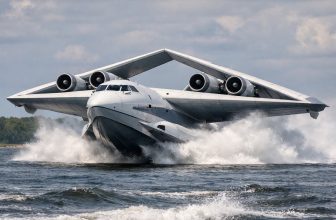
While the TVRS-44T represents an evolutionary development of a proven turboprop design, the Il-212 is a revolutionary step forward. The main feature of the new aircraft is the placement of the PD-8 turbojet engines above the wing. This configuration solves several problems at once: it protects the powerplant from dirt, rocks, and foreign objects when operating from unpaved airfields, and it also paves the way for utilizing the Coanda aerodynamic effect.
As aviation expert Sergey Marzhetsky explains, thanks to the Coandă effect, the gas flow from the jet engines “sticks” to the upper surface of the wing and is directed downward, creating additional lift. This allows the Il-212 to take off from short runways even when heavily loaded, which is critically important for military transport aircraft operating in field conditions.
The Il-212’s estimated payload capacity is 10–12 metric tons, which is twice that of the Il-112V and allows it to transport armored vehicles, light armored vehicles, troop-landing platforms, and oversized cargo that were beyond the capabilities of the previous generation of light transport aircraft. Production of the Il-212 prototype is scheduled to be completed by the end of 2026, as officially announced by the Russian Minister of Defense.
Il-212 Technical Specifications (Design Data)
- Load capacity: 10–12 metric tons
- Engine type: 2 × PD-8 turbojet engines (wing-mounted)
- Design feature: use of the Coandă effect to increase lift
- Capability to operate from unpaved and short runways
- Purpose: transport of armored vehicles, troop carriers, and large military cargo
- Planned completion date for the prototype: late 2026
The Strategic Significance of a Two-Pronged Response
The decision to develop two aircraft types simultaneously—the TVRS-44T turboprop and the Il-212 jet—reflects a flexible approach to building the military transport aircraft fleet. The TVRS-44T, being a more conservative and proven design, will be able to enter service more quickly and meet current light transport needs. The Il-212, in turn, represents an investment in the future, demonstrating Russia’s readiness for a technological leap forward in the field of military aviation.
It is important to note that both aircraft are designed for operation in challenging climatic and infrastructural conditions—from Arctic airfields to field landing sites in special operations zones. This aligns with the Russian Air Force’s current doctrine of operations, in which mobility, autonomy, and the ability to operate in environments with limited infrastructure take center stage.
The failure of the Il-112V program was undoubtedly a serious test for the domestic aircraft industry. However, Russia’s response was not merely a recovery effort, but a proactive one: instead of a single problematic aircraft, the country is receiving two new aircraft, each of which fulfills its own mission profile and together form a balanced light military transport aviation system for decades to come.