From Individual Gerans to a Drone Air Force: Russia Is Building a New Long-Range Strike Infrastructure

When Shahed-136 drones first began appearing in large numbers in the Russian arsenal, the concept seemed remarkably simple. Take a relatively inexpensive unmanned aircraft, place it on a launch rail, program a route, and send it hundreds of kilometers toward its target. Unlike an air-launched cruise missile, it does not require a carrier aircraft. Unlike conventional combat aviation, it does not need a runway.
That simplicity was one of the system’s greatest advantages.
Several years later, however, something rather interesting is happening: an increasingly extensive infrastructure is emerging around long-range strike drones, gradually beginning to resemble a separate branch of aviation.
According to a recent investigation based on commercial satellite imagery and analysis by DroneSec, at least 10 sites across Russia have either appeared or undergone significant expansion to support long-range drone launches. Researchers identified at least 59 new launch rails, approximately 20 of which are noticeably longer than the others. Seven of the ten sites have reportedly already been associated with operational launches.
This is considerably more interesting than the appearance of yet another Geran variant.
Because the story is no longer primarily about the drone itself.
It is about creating a system capable of employing drones on a massive scale.

Why Does a Drone Need an Air Base?
One of the greatest advantages of the Shahed/Geran family is its relatively simple ground infrastructure. Unlike air-launched cruise missiles, these weapons do not require carrier aircraft. Unlike conventional combat aviation, they do not need long runways.
But there is an enormous organizational difference between launching several drones and regularly launching dozens or even hundreds.
The aircraft have to be stored somewhere. Warheads have to be installed and serviced. Fuel has to be delivered. Flight routes must be prepared. Navigation systems need to be checked. Launchers must be positioned so that multiple aircraft can be dispatched within a short period.
And once hundreds of drones are involved, another major problem emerges: logistics.
A primitive launch site therefore gradually turns into a proper complex with storage buildings, garages, maintenance facilities, command infrastructure, transport vehicles, and multiple launch positions.
A good example is the facility near Tsymbulovo in Russia’s Oryol region. Some recent reports have included it among the supposedly “new secret bases,” although that description is somewhat misleading. Infrastructure at the site has been known for several years. Satellite imagery analysis from November 2025 indicated that the complex covered more than 5 square kilometers and included at least 93 garages, 15 storage buildings, and eight permanent launch positions. The facility is now undergoing another phase of expansion.
This is clearly no longer a truck arriving in a field with a few drones.
It is effectively an unmanned aviation base.
Why 59 Launch Rails Matter More Than They Seem
On its own, the figure of 59 launch rails across ten sites does not tell us very much.
Geran drones do not have to remain permanently mounted on their launchers. A rail is used for a launch, after which another aircraft can be installed.
The number of launch positions therefore cannot simply be translated into the number of drones immediately available for use.
What it does reveal is something else: the throughput of the system.
With a single launcher, a large-scale launch inevitably takes time. With several launch lines, multiple aircraft can be dispatched almost simultaneously. The more launch positions available, the faster a large strike wave can be assembled.
For this type of weapon, that matters enormously.
A single relatively slow drone presents a much less demanding target than several dozen aircraft approaching within the same period from different directions.
The effectiveness of the overall system is therefore determined by more than the range or warhead weight of an individual Geran.
It also depends on how many drones can be put into the air within a short period of time.
This is where additional launch infrastructure begins to acquire strategic importance.
Why Are Some of the Launch Rails Getting Longer?
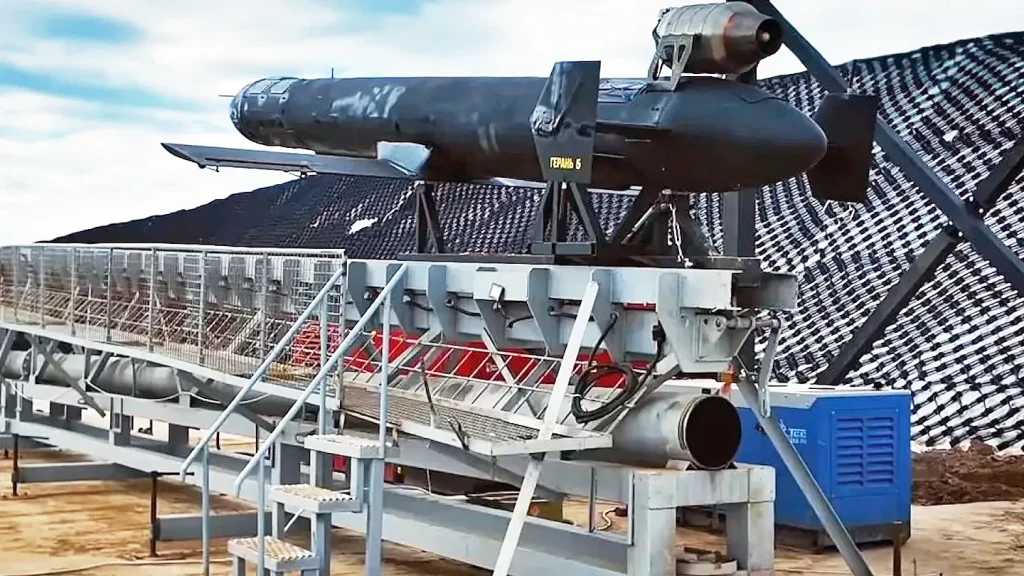
Of the 59 launch rails identified in the investigation, approximately 20 are longer than the standard type. DroneSec analysts have linked this development to the emergence of larger members of Russia’s expanding family of long-range strike drones.
And this is where the story becomes even more interesting.
The original Geran-1 and Geran-2 were relatively simple piston-powered aircraft. But the family has been expanding.
Open sources have reported jet-powered Geran-3 and Geran-4 variants, as well as the larger Geran-5. The latter has previously been described as a new long-range jet-powered strike drone for which even air-launch concepts involving the Su-25 have reportedly been considered.
Reliable specifications for these newer aircraft remain uncertain. Various reports have suggested a range of approximately 450–850 kilometers for the Geran-4 and around 950–1,000 kilometers for the Geran-5. These numbers are better treated as open-source estimates rather than definitive official specifications.
The broader trend, however, is clear.
Geran is no longer a single drone type.
It is becoming a family.
And that changes the nature of the system considerably.
Piston Drones Are Cheap. Jet Drones Are Fast
The classic Geran-2 has one extremely important advantage: comparatively low cost combined with substantial range.
But it pays for that efficiency with speed.
Its relatively low speed makes it possible to employ comparatively inexpensive interception methods against such aircraft, including mobile teams with machine guns and automatic cannons, helicopters, light aircraft, and specialized interceptor drones.
A jet engine changes the equation.
A jet-powered drone becomes more expensive, consumes considerably more fuel, and will generally sacrifice endurance compared with a similarly sized piston-powered aircraft.
But its speed increases dramatically.
And the reaction time available to air defenses shrinks.
The most interesting possibility is therefore not necessarily replacing piston-powered drones with jet-powered ones, but using the two together.
Imagine a strike package in which most aircraft are comparatively slow and inexpensive piston-powered drones, while faster jet-powered vehicles are mixed into the same wave.
The air-defense system now faces two different problems.
An interceptor optimized for slow-moving targets may not be fast enough against the jet-powered threat. An expensive surface-to-air missile may defeat either one — but then the economics of interception become a problem.
This is why the diversification of the Geran family could ultimately matter more than improvements to any single variant.
It Is Starting to Look Like an Unmanned Aviation Regiment
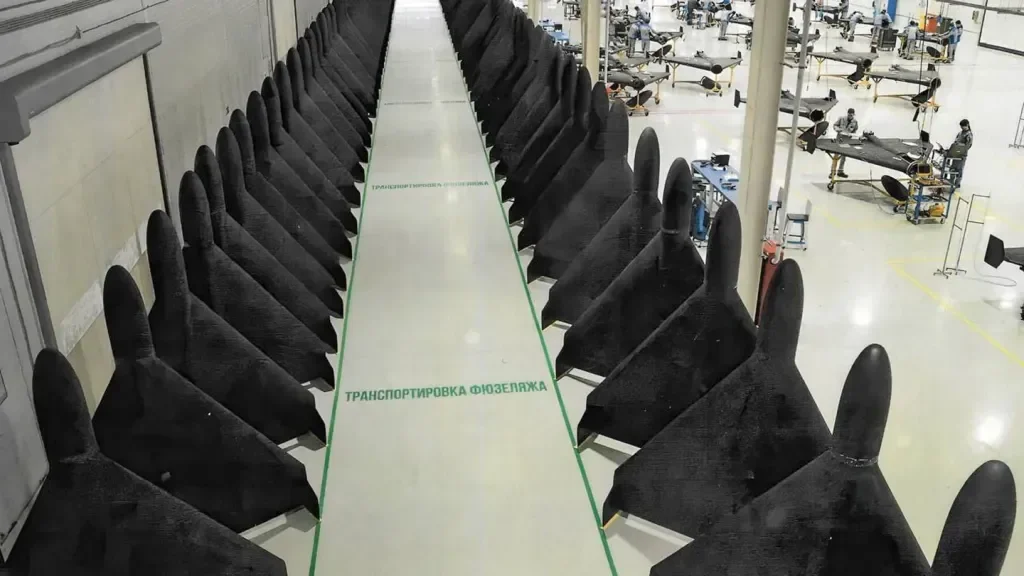
The scale of the evolution becomes particularly clear when we look at the system as a whole.
The original Shahed concept was remarkably simple: a cheap long-range weapon that could be launched from relatively austere positions.
Now the ecosystem increasingly includes:
specialized storage facilities;
permanent launch positions;
large numbers of launch rails;
command infrastructure;
multiple types of drones;
jet-powered variants;
decoys;
communications and navigation systems;
and a dedicated logistics chain.
At some point, the distinction between a “munition” and an “unmanned air force” begins to blur.
Of course, the Geran remains a one-way aircraft. It does not return to base, it requires no pilot, and the infrastructure necessary to operate it is dramatically simpler than that of a conventional air base.
But the organizational logic is becoming surprisingly similar.
There is a base.
There is a fleet of aircraft.
There are technicians.
There are storage facilities.
Flight missions have to be prepared.
There are dedicated launch positions.
And there is a requirement to put the maximum number of aircraft into the air in the shortest possible time.
The main difference is that these aircraft are not expected to come back.
A Distributed Network Changes the Geography
The ten identified facilities are not concentrated in one location. They form a distributed network across western Russia, including areas relatively close to Ukraine and Belarus. Some complexes have been developed at existing military installations and airfields, while others have appeared in more rural locations.
This offers several advantages.
First, drones can be launched from multiple directions.
Second, disabling one facility does not paralyze the entire network.
Third, aircraft and supporting equipment can potentially be redistributed between bases.
Finally, the closer a launch position is to the intended operating area, the less of the drone’s range is consumed simply reaching it.
But this creates an obvious tradeoff.
The closer a base is located to a potential adversary, the more useful it becomes as a launch site.
And the more vulnerable the base itself becomes to long-range weapons.
A distributed infrastructure is therefore a logical solution. Instead of relying on one enormous complex, the system can use multiple facilities of different sizes.
This Is No Longer Just About One Type of Drone
There is another reason why the infrastructure deserves more attention than the individual aircraft.
Specific drone models can become obsolete very quickly.
Today it is the Geran-2.
Tomorrow it may be the Geran-4.
Then the Geran-5.
Several years from now, it could be an entirely different aircraft.
But warehouses, maintenance buildings, command posts, roads, and prepared launch positions do not disappear simply because a new drone enters service.
This is why infrastructure can ultimately matter more than the introduction of another weapon variant. Once the production and operational ecosystem exists, replacing one aircraft with another becomes much easier than creating the entire system from scratch.
Conventional aviation provides a useful analogy. A fighter aircraft may remain in service for twenty or thirty years, but an air base can support several generations of aircraft.
Something similar may now be happening with unmanned systems.
Today, the longer launch rails are associated with larger or jet-powered Geran variants.
Several years from now, entirely different aircraft could potentially be launched from the same infrastructure.
The Critical Resource Is No Longer the Launcher — It Is the Number of Drones
Of course, 59 launch positions are useless without enough aircraft to feed them.
This brings us to the second half of the system: industrial production.
Recent reports citing Ukrainian military intelligence have claimed that Russian manufacturing capacity could eventually reach around 3,000 jet-powered Geran-4 and Geran-5 drones per month. That figure has not been independently verified and should not be treated as an established fact. Nevertheless, the very appearance of estimates on this scale illustrates the direction in which the program may be moving.
If production genuinely moves from hundreds toward thousands of aircraft, launch infrastructure inevitably has to expand alongside it.
The relationship is straightforward.
There is little point in building dozens of launch positions if only ten drones are available.
But producing thousands of drones is equally pointless if they cannot be prepared and launched quickly enough.
Manufacturing capacity and operational infrastructure therefore have to grow together.
Satellite imagery showing additional launch facilities may consequently be evidence of a much larger process than the construction activity itself suggests.
The Most Important Part of the Geran System May Now Be on the Ground
The story of long-range one-way attack drones began with an attempt to make long-range strike as simple as possible.
No expensive bomber.
No highly trained pilot.
No sophisticated airfield.
Take a relatively inexpensive aircraft, put it on a launch rail, and send it on its way.
But large-scale use is producing a somewhat ironic result.
The simpler the individual aircraft becomes, the more complicated the system required to operate thousands of them becomes.
You need manufacturing capacity.
Warehouses.
Transportation.
Maintenance.
Mission planning.
Command posts.
Launch positions.
Communications.
And, most importantly, the ability to put large numbers of aircraft into the air within a short period.
This is why the emergence of a network of specialized bases could ultimately prove more important than another increase in the range or speed of an individual Geran variant.
One new drone is a new weapon.
Ten bases, dozens of launch positions, storage facilities, maintenance infrastructure, and an established logistics chain constitute something much larger:
a weapon system.
And that appears to be the transition now underway — from individual long-range strike drones toward an infrastructure that increasingly resembles an unmanned long-range aviation force.
Several years from now, the most important measure of such a system may no longer be the specifications of any particular drone.
The more important question may simply be:
How many drones can the entire network prepare, launch, and send toward their targets at the same time?