From “RS” to “SR”: The History of the Development and Joint Work on Supersonic Bombers and Missile Carriers in the USSR

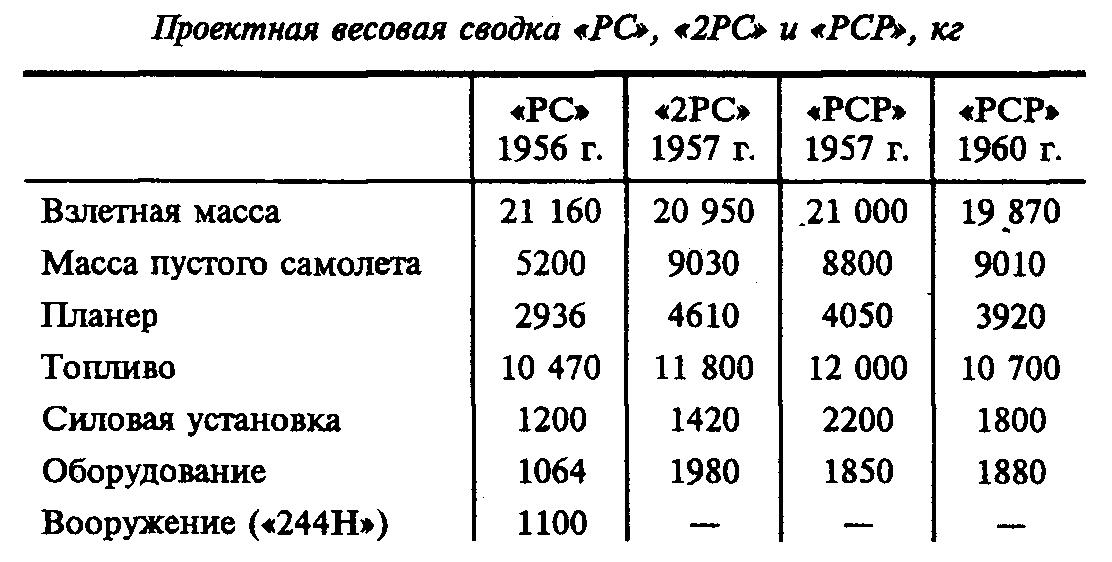
In the mid-20th century, following the first successful tests of Soviet nuclear weapons in 1949 and 1951, as well as the development of the compact but powerful “244N” warhead (“Tatyana”) in 1953, the country was faced with the urgent need to develop reliable delivery systems capable of delivering these weapons to any point on the globe. Initially, the main delivery platform was the mass-produced Tu-4 bomber; however, the rapid development of aviation technology and the emergence of jet fighters necessitated the creation of fundamentally new aircraft. In the first half of the 1950s, against the backdrop of the general race for supersonic speeds, a group of enthusiasts put forward a stunning proposal: to create an aircraft capable of flying faster, higher, and farther than any existing counterpart. Achieving such an ambitious goal required not only cutting-edge scientific research but also a robust experimental facility—a task that seemed extremely difficult given the monopoly held by the major design bureaus of the time.
Pavel Tsybin’s Preliminary Design and the Founding of OKB-256
The initiator of this groundbreaking project was Pavel Vladimirovich Tsybin, who had previously made a name for himself by designing sports and paragliders. On March 4, 1954, he sent a confidential letter to the country’s leadership proposing the development of the “RS” jet aircraft, which would possess unprecedented performance characteristics: a maximum speed of 3,000 km/h, a service ceiling of 30,000 meters, and a range of 14,000 kilometers. To achieve these performance metrics, the plan called for using hexagonal wing and fuselage profiles with a relative thickness of just 2.5–3.5%, as well as ensuring an unprecedented structural weight-to-strength ratio of 80%. The most unusual feature of the preliminary design was the concept of a detachable tail section, which took the form of a winged nuclear bomb. Upon reaching the target area, this “special payload” was to separate and glide toward the target, while the lightweight carrier, transitioning to a “duck” configuration using its nose horizontal stabilizers, would return to its home territory. Despite skepticism regarding the claimed weight efficiency—which, following tests by TsAGI, was revised to a more realistic 60%—the proposal was highly regarded. On May 23, 1955, a government decree was issued establishing Design Bureau No. 256 (OKB-256) at Plant No. 256 in Podberezje, near Moscow, and authorizing the start of work on the “RS,” with significant funding allocated and strict deadlines set for the construction of the first prototype by early 1957.
Aerodynamic Experiments and the First Flight of the NM-1
The establishment of the new design bureau faced serious staffing and production challenges. Since the best specialists had already been assigned to leading design bureaus, OKB-256 was staffed primarily by less experienced engineers, which inevitably affected the pace and quality of the work. Nevertheless, the team, led by Tsybin and his deputies—including the renowned aircraft designer Vadim Borisovich Shavrov—set about putting their ideas into practice. A full-scale model, the NM-1, was built to test the aerodynamic configuration and the unique landing gear layout. This aircraft featured a shortened nose section with ballast and a lightweight fuel system. Its main feature was a landing ski, which was used in conjunction with a jettisonable wheeled takeoff bogie during takeoff. Construction of the NM-1 was largely completed by mid-1958. After a series of delays caused by doubts about the ski’s strength and adverse weather conditions, on April 7, 1959, test pilot S. Amet-Khan made the first successful flight on the NM-1. During a series of tests involving ten pilots and comprising 32 flights, the fundamental feasibility of controlling an aircraft with a low-aspect-ratio wing and ski landing gear was confirmed. The aircraft demonstrated good stability during takeoff and landing, effective controls at low speeds, and overall “flyability,” although it also revealed some issues with vibration during the rollout and an increased rollout distance due to ski drag.
The Transformation into an “RSR” Reconnaissance Aircraft and the Battle for Engines
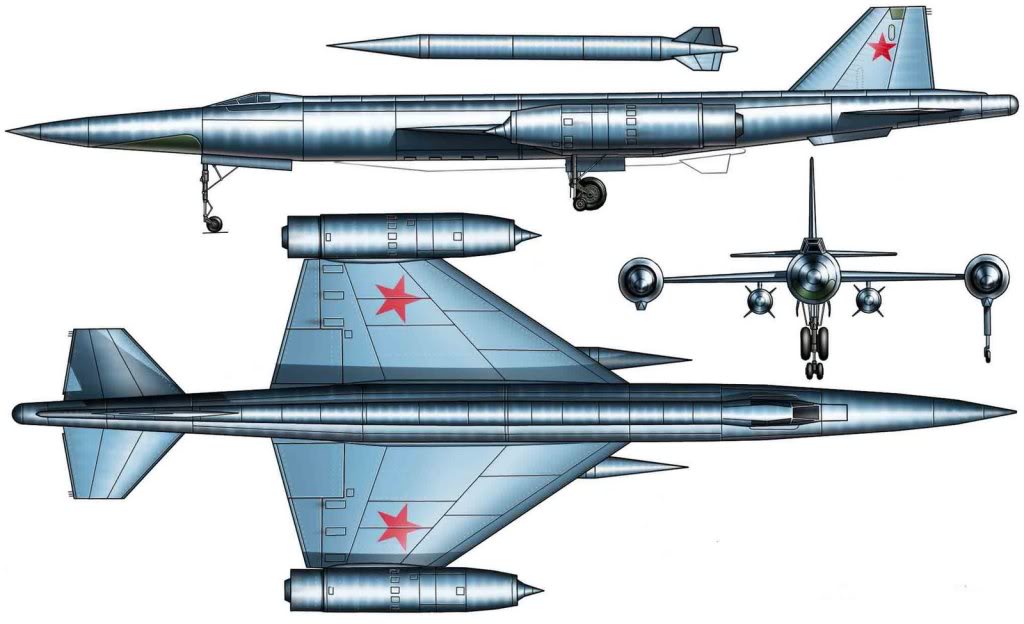
In parallel with the NM-1 tests, Design Bureau 256 was engaged in intensive development of a full-fledged supersonic reconnaissance aircraft, the “RSR,” which represented an evolutionary development of the original “RS” concept. The decision to abandon the detachable bomb-tail design was driven by shifting priorities and the need to create a high-altitude, high-speed reconnaissance aircraft. The new aircraft was equipped with two R-11F engines featuring adjustable air intakes, similar to those used on the MiG-21F fighter. To achieve the required flight performance, the designers took unprecedented measures to lighten the structure. The traditional five-spar wing configuration was replaced with a sixteen-rib open-web structure using roller welding, which significantly reduced weight while maintaining strength. Thin-walled components were widely used, the number of bolted joints was minimized, and standard parts, such as plug connectors and electrical wiring, were ordered in specially reduced and lightweight versions. The most significant innovation was the abandonment of heavy supersonic external fuel tanks in favor of lighter tanks that were jettisoned at subsonic speeds, allowing the aircraft to break the sound barrier in its “unencumbered” state. The middle section of the fuselage was converted into a pressurized semi-hexagonal compartment with a lower window, in which complex photographic equipment—including AFA-33, AFA-34, and AFA-40 aerial cameras with various focal lengths, as well as radar and radio reconnaissance stations.
Administrative Setbacks and the Program’s Closure
Despite technical successes and the start of construction of “RSR” prototypes not only in Podberezje but also at Plant No. 99 in Ulan-Ude, the project faced insurmountable administrative opposition. The main opponent was Andrei Nikolaevich Tupolev, who, wielding enormous authority, blocked the delivery of the promising D-21 engines for the “RSR,” citing the need to ensure mass production of the Tu-124 passenger aircraft. In an attempt to save the project, Tsybin secured support from TsAGI and the Air Force, as well as temporary permission to use the R-11F engines. However, the fate of OKB-256 was already sealed. In October 1959, the bureau was placed under the authority of V. M. Myasishchev, and shortly after Myasishchev was removed from his position as chief designer, the team and production facilities were transferred to V. N. Chelomei, who repurposed the plant for the production of rocket and space technology. By the summer of 1961, work on the “RSR” had been completely shut down; finished aircraft and work-in-progress were sent to be melted down, and unique technical developments and full-scale prototypes were transferred to the Moscow Aviation Institute (MAI) as teaching aids. Some of Tsybin’s ideas were later implemented in the MiG-25R project, which, however, failed to achieve the range specifications set for the “RSR” and remained a tactical reconnaissance aircraft.
The Trio of Engineers: Bartini, Tsybin, and Shavrov
In parallel with the development of the “RSR” project, the management of OKB-256 maintained close working ties with Robert Ludvigovich Bartini, who had been working at SibNIA since 1952 on promising designs for supersonic wings. Bartini developed the concept of a wing with variable leading-edge sweep across the span—the so-called crescent-shaped or S-shaped wing—which was capable of self-balancing when breaking the sound barrier. This wing, supplemented by geometric twist to improve aerodynamic performance, underwent comprehensive testing in wind tunnels and subsequently gained widespread recognition in the global aviation community. This scientific foundation laid the groundwork for new, even more ambitious joint projects, in the development of which Vadim Shavrov—who possessed vast experience in the design of seaplanes—took an active part.
The A-57 Strategic Complex and the “RSS” Cruise Missile
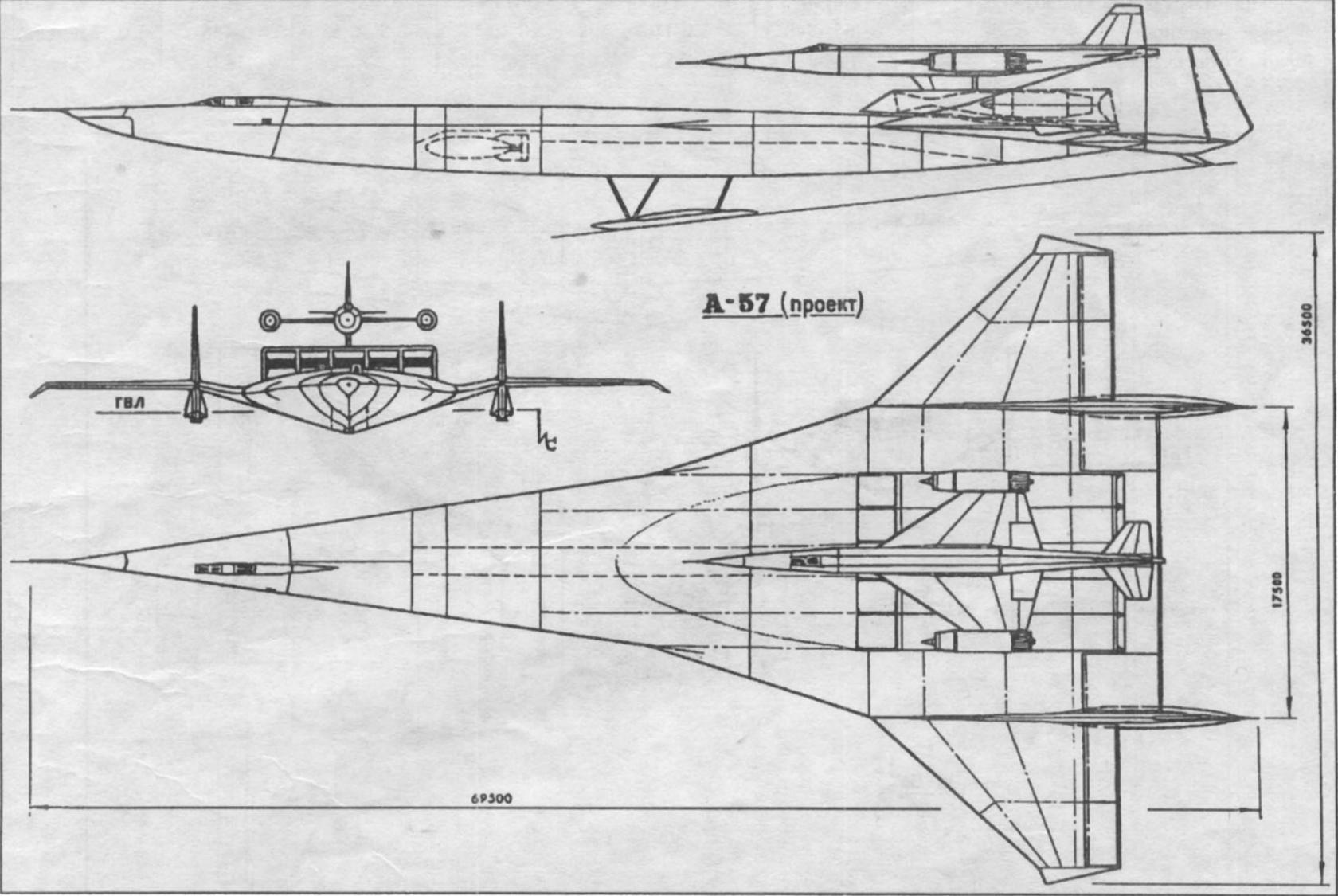
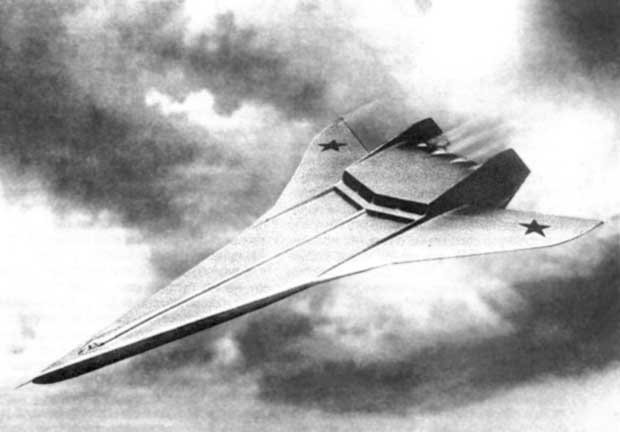
The pinnacle of Bartini and Tsybin’s collaborative work was the A-57 supersonic strategic missile-carrying bomber project, developed in 1957. This gigantic aircraft, weighing 320 metric tons, was intended to be sea-based, which ensured its stealth and mobility across the world’s oceans. The A-57 was a tailless flying wing with a wing area of 755 square meters and a sharply keeled underside that tapered into a semicircular shape toward the tail. The power plant consisted of five NK-10 engines designed by N. D. Kuznetsov, each of which developed up to 25,000 kgf of thrust. The engines were arranged in a horizontal array above the trailing edge of the wing, which allowed the aircraft to reach speeds of up to 2,500 km/h at an altitude of 10,000–11,000 meters, with a practical service ceiling of 18,000 meters. A complex landing gear system was used for takeoff and landing on water or land: a main 10-meter ski on a parallelogram mechanism and two wide under-keel skids for lateral stability. The A-57’s primary armament was to be the “RSS” cruise missile, developed based on the “RSR” design. Instead of a cockpit and reconnaissance equipment, the missile carried a nuclear warhead. Equipped with two RD-013 direct-flow engines designed by M. M. Bondaryuk, the “RSS” was intended to separate from the carrier at subsonic speed, accelerate to 2,800 km/h at an altitude of 20,000 meters, and engage targets at a range of up to 5,000 kilometers from the launch point.
Naval Projects: The “RGSR” Reconnaissance Aircraft and the A-58 and E-57 Bombers
While working on the A-57 complex, Vadim Shavrov led the design of the “RGSR,” a sea-based supersonic reconnaissance aircraft. This aircraft, which built upon the concepts of the “RSR,” was fully adapted for operation from the water’s surface. The hull featured a seagoing, slightly keeled bottom with a wave-breaker and side bulges, and the keel ran the entire length without a redan. Due to the increased aerodynamic drag caused by the water surface, the wingspan was reduced to 8 meters, the sweep angle was increased to 60 degrees, and the wing itself was raised to the upper section of the hull, transforming the aircraft into a high-wing configuration. The D-21 engines were mounted above the wing in the area of maximum chord length to prevent water from splashing into the air intakes, and the horizontal stabilizer and keel were also raised to protect them from the exhaust jets. Lateral stability on the water was provided by fuel tanks located under the wingtips, which served as floats. To facilitate takeoff and landing, the design called for the use of underwater hydrofoils, which lifted the fuselage above the water, while side wings mounted on floats prevented the aircraft from rolling. In addition, as part of this program, designs were developed for the A-58 long-range maritime bomber, equipped with four NK-6 engines, and the E-57 strike aircraft for operations against European targets. The E-57 was a two-seat flying wing with a mass of 120,000 kg, featuring a four-stage variable leading-edge sweep, two NK-10 engines in a single nacelle atop the fuselage, and an extended tail section that tapered into floats. These ambitious projects never made it past the drawing board; they were shelved due to technological complexity and a shift in strategic priorities toward rocket and space technology.
Tactical and Technical Specifications (TTS) of Projects
“RS” Project (Preliminary Design):
- Maximum speed: 3,000 km/h.
- Practical ceiling: 30,000 m.
- Flight range: 14,000 km.
- Wingspan: 10 m.
- Wing area: 65 m².
- Wing sweep at the leading edge: 58°.
- Relative profile thickness: 2.5–3.5%.
Full-scale model NM-1:
- Cruising speed: up to 500 km/h.
- Practical ceiling: up to 4,000 m.
- Flight duration: 11–40 min.
- Takeoff speed: 325 km/h.
- Chassis features: a duralumin landing ski with a jettisonable wheeled takeoff bogie.
The “RSR” supersonic reconnaissance aircraft:
- Power plant: 2 × R-11F turbofan engines.
- Blade design: 16-wall openwork pattern with roller welding.
- Reconnaissance equipment: a suite of AFA-33, AFA-34, and AFA-40 aerial photography systems mounted on universal platforms in a pressurized compartment, a radar station, and a radio reconnaissance station.
- Features: elimination of heavy supersonic under-wing fuel tanks, lighter wiring and fasteners.
A-57 Strategic Missile-Carrying Bomber:
- Aircraft weight: 320 metric tons.
- Wing area: 755 m².
- Power plant: 5 × NK-10 turbojet engines (each with a thrust of 25,000 kgf).
- Maximum speed: 2,500 km/h (at an altitude of 10,000–11,000 m).
- Practical ceiling: 18,000 m.
- Chassis: a main 10-meter ski mounted on a parallelogram mechanism, and two under-keel float skis.
- Armament: internal mounting for the “244N” nuclear bomb and external mounting for the “RSS” cruise missile.
The “RSS” Winged Missile:
- Power plant: 2 × RD-013 ramjet engines.
- Separation speed from the carrier: 800–850 km/h.
- Cruising speed: 2,800 km/h.
- Flight altitude: 20,000 m.
- Flight range: 5,000 km (from the separation point).
- Warhead: nuclear charge.
The “RGSR” maritime reconnaissance vessel:
- Power plant: 2 × D-21 (D-20F) turbojet engines.
- Wingspan: 8 m.
- Wing sweep at the leading edge: 60°.
- Configuration: high-wing layout with engines and stabilizer mounted above the wing.
- Features: a seaworthy, slightly keeled hull with a wave-breaker; float-type fuel tanks under the wing tips; and underwater fins for takeoff and landing.
E-57 Attack Aircraft:
- Aircraft weight: 120,000 kg.
- Wing area: 270 m².
- Powerplant: 2 × NK-10 turbojet engines (thrust 10,000 kgf, 25,000 kgf with afterburner).
- Maximum speed: 2,500 km/h.
- Range: 4,500 km.
- Practical ceiling: 18,000 m.
- Configuration: flying wing with a four-stage variable leading-edge sweep, two keels with reverse-swept rudders that merge into floats.
Sources:
https://alternathistory.ru/ot-rs-do-sr-chast-1-istoriya-sozdaniya-samoleta-rs/
https://alternathistory.ru/ot-rs-do-sr-chast-2-sovmestnaya-rabota-bartini-tsybina-i-shavrova/