Germany’s Cobra 600 Takes Flight: Why an IRIS-T Missile Needs Its Own Jet-Powered Drone

In August 2026, a rather unusual first flight took place over the Baltic Sea. A small jet-powered uncrewed aircraft took off, flew just over 20 kilometers, and returned safely. By modern drone standards, that is hardly an impressive achievement. What makes the aircraft interesting is not how far it flew, but what it is eventually supposed to carry.
A single IRIS-T air-to-air missile.
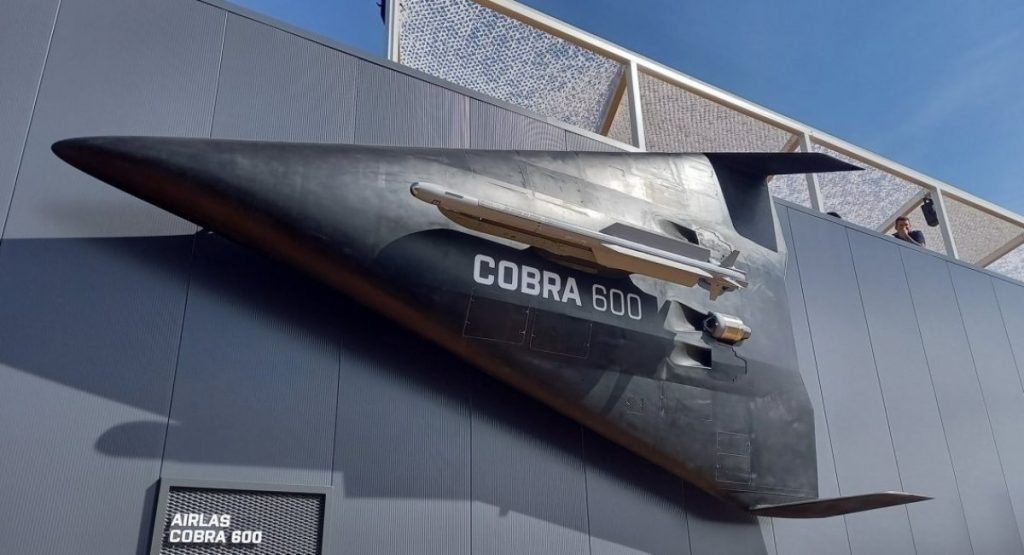
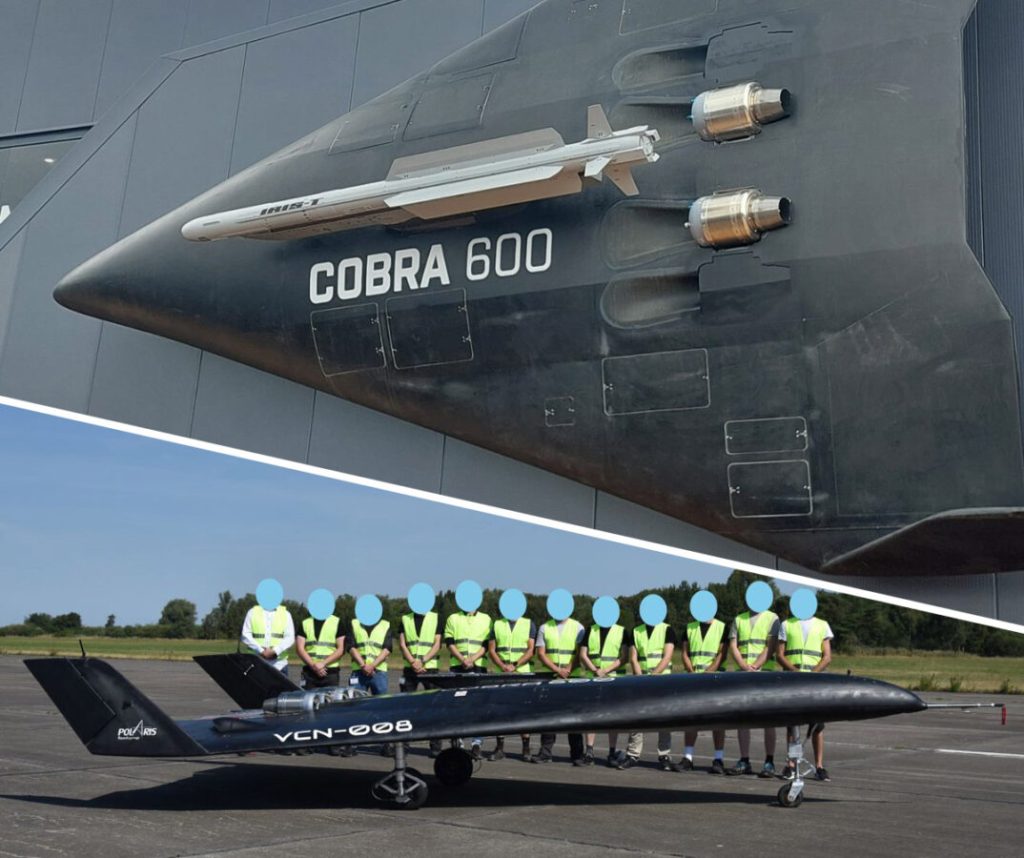
Germany’s Diehl Defence and startup POLARIS Raumflugzeuge are developing the Cobra 600, also known as AirLAS — Airborne Launching and Attack System. The aircraft has a maximum takeoff weight of more than 600 kilograms, uses jet propulsion, features retractable landing gear, and is designed to return after completing its mission. A standard aviation pylon, similar to the type used on the Eurofighter Typhoon, is mounted on top of the aircraft, with a conventional IRIS-T air-to-air missile attached to it.
At first glance, this seems like a strange arrangement. To launch a single missile weighing around 90 kilograms, the Germans are building a dedicated six-meter jet aircraft weighing several hundred kilograms. The IRIS-T itself has existed for years in both air-launched and ground-based forms, while the IRIS-T SLS/SLM family already allows related missiles to be fired from the ground.
So why build another aircraft?
Because Cobra 600 effectively proposes to take an air-defense launcher off the ground and send it forward to meet the target.
This Is Not an Uncrewed Fighter
There is an important distinction to make from the outset. Cobra 600 certainly looks like a small combat drone: it has a delta wing, vertical surfaces at the wingtips, a compact fuselage, jet engines, and a missile carried on its back. It is therefore tempting to describe it as an uncrewed fighter.
But its developers describe the system very differently. Representatives of the program have explicitly emphasized that Cobra 600 is neither a loyal wingman nor a Collaborative Combat Aircraft. It does not carry a full suite of onboard sensors for independently searching for aerial targets. The concept has even been described as an airborne launch rail.
That description explains the entire philosophy behind the project. Cobra is not supposed to patrol independently, search for targets with its own radar, and engage in air combat. It is intended to become part of a much larger air-defense network. External sensors provide the air picture, while the drone carries the missile to the point from which it can be launched most effectively.
In other words, this is not really an uncrewed fighter.
It is a mobile airborne missile launcher.
IRIS-T Suddenly Gets a Completely Different Geometry
The original IRIS-T was developed as a short-range air-to-air missile. It is a compact weapon approximately 2.94 meters long, equipped with an imaging infrared seeker and designed for very high maneuverability. The ground-based IRIS-T SLS uses the air-launched missile, while the longer-range IRIS-T SLM employs a larger motor and other modifications.
Any missile launched from the ground faces a fundamental problem: a substantial portion of its energy must be spent gaining altitude and speed.
An air-launched missile starts the engagement under much more favorable conditions. If the launch platform is already flying several kilometers above the ground and moving at high speed, the missile does not have to generate all of that initial energy using its own propellant. This is one reason why an air-launched missile can achieve much more favorable kinematics than a comparable weapon starting from the ground.
Cobra introduces another factor: geography.
Instead of waiting for an enemy aircraft to approach a stationary air-defense battery, the launch point itself can be moved hundreds of kilometers forward.
The Missile Does Not Fly 400 Kilometers
This is an important distinction because an impressive figure of around 400 kilometers has already become associated with Cobra 600.
But nobody is turning IRIS-T into a 400-kilometer-range missile.
Publicly available information points instead to a combat-loaded range of roughly 400 kilometers for the Cobra 600 itself. In other words, most of that distance is covered by the uncrewed carrier, not by the missile. Once the drone reaches the required area, it launches the IRIS-T, which performs the final interception.
That creates a fundamentally different engagement sequence.
A conventional surface-to-air missile system works roughly like this: a radar detects the target, the missile launches from the ground, and its motor must accelerate it, lift it to altitude, and carry it toward the target.
AirLAS adds an intermediate step: the system detects the target or identifies the likely threat axis, Cobra flies forward with the missile, moves into a favorable position, and then launches IRIS-T from the air.
It is effectively a two-part weapon delivery system, except that the first part can return home after launching the second.
Why Make the System So Complicated?
Imagine a ground-based air-defense system with an effective engagement zone extending several dozen kilometers. An enemy aircraft simply has to remain outside that area. It can launch stand-off weapons, avoid known air-defense positions, or operate beyond the interceptor’s reach.
The obvious answer is to build a longer-range surface-to-air missile. But greater range generally requires a larger motor, more propellant, greater missile weight, larger launchers, and higher cost.
Cobra approaches the problem from the opposite direction.
Instead of making the missile fly hundreds of kilometers to the aircraft, carry the missile hundreds of kilometers closer to the aircraft first.
In that sense, AirLAS resembles a fighter combat air patrol, except that instead of sending an expensive crewed fighter into the area, the system uses a relatively simple uncrewed aircraft carrying a single missile.
This is why comparing Cobra 600 with a conventional combat drone can be misleading. Its value does not come primarily from what the drone itself can do, but from how far forward it can move the weapon of an existing air-defense network.
An Airborne “Range Extender” for Air Defense
Ground-based air defenses face another unavoidable geometrical problem: the radar horizon. The lower a target flies, the later a ground-based radar can detect it. No amount of transmitter power can eliminate the curvature of the Earth.
Moving the launch platform into the air changes part of that geometry, although Cobra itself, according to public descriptions, is not intended to independently search for targets. Most targeting information is expected to come from external sources. The developers envision the aircraft as part of a wider IRIS-T network in which ground radars and other sensors detect and track targets while the drone serves as a forward-positioned launch point.
This matters because the missile launcher can now move independently of the radar. The ground battery can remain in a comparatively protected area while its weapon is carried much closer to the expected route of the target.
The concept resembles a broader trend already transforming modern air warfare: the platform that sees the target no longer has to be the platform that fires the weapon.
Why IRIS-T?
Diehl’s choice is entirely logical. The company already produces IRIS-T, the missile has been in service for years, is manufactured in series, and has been integrated with numerous aviation platforms. There is little reason to develop both a completely new drone and a completely new interceptor at the same time.
The use of a standard aviation interface is equally important. Cobra carries the missile on a pylon of the same general type used on the Eurofighter. This simplifies integration and allows the developers to concentrate on the carrier aircraft, communications, and the wider AirLAS architecture.
IRIS-T also uses a modern imaging infrared seeker. Once the missile receives sufficient targeting information to reach the engagement area, it does not require continuous radar illumination during the terminal phase in the way some older missile systems did.
As a result, Cobra does not need to become a miniature flying surface-to-air missile system with its own large radar.
That significantly reduces the complexity of the aircraft.
Six Meters of Aircraft for One Missile
Cobra 600 itself is an unusual machine. Its designation is related to its length — approximately 600 centimeters, or six meters. The aircraft uses a delta-wing configuration with vertical surfaces at the wingtips and features retractable tricycle landing gear. This is an important distinction from one-way attack drones: Cobra is intended to take off conventionally, perform its mission, and, if it survives, land again.
The aircraft displayed at ILA 2026 used two JetCat P1000-PRO micro-turbojet engines, each producing just under 250 pounds of thrust. The design can accommodate four engines; on the exhibition aircraft, two had reportedly been removed for use in another company project. Images of more developed configurations also show four engines integrated into the airframe.
Maximum speed, service ceiling, the precise range of the operational configuration, and projected unit cost have not yet been officially disclosed. It is therefore much too early to treat the current demonstrator as a finished operational interceptor. During its first flight in August, Cobra covered just over 20 kilometers at a takeoff weight exceeding 600 kilograms. According to more recent information from POLARIS, that flight was conducted without an operational missile, with further IRIS-T integration testing expected during subsequent trials.
The Key Advantage Is That Cobra Does Not Have to Be Expended
This is where Cobra differs fundamentally from a conventional two-stage missile.
Imagine that the target turns away, disappears, or the engagement is canceled. Once a conventional missile has been launched, it is lost regardless of what happens next.
Cobra can return.
If the IRIS-T is not needed, the drone can land with the missile still attached. If the weapon is launched, the carrier can theoretically still return, receive another missile, and fly another mission.
The developers have used the unusual formulation “recoverable, expendable and affordable.” The aircraft is intended to be reusable, but losing it should be considerably less painful than losing a crewed fighter.
This represents an important economic compromise. A full-scale combat aircraft is far too expensive to use simply as a flying launcher for one missile. A conventional missile carrier is disposable. Cobra attempts to occupy the space between those two extremes.
Now Compare It With a Conventional Fighter Patrol
The traditional way to intercept an aircraft hundreds of kilometers beyond the reach of a ground-based air-defense system is straightforward: send a fighter. It flies into the area, finds the target, and launches its missile.
But the fighter brings much more than a missile. It also brings a pilot, an expensive radar, an electronic warfare suite, life-support systems, an ejection seat, sophisticated avionics, and an aircraft worth tens of millions of euros.
Cobra does not need most of that.
It does not have to independently win an air battle. It does not need a pilot. It does not need a large radar. It does not need a cannon or a large missile load.
Its mission is far simpler: deliver one IRIS-T to the right point in space at the right time.
That narrow specialization is precisely what could make the system substantially cheaper than maintaining a conventional fighter patrol for the same purpose.
But Shooting Down Su-34s Is Still a Concept, Not a Proven Capability
This is where the most dramatic claim surrounding the project — the possibility of hunting aircraft launching stand-off weapons — needs to be treated carefully.
The basic logic is certainly there. If an aircraft can release glide bombs or other long-range weapons while remaining beyond the engagement zone of a conventional surface-to-air missile system, one possible response is to move the missile launch point closer to the area where that aircraft is expected to operate. High-value aircraft operating in predictable launch zones are among the scenarios being discussed for AirLAS.
But there is a huge distance between an attractive diagram and an actual interception. Cobra must reach the correct area quickly enough, receive accurate external targeting information, maintain reliable communications in an electronic warfare environment, position IRIS-T correctly for the engagement, and do all of this before the hostile aircraft completes its mission and withdraws.
The opponent will not necessarily cooperate. Fighter escorts, long-range air-to-air missiles, electronic warfare systems, and intelligence about air-defense activity all complicate the problem.
Cobra 600 should therefore be viewed today not as a proven “bomber hunter,” but as an experimental method of radically moving the interception line forward.
The Hardest Part May Not Be the Aircraft at All
Building a small jet-powered drone is comparatively straightforward. IRIS-T already exists.
Making everything function as a single weapon system is much harder.
A ground radar has to detect the target. The information must enter the command network. Cobra has to receive a route and interception data. Communications must remain reliable across long distances and under active electronic warfare. Finally, the system must provide the missile with sufficiently accurate targeting information for its own seeker to acquire the target.
Developers are already considering several long-range communication solutions, including satellite links.
And this is where the real technological challenge of AirLAS lies.
Cobra by itself is merely a small jet aircraft.
IRIS-T by itself is an established missile.
The innovation appears when ground radar, datalinks, the uncrewed carrier, and the missile begin operating as a single weapon.
The Idea Is Not New — But Modern Technology Makes It Simpler
The idea of moving a missile launch point closer to the target is hardly new. Combat aviation does it naturally: a fighter is effectively a reusable carrier that transports missiles closer to their targets. Concepts for uncrewed interceptors have also existed for decades.
The problem was that such projects traditionally tended to evolve into another complicated aircraft.
Modern electronics, satellite navigation, automatic flight-control systems, networking, and relatively inexpensive small jet engines offer another possibility: keep the carrier as simple as possible and move the sophisticated sensors elsewhere in the network.
This is why Cobra 600 looks somewhat strange.
It is not an attempt to build a cheap Eurofighter without a pilot.
It is an attempt to determine how much of a Eurofighter is actually necessary if the only mission is to deliver one IRIS-T missile to its launch point.
Perhaps all that is required is a wing, engines, landing gear, an autopilot, a communications link, and a single missile rail.
This Could Change the Architecture of Air Defense
A traditional surface-to-air missile system is geographically concentrated. There is a radar, a command post, and a number of launchers. If greater engagement range is required, the usual solution is to build a larger missile.
AirLAS proposes breaking that relationship.
The radar can remain on the ground. So can the command post. But the launcher moves — or, more accurately, flies hundreds of kilometers forward.
The effective reach of the air-defense network would then be determined not only by the kinematics of the interceptor missile itself, but also by the range of its carrier.
And that may be the most interesting idea behind the entire program.
Instead of developing one extremely expensive missile with enormous range, it may be possible to combine an existing compact interceptor with a separate reusable carrier. After the mission, the carrier returns, receives another missile, and once again becomes a forward-deployed airborne launch platform.
Of course, the concept is only now entering serious flight testing. Cobra 600 has completed just its first short flight, full IRIS-T integration still lies ahead, and several critical performance figures — including cost — remain unknown. Calling it a revolution in air defense would therefore be premature.
But the underlying idea is genuinely interesting.
For decades, the development of long-range air defense has generally followed an obvious rule: if you need to shoot farther, build a larger and longer-range missile.
Diehl and POLARIS are approaching the problem from the opposite direction.
The missile may not need to fly an additional 300 or 400 kilometers.
Sometimes it may be cheaper to send the launcher those 300 or 400 kilometers first — and then bring it home again.