How did the Soviet Union develop a competitor to the "Tomahawk," and what happened to it?

In the early 1970s, Lev Lyuliev, chief designer at the “Novator” Design Bureau, approached Defense Minister Ustinov with blueprints for a fundamentally new winged vehicle.
Strange as it may seem, Ustinov listened and… refused. There was nothing strange about the fact that he listened—Dmitry Fedorovich always did exactly that—but his refusal… that’s where questions arise. However, those questions disappear once you realize that Soviet industry at the time was simply not ready for such groundbreaking developments.
Lyuliev put the blueprints away in his desk.
A few years passed, and it was Ustinov himself who called to retrieve those blueprints from the archives. The project, which had been rejected once, would soon become the Soviet response to that very “Tomahawk”—one that would turn out to be far more interesting than its counterpart—but then something would happen, and this very “response” would disappear from our view.
So what exactly did Lyuliev come up with, and why didn’t his highly effective invention survive to the present day?
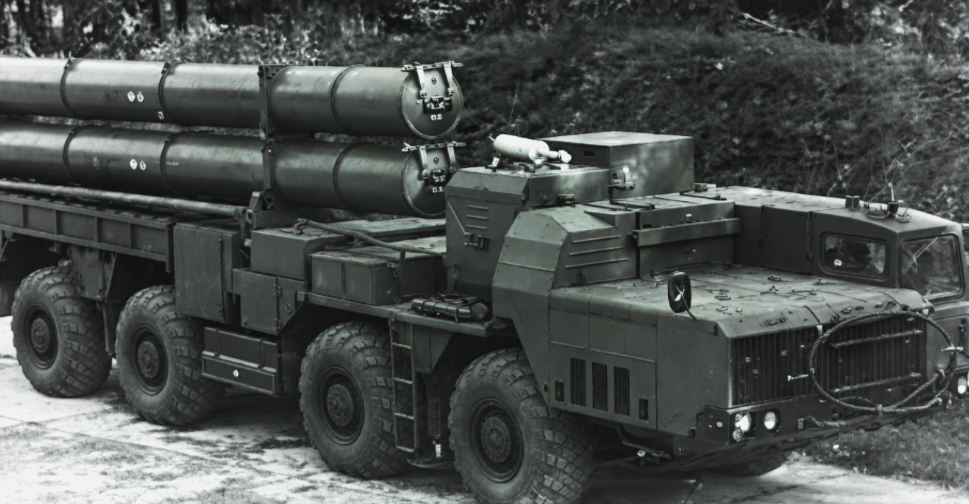
As we all know, in 1983, American BGM-109G Gryphon missiles began arriving in large numbers at bases in Western Europe. The Soviet military leadership demanded that a counterpart be developed and, as usual, allotted “a full” two years for the project.
The task was not assigned to the “Raduga” Design Bureau, the Air Force’s usual developer. Ustinov personally ordered that it be sent to the “Novator” Design Bureau under Lyuliev, where they were already mass-producing sea-based strategic cruise missiles for the “Granat” system, and it was precisely this existing work that offered a chance to meet the deadline.
On top of everything else, the “Novator” design team had already begun working on this project at the turn of 1969–1970, at their own risk, taking a fundamentally different approach from their renowned competitors—namely Chelomey, Bereznyak, and Seleznev. The official decision by the Military-Industrial Complex (VPK) was not issued until 1975, but the initiative-driven design already existed on paper by that time.
Lyuliev pulled out the blueprints. The complex was named “Relief.” The official resolution by the Council of Ministers and the Central Committee regarding its development was issued on October 4, 1984; by that time, work on the project had actually been underway for over a year.
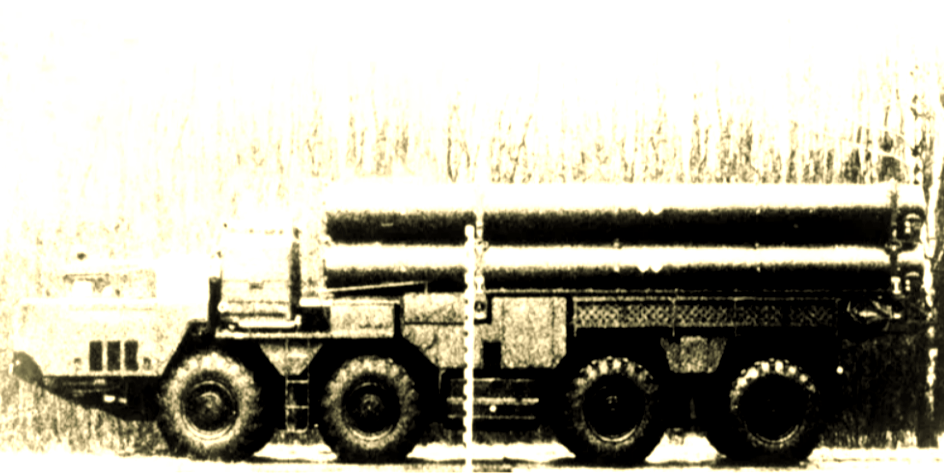
The project presented numerous challenges—to put it mildly—one of which was the task of mounting six warheads on a single, relatively small chassis. Of course, such a complex problem could not be solved head-on, since the standard layout overloaded the MAZ-543M and reduced its mobility to an unacceptable level.
The engineers resolved the situation as elegantly as possible by arranging six KS-122 containers and assembling them into a single unit with its own control system.
As a result, the Soviet ASPU carried as many as six warheads, compared to four on the American Gryphon TEL, and this with a comparable range of 2,600–2,900 kilometers. Each weighed about 1,700 kilograms, carried a 200-kiloton nuclear warhead, and flew toward its target at extremely low altitudes, skirting the terrain.
The onboard digital computer continuously cross-checked the radio altimeter readings against digital maps of the correction zones; in fact, it was a completely autonomous inertial system without a single external signal. To radars, this device was practically invisible.
The test launches (about ten between 1984 and 1986 at the Akhtubinsk test site) were generally successful. Admittedly, this was far from a leap into the unknown, since by that point the naval “Granat” had already undergone about thirty launches, and the land-based version had inherited all that testing experience.
In 1986, the “Relief” was adopted for service. The design documentation was sent to the Kalinin Machine-Building Plant in Sverdlovsk—the very same plant that Lyuliev personally built as a production base when he was appointed chief designer back in June 1945, and he worked there until 1965. The plan was to deploy the production-model systems between 1987 and 1990.
They set up…
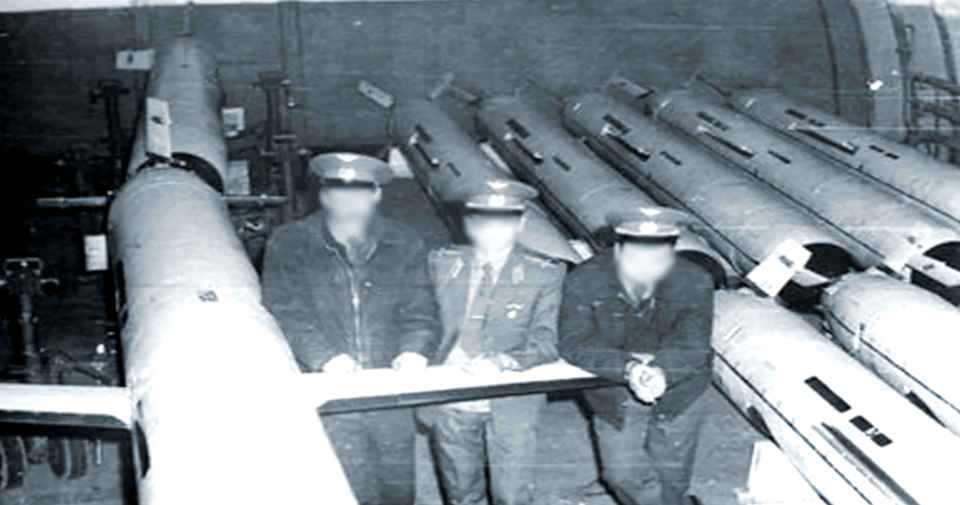
Soviet soldiers next to “shells” for “Relief”
They only managed to produce the first production batch. Several vehicles that never made it into the production lineup.
U — Recycling
On September 20, 1988, less than two years after they were adopted for service, the first four KS-122s were blown up at an air base near Jelgava.
On October 5, the last launchers were destroyed. U.S. experts were present during the disposal. The 56-metric-ton 8×8 vehicle, capable of transitioning from a travel configuration to a combat configuration in fifteen minutes, disappeared before it ever took up a position with the unit.
It is generally believed that the INF Treaty was roughly symmetrical. The numbers tell a different story. The USSR destroyed 1,846 warheads, while the U.S. destroyed 846.
There is, however, another side to the story, because, by all accounts, at the time the treaty was signed, the Soviet side had a significantly larger total number of medium- and short-range missiles than the American side, and it was precisely this ratio that determined the scale of the losses—but as they say, that’s a whole different story…
The “Oka”—an operational-tactical system with a range of 400 kilometers—was also targeted for destruction, even though it was not formally covered by the treaty at all. It was included under a separate agreement reached during the negotiations. The treaty did not affect the naval “Tomahawk” missiles (as a reminder, there were thousands of them) in any way.
That’s how it is. It turns out that our “response” was scrapped, while thousands of sea-launched “Tomahawks” remained in service, falling outside the scope of the treaty. During those years, the USSR lost its only land-based platform for long-range cruise missiles, having failed to deploy a single production model.
Source — https://dzen.ru/a/ahWJYGXk-lr1-Zne