One Missile Hides Inside an F‑35, the Other Launches from the Ground: Why Denmark Wants Both

Denmark has decided to acquire two types of long-range precision weapon: the Norwegian Joint Strike Missile for its F‑35A fighters and the ground-launched Anthem system developed by the American company Covenant. At first glance, this may look like another routine addition to the country’s arsenal. In practice, Copenhagen is building something it has never possessed before — a deep-strike capability with two independent launch methods, two very different levels of technological risk and two distinct approaches to the cost of warfare.
Not Two Similar Missiles, but Two Ways to Strike
On October 22, 2026, Danish Defense Minister Jeppe Bruus confirmed the decision to acquire JSM and Anthem. The logic was straightforward: weapons launched from different platforms allow Denmark to operate from both the ground and the air and, if attacked, engage targets deep behind enemy lines. Copenhagen has not disclosed the number of missiles, the value of the purchases, their storage locations or their delivery schedules. In the case of JSM, Denmark has so far announced an intention to buy. Kongsberg says the scope and value will be determined during negotiations before a final contract is signed.
The real significance of the announcement lies less in the maximum range of either missile than in the combination of their launch platforms. An F‑35 can redeploy rapidly between airfields, approach from different directions and release a missile at altitude, increasing its practical reach. Yet an air strike depends on serviceable aircraft, usable runways, trained crews, fuel and a substantial support infrastructure. A ground-based weapon is less strategically mobile, but it can remain on alert, disperse between positions and launch without sending an expensive fighter into the air.
The two systems therefore create complementary strike arms. JSM turns the Danish F‑35A into a low-observable cruise-missile carrier able to attack from outside the immediate reach of many defenses. Anthem gives the land forces their own deep-strike weapon, independent of combat-aircraft sorties. If one launch method is temporarily unavailable, Denmark does not lose the entire capability.
JSM: A Missile Built Around the F‑35
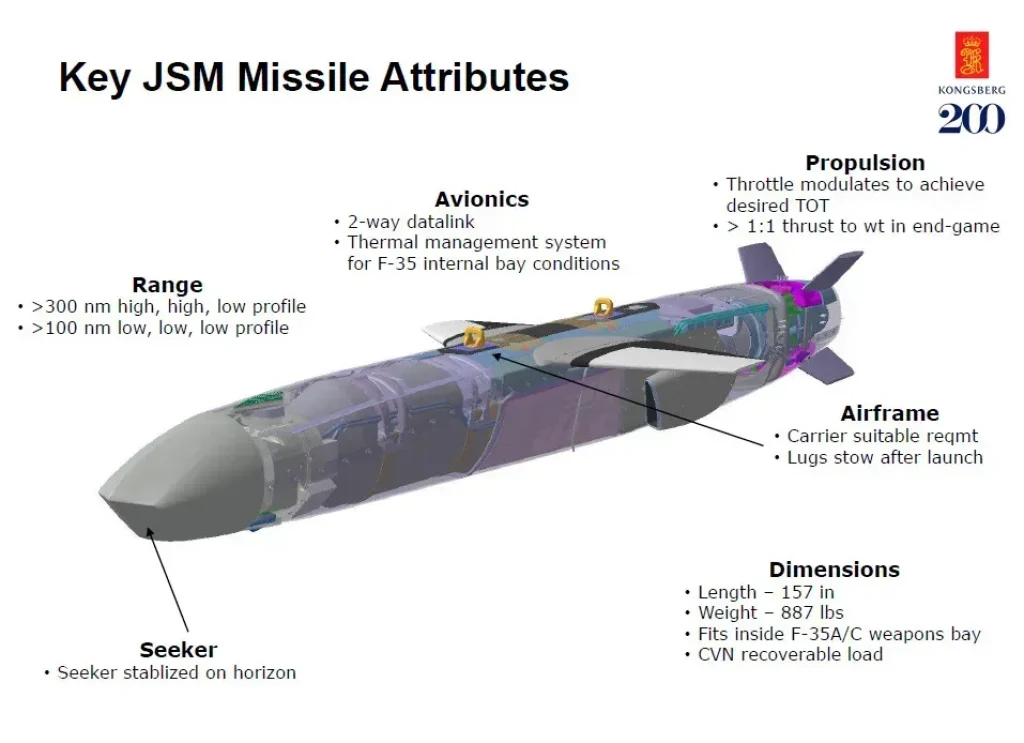
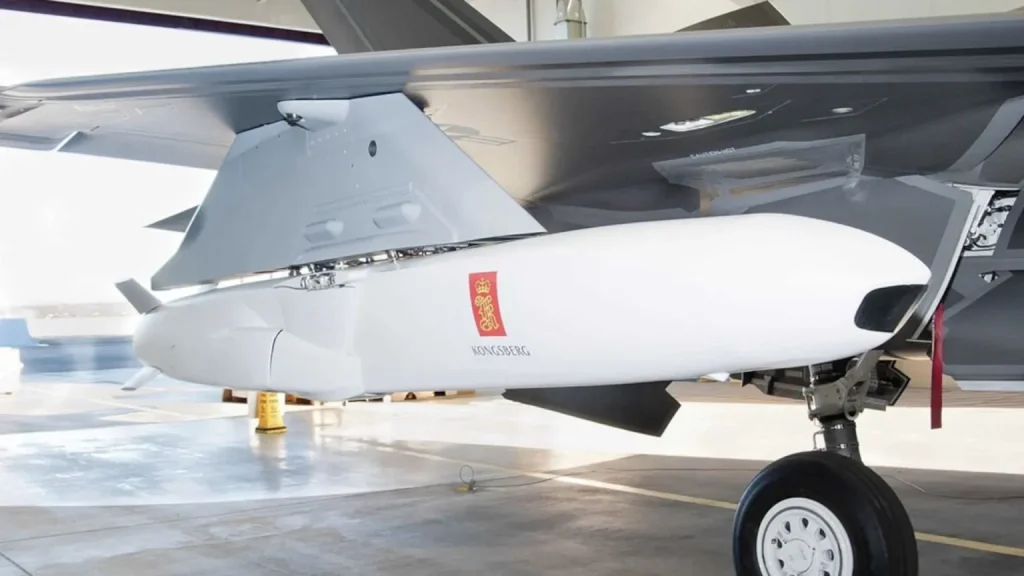
Norway’s Kongsberg developed the Joint Strike Missile from the proven Naval Strike Missile. JSM, however, is not simply an NSM fitted to an aircraft. Its airframe was redesigned so that the weapon would fit inside the F‑35A’s internal weapons bay. That distinction matters. Missiles carried on external pylons enlarge the aircraft’s radar signature, whereas internal carriage preserves the feature for which the F‑35 was designed: low observability. Denmark is set to become the seventh country to select JSM, following Norway, the United States, Japan, Australia, Germany and Canada.
According to Kongsberg, the JSM is four meters long, weighs 416 kilograms, travels at high subsonic speed and has a stated range of more than 350 kilometers. Its actual reach depends on the launch conditions and flight profile. A high-altitude release conserves fuel, while a prolonged low-level penetration profile reduces range but makes the missile harder to detect. JSM is designed to attack ships and land targets, including mobile, heavily defended and high-value objectives.
Its guidance does not depend on a single sensor. Inertial and satellite navigation take the missile toward the target area, while terrain-reference navigation helps it remain on course if the satellite signal is jammed or unavailable. In the terminal phase, a passive imaging-infrared seeker identifies the target. Because the seeker does not emit radar energy, it does not reveal the missile’s presence in the same way as an active radar seeker and is immune to conventional radio-frequency jamming. A two-way data link allows operators to update targeting information in flight or redirect the weapon toward another objective. Combined with low-altitude flight and reduced-signature shaping, these features make JSM an expensive but mature tool for difficult missions.
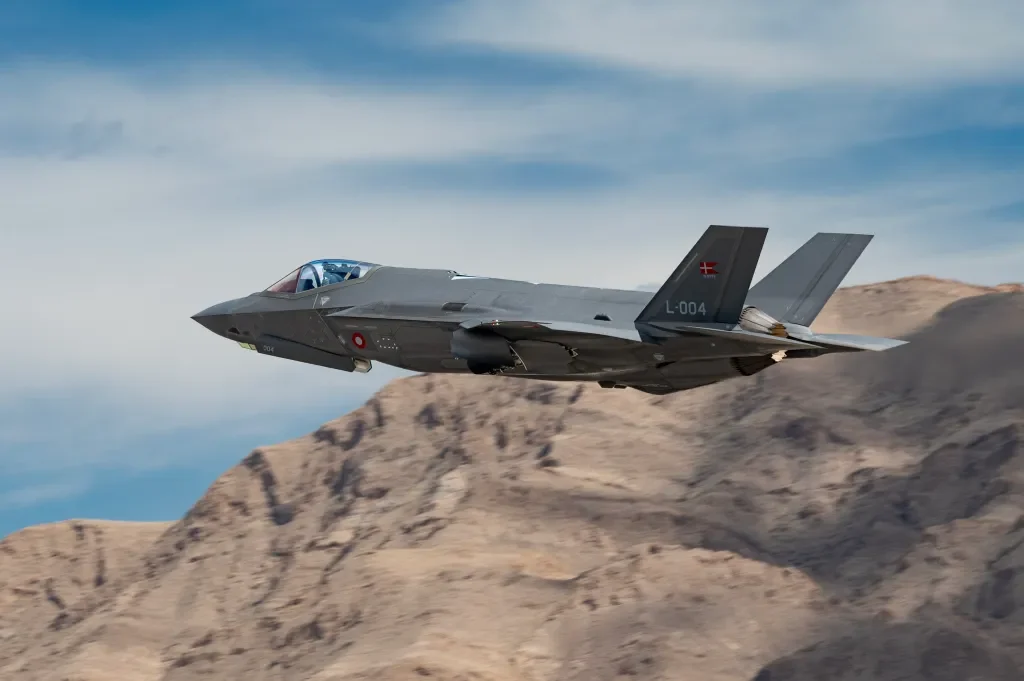
The choice also makes sense because Denmark is now building its entire fighter force around the F‑35A. Its last F‑16s left operational service in January 2026, while Copenhagen plans to expand the F‑35 fleet from the original 27 aircraft to 43. Buying a missile designed for the jet’s internal bay turns that investment into a complete strike system rather than merely a fleet of modern fighters.
Anthem: Missile, Drone or Flying Expendable?
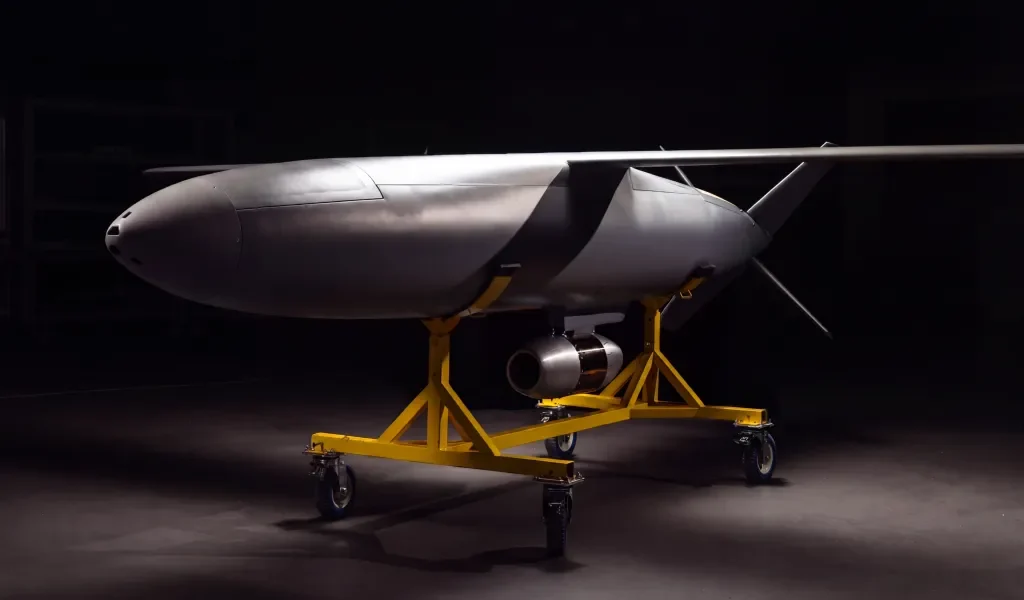
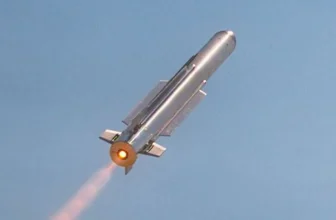
If JSM is an established product from a major defense company, Anthem is the most intriguing part of the Danish decision. It is being developed by Covenant, an American startup that until recently operated with little publicity. Even the company avoids placing the weapon in a narrow category, describing it as a “deep precision-strike munition.” In engineering terms, Anthem appears to occupy the increasingly blurred space between a traditional cruise missile and a one-way attack drone. It launches from the ground with a solid-fuel booster and then transitions to cruise flight using a heavy-fuel jet engine.
Its official range remains secret. Press reports have mentioned a figure of approximately 1,200 kilometers, but Covenant has not confirmed it, so the number should not be treated as an established specification. What is known is that the weapon carries a warhead weighing more than 200 kilograms; other reports place the upper payload figure at roughly 250 kilograms. The guidance package, terminal seeker, resistance to electronic countermeasures and exact launch arrangement have not been disclosed. Test images show the missile standing on tricycle landing gear, suggesting that one configuration may use a rocket-assisted takeoff from a prepared strip, but the final Danish launch system remains unknown.
Anthem’s appeal is not the promise of yet another technological masterpiece. Covenant is trying to change the price and production rate of long-range strike weapons. The company is aiming for a unit price in the mid-six-figure euro range, while conventional export cruise missiles can cost several million. It says Anthem has completed more than 200 test flights and plans to manufacture the weapon in Dallas and Leipzig. Its stated 2027 target is 1,000 missiles per year at each of those plants, followed by a further increase in output. For now, that is an industrial ambition rather than demonstrated production capacity.
This is where the risk in Denmark’s choice becomes clear. JSM already has several government customers, has undergone a lengthy integration process with the F‑35 and rests on the proven technological foundation of NSM. Anthem still has to demonstrate not only its flight performance but also its ability to enter mass production, retain accuracy under active countermeasures and remain reliable after long periods in storage. Denmark is effectively buying more than a missile: it is securing a place among the first operators of a new industrial model. In return, it may receive the weapon sooner than many allies and in quantities that would be prohibitively expensive if Copenhagen relied exclusively on premium cruise missiles.
The Third Layer That Is Easy to Miss
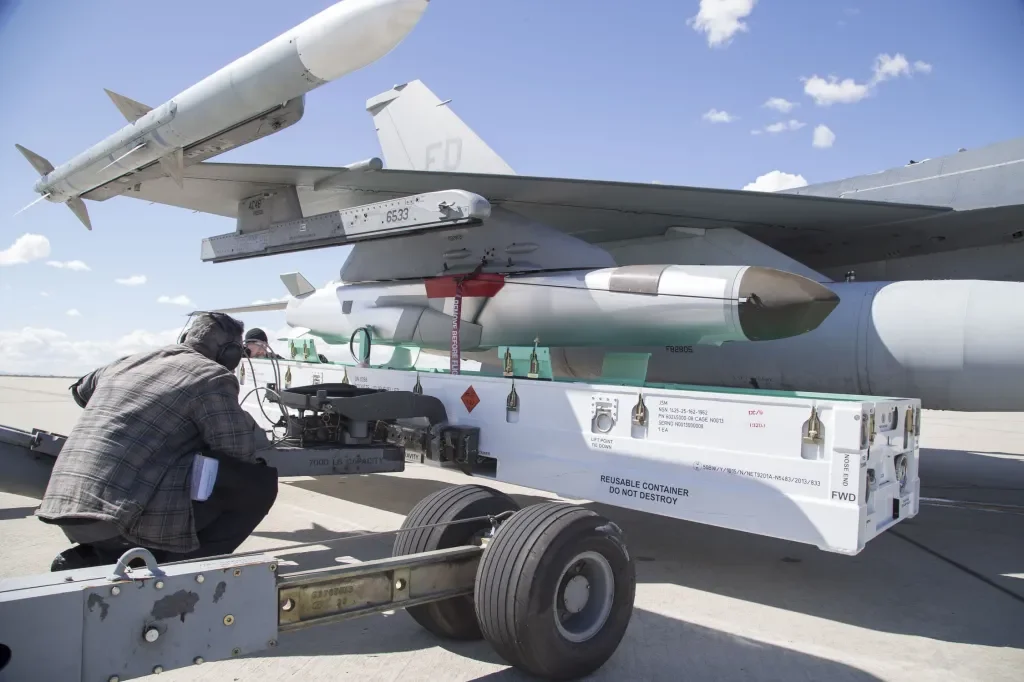
The JSM–Anthem combination is not emerging in isolation. In June 2026, the United States approved a possible sale to Denmark of 200 AGM‑158 JASSM‑ER air-launched cruise missiles, associated equipment and support, with an estimated total value of up to $842 million. A US government notification authorizes a potential sale; it does not mean that every missile has already been ordered, much less delivered. Nevertheless, it reveals the scale of Copenhagen’s plans.
If all these programs proceed, Denmark’s long-range strike force will have three distinct layers. The compact JSM fits inside the F‑35, can engage ships and land targets and preserves the aircraft’s low-observable configuration. The larger JASSM‑ER is intended primarily for long-range attacks against land targets and gives tactical aviation considerably greater reach, although its integration arrangements, Danish launch platforms and entry-into-service schedule still require confirmation. The ground-launched Anthem is supposed to provide a persistent and potentially more numerous strike reserve that does not require a combat aircraft.
Denmark is also introducing or expanding several shorter-range systems, including NSM anti-ship missiles for its frigates and coastal defenses and the Israeli PULS multiple-launch rocket system. They should not all be thrown into a single list as interchangeable weapons. NSM is primarily a maritime weapon, while PULS remains a flexible rocket-artillery system. JSM, JASSM‑ER and Anthem push the engagement zone far beyond the immediate battlefield or coastline. Denmark is not replacing one old weapon with one new missile; it is constructing a ladder of ranges and launch options.
Why This Matters So Much for Denmark
Denmark looks small on a map, but its position is anything but secondary. The Danish straits connect the Baltic and North seas, while the country’s airfields and naval bases lie close to routes along which allied forces may have to move. In this geography, an indigenous long-range strike capability changes Denmark’s role. It becomes more than a transit area and defensive line; it gains the ability to participate independently in planning operations against distant targets.
Range alone does not guarantee effectiveness. A missile needs intelligence, precise coordinates, communications, route planning and post-strike assessment. Attacking a moving ship is particularly demanding: during the missile’s flight, the target may travel tens of kilometers, making external targeting and in-flight updates crucial. The F‑35 can serve as part of such a reconnaissance-and-strike network, but a ground-launched Anthem battery will also require information from aircraft, ships, drones, satellites or allied surveillance systems. Without that network, even a weapon with exceptional range can become an expensive way to strike yesterday’s coordinates.
The Danish decision should therefore not be judged by a single headline range figure. Its strength lies in spreading risk. One weapon is mature and closely tied to an expensive aircraft; the other promises relative affordability and mass production but still carries considerable technical uncertainty. One launches from the air and can approach from different directions; the other can wait on the ground and preserve a strike option when aircraft are occupied or airfields are unavailable. Together, they give Denmark something it has never truly possessed: an independent, multi-option capability to threaten important targets far beyond its national territory.
The price, order size and delivery schedule remain undisclosed, while the most impressive claims about Anthem have yet to be verified. The logic of the purchase, however, is already visible. Copenhagen is not buying a “wonder weapon.” It is buying resilience: multiple launch platforms, separate production chains, weapons at different price points and the freedom not to place its entire long-range strike capability on a single type of missile.