Today’s 30-minute U.S.-Venezuelan skirmish raised a lot of questions—in particular, “How is it that American helicopters can just fly over Caracas like that? How come they weren’t all shot down by MANPADS, especially those slow-moving Chinook transport helicopters?!”
Well, let me explain a little bit—here’s how:
To start, let’s take a look at the AN/ALQ-144. This quirky-looking little device—which resembles either a cylindrical disco ball or a Christmas tree ornament—was developed by Sanders Associates, Inc. back in the 1970s—specifically as a response to the man-portable air-defense systems (MANPADS) that were emerging at the time. The development of man-portable air-defense systems caused serious concern among military officials regarding the survivability of helicopters on the battlefield; thermal decoys did not seem to be a comprehensive solution.
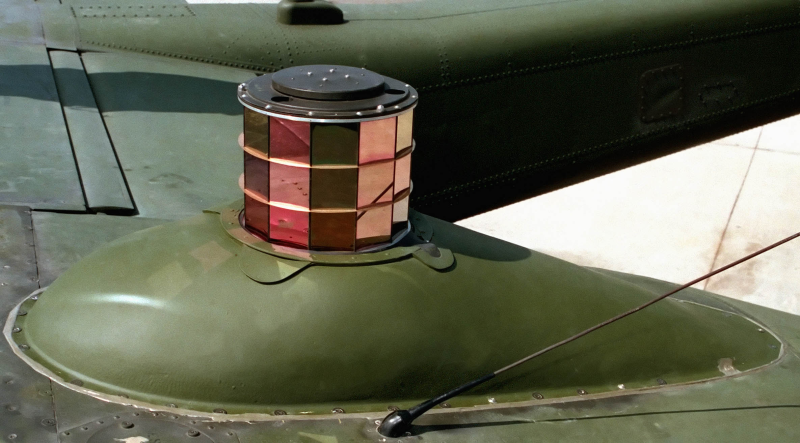
The design of the base model AN/ALQ-144 is based on a powerful infrared lamp (early models used silicon carbide, while modern ones use a cesium arc), capable of producing very bright thermal radiation in a spectrum close to that of a running engine. This lamp is surrounded by a cylindrical metal shutter with slits; its rotation allows the thermal radiation flux to be modulated into a sequence of pulses. The shutter’s rotation speed is selected to roughly match the scanning rate of the homing head (HH) of enemy MANPADS.
Most early MANPADS models used a rotating disk with a pattern of transparent and opaque sectors to determine the target’s position. The disk was positioned in front of the infrared detector in the missile’s seeker head; as it rotated, the disk would alternately obscure the target (with the opaque sectors) and reveal it (with the transparent sectors). As a result, the infrared detector produced a fluctuating signal; by correlating this signal with the disk’s rotation speed, the missile’s control system determined which direction the target was in and adjusted the seeker head accordingly.
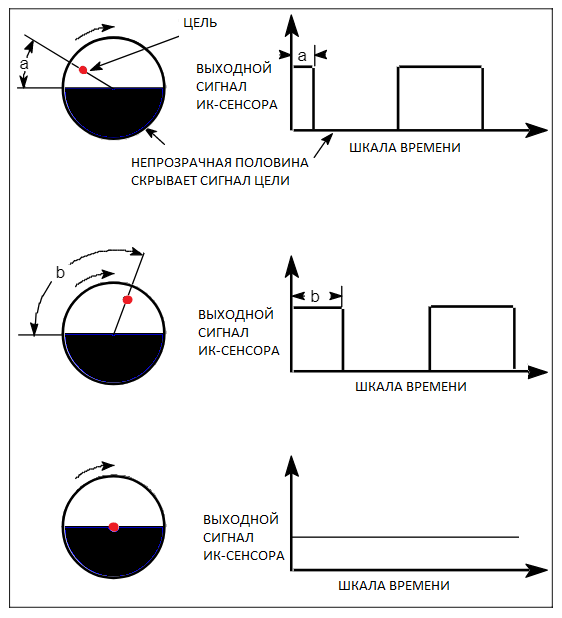
The simplest version, with a rotating disk divided into two sectors—a transparent one and an opaque one
When the target was directly along the homing head’s axis, the intermittent signal became continuous. This meant that the target had been “locked on” and the homing head was pointing directly at it and keeping it centered in its field of view. Now the missile could be launched, and it will automatically keep the seeker pointed at the target—if the target shifts, the continuous signal becomes intermittent, and the missile’s automatic system uses this to determine exactly where and how much the target has shifted, and reorients the seeker accordingly.
So what does the AN/ALQ-144 do? It emits powerful infrared pulses, modulated in such a way that a signal reaches the missile’s detector regardless of the rotating disc’s position. The missile’s guidance system becomes confused; instead of receiving a single signal, it receives two (one from the helicopter’s engine and the other from the AN/ALQ-144) and cannot determine which way to point the missile’s seeker. Even if the missile’s seeker is pointed directly at the helicopter’s engine, the false pulses coming from the AN/ALQ-144 prevent the detector from generating a continuous signal. The target is not “locked on.” The operator can press the launch button on his trusty “Strela” or “Radey” as many times as he likes; until the target is locked on, the missile will not launch.

If a MANPADS is fired from a long range, the actual signature of the helicopter’s engine and the false signature generated by the AN/ALQ-144 could, in principle, blend together. And the missile would be able to lock onto the target and launch. But as it approaches the target, the signals will begin to… that’s right, diverge. The missile will be unable to continue aligning its seeker head with the target; it will constantly assume that the target is somewhere to the side (since a continuous signal cannot be received regardless of the seeker’s orientation) and will safely veer off course.
More modern MANPADS homing systems, of course, use more sophisticated search mechanisms—to which more sophisticated infrared countermeasure systems have been developed. Second-generation MANPADS, for example, used—instead of a rotating disk— — the rotation of the entire seeker head, slightly offset from the central axis (i.e., conical scanning), which emitted not a continuous signal when a target was “acquired,” but a uniform pulse frequency. To counter such homing heads, the older AN/ALQ-144 units were modified accordingly. It became possible to operate in more than one mode simultaneously (by installing two shutters rotating at different speeds), and subsequently to configure the required operating mode and select it directly in flight to counter specific systems. The principle remains the same: to present the HTS with more than one heat source in such a way that it cannot effectively “lock onto” a single one and thus cannot track the target.
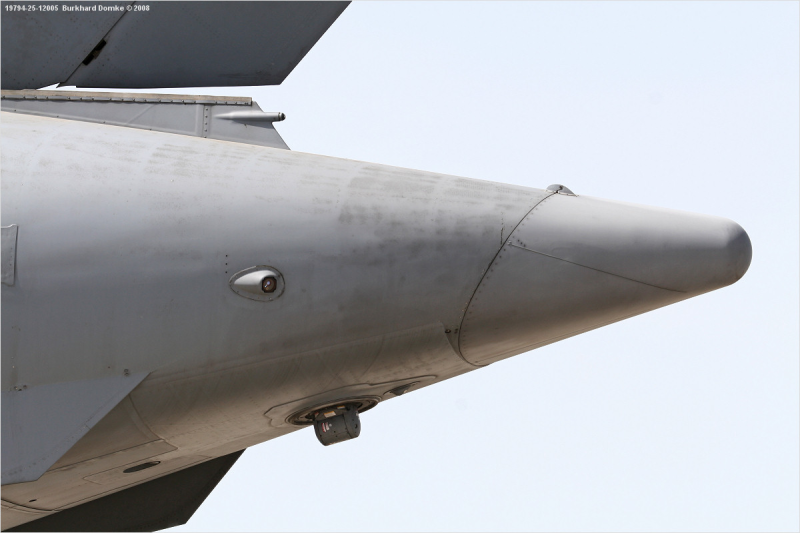
AN/AAQ-24 Nemesis directed-infrared countermeasure system turret mounted under the tail of the aircraft
Later, as increasingly sophisticated MANPADS detection systems were developed, helicopter defense measures shifted from omnidirectional jamming systems (such as the AN/ALQ-144) to directional ones—which detected a missile launch, aimed a powerful infrared spotlight at it, and “jammed” the homing head with directed radiation modulated in such a way as to confuse the missile. However, the good old AN/ALQ-144 has not been abandoned either; first, there are still tens of thousands of older-model MANPADS in the world, and second, the AN/ALQ-144 (in combination with infrared-absorbing paint and engine exhaust cooling systems) helps “blur” the helicopter’s infrared signature, making it indistinct and unrecognizable. This significantly facilitates the operation of directional jamming systems.

P.S. According to available information, the Venezuelan “army” is equipped with “Igla-S” MANPADS (export model), the specifications of which are well known to the U.S. military—these MANPADS were widely exported, including to Slovenia (a NATO country), and were offered to Finland. Consequently, it is obvious that American helicopter pilots had an excellent opportunity to calibrate their infrared countermeasure systems. This explains why they were able to fly so calmly over Caracas—all of Venezuela’s somewhat serious air defense systems were taken out by airstrikes in the very first wave of the attack, and the American helicopters were reliably protected from the not-so-new MANPADS.