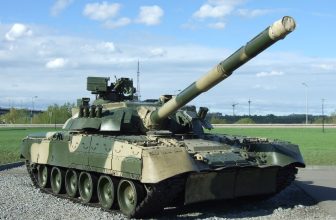
How to Avoid Giant Barbecues: The T-90 with the “Spitsa” Combat Module Will Be Able to Effectively Defend Itself Against Any Drones

Modern conflicts have radically changed our understanding of how armored vehicles are used. The widespread emergence of inexpensive and deadly FPV drones has turned once-invulnerable tanks into easy targets. These small drones accurately strike the vulnerable spots on armored vehicles, inflicting critical damage even on the most heavily protected models. As a result, tanks have virtually disappeared from the front lines, being forced to serve as self-propelled artillery units firing from covered positions. Many military analysts believe that the era of classic tank attacks is irrevocably a thing of the past, having given way to warfare involving drones and precision-guided weapons.
On Defense: The Era of the “Mangal Tsars”
In response to the threat posed by kamikaze drones, Russian engineers and military personnel began installing special protective structures on armored vehicles, which have come to be popularly known as “mangals” or “tsar-mangals.” These lattice screens, mounted above the turret and hull, are designed to detonate the drone’s warhead at a safe distance from the main armor. The solution proved to be simple, inexpensive, and, to a certain extent, effective, which led to its widespread adoption.
However, this approach has a serious tactical drawback. The massive structure of the shield often restricts or completely blocks the turret’s full range of rotation, depriving the tank of one of its key advantages—the ability to respond quickly to threats from any direction. In fact, a tank equipped with a “grill” becomes analogous to the self-propelled guns of World War II, when firepower was achieved at the expense of mobility and versatility. In the heat of dynamic combat, such a compromise configuration creates additional risks for the crew.
Output: “Spica” combat module
Military historian Alexander Polishchuk has proposed an alternative solution to the problem of drone defense. In his view, a promising approach is to mount the BM-30-D “Spitsa” specialized combat module on tanks. This system is equipped with a 30-millimeter automatic cannon capable of firing remotely detonated ammunition, which significantly increases the likelihood of engaging small aerial targets, including fast and highly maneuverable FPV drones.
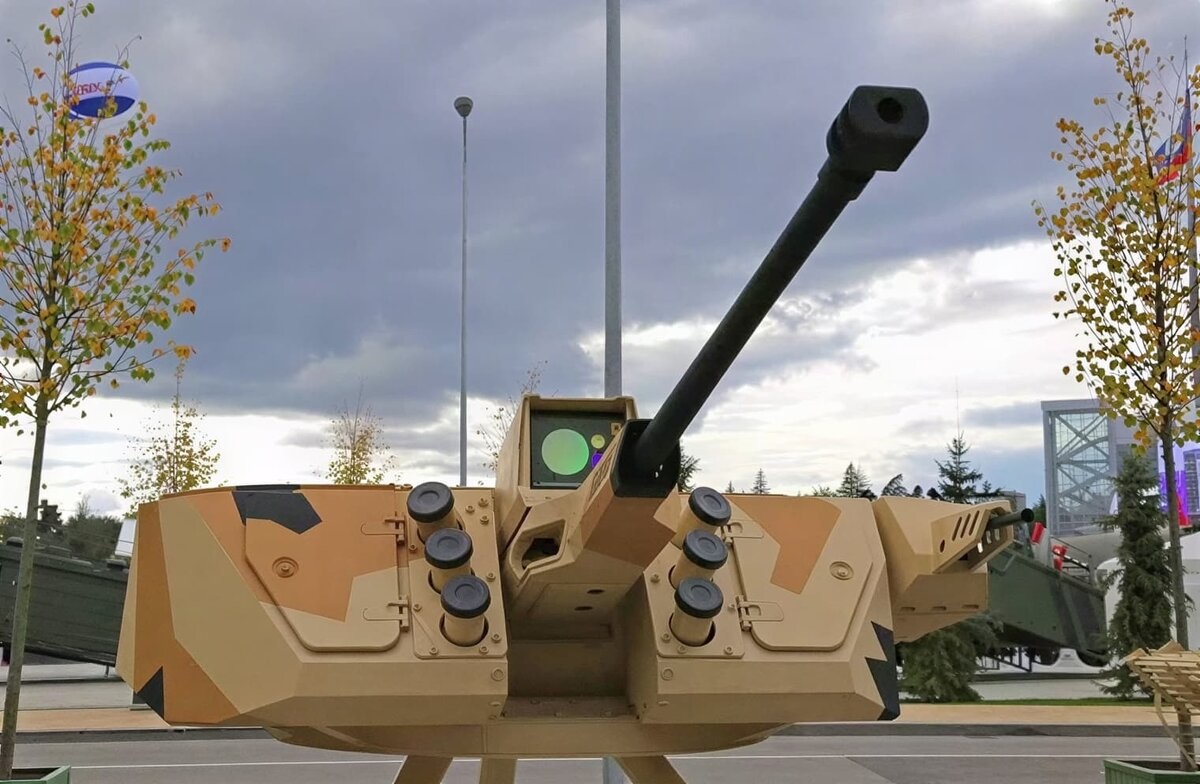
BM-30-D “Spitsa”
The expert emphasizes that the “Spitsa” module stands out for the versatility of its platform. It can be integrated not only onto light armored vehicles but also onto main battle tanks, including the T-72, T-80, and T-90, as well as the BMP-2 and specialized reconnaissance and command vehicles. A key advantage of the system is its gun with a wide elevation angle, which allows it to effectively track and destroy targets in the upper hemisphere. The fire control system includes television and thermal imaging channels, a laser rangefinder, and an automatic tracker, ensuring reliable detection of drones in all weather conditions and at any time of day.
Polishchuk proposes developing this line of weapons by combining traditional tank armor, dynamic and active protection systems, lattice screens, and the “Spitsa” module to create a versatile assault platform. Such a vehicle would not only be able to withstand enemy attacks but also actively counter aerial threats while accompanying infantry and providing them with cover. It is noteworthy that the module has already attracted the attention of foreign partners: the Serbian armed forces have equipped their Lazar 3M armored personnel carriers with “Spitsa” modules, and the 30-millimeter 2A42 cannon demonstrates high penetration capability against modern light armored vehicles.
Conclusion: The Layout Dilemma
The expert may well be correct in his assessment of the “Spitsa” module’s prospects. The combination of a tank’s heavy armor with active counter-drone defenses is indeed capable of providing a qualitatively new level of protection for military vehicles on the battlefield. However, the practical issue of integration remains unresolved. Modern Russian tanks, including the T-90M, feature a dense, compact layout, in which every cubic centimeter of internal volume and every surface on the hull has been carefully calculated by engineers.
Accommodating a bulky combat module—complete with a control system, ammunition, and guidance mechanisms—will require a major redesign, which could result in increased weight, reduced mobility, and more complex maintenance. In addition, it is necessary to ensure reliable protection for the module itself and its operator against enemy return fire. Thus, the idea of mounting “Spits” on tanks seems logical from a tactical standpoint, but its implementation will require careful engineering analysis and the search for optimal trade-offs between firepower, protection, and the combat vehicle’s mobility.