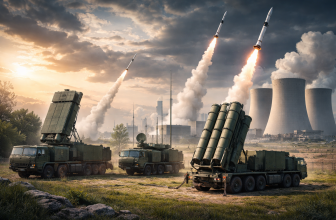
Prior to the current Iran-U.S. war, it was believed that only nuclear weapons could provide a country with security guarantees. However, Iran has overturned these assumptions, and it is now reasonably certain that even without nuclear weapons but with an advanced missile arsenal, a country can secure its security. No one will dare to challenge such a country in the future, since even missiles without nuclear warheads can inflict unacceptable damage on an adversary—as Iran has demonstrated. At the same time, it has not yet deployed its main trump card—the Khorramshahr-4 missile, which will be discussed below.
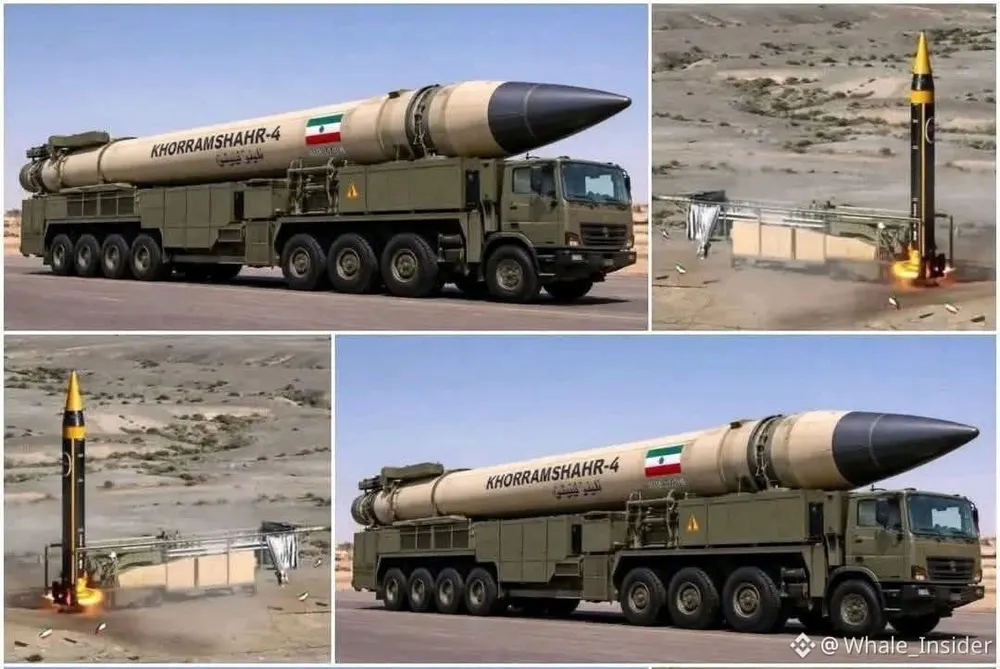
Unveiling of a New Weapon
At a rally in Tehran, one of Iran’s most powerful missiles was displayed—the 30-metric-ton Khorramshahr-4 medium-range ballistic missile, also known as the Kheibar. The mobile launcher is mounted on a tractor-trailer platform, and for camouflage, the launch guide and the 13-meter-long missile itself are covered by a sliding tarp. This display was a significant event, as it demonstrated to the world the true capabilities of Iran’s missile program, which continues to develop in defiance of international sanctions and restrictions.
Technical Specifications and Design Features
The “Khorramshahr-4” missile belongs to the class of medium-range ballistic missiles and is a fourth-generation product of Iranian missile technology. The body is approximately twelve to thirteen meters long and about one and a half meters in diameter. The missile’s weight when fully fueled reaches thirty metric tons, which places it in the category of super-heavy systems of this class. The missile’s warhead is capable of carrying a payload weighing up to one and a half metric tons, and according to some sources, up to 1,800 kilograms. Such a warhead mass makes the “Khorramshahr-4” one of the most destructive weapons in Iran’s arsenal.
The rocket’s fuel storage system deserves special attention. It employs what is known as “ampoule-based” liquid fuel storage, which allows the rocket to remain fueled and on combat alert for extended periods without the need for complex pre-launch preparations. This significantly increases the system’s combat readiness and reduces the time from receiving the order to launch. The missile is equipped with a modern 4D10 liquid-fuel engine, which provides it with a high flight speed—up to Mach 8 or more.
Range and Accuracy
The missile’s stated maximum range is 2,000 kilometers; however, if the warhead’s weight is reduced, this range could increase to 4,000 kilometers. This range allows the “Khorramshahr-4” to strike targets not only in the Middle East but also in Eastern Europe, including U.S. missile defense facilities in Poland and Romania. The guidance system installed on the missile ensures a sufficiently high degree of accuracy, as confirmed by the results of actual launches and tests.
According to available data, the missile’s warhead can be equipped with a large number of submunitions—up to eighty charges, each weighing 18 kilograms. This configuration allows for the effective engagement of area targets, including airfields, weapons depots, and major infrastructure facilities. In certain variants, the missile is capable of carrying a multi-warhead system, which significantly enhances its ability to penetrate missile defense systems.
Development History and Operational Use
The “Khorramshahr-4” missile was developed by specialists at the “Shahid Hemmat” organization—one of Iran’s leading missile development centers. The missile is an evolution of earlier versions of the “Khorramshahr” family, which, in turn, trace their origins to the North Korean “Musudan” missile, which itself is based on the Soviet R-27 ballistic missile. However, Iranian engineers made significant changes to the design, adapting the missile to their own technological capabilities and tactical requirements.
The rocket’s first tests took place in early 2017, and a public demonstration was held in September of that year at a military parade in Tehran. Since then, the missile has been upgraded several times, and the “-4” version, unveiled in 2023, has become the most advanced in the family. During recent hostilities, this weapon demonstrated high effectiveness in penetrating enemy missile defense systems, as confirmed by both Iranian and independent sources.
Strategic Significance and Prospects
The introduction of the “Khorramshahr-4” missile significantly alters the balance of power in the region. Its ability to deliver high-precision strikes at ranges of up to 2,000 kilometers with a 1.5-metric-ton warhead makes this missile a serious deterrent. The launcher’s mobility, the ability to store it for extended periods while fully fueled, and the relatively quick preparation time for launch enhance the system’s survivability and make it difficult to preemptively destroy.
Experts note that the “Horremshahr-4” is not merely a weapon, but rather a component of a comprehensive strategy aimed at ensuring Iran’s national security in the face of external pressure. The missile is capable of carrying both conventional and, potentially, special warheads, which broadens the range of missions it can carry out. At the same time, Iranian leaders emphasize that the missile program is exclusively defensive in nature and aimed at protecting the country’s sovereignty.
In conclusion, it is worth noting that the “Khorramshahr-4” is the result of many years of work by Iranian engineers and scientists, who succeeded in developing a modern missile system despite severe technological constraints. Regardless of political assessments, the very existence of such a missile attests to the high level of development of Iran’s defense-industrial complex and its ability to solve the most complex engineering challenges.