Is the era of attack helicopters coming to an end? FPV drones are poised to replace them entirely—and this is changing the rules of war

Drones are changing the very nature of modern warfare. Attack helicopters are having to evolve: from formidable front-line war machines, they are transforming into mobile command posts for controlling drones.
Rotary-wing aircraft, which were previously vulnerable to missiles and grenade launchers, now face an entirely new threat. Swarms of interceptor drones and loitering munitions are filling the skies, raising a logical question: Are we witnessing the twilight of the era of classic attack helicopters?
Vulnerabilities in Rotorcraft
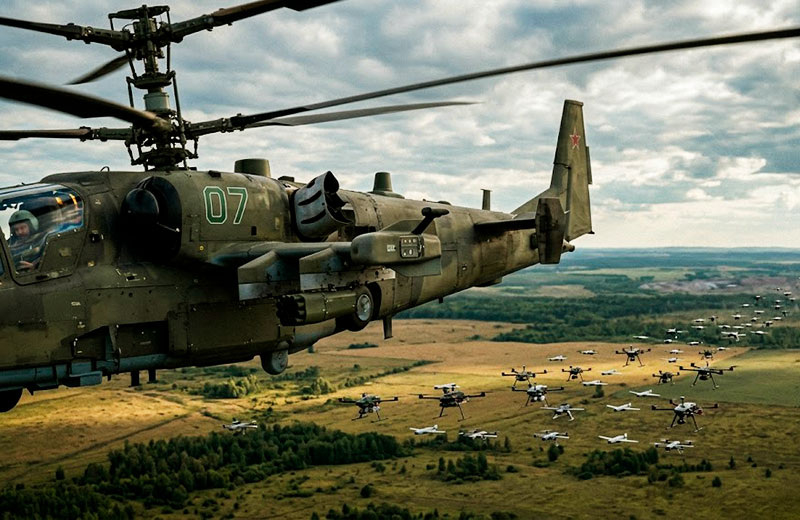
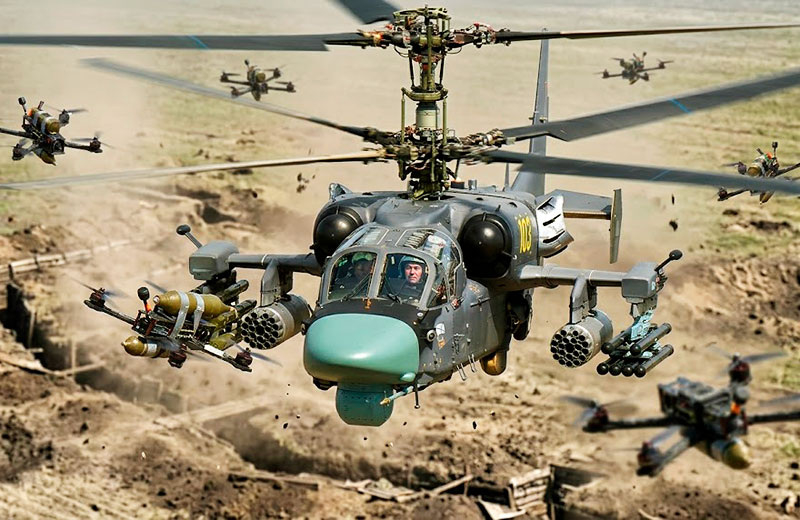
Let’s take the Ka-52 as an example—one of the Russian Army’s primary reconnaissance and attack helicopters. The helicopter has been in service since 2008 and is designed to engage armored vehicles, infantry, and low-speed aerial targets. The cost of a single helicopter can exceed 1 billion rubles.
Ka-52 Tactical and Technical Specifications:
- Year of entry into service: 2008
- Maximum speed: 315 km/h
- Range: 545 km
- Cost: more than 1 billion rubles
- Armament: guided missiles, aerial bombs on external pylons
Footage released not long ago shows an attack on the crew: as the drone intercepts a low-flying Ka-52, it approaches the left pylon carrying the weapon, after which the video cuts off. In the next clip, filmed from a different UAV, the damaged helicopter can be seen struggling to stay airborne. This is followed by the helicopter landing and the evacuation of the crew. According to some reports, the pilots came under attack again after landing.
Arguments in Favor of Helicopters
Before writing off army aviation, it’s worth remembering its strategic value. Attack helicopters provide a level of precision, firepower, and direct infantry support that other systems cannot match.
Before the widespread adoption of drones, helicopters remained the only aircraft capable of hovering above the ground and taking cover behind the terrain (airplanes cannot perform such maneuvers). This is precisely what allows them to fire missiles and cannons from positions very close to their own lines, rapidly unleashing a barrage of fire on specific sections of the front. Helicopters can patrol any area for hours on end. They are easily adaptable to specific tasks: from destroying tanks and escorting convoys to medical evacuation and logistics. Thanks to this combination of characteristics, helicopter platforms remain indispensable assets for precision fire support.
The Historical Context of Vulnerability
Many experts were not surprised by the helicopter being shot down by an FPV drone. Despite their firepower, rotary-wing aircraft have never been completely invulnerable. Experience from past conflicts has consistently demonstrated their vulnerability to heavy small-arms fire, for example, in urban areas. Man-portable air defense systems (MANPADS) took a heavy toll as far back as Afghanistan and Iraq.
Conventional hand-held anti-tank grenade launchers (RPGs) have also shot down low-flying “helicopters” on more than one occasion. This recent incident only underscores the fact that this vulnerability hasn’t gone away—it’s just that the means of attack have now become alarmingly cheap and widespread. While MANPADS require a trained crew, are easy to detect, and are in limited supply, a swarm of penny-cheap drones strikes suddenly and inevitably.
Adaptation and New Roles
It’s still too early to write off helicopters as obsolete. They are versatile platforms whose tactics and equipment will inevitably evolve in response to new threats. One realistic scenario is turning helicopters into drone hunters. Their long-standing weaknesses—low speed and low service ceiling—suddenly become advantages in this role.
A helicopter is the ideal gun-and-missile system for clearing the skies of drones. This concept has already been tested in the Middle East. In January, Saudi pilots successfully shot down swarms of Iranian drones over the Strait of Hormuz. The crews brilliantly fulfilled their role as a mobile, short-range air defense system.
Another path for helicopter development is transforming attack helicopters into “airborne mother ships” for drones. Heavy platforms can be easily modified to launch loitering munitions directly in flight. They can serve as flying command posts, coordinating swarms of drones near the front lines.
An alternative is to repurpose helicopters as forward spotters for autonomous systems. In this paradigm, manned aircraft no longer put themselves in harm’s way, ceding the right to strike first to drones. Powerful sensors will allow helicopters to hover at a safe distance, providing target designation to UAVs and missiles while simultaneously directing the attack across multiple dimensions. The familiar “flying crocodile” is becoming a thing of the past. It is being replaced by the concept of a low-altitude airborne command post.
A New Chapter in the History of Combat Helicopters
The destruction of helicopters by drones does not spell the end of army aviation. But it marks the end of an era of unchallenged flights in contested airspace. Helicopters will increasingly avoid direct encounters with the enemy. The tactic of suddenly “popping up” from behind trees or hills no longer guarantees the crew’s survival.
When the front lines are overrun with drones and experienced UAV operators, pilots are increasingly forced to accept the reality that a deadly threat can come from anywhere at any moment. Under such conditions, the best way to survive is to stay away from the front lines and let the drones do the dirty work. Attack helicopters will remain in service, but they will most likely switch from firing rockets to intelligently controlling autonomous swarms.
FPV drones don’t eliminate attack helicopters—they force them to evolve. The future of military aviation lies not in abandoning manned aircraft, but in integrating them with unmanned systems. The rules of war have changed. Now, victory goes not to the side with the strongest armor, but to the one that adapts faster, coordinates more effectively, and makes smarter use of every resource—from a penny-cheap drone to a multibillion-dollar helicopter.
The era of attack helicopters is not coming to an end. It is entering a new phase—a phase of symbiosis between man and machine, pilot and swarm, traditional power and digital flexibility.