Is the U.S. Ready for a New War in the Middle East? A Comparison with Operation Desert Storm

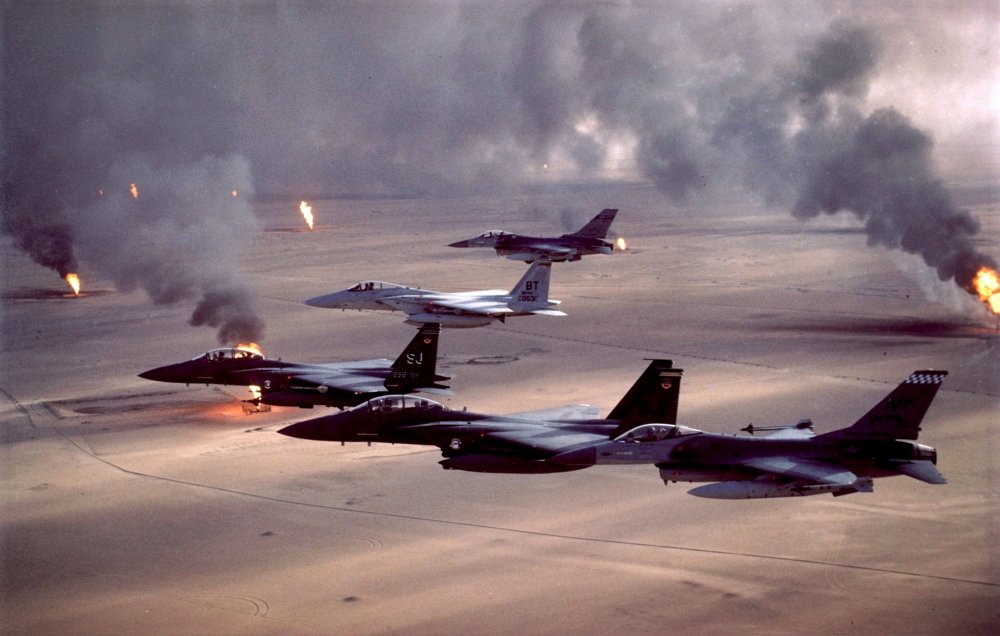
I’m old enough to remember the U.S. war against Iraq—better known as “Desert Storm”—very well. At the time, it was the largest and most technologically advanced war since World War II, since the Americans’ enemy—the Iraqi army—was quite strong both by regional standards and by global standards. The decisive victory did not come as easily to the Americans as it might seem today. Yes, they carried out a classic blitzkrieg, but it was made possible by an unprecedented concentration of forces and resources in the region. The only time the Americans fought with such a large force was against Germany during World War II.
Is the U.S. capable of launching a similar campaign against Iran? Let’s try to figure it out; there’s already enough information online to draw some conclusions.
However, let’s start by comparing the U.S.’s adversaries: the Iraqi and Iranian armies. Of course, more than three decades separate them, but we can still draw some conclusions.
Contents:
Summary Table of Features
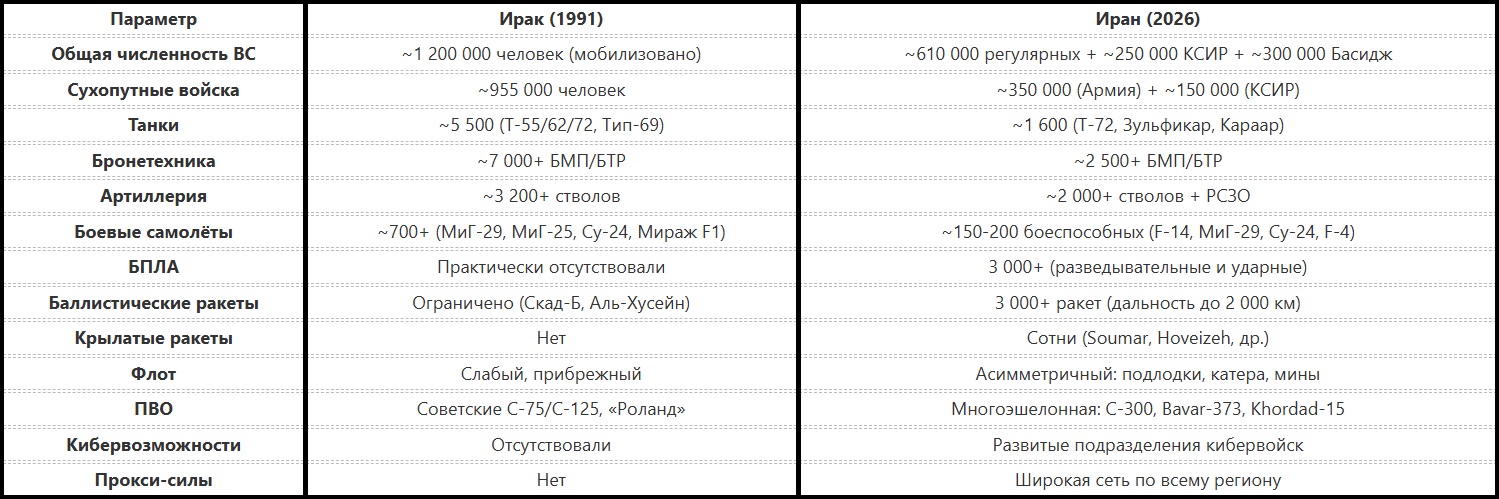
Ground Forces: Quantity vs. Flexibility
🇮🇶 Iraq 1991: “The Soviet Hammer”
- Saddam Hussein’s army was modeled after the Soviet army: massive armored formations and a deep, echeloned defense.
- After an eight-year war with Iran (1980–1988), the army had combat experience but was exhausted.
- Doctrine: holding occupied territories, counterattacks by large formations.
Tanks: ~5,500 units
— T-55/T-62: ~4,000 (obsolete, but widely used)
— T-72: ~1,000 (the best ones, but mostly with the Republican Guard)
— Chinese Type 69: ~500
Artillery: ~3,200+ systems
— 122–152 mm towed and self-propelled artillery pieces
— Multiple-Launch Rocket Systems: Soviet “Grad” and Chinese Copies
Infantry Weapons:
— AKM assault rifles, RPD/PK machine guns
— Anti-tank guided missile system: AT-3 Sagger (obsolete, manually guided)
- The low level of training among enlisted personnel (many conscripts).
- A rigid chain of command: local initiative was suppressed.
- Outdated communications and intelligence: units often operated “blind.”
- Reliance on Soviet logistics, disrupted by sanctions.
🇮🇷 Iran 2026: “Hybrid Asymmetry”
- Two parallel armies: the regular Army (Artesh) and the Islamic Revolutionary Guard Corps (IRGC).
- Doctrine: “active defense” + asymmetric attack + proxy wars.
- An emphasis on mobility, dispersal, stealth, and strikes against the enemy’s vulnerabilities.
- Tanks: ~1,600 units
— T-72S/S1: ~400 (upgraded)
— Zulfikar: ~150 (in-house design, 125-mm gun)
— Karaar: ~100 (upgraded T-72 with T-90 components)
— Obsolete: Chiften, M-60, T-55 (in reserve)
- Armored Vehicles: ~2,500+ units
— Infantry Fighting Vehicles: BMP-1/2, Boragh (domestic)
— Armored personnel carriers: Raez, Sarir, Soviet/Chinese models
- Artillery and Multiple Launch Rocket Systems:
— Self-propelled guns: 2S1, 2S3, Raad-1/2
— Multiple-launch rocket systems: Fajr-3/5, Zelzal, Kheibar (range up to 200+ km)
— Tactical missiles: Fateh-110, Zolfaghar (high-precision)
- Anti-tank weapons:
— Anti-Tank Guided Missile Systems: Toophan (TOW clone), Dehlavieh, Raad-T
— Modern: with thermal imaging guidance, “fire-and-forget”
- The high level of motivation among the ideologically trained units of the IRGC.
- Experience from actual combat in Syria, Iraq, and Yemen.
- An extensive network of underground bases and tunnels (“missile cities”).
- The ability to quickly disperse forces, making it more difficult to target them.
Air Force: Collapse vs. Survival
🇮🇶 Iraq 1991
- Operational fleet: ~700 aircraft
— Fighter jets: MiG-29 (40), MiG-25 (30), MiG-23, Mirage F1
— Attack Aircraft: Su-22, Su-25
— Bombers: Tu-22, Su-24
— Helicopters: Mi-24, Gazelle (equipped with an anti-tank missile system)
- Issues:
— The lack of modern electronic warfare systems and precision-guided weapons
— Inadequate training of pilots for night and challenging conditions
— Dependence on foreign spare parts (subject to sanctions)
— The lack of an effective AWACS system
- Result:
— Approximately 150–200 aircraft were lost in the air and on the ground
— Many crews flew to Iran without engaging in combat
🇮🇷 Iran 2026
- Operational strength: ~150–200 combat-ready aircraft
— Fighter jets: F-14 Tomcat (upgraded), MiG-29, Su-24
— Obsolete: F-4 Phantom, F-5 Tiger (upgraded)
— Training and combat exercises: in-house developments (Kowsar, Azarakhsh)
— Helicopters: AH-1J Cobra, Mil Mi-17, and our own Shahed-285
- Compensating for the limitations of manned aviation:
— 3,000+ UAVs: Shahed-136 (kamikaze), Mohajer-6, Kaman-22
— Air-launched cruise missiles
— Integration with Air Defense and Missile Forces
- Strengths:
— Widespread use of drones: inexpensive, effective, and difficult to intercept
— Experience coordinating UAVs with artillery and special forces
— Domestic production: independence from imports
Missile Forces: From “Skadov” to a High-Precision Arsenal
🇮🇶 Iraq 1991

- Total: ~100–150 ballistic missiles in the arsenal.
- Purpose: Attacks on Israel and Saudi Arabia—intended to have a psychological impact, but causing minimal military damage.
- Lack of guidance systems: The missiles were weapons of terror, not precision strikes.
🇮🇷 Iran 2026
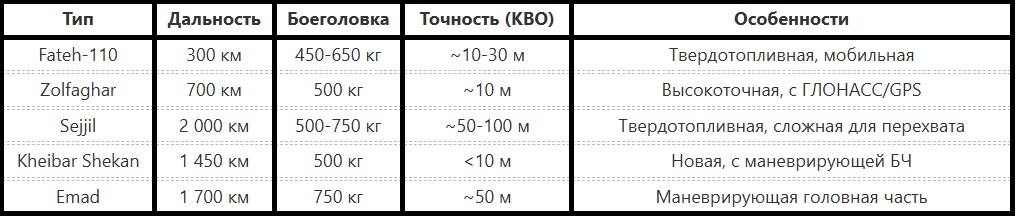
- Total: 3,000+ ballistic missiles—the largest arsenal in the Middle East.
- Cruise missiles: Soumar, Hoveizeh (range: 1,350+ km), launched from land, sea, and air.
- Tactics: massive barrages to overwhelm the enemy’s missile defense systems.
- Integration with UAVs: reconnaissance drones + missiles + real-time damage assessment.
Key difference: Iraq in 1991 had missiles as “weapons of last resort.” Iran in 2026 has missiles as its primary means of deterrence and attack, integrated into a unified combat system.
Naval Forces: Coastal Defense Against Asymmetric Threats
🇮🇶 Iraq 1991
- Navy: symbolic—a few missile boats and mine-laying vessels.
- Bases: Umm Qasr and FAO are vulnerable to airstrikes.
- Result: The fleet was virtually destroyed in the first days of the war and had no impact on the course of the conflict.
🇮🇷 Iran 2026
- Regular Fleet (Iranian Navy):
— Submarines: 3 × Kilo-class (Russian), 20+ small submarines
— Frigates: Moudge-class (domestically built, equipped with Noor missiles)
— Corvettes: Sina-class, Bayandor-class
— Missile boats: dozens, equipped with anti-ship missiles
- KSIR (maritime component):
— 1,000+ high-speed boats equipped with rockets, machine guns, and anti-tank guided missiles
— “Swarm” Tactics: Massed Attacks by Small Targets
— Mine-laying weapons: thousands of sea mines to block the Strait of Hormuz
- Anti-ship missiles:
— Noor, Qader, Nasr (range: 35–200+ km)
— Copies of the Chinese C-802, in-house designs
— Launch: from the shore, ships, submarines, and UAVs
- Strategy:
— Do not win in open combat
— Create unacceptable risks for the enemy fleet
— The threat of a closure of the Strait of Hormuz (20% of the world’s oil)
Air Defense and Electronic Warfare: From a “Leaky Umbrella” to a Multi-Layered Defense
🇮🇶 Iraq 1991
- Systems: S-75, S-125, S-200 (Soviet), “Roland” (French).
- Problems:
- Outdated radars vulnerable to anti-radar missiles.
- Lack of integration: each system operated autonomously.
- Poor operator training; lack of widespread use of decoys.
- Result: Air defenses were neutralized in the first few days, and the coalition air force operated with near impunity.
🇮🇷 Iran 2026
- Multi-layered air defense system:
— Long-range systems: S-300 PMU2 (Russia), Bavar-373 (domestic equivalent of the S-400)
— Mid-range: Khordad-15, Talash, 3rd Khordad
— Close-range defense: Mersad, Shahin, man-portable air defense systems
- Features:
— Domestic Production: Independence from Sanctions
— Mobile systems: difficult to detect and destroy
— Integration with radar networks and reconnaissance UAVs
— Use of decoys, electronic jamming
- REB:
— Systems for jamming enemy GPS, communications, and radar
— Experience in intercepting and landing foreign UAVs (the RQ-170 Sentinel in 2011)
Asymmetry and Proxy Capabilities: A Factor That Wasn’t Present in 1991
🇮🇶 Iraq 1991
- They were practically nonexistent.
- Iraq functioned as a traditional state with a regular army.
- The lack of allies in the region following the occupation of Kuwait.
🇮🇷 Iran 2026
- “Axis of Resistance” — a network of proxy forces:
— Hezbollah (Lebanon): 50,000+ fighters, 150,000+ rockets
— Houthis (Yemen): ballistic missiles, UAVs, attacks on Saudi Arabia and the UAE
— Shiite militias (Iraq): Kata’ib Hezbollah, Asaib Ahl al-Haq
— Pro-government forces (Syria): integration with Iranian advisers
— Hamas and Islamic Jihad (Gaza): Rocket Attacks on Israel
- Tactics:
— Attacks via third parties — denial of responsibility
— Stretching the enemy’s resources across multiple fronts
— Attacks on economic infrastructure (oil facilities, ports)
— Cyberattacks, disinformation, psychological warfare
- IRGC Special Forces “Quds”:
— Training, equipping, and coordinating proxy forces
— Overseas operations, sabotage, targeted assassinations
This is a qualitatively new dimension of warfare that did not exist in 1991. Iran can wage a conflict without engaging in direct confrontation, which sharply raises the threshold for escalation on the part of the adversary.
Summary Analysis: Who Is Stronger?
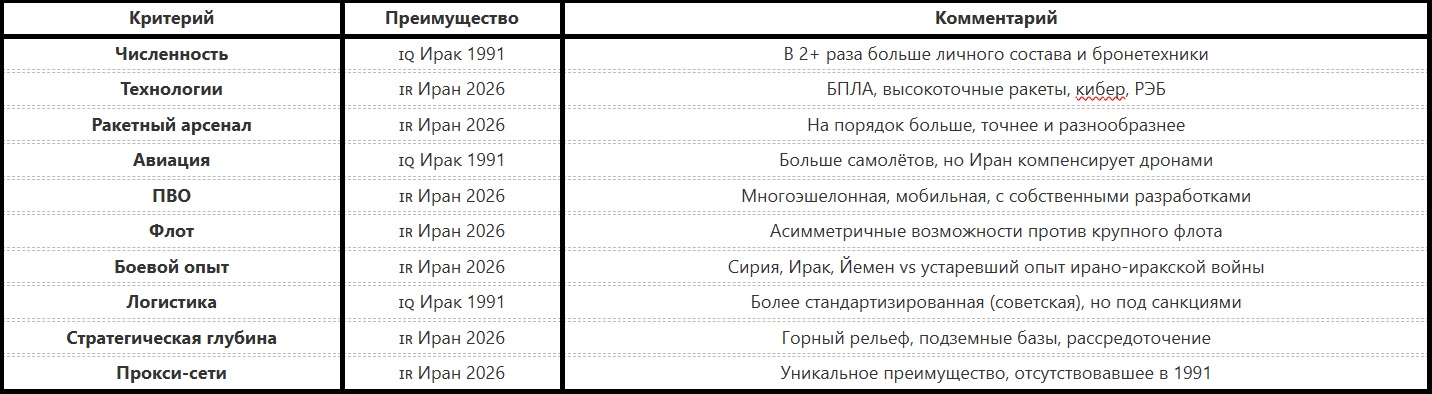
Key Findings
-
- Iraq in 1991 was an army of the industrial age: massive, heavily armored, but technologically backward and vulnerable to precision-guided weapons.
- Iran in 2026 is an army of the hybrid era: smaller in size, but more flexible, technologically advanced, and capable of waging war on multiple levels simultaneously (conventional, asymmetric, cyber, and information).
- The paradox of power: Iraq in 1991 had more tanks and aircraft, but was defeated in 100 hours. Iran in 2026 has fewer conventional weapons, but possesses capabilities capable of inflicting unacceptable damage even on a technologically superior adversary.
- The Deterrence Factor: In 1991, Iraq lacked the means to respond effectively to strikes on its territory. In 2026, Iran could respond with a massive missile and drone strike against U.S. and allied bases and the region’s energy infrastructure.
- Lessons from History: A direct “tank-versus-tank” or “aircraft-versus-aircraft” comparison is of little value today. Modern warfare is won not by numbers, but by integration, precision, adaptability, and the ability to operate under conditions of uncertainty.
Conclusion
The Iranian military of 2026 is no stronger than the Iraqi military of 1991 in the classical sense of “brute force.” But it is a far more dangerous adversary because it is capable of waging war using new methods for which traditional armies are not always prepared. This makes any potential conflict with Iran far more complex, protracted, and risky than “Desert Storm.”
An Analysis of U.S. and Iranian Military Capabilities
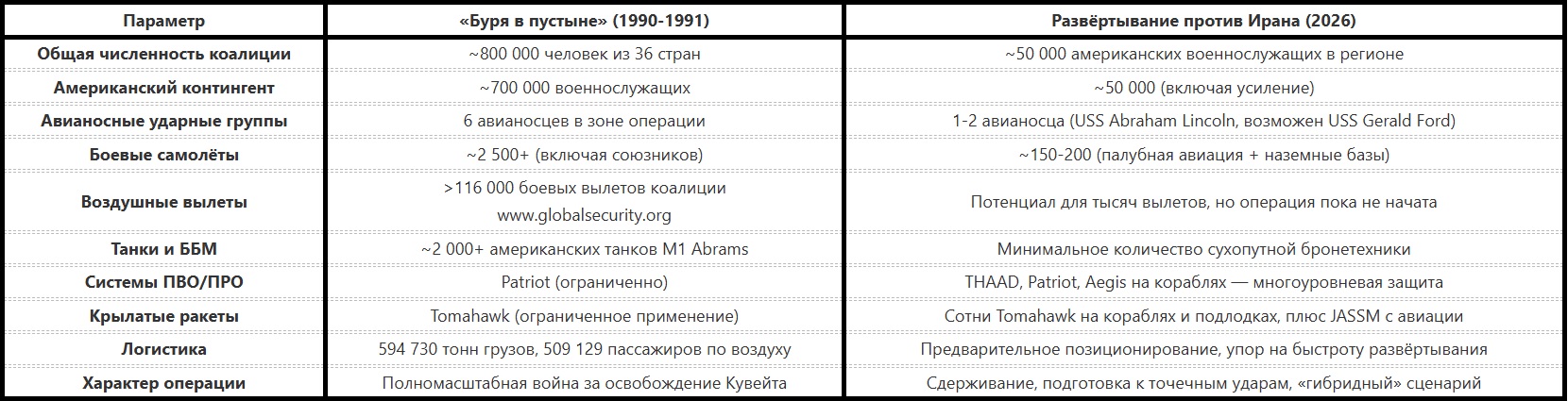
“Storm in the Desert”: The Scale of a Conventional War
Army
Aviation
- Coalition aircraft have flown more than 116,000 combat sorties.
- More than 2,500 aircraft are involved, including the F-15, F-16, A-10, B-52, and F-117.
- A total of
18,466 transport flights
were conducted to transport personnel and cargo.
Fleet
- Six aircraft carrier strike groups were operating in the Persian Gulf region.
- The ships enforced the blockade, launched Tomahawk cruise missiles, and provided cover for amphibious operations.
Results
- Iraq lost: 3,700 of its 4,280 tanks, 2,400 armored vehicles, and 2,600 artillery systems
- Coalition casualties: 148 killed in action, 145 non-combat casualties
- The operation concluded after 100 hours of ground offensive operations following a 38-day air campaign.
Deployment 2026: Precision Deterrence and Technological Superiority
Current Force Composition (as of February 2026)
Naval Forces
- The aircraft carrier USS Abraham Lincoln (CVN-72) with Carrier Air Wing 9:
- F-35C Lightning II (stealth) fighter jets
- F/A-18E/F Super Hornet
- EA-18G Growler (electronic warfare)
- E-2D Hawkeye (AEW&C)
- Escort: 3 Arleigh Burke-class destroyers (USS Frank E. Petersen Jr., USS Michael Murphy, USS Spruance) equipped with the Aegis system and Tomahawk missiles
- Additional ships in the region: USS McFaul, USS Mitscher (Strait of Hormuz), USS Roosevelt (Mediterranean Sea)
- Submarines: at least one nuclear-powered submarine equipped with cruise missiles
Air Force
- F-15E Strike Eagles have been deployed from Lakenheath Air Base (United Kingdom) to Muwafak al-Salti Air Base (Jordan) to carry out deep strikes
- Reconnaissance platforms: RC-135W Rivet Joint, MQ-9 Reaper, E-8 JSTARS.
- KC-135 Stratotanker refueling aircraft
to extend the operational range of the air force - There are reports that preparations are underway to deploy a second aircraft carrier strike group (the USS Gerald Ford or the USS George H.W. Bush)
Missile Defense
- THAAD systems have been deployed in Israel and the UAE.
- Patriot systems at bases in Qatar, Kuwait, and Jordan.
- An Air Defense Coordination Center (MEAD-CDOC)
has been established at Al Udeid (Qatar) to integrate defense efforts
Personnel
- The latest troop surge has added approximately 5,700 service members, bringing the total number of U.S. forces in the region to approximately 50,000
- By way of comparison: in 1991, more than 500,000 U.S. military personnel were deployed in Saudi Arabia alone.
Key Differences in Strategy

Challenges and Limitations of Modern Deployment
- The smaller troop strength—50,000 versus 700,000—means that the U.S. is not prepared for a full-scale ground war.
- Vulnerability of military bases — U.S. bases in Qatar, Kuwait, and the UAE are within range of Iranian ballistic missiles and drones.
- Reliance on allies—access to bases, airspace, and logistics—requires political support, which may be unstable.
- Economic factor — the cost of modern high-precision munitions and stealth aircraft makes a prolonged campaign extremely expensive.
- The risk of Russia and China becoming involved—both countries have interests in the region and could provide Iran with political, intelligence, or even military support.
Conclusions
- Scale: “Desert Storm” was an operation aimed at waging a conventional large-scale war. The current deployment is a deterrence and coercion operation designed to deliver precision strikes and exert diplomatic pressure.
- Technology vs. Numbers: In 1991, the U.S. did not rely solely on its technological advantage but also deployed a massive army. Today, the focus is on qualitative superiority: stealth, cyber capabilities, and precision-guided weapons. Moreover, no one knows for sure whether such superiority actually exists.
- Strategic flexibility: The current deployment of U.S. forces in the Persian Gulf region allows for a rapid shift from deterrence to strike, but is not intended for occupation or a prolonged ground campaign.
- Political Context: In 1991, the operation enjoyed broad international legitimacy through the United Nations. Today, U.S. actions toward Iran are met with a more mixed international response, which limits the possibilities for building a coalition.
- Economic sustainability: The high cost of modern systems makes a prolonged campaign against Iran more economically burdensome than the 1991 war, despite its smaller scale.
Conclusion: How Likely Is an Iran-U.S. War, and What Would It Look Like?
Based on the above, it is not difficult to draw conclusions about what a war between the U.S. and Iran would be like—if it were to happen at all.
So, a ground campaign similar to “Desert Storm” is completely out of the question. We have neither the manpower nor the resources for it.
An air campaign similar to those in Iraq or Yugoslavia. I’d put the probability of that happening at 20–30 percent. A full-scale campaign would require 10 times—or at least 5 times—as many aircraft. With the forces the U.S. currently has in the region, it can at most carry out precision strikes on certain targets. It’s not even possible to neutralize Iran’s air defense systems with those forces.
A change of power following the Venezuelan model. In my view, this is the only possible scenario. If we manage to bribe the Iranian elite—especially members of the IRGC—then such an operation could very well be carried out. By and large, such an operation could be carried out in any country, even in Russia, but it would require betrayal by the elite among high-ranking security officials.
Overall Conclusion
If Iran’s intelligence services function normally, as usual, then there will be no U.S. war against Iran in the near future. The U.S. has only one option: a change of power through internal subversion within Iran. The U.S. does NOT have the forces in the region to conduct a full-scale operation, whether on land or in the air. And, as I see it, at the current stage of military development, the U.S. will not be able to muster forces comparable to those assembled in 1991—not at all.
The factors here include both the turmoil within the U.S. and the poor overall condition of the Army and Navy. So all this posturing is nothing but a PR stunt and nothing more.
That’s my opinion, but I could be wrong. We’ll find out very soon whether I was right or not.