It Does Not Need to Hit the Drone—It Builds a Wall in Front of It: How Turkey’s GÖKDENİZ Gun Works

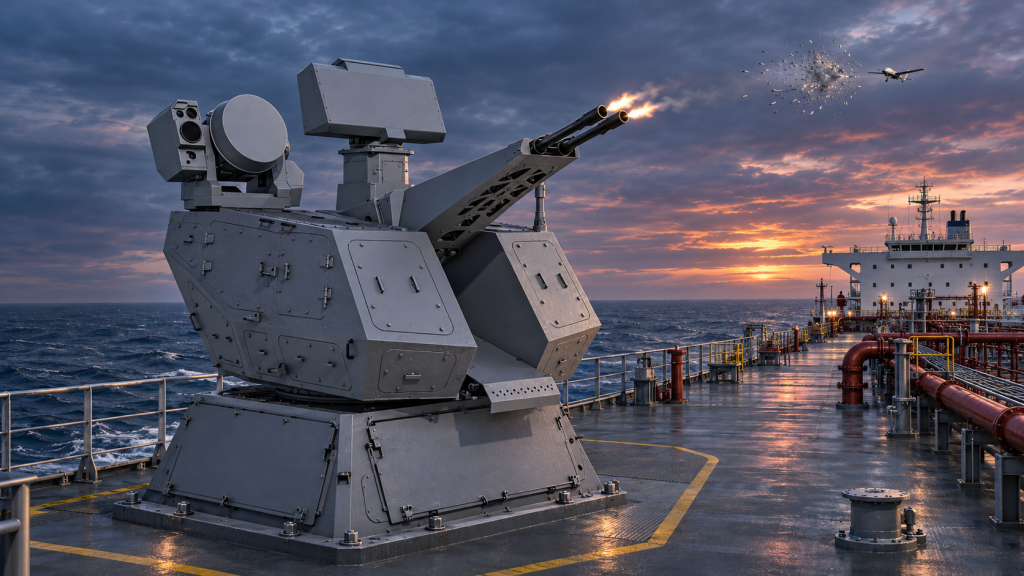
At Euronaval 2026, Turkish defense company ASELSAN presented an unusual concept: an ordinary oil tanker equipped with a complete air-defense system. A twin-barrel 35mm GÖKDENİZ gun was installed on the stern, accompanied by a containerized GÖKSUR vertical-launch missile system.
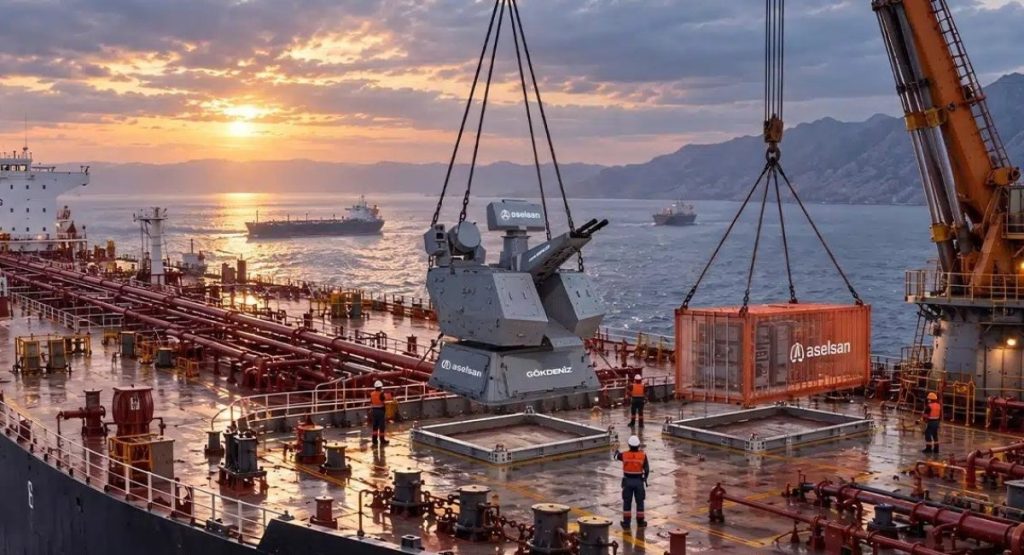
The main novelty was not the gun itself—GÖKDENİZ is already being installed aboard warships—but the method of deployment. Its radar, computers, operator station, generator, and weapon system are combined into a removable module. It can be temporarily installed aboard a commercial vessel, offshore platform, or coastal facility before being moved elsewhere.
The GÖKDENİZ itself is particularly interesting. Unlike conventional naval guns that attempt to saturate a target with a stream of projectiles, the Turkish system combines a large 35mm caliber with programmable ATOM ammunition. The gun does not necessarily need to hit a small drone or sea-skimming missile directly. Instead, it creates a cloud of tungsten fragments precisely in the target’s path.
A Naval Version of a Land-Based Anti-Aircraft Gun
GÖKDENİZ was developed as the naval counterpart of Turkey’s KORKUT self-propelled anti-aircraft system. The land vehicle carries two 35mm automatic cannons and is intended to protect ground forces against aircraft, helicopters, cruise missiles, and unmanned aerial vehicles.
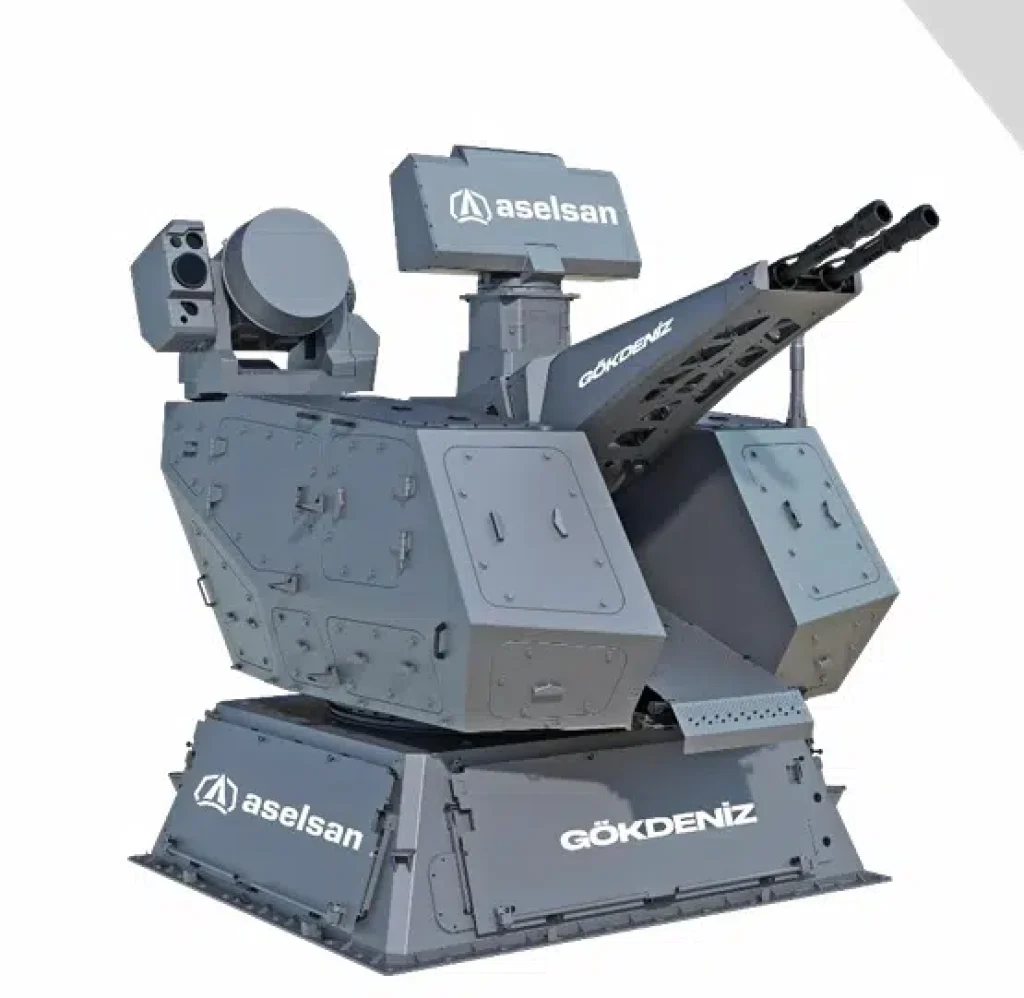
For the naval version, ASELSAN retained the basic artillery system but installed it inside an enclosed, stabilized turret. The weapon was then combined with naval radars, electro-optical sensors, and an integrated fire-control computer.
The turret contains two 35×228mm KDC-02 automatic cannons. Each has a rate of fire of up to 550 rounds per minute, producing a combined rate of 1,100 rounds per minute. The stated effective range against aerial targets with ATOM ammunition is four kilometers.
The system is designed to engage:
- Anti-ship missiles
- Cruise missiles
- Aircraft and helicopters
- Unmanned aerial vehicles
- Small boats and other surface threats
GÖKDENİZ serves as the final artillery layer of a ship’s defenses. If surface-to-air missiles fail to stop an incoming threat, the gun must destroy it only seconds before impact.
Why 1,100 Rounds per Minute Is Not Necessarily Too Slow
Compared with the American Phalanx, which can fire several thousand 20mm rounds per minute, GÖKDENİZ’s rate of fire may appear modest. Comparing close-in weapon systems by firing rate alone, however, can be misleading.
Phalanx creates a dense stream of relatively small projectiles and relies primarily on direct hits. GÖKDENİZ fires much heavier 35mm rounds, each carrying a substantially larger payload. A programmable ATOM shell does not need to strike the target itself.
As it approaches the calculated intercept point, the projectile opens and releases a forward-moving cloud of tungsten fragments. The drone or missile then flies directly into this cloud and suffers numerous impacts.
A single 35mm airburst shell can cover a much larger area than an ordinary impact-fuzed projectile. GÖKDENİZ can therefore compensate for its lower rate of fire by making every round more effective.
A similar principle is used by Switzerland’s AHEAD ammunition for the Oerlikon Millennium gun. Turkey’s ATOM develops the same general concept for ASELSAN’s own land and naval weapon systems.
How the Shell Knows When to Detonate
Before firing, the ship’s radar determines the target’s position, speed, direction, and altitude. The fire-control computer then calculates where the projectile’s trajectory will cross that of the target.
Even rounds from the same production batch can leave the barrel at slightly different velocities. Propellant temperature, barrel wear, and other factors create small variations. Over several kilometers, that difference could cause the shell to detonate too early or too late.
The system therefore measures the actual muzzle velocity of every round and uses that value to program its electronic time fuze. ATOM counts its flight time and detonates directly in front of the target.
A complete ATOM 35 IABM round weighs approximately 1.78 kilograms and has a muzzle velocity of around 1,020 meters per second. Its base-mounted electronic fuze includes a self-destruct function and is programmed using the measured muzzle velocity. The payload contains tungsten fragments.
The gun fires a short burst, with every projectile receiving its own detonation time. This produces not one fragment cloud, but an elongated lethal zone along the target’s predicted path. The effect is particularly useful against small drones that are difficult to strike with conventional ammunition.
Why the System Uses Two Barrels
Two cannons increase the volume of fire, but they provide another advantage: GÖKDENİZ can rapidly create several successive clouds of fragments.
If the first fragment pattern fails to destroy the target, the next appears slightly farther along its flight path. The radar continues tracking the threat and updating the firing solution.
The system uses an automatic linkless ammunition-feed mechanism. Two types of ammunition can be loaded simultaneously:
- Programmable ATOM rounds for aerial targets
- Conventional high-explosive incendiary ammunition for boats and other surface threats
The operator does not have to reload the gun manually when the target changes. The feed system selects the appropriate ammunition and delivers it to the cannons.
This makes GÖKDENİZ more than an anti-missile weapon. When a fast attack boat appears, the system can switch to conventional explosive rounds. If a drone is detected, it returns to programmable airburst ammunition.
Early descriptions indicated approximately 100 ready rounds for each cannon, although ASELSAN has not disclosed the ammunition capacity of the latest versions. This is especially important for the containerized system because it determines how many targets can be engaged before reloading becomes necessary.
The Gun Can Find and Track Targets Independently
In its full configuration, GÖKDENİZ is more than a turret carrying two cannons. The system can include a three-dimensional search radar, a dedicated tracking radar, and an electro-optical sensor package.
The search radar detects approaching objects and sends their coordinates to the fire-control system. A more precise tracking radar and optical sensors then maintain a lock while the computer calculates the engagement solution.
The electro-optical system includes a thermal imager, television camera, and laser rangefinder. This allows GÖKDENİZ to continue operating in a jamming environment or to track a target passively without activating its own radar.
The system can be integrated with a ship’s combat-management network and receive data from other sensors. In the autonomous configuration, it uses its own detection equipment and can perform the entire sequence—from target search to engagement. Whether weapons are released automatically depends on the operating rules and settings selected by the crew.
During qualification tests, GÖKDENİZ autonomously detected, tracked, and engaged a high-speed, low-flying target representing an anti-ship missile. ASELSAN states that the target drone was traveling at more than 180 meters per second.
Why a Four-Kilometer Range Matters
An anti-ship missile traveling at approximately 300 meters per second covers four kilometers in around 13 seconds. During that brief interval, the system must detect the threat, rotate the turret, begin tracking, calculate the intercept point, and open fire.
If the target is damaged near the outer edge of the engagement zone, the ship may still have time to fire another burst. A 20mm system with a shorter effective range could have a much narrower opportunity for a second engagement.
Four kilometers does not mean that every drone or missile will reliably be destroyed at that distance. Actual performance depends on target size and speed, flight altitude, sea conditions, weather, and tracking accuracy.
The faster the object, the less time the system has to react. A sea-skimming missile may appear over the radar horizon with very little warning, while a maneuvering target forces the fire-control computer to update the detonation point continuously.
GÖKDENİZ remains a weapon of last resort. Its purpose is to save the ship after the outer defensive layers have already failed.
Where GÖKDENİZ Outperforms Phalanx—and Where It Does Not
The Turkish system’s principal advantage is its programmable 35mm ammunition. Airburst fuzing increases the probability of damaging small targets and permits effective fire at a greater distance.
GÖKDENİZ can also switch between ATOM and conventional high-explosive rounds, making it better suited to engaging a mixture of aerial and surface threats.
Phalanx is more compact, widely deployed, and has a much higher rate of fire. Its six-barrel cannon rapidly produces a dense stream of projectiles but relies primarily on direct hits or very close passes.
GÖKDENİZ has only two barrels, but every shell is heavier and can attack the target with a cloud of tungsten fragments. One weapon attempts to hit the target with a large number of small projectiles; the other fills the predicted flight path with fragments.
There is no universal winner. Against a single small drone, a programmable 35mm projectile may be more economical. During an attack by multiple high-speed targets, ammunition capacity, target-switching speed, and the radar’s ability to track several threats become decisive.
The Entire System Now Fits Into a Deployable Package
At Euronaval 2026, ASELSAN introduced a deployable GÖKDENİZ configuration for ships that were not originally designed to carry military weapons. The gun is installed on a dedicated mounting platform, while a nearby container houses the generator, control equipment, and operator station.
The system can operate independently of the ship’s electrical network and does not require deep integration with the host vessel. Once a high-risk voyage is complete, the weapon can be removed and installed aboard another ship or at a shore facility.
The phrase “install and fire,” however, oversimplifies the process. The deck must support the weight of the system and absorb the recoil of two 35mm cannons. Mounting points have to be prepared, safe firing sectors established, and superstructures, antennas, and pipelines kept outside the gun’s line of fire.
Mounting an automatic cannon aboard an oil tanker is particularly controversial. Flammable cargo is nearby, while firing produces hot gases, vibration, and a risk that projectiles or fragments could strike parts of the vessel. The system would require special safety procedures, a trained military crew, and reliable identification of potential targets.
The tanker shown by ASELSAN should therefore be viewed as a concept rather than evidence of an imminent mass rearmament of commercial shipping.
Missiles Create a Second Defensive Layer
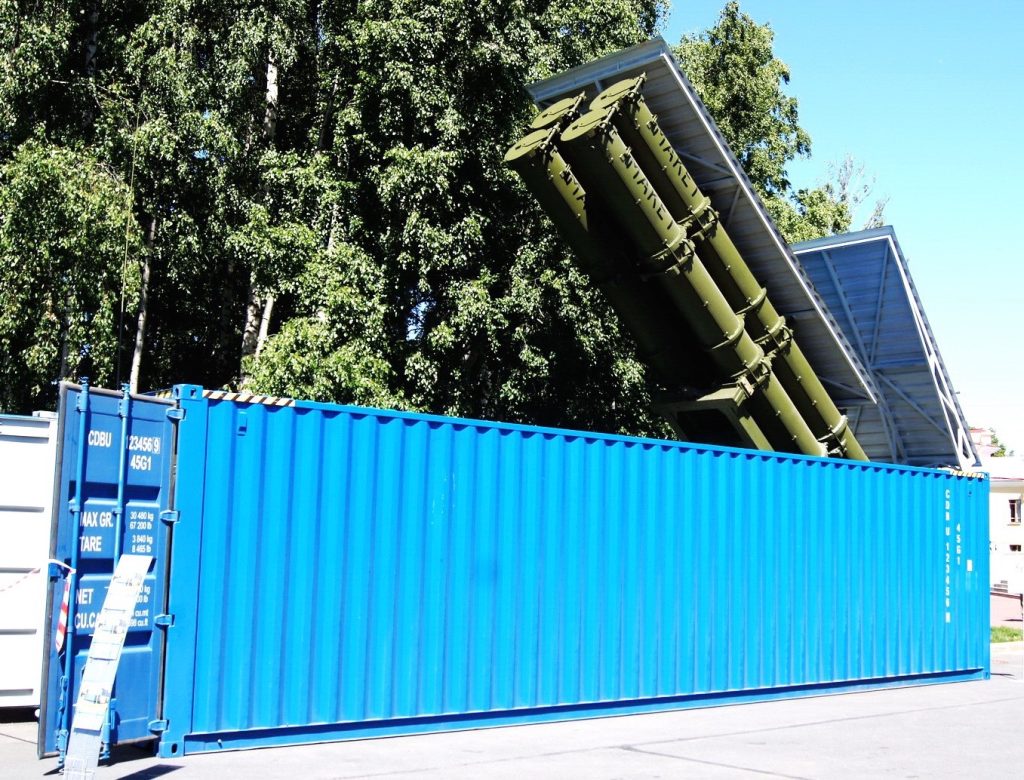
Alongside GÖKDENİZ, ASELSAN is proposing a containerized GÖKSUR VLS surface-to-air missile system. One container holds the vertical launchers, while another houses the control center, sensors, and generators.
The missiles have a stated range of up to 15 kilometers. They use an imaging infrared seeker, a bidirectional datalink, and thrust-vector control.
In this configuration, GÖKSUR is intended to destroy threats at the outer layer. If an incoming missile penetrates to within four kilometers, GÖKDENİZ takes over.
The result is a layered defensive system that could be temporarily installed aboard a vessel without transforming it into a purpose-built warship. The concept looks attractive, although the cost of the radars, missiles, guns, and trained personnel could approach that of a dedicated patrol vessel.
Not a Magic Shield, but a Final Attempt
GÖKDENİZ cannot guarantee protection against every attack. Its ammunition supply can be exhausted, its radar can be jammed, and several threats can approach from different directions simultaneously. A large, slow tanker remains a highly visible target regardless of how many guns are installed on its deck.
Against individual drones, low-flying missiles, and fast attack boats, however, the Turkish system represents a serious self-defense capability. Its ATOM ammunition is particularly important: it turns a twin-barrel gun with a moderate firing rate into a weapon capable of placing a wall of fragments directly in the target’s path.
ASELSAN’s new proposal combines two ideas. The first is a programmable 35mm shell that does not require a direct hit. The second is an autonomous containerized package that can temporarily transform almost any sufficiently strong deck into a naval air-defense position.
GÖKDENİZ remains the final defensive layer. But when only seconds remain before impact, a wall of tungsten fragments may prove more valuable than thousands of rounds fired past the target.