Shield AI has unveiled the first full-scale prototype of X-BAT—a jet-powered, low-observable unmanned aircraft designed to take off vertically from a mobile platform, rotate into horizontal flight, and continue its mission like a conventional airplane. After completing its assignment, it is expected to reverse the maneuver and land on its tail.
In size, propulsion, and intended armament, X-BAT is much closer to a fighter than a conventional drone. Shield AI claims a combat radius of around 1,000 nautical miles, internal bays for large weapons, electronic-warfare capabilities, and the ability to operate without maintaining constant communications with a human controller.
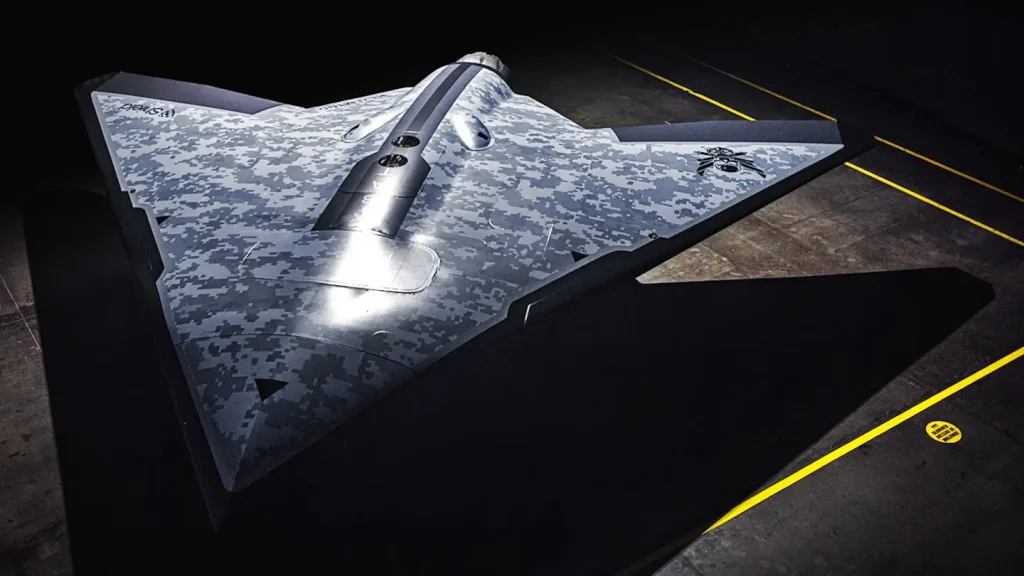
X-BAT has not yet flown. The newly unveiled X-BAT 001 is the first of two full-scale prototypes intended to prove that a fighter-sized jet can safely take off and land on its tail without requiring an airfield.
A Full-Scale Aircraft Instead of Another Mock-Up
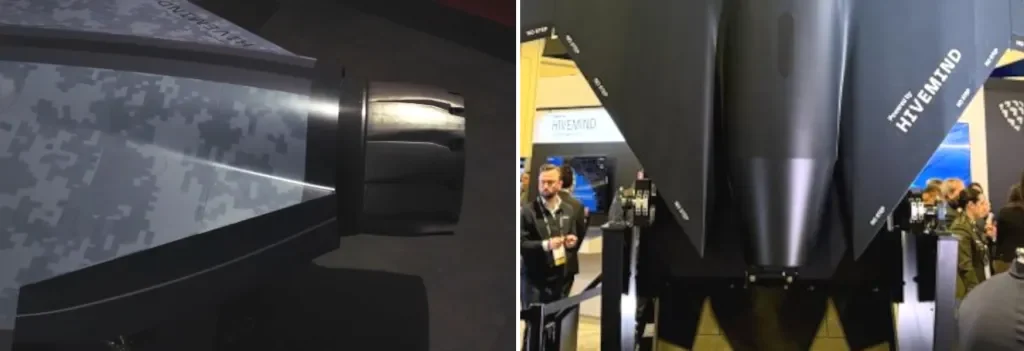
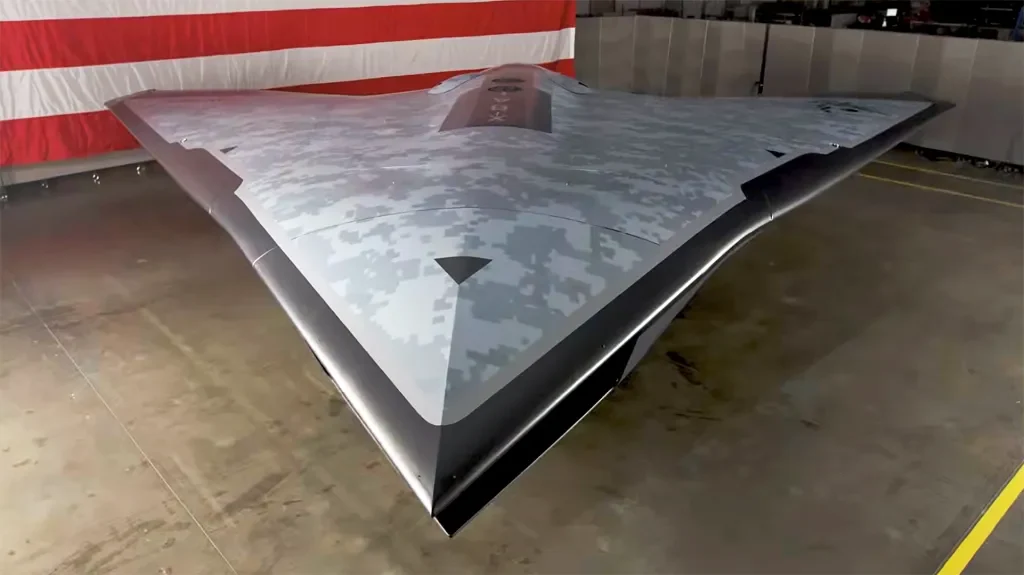
The first prototype was built at Shield AI’s facility in Frisco, Texas. It is now being transported to the company’s flight-test center in Newton, Kansas.
X-BAT 001 already incorporates a full-scale airframe, a GE Aerospace F110 engine, the complete propulsion path, and a thrust-vectoring system. It is not an empty exhibition mock-up, although the prototype still differs noticeably from the planned production aircraft.
X-BAT has a wingspan of approximately 39 feet, or 11.9 meters. Its advertised maximum range exceeds 2,000 nautical miles—more than 3,700 kilometers—while its objective combat radius is 1,000 nautical miles, or approximately 1,850 kilometers. The aircraft is expected to operate above 50,000 feet and withstand maneuvering loads exceeding four Gs.
These figures suggest Shield AI is not building a cheap fighter companion but a relatively large, independent combat aircraft. The company says X-BAT will be roughly twice the size of the first generation of U.S. Collaborative Combat Aircraft and will perform air-to-ground and maritime strike missions in addition to air combat.
The label “unmanned fighter” should still be treated cautiously. X-BAT has not demonstrated its flight performance or weapons capability. Yet its dimensions and proposed mission equipment clearly place it far beyond the category of an ordinary reconnaissance drone.
How a Jet Aircraft Lands on Its Tail
Before takeoff, X-BAT stands vertically on a dedicated mobile platform, with its exhaust nozzle pointing toward the ground. The engine starts and generates more thrust than the aircraft’s weight, lifting the drone vertically. X-BAT then gradually lowers its nose and transitions into conventional horizontal flight.
Landing reverses the process. The aircraft slows down, raises its nose, enters a vertical hover, and descends onto the platform.
The key to this system is the F110-GE-129E engine fitted with an Axisymmetric Vectoring Exhaust Nozzle, or AVEN. The basic F110 is already well established. Different versions power the F-16 and F-15, while the entire engine family has accumulated more than 11 million flight hours.
The thrust-vectoring nozzle was originally developed in the 1990s for an experimental F-16. During that program, it accumulated 73 hours of ground testing and 135 flight hours across 95 sorties. The hardware then spent decades in storage before Shield AI and GE Aerospace returned it to service.
In July 2026, the companies performed the first integrated engine run of the F110 with the restored AVEN and tested the nozzle’s movement. X-BAT requires a new application of the system. During conventional flight, the nozzle can improve maneuverability. In vertical flight, it must support the aircraft’s entire weight and rapidly correct its attitude.
The nozzle controls pitch and yaw. For roll control, Shield AI plans to bleed compressed air from the engine and route it through small thrusters in the wings. The result is loosely comparable to a spacecraft’s reaction-control system, although X-BAT will use air drawn from its jet engine.
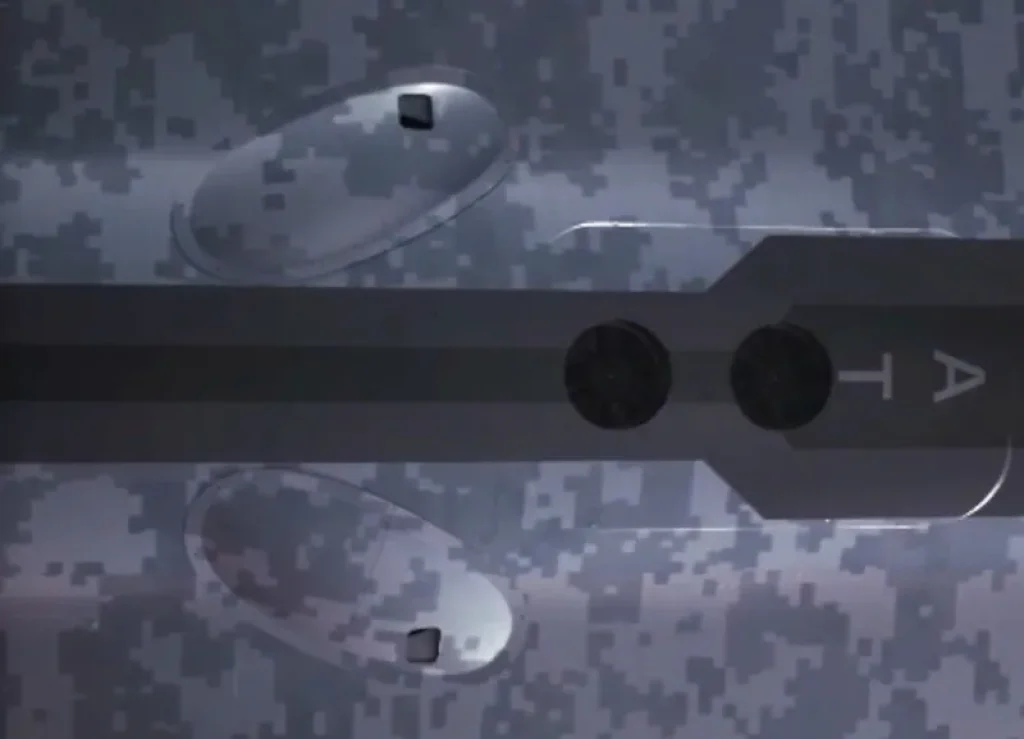
The prototype has additional openings and bulges on the upper rear fuselage. Shield AI has not explained their purpose, but they may be connected to the air ducts and control systems required during vertical flight.
Why X-BAT Is Not Another F-35B
The F-35B can also take off and land vertically, but it uses a much more complicated propulsion arrangement. A shaft-driven lift fan is installed behind the cockpit. The main exhaust nozzle rotates downward, while additional roll-control ducts provide lateral stability.
This arrangement allows the F-35B to remain approximately level while hovering. The lift fan, driveshaft, doors, and related equipment, however, occupy considerable internal volume and add weight even when the aircraft is flying conventionally.
X-BAT has no separate lift fan. Instead, the entire aircraft stands vertically before takeoff, while the main engine provides all lifting thrust. This frees internal space for fuel, electronics, and weapons, but makes the transition between vertical and horizontal flight much more challenging.
An engine failure during hover would leave almost no opportunity to save the aircraft. The jet exhaust is also directed straight toward the launch platform or ship’s deck, creating extreme heat, pressure, and the risk of hot gases being drawn back into the intake.
Shipboard recovery will be even more demanding. The platform will be moving, the deck may be pitching and rolling, and turbulent airflow will surround the vessel. The drone must still land precisely on its recovery equipment. Shield AI has not yet shown how X-BAT will be secured after touchdown.
An Old Idea That Needed a Computer

Engineers attempted to build tail-sitting fighters as early as the 1950s. The Convair XFY-1 Pogo and Lockheed XFV-1 were intended to operate from relatively small ships and defend naval formations from air attack.
The aircraft could take off, but landing proved extremely difficult. The pilot had to look backward over his shoulder while controlling an aircraft hovering on propeller thrust. Even experienced test pilots considered the maneuver too dangerous for routine operations.
X-BAT removes the pilot from the cockpit. A flight-control computer can continuously process data from inertial systems, cameras, and other sensors while making immediate corrections through the vectoring nozzle. It does not become disoriented, struggle to look backward, or suffer from the unusual vertical attitude.
Modern digital flight controls and autonomous software have allowed Shield AI to revisit a concept that appeared almost impractical 70 years ago.
The company has already gained experience with the smaller V-BAT, a piston-powered tail-sitting drone with a ducted pusher propeller. Scaling that arrangement up to a fighter-sized jet, however, will be vastly more difficult.
A Fighter Engine and F-35-Sized Weapons Bays
Shield AI says X-BAT will have internal weapons bays comparable in size to those of the F-35. Each bay is intended to carry weapons in the 2,000-pound class—approximately 900 kilograms.
Possible payloads include air-to-air missiles, guided bombs, and anti-ship weapons. During missions where stealth is less important, additional stores could be carried on external hardpoints.
The exact weapons configuration, number of bays, and maximum payload have not been disclosed. It is also unclear whether the advertised combat radius can be maintained while conducting vertical takeoff with a full weapons load.
Vertical flight consumes a considerable amount of fuel. The engine must support the aircraft’s entire weight on thrust alone during takeoff, transition, deceleration before landing, and final descent. The heavier X-BAT becomes, the less thrust margin remains for control.
Meeting every advertised objective simultaneously—vertical takeoff, heavy internal weapons, and a combat radius of 1,000 nautical miles—will be difficult. The published figures remain program goals rather than demonstrated performance.
Eighty Kilowatts for Radars and Electronic Warfare
The F110 must not only propel the aircraft but also generate electricity for its mission systems. Shield AI claims X-BAT will have approximately 80 kilowatts of available electrical power.
This should be sufficient for an active radar, communications equipment, intelligence sensors, and an electronic-warfare suite. On one mission, X-BAT might serve as a strike aircraft; on another, it could operate as a reconnaissance platform or jammer.
The exact sensor configuration remains undisclosed. The company promises a combination of active and passive systems for detecting airborne, surface, and ground targets. Preserving low observability will require most antennas to be integrated into the airframe and weapons to remain behind internal bay doors.
The X-BAT 001 prototype already has a swept, tailless planform optimized to reduce radar signature. Its protruding vectoring nozzle, however, is not the final low-observable solution. Shield AI acknowledges that the production propulsion system will require additional signature-reduction measures.
The production X-BAT could differ from X-BAT 001 in much the same way that the experimental X-35 differed from the eventual F-35. The prototype’s immediate purpose is to validate the aerodynamics, propulsion system, and vertical-flight controls.
Autonomy Matters More Than Remote Control
X-BAT is not intended to be continuously flown over a radio link by a remote pilot. Its “pilot” will be Shield AI’s Hivemind autonomy software.
The system is designed to perform missions when satellite navigation is unavailable and communications are degraded. A human operator defines the mission, objectives, and restrictions, while the aircraft plans its route, controls its flight, and responds to changing conditions.
Hivemind has already been tested aboard other aircraft. During one demonstration, two jet-powered BQM-177A unmanned targets autonomously performed a combat air patrol mission and interacted with a virtual F/A-18.
Autonomy is particularly important for X-BAT. Vertical takeoff and landing require hundreds of rapid corrections that cannot be reliably performed through a communications link with even a small delay. The aircraft is also intended to operate in environments where GPS and communications may be jammed.
This does not necessarily mean X-BAT will independently make politically and legally significant decisions about using weapons. Shield AI describes it as an autonomous executor of an assigned mission, not a completely independent hunter.
Replacing an Airfield With a Trailer
X-BAT’s most important advantage is neither air-combat performance nor stealth. It is independence from runways.
Modern combat aviation depends on a relatively small number of major bases. Their coordinates are known in advance, and damage to runways, fuel storage facilities, and maintenance infrastructure can sharply reduce sortie generation.
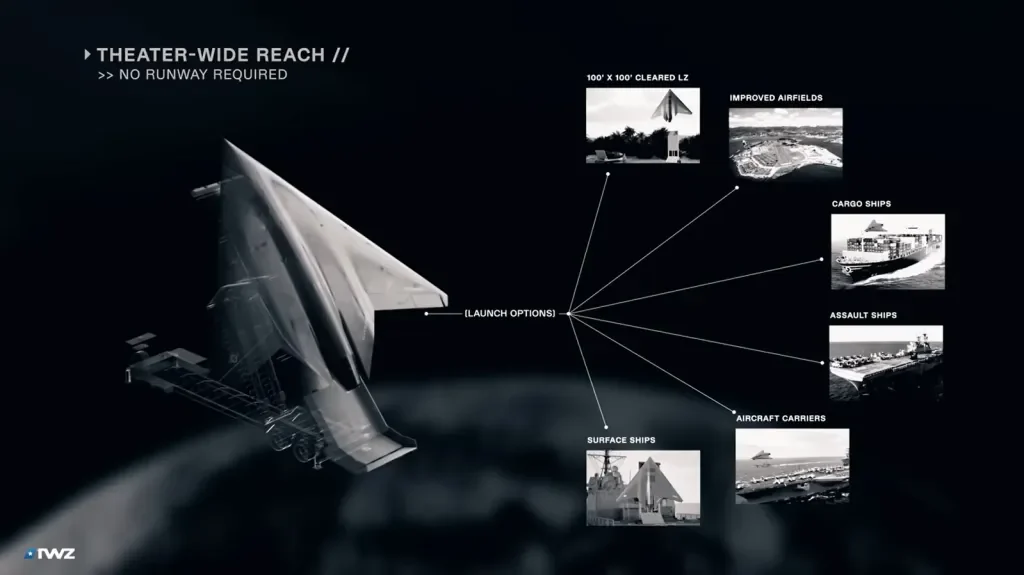
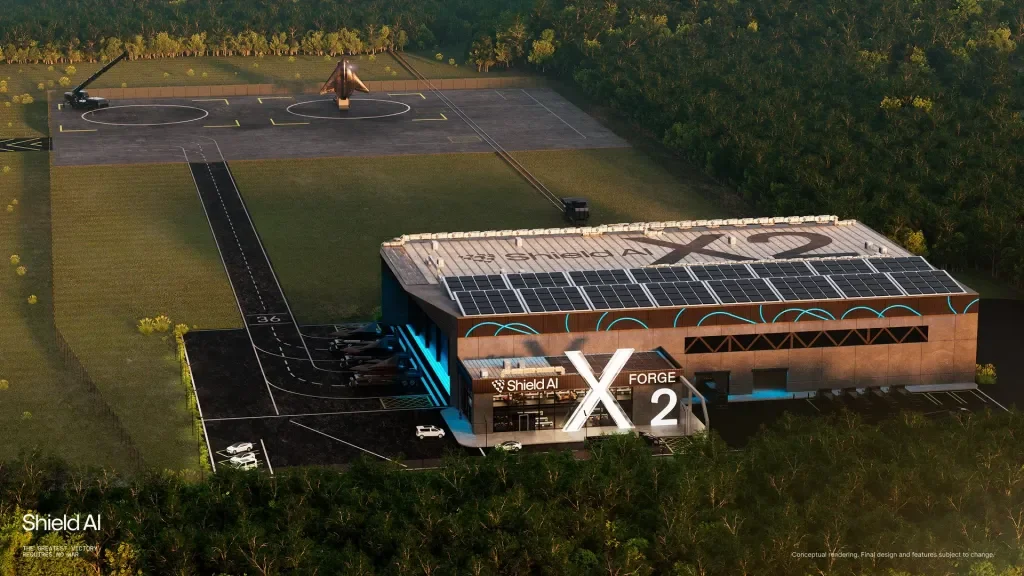
X-BAT is intended to travel on a mobile launch-and-recovery platform. After stopping, the system raises the aircraft vertically and prepares it for launch. When the drone returns, the same platform receives it before moving to another location.
Shield AI compares this concept with mobile missile launchers. An adversary would have to search for small units that are constantly relocating rather than attacking one large, fixed airfield.
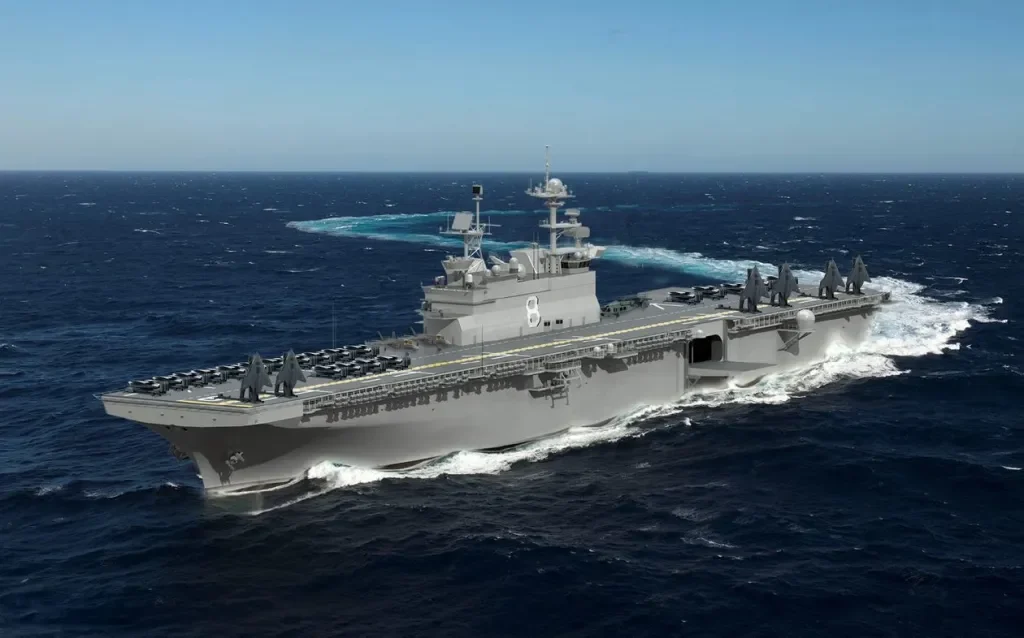
X-BAT could operate from islands, roads, temporary sites, and ships. The company claims that up to three drones can fit within the deck space normally occupied by one conventional fighter or helicopter.
In practice, the mobile unit would still require fuel, weapons, spare parts, communications equipment, and trained technicians. It would not, however, need a long runway that must be built and repeatedly repaired.
An Aircraft Carrier Is No Longer Essential
At sea, the vertical-flight arrangement creates especially interesting possibilities. X-BAT could be deployed not only from aircraft carriers but also from amphibious assault ships, expeditionary sea bases, and other vessels with sufficiently strong and spacious decks.
Shield AI’s concept art shows dozens of aircraft aboard America-class amphibious ships. Unlike the F-35B, the drones would not need a takeoff run or a relatively clear flight deck. Each remains attached to its own mobile launch-and-recovery vehicle and occupies less space.
The Navy could theoretically gain additional strike-aircraft formations without building more nuclear-powered carriers. X-BAT would not replace a carrier fighter. It would probably have less maneuverability, payload, and sensor capability. It could, however, increase the number of missiles and sensors a naval formation can put into the air.
This possibility has attracted the attention of the U.S. Navy. Under the Runway Independent Maritime Expeditionary Strike, or RIMES, effort, the Navy and other government organizations have committed approximately $200 million to X-BAT. Shield AI has pledged a similar amount of its own funding, bringing total announced public and private investment to $400 million.
First, It Will Be Suspended From a Crane
Testing will begin cautiously. Shield AI will first run the X-BAT’s engine while the aircraft remains secured horizontally on its launch platform. The prototype will then be raised vertically so engineers can test the propulsion and control systems again.
After that, X-BAT will be suspended from a huge crane. The aircraft will be able to move and balance on engine thrust, while safety cables prevent it from falling if the control system fails. Only after completing these tethered tests will the crane be removed and untethered flights begin.
This sequence illustrates how much risk remains. Shield AI must still demonstrate stable hovering, transition to horizontal flight, the reverse rotation before landing, and accurate descent onto the recovery platform.
The company must also prove that the exhaust does not damage the launch site, that the engine does not ingest its own hot gases, and that the flight-control system remains stable in crosswinds.
An Extremely Ambitious Schedule
Shield AI intends to begin prototype flight testing before the end of 2026. A fully missionized X-BAT is expected to fly in 2028, with serial production beginning as early as 2029. The company has suggested that at least limited operational capability might emerge during the same year.
For an entirely new jet aircraft, this timeline is extraordinarily optimistic. X-BAT must simultaneously test its airframe, engine, vectoring nozzle, vertical-control system, low-observable features, autonomy software, sensors, and weapons.
Even if the prototype successfully lifts off and transitions to horizontal flight, a long distance will remain before it becomes an operational combat aircraft. Shipboard trials, recovery in rough seas, and confirmation of the advertised range with a combat payload will be particularly challenging.
X-BAT already differs from many impressive concept projects because it has progressed to a full-scale physical prototype. It has a real engine, a previously flight-tested vectoring nozzle, two prototypes under construction, and substantial government funding.
A Drone That Could Change the Meaning of “Airfield”
X-BAT is not intended to outperform a conventional fighter in every category. Vertical takeoff inevitably consumes fuel, complicates the design, and restricts payload. The launch platform will require a well-trained support team, while tail-first recovery will remain risky even under computer control.
The project instead attacks one of modern aviation’s greatest vulnerabilities: dependence on large airfields and aircraft carriers. If X-BAT can truly fly thousands of kilometers, carry weapons internally, and return to a mobile platform, commanders may no longer have to choose between long range and runway independence.
For now, this is not an operational unmanned fighter but an extremely expensive technical hypothesis. X-BAT 001 must prove that a fighter-sized jet can stand calmly on its tail, launch from a trailer, and return to the same platform.
If it succeeds, Shield AI’s most important achievement will not simply be a new drone. The company will have attempted to turn almost any suitable patch of ground—or ship’s deck—into a miniature airfield.