Dear colleagues. I would like to present to you a proposal to address a serious problem: the severe shortage of repair personnel and the need to fully staff repair units for the maintenance of armored vehicles and other military vehicles.
Here’s how I see it.
In 1928, the Bolshevik Plant began mass production of the first Soviet tank, the T-18 or MS-1.
Since the tank, as always, was far from perfect—that is, it broke down frequently—a decision was made to build a repair shop so as not to take up the factory’s production space. A repair team of workers was also formed.
But there were some smart people who could “see the big picture” and fully understood that the small production run of the MS-1 was insufficient for a country like the USSR, and an engineer named “Petrov” managed to convince the leadership to build a large repair facility. Fortunately, no special repair equipment was required. He fully understood that the T-18 was a temporary model, but that thousands of tanks would be needed—and all of them would have to be repaired. By presenting these arguments to management, he secured approval to open a school for repair technicians based at the FZU school.
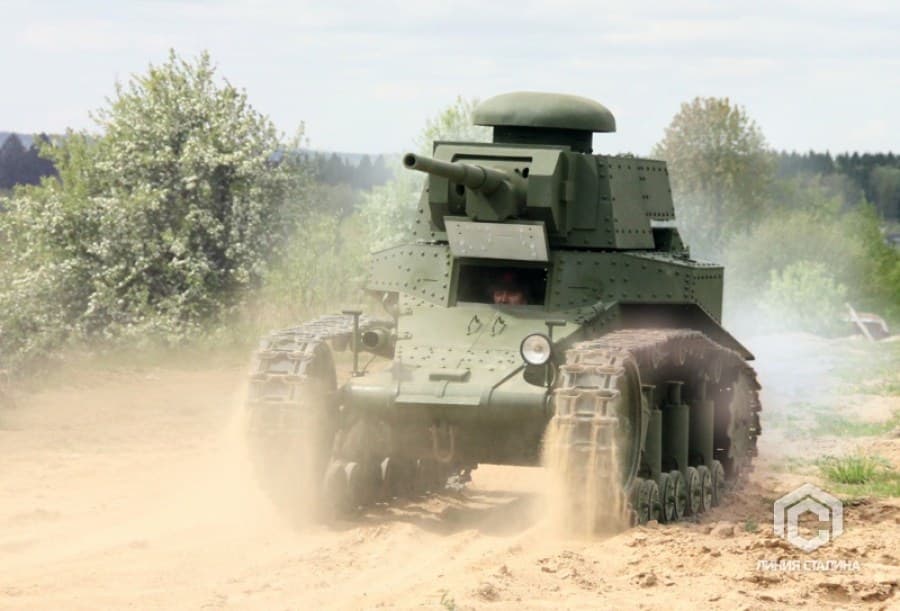
MS-1 (T-18)
In the Soviet Union, major industrial enterprises had FZU schools where workers were trained for those same factories.
Engineer “Petrov” did not come up with anything new. The FZU school system had its origins in 1918, and by the time serial production of the T-18 tank began, it was well-established in producing skilled workers.
Students were recruited for the repair school (until 1930) starting at age 14 and trained for four years. They successfully combined classroom study with hands-on training. During practical training, special attention was paid to repairs. After graduating from the FZU repair school, an 18-year-old graduate was hired by the “Bolshevik” factory as an armored vehicle repair specialist in the repair shop. He worked there for three years until he turned 21, after which he was drafted into the Army.
By that time, a decision had been made to establish repair shops in every military district with more than 1,000 pieces of armored vehicles. These shops perform routine maintenance on Category 3 armored vehicles as well as repairs on motor vehicles.
After completing a six-month basic training course, the maintenance technician serves at a military district maintenance base or works at his home factory—if that makes sense. Then he is discharged to the reserves. He either returns to his previous job or enrolls in a technical school based on a recommendation.
Let’s summarize. Four years at a vocational school. Little to no experience. Plus three years of work as a repairman and two years of service in a repair battalion.
That’s a total of nine years of experience as a repairman.
This is how we recruit mechanics and commanders from tank factories to tank schools. We establish tank schools in cities where tanks are manufactured. The training program includes mandatory practical training at the factory.
Loaders and radio operators/gunners can serve as repair assistants. And it’s worth recruiting them from tank factories.
Next, apply the experience of the FZU repair school to all tank (tractor) and automobile factories. Increase the number of graduates from FZU specialized schools to fully support the repair infrastructure of the entire Red Army.
Thus, the technical condition of the Red Army’s armored and motor vehicles is excellent, thanks to strict oversight by GABTU. To this end, a GABTU district commission has been established in each military district. GABTU has also stipulated that Category 3 armored vehicles must undergo repairs at district workshops. Category 4 armored vehicles undergo major repairs at the manufacturer’s plant in repair facilities. To this end, it is transported by rail to the factory. However, before sending armored vehicles for major repairs, the military unit receives a new tank from the factory. Thus, the combat readiness of armored units does not decline. In fact, it actually increases. I agree that some of the vehicles are currently under repair, but ultimately they will be repaired.
In 1935, a serious problem arose: a severe shortage of spare parts. Category 3 and 4 armored vehicles account for 20% (approximately) of the total number and are being replaced with new equipment. Hundreds of unserviceable vehicles are piling up in units, and removing any parts for repair is strictly prohibited. This situation must be changed immediately—without compromising the combat readiness of the Armored Forces.
The tsar’s advisors deliberated at length. What should be done? Several options were proposed. But one in particular caught many people’s attention. It was proposed by an engineer named “Petrov,” who had been invited to join them. His contributions to organizing the repair of vehicles and armored vehicles were taken into account.
Engineer “Petrov” proposed—at great risk, since the tank factories were operating at full capacity and producing virtually no spare parts—to reduce tank production by 15 percent and reallocate the remaining capacity to spare parts production. He stated outright that following such a plan would be disastrous and wasteful. He also provided calculations. By early 1934, 2,337 T-26 tanks had been produced. Of these, 200 (approximately) required routine and major repairs. In 1934, plans called for producing more than a thousand. Why should we produce 1,000 tanks when 200 are sitting idle without major repairs due to a lack of spare parts? And over time, there will be even more tanks like that. By reducing tank production and increasing spare parts production, we save enormous resources—specifically, by cutting back on the production of turrets, armored hulls, guns, and other components.
We thought about it for a long time and debated the issue. But we reached a consensus: to reduce tank production by 15% and redirect the freed-up capacity to the production of spare parts. We will ensure that repairs of armored vehicles and motor vehicles are carried out to the required standard. Entrust the GBTU with overseeing the repairs.