Kaiser's Last Hope, or The First Super Heavyweight

Long before German engineers turned their talents to the extravagant and highly “optimistic” designs of World War II heavy tanks, they were already working on the development of super-heavy tanks during World War I. The war began in 1914, and technology in aircraft, machine guns, and artillery quickly kept pace with the constant changes. Tanks did not appear until the war had reached a stalemate in the trenches.
World War I on the Western Front was fought primarily using extensive and well-fortified trench systems. Consequently, the front was largely characterized by slow advances on both sides, which were either too costly and deadly or too insignificant to make a real difference on the battlefield. The British demonstrated the success of the mobile armored battery concept during the Battle of the Somme. At that time, 32 Mark I tanks—the first mass-produced tanks in history—were deployed. And although only 18 tanks managed to reach the German positions, the capture of a 5×5 km section of the enemy’s defenses made a great impression on the Allied command. This was despite the fact that the hulls of these steel monsters, behind which the infantry took cover from enemy fire, reduced soldier casualties by a factor of 20.
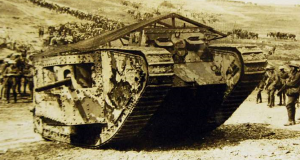
In response, in September 1916, Germany established a tank development department and focused its efforts on countering this new threat, which led to the production of the A7V tank, which entered production in 1917, but by early 1918, only 20 units had been built due to limited resources and the tank’s modest capabilities, such as a maximum speed of 15 km/h on roads and a range of 80 km on roads or 30 km off-road. In a broader strategic context, the German High Command, faced with the Allies’ numerical superiority in tanks—more than 8,000 produced by the Entente compared to just two dozen German tanks—prioritized providing qualitative rather than quantitative fire support for the attacking forces. These massive super-heavy behemoths, supported by artillery and infantry, were intended to cut huge gaps in the enemy’s defenses.
Shortly before testing began on the prototype of the Marienwagen I mit Panzeraufbau tracked armored vehicle—which could only be called a tank by a stretch of the imagination— in late March 1917, the German General Headquarters issued a directive to Captain (Reserve) Josef Folmer, chief engineer of the Experimental Division of the Motorized Troops Inspectorate—who was simultaneously working on the A7V heavy tank and the LK-I in collaboration with Captain Weger—who would later oversee compliance with the General Staff’s tactical requirements—a task to develop a tank initially “modestly” named Gross Kampfwagen (“large combat vehicle”) to break through French positions on the Western Front.
The vehicle’s design was approved by the Ministry of Defense on June 28 of that year and became known as the “Kolossal-Wagen,” or “K-Wagen” for short.
According to the project, the plan was to develop a tank with the following specifications:
Weight: 150 metric tons
Armament: 2–4 50–77-mm guns
-4 7.92-mm machine guns
-2 flamethrowers
Power -2×200–300 l.s.
installation
Armor—30 mm (circle)
Crew: 18 people
Initially, one year was allocated for the design and construction of 10 tanks, but the General Headquarters soon reduced this timeframe to 8 months, while significantly expanding the program. It was expected that at least 100 tanks based on the revised design would be built in 1918. The cost of a single K-Wagen was initially estimated at 500,000 German marks, which, given Germany’s difficult economic situation, was an astronomical sum.
Of course, the British “rhombuses” could not have failed to influence the minds of German engineers. This was evident both on the outside and inside the new tank: the fighting compartment and the command compartment were located at the front, while the engine and transmission were at the rear, and the tracks wrapped around the entire hull. The main armament was housed in large sponsons on the sides.
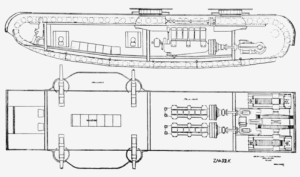
The internal layout divided the hull into four compartments, with the crew positioned on two levels. The middle section of the hull housed the fighting compartment, which was combined with the command compartment. Both drivers’ stations were located behind the machine gun mounts and had no viewing devices whatsoever. The tank was commanded by the commander, who, together with the artillery officer, was stationed on the upper deck and observed the battlefield from a cylindrical armored turret with six observation slits and a hatch on top. Since the tank was intended to be equipped with a radio, a position for the radio operator was located in the center of the fighting compartment.
Large sponsons were mounted on the sides, each designed to accommodate two 77-mm caponier guns with semi-automatic breeches and two 7.92-mm heavy machine guns. The idea of equipping the tank with flamethrowers was abandoned almost from the very beginning of the project. Guns were likely preferred because their recoil length was only 40 cm, making them seem suitable for narrow combat zones.
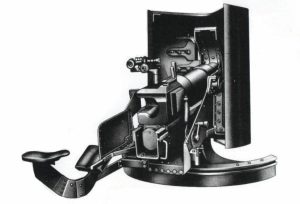
The swinging part of the gun was mounted on a rotating turret with a semicylindrical shield and a breech guard. The gun was aimed at the target using a telescopic sight and coaxial handwheels. The front section of the sponson was designed to provide the maximum firing sector for the guns. There is no data on the armor-piercing capabilities of the gun’s shells. However, I believe that in actual engagements with British tanks, it would have proven quite effective. The Germans were already using direct-fire engagements from this gun against armored vehicles, which is precisely why the 7.7 cm Feldkanone 96 n.A. was originally planned to be mounted on the A7V. There is a common belief that the tank’s guns were taken from the Istein Fortress. But this fortress, whose origins date back to the Middle Ages, was never modernized in time for the war. However, it is quite possible that they came from Fort Istein (Feste Istein). The ammunition for the guns included 800 rounds for the cannons and 21,000 rounds for the seven 7.92-mm Maxim MG08/15 machine guns.
The third and fourth compartments housed the engine and transmission. Calculations showed that a cluster of 300-silny engines would not provide sufficient specific power, so the decision was made to use two Daimler-Benz engines with a power output of 650 l.s. Two mechanics were assigned to maintain them; their duties also included firing the stern machine guns. Next to the engines were fuel tanks with a total capacity of 3,000 liters. The engines were connected to the transmission via drive shafts routed through openings in the bulkhead separating the engine compartment from the transmission compartment. Two gearboxes, each with three forward gears and one reverse gear, distributed power to individual tracks, ensuring precise maneuvering at low speeds over rough terrain.
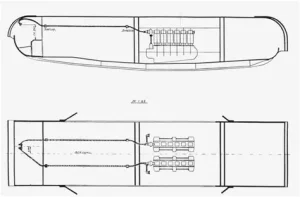
This design prioritized reliability and control over sheer acceleration, which was essential for a super-heavy tank intended for use in the confined spaces of trench warfare. It was calculated that a maximum speed of 7.5 km/h could be achieved while maintaining a minimum speed of 1.9 km/h. Exhaust pipes with mufflers and radiators were routed to the roof at the rear of the hull. Four ventilation hatches in the hull roof and three on each of the sponsons were provided to allow air into the cooling system and to exhaust hot air from the engines.
The tracks, driven by a rear-mounted drive wheel, consisted of alternating inner and outer track links, and the bolts connecting them served as axles for the flanged rollers. This type of track had previously been tested on the “Orion” tractor. Its advantages included reduced friction losses in the joints and improved track efficiency; however, the increased weight of the track encircling the long hull virtually negated these advantages.
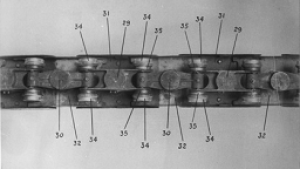
The inner part of the track links slid along guide rails inside the armored housing, while the outer part of every other track link (a special lug on every other track link) wrapped around the outside of this armor. It was hoped that the projections on the track links would prevent the tracks from coming off during maneuvering. The upper tracks, with their front and rear descending sections, were covered by an armored roof that merged into curved armor screens. The lower tracks followed a wide-radius arc—in accordance with the design philosophy of that era— this was intended to provide better maneuverability and less rolling resistance on hard ground, as well as increased cross-country capability on soft ground, by allowing the tracks to sink into the ground and increasing the contact area. The track was driven by a rear-mounted drive sprocket.
Internal coordination relied on electrical communication systems adapted from submarine technology, which used signal lights and wiring to transmit commands without resorting to acoustic methods in a noisy environment. The commander and the artillery officer observed the battlefield and issued orders to fire on targets. Orders were given using light signals.
The K-Wagen tank turned out to be truly massive in every respect. According to various sources, its full crew was to consist of between 22 and 26(!) people. The final version had the following crew: a commander, two drivers, an artillery officer, 12 artillerymen (loaders, gunners, ammunition handlers), 8 machine-gunners (two per machine gun), and two mechanics.
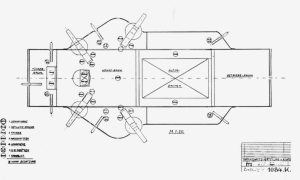
It is not hard to understand why the K-Wagen had to be staffed with, quite literally, a crowd of tank crew members, given the conservatism of the High Command. According to the old veterans, a full crew was required to operate a single gun. Apparently, they decided not to make an exception for tanks. The same applied to machine guns—as in the infantry, they required a gunner and a loader.
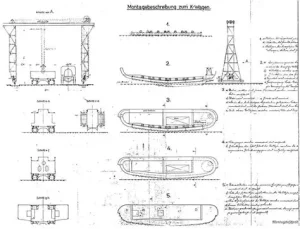
The tank’s hull was assembled on a frame made of large rolled steel plates, secured with rivets and bolts. The removable sponsons had a complex shape, with gun ports cut into the front and rear walls of the widened section of the sponson. The suspension consisted of forty large coil springs (twenty on each side). A key innovation in the K-Wagen’s engineering was its modular design, which divided the hull into six separate sections for transport by rail: the command post, the combat compartment, the engine room, the transmission compartment, the steering compartment, and the electrical compartment. Each module was designed to be disassembled and shipped separately, then reassembled on site approximately 6 kilometers behind the front lines using cranes and heavy trucks to handle the components. This approach solved the logistical challenges of moving the “colossus” in one piece, despite the transportation limitations of the time. It is believed that the tank could be divided into 15–20 parts for ease of transport. A technology was developed for assembling the “K-Wagen” tank using a bridge crane and special trailers. As an auxiliary measure, plans were made to manufacture a self-propelled jib crane based on the A7V chassis.
Work on the K-Wagen prototypes was assigned to the Riebe factory in Berlin-Weißensee and the Wegmann factory in Kassel, with contracts for five tanks at each facility in June 1917.
The tank’s design was revised several times, which slowed down the work. For example, in addition to scrapping plans to install flamethrowers and revising the power plant, the tank was shortened to 12.8 meters, which significantly reduced its weight. Construction work focused on assembling the massive hull structure, which required specialized technologies from bridge-building firms and machine tool manufacturers due to the tank’s unprecedented size and weight. By the fall of 1917, completion was still nowhere in sight. On October 18, 1917, the Field Equipment Testing Department stated that the K-Wagen was better suited for positional warfare, which completely undermined the purpose of its design.
On November 20, 1917, the Battle of Cambrai took place. The British attacked with 8 divisions and 365 Mark IV tanks. They achieved a breakthrough 13 km wide and 9 km deep. Eight thousand prisoners and about 100 artillery pieces fell into their hands. Admittedly, the Germans managed to retake the area by December 7. But the shock of what was, at that time, the largest (and initially successful) deployment of tanks must have made a strong impression on the Germans. The emergency situation on the Western Front prompted the Department of Motor Vehicles to hold in-depth discussions with the German High Command on December 1, 1917. It becomes clear from this that the command insists on deploying armored cars on the Western Front as soon as possible and in the greatest possible numbers, which means that the production of the K-Wagen must be accelerated by all means. Tank production began in April 1918. Despite numerous technical shortcomings, production proceeded at a rapid pace.
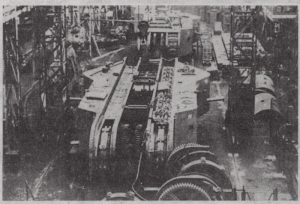
Work on the prototypes intensified in the spring of 1918; official reports noted that assembly was still underway even in July, but production was suddenly halted in October due to the impending armistice. By the end of 1918, Riebe had brought his prototype to the final stage of assembly, including the completion of most of the fuselage, while Wegmann’s prototype was at a less advanced stage, with no engines installed. Both efforts were severely hampered by a shortage of resources, including steel and other materials that had been diverted to the front lines during the German offensives of 1918, as well as difficulties in securing parts from suppliers and skilled laborers due to wartime demand.
After the armistice was signed, the need for super-heavy tanks disappeared entirely. Nevertheless, German representatives asked the Allied command to complete at least one K-Wagen and conduct tests on it in 1919. The British did not strongly object to continuing work on the German tanks, hoping for future benefits, but for the French, it was a matter of principle. Their hatred for all things German was so intense that they sent virtually all captured German weaponry to the scrapyard, passing on only a small portion of it to their allies in Eastern Europe. The K-Wagen tanks met the same fate—in early 1919, both unfinished prototypes were scrapped. Some speculate that in 1926, two sets of running gear for the K-Wagen tanks were sold to the Spanish.
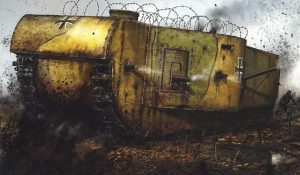
FINAL SPECIFICATIONS
Crew: 22 people
Height, m: 3.3 (2.9 to the roof)
Length, m: 12.8
Width, m: 5.9 (3.1 without side skirts)
Armor thickness, mm: front, sides — 30
Armament: guns—4×7.7 cm Feldkanone 96 n.A.; machine guns—6–7×7.92 mm MG.08
Ammo load: 800 shells, 21,000 rounds
Engine: Make — Daimler-Benz V6; Type — carburetor; Number of cylinders — 6; Cooling — liquid; Power, hp — 2 × 650
Maximum speed, km/h: 7.5