In our history, the R-7 rocket represented a significant breakthrough (especially in engine design), enabling the delivery of thermonuclear warheads over intercontinental distances and launching the first satellite into Earth orbit. However, in this AI, I would like to propose a “low-tech” alternative based on the R-5 rocket engine, which could have been implemented much earlier than 1957 (around 1954).
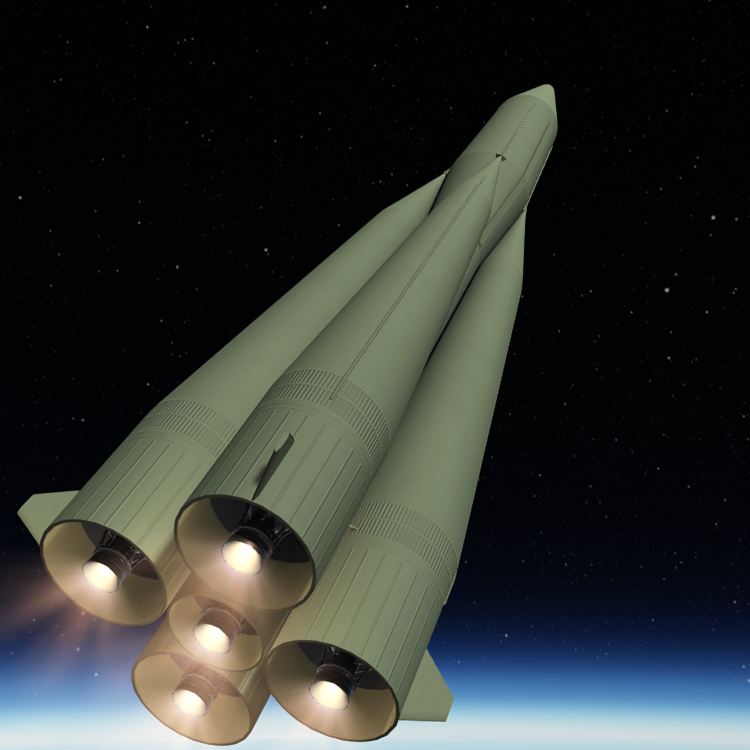
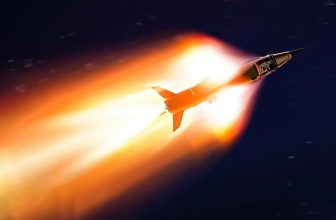
A Rocket in Flight
Fantasy Backstory:
In 1949, following the test of the first nuclear bomb, the Soviet leadership reassessed the role of the Strategic Rocket Forces, and OKB-1 was tasked with halting work on the R-3 medium-range missile and, instead, developing an intercontinental ballistic missile with a range of 7,000 km as quickly as possible, based on existing technical achievements. OKB-1 understood the full complexity of this task but did not defy the top leadership and began work. As a result of theoretical research, a preliminary design was developed in the shortest possible time. The new missile was planned to incorporate a number of innovations, including integrated fuel tanks and a new propellant. The thrust of the RD-103 engine was generally sufficient, but its specific impulse was too low. This problem was solved by replacing ethanol with “Hydyne” (Hydyne is 60% NDMG + 40% diethylenetriamine; in reality, it was used in the American line of modernized V-2 rockets, the “Redstone”). Although Korolev hated hydrazine, he was forced to take this step; otherwise, he would have been unable to meet the government’s deadlines, since he would have had to develop a revolutionary engine from scratch (which became the RD-107 in ReI). Hydrazine, however, allowed the specific impulse of the RD-103 to be increased from 248 to 265 seconds without modifying its design, while also slightly boosting thrust. This led to the first launch of the R-5 ICBM on March 15, 1954 (which failed).
***
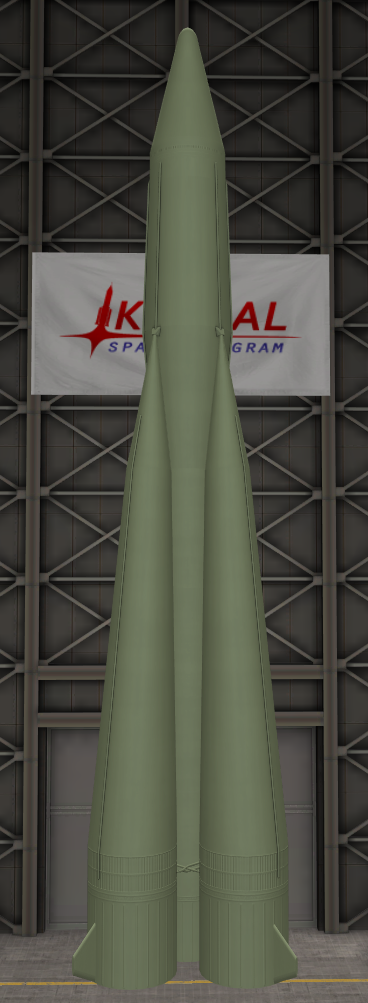
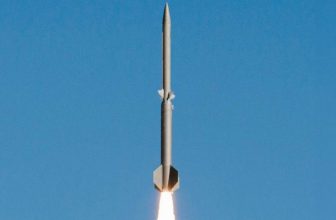
A rocket model created in KSP+RP-1
MBR TTT:
- Starting weight: 150 metric tons;
- Dry Weight: 14 metric tons (with fuel);
- Range: 7,000 km;
- Warhead weight: 1,400 kg (upgraded ReI R-5M warhead);
- Stage 1: 4 RD-103MG engines with a thrust of 491 kN at sea level and a burn time of 243–265 seconds; total weight of the 4 modules: 97 metric tons;
- Stage 2: RD-103MG with a thrust of 491 kN at sea level and a burn time of 243–265 seconds; stage weight with warhead: 53 metric tons;
- Dimensions: 6 x 6 x 25 m;
- Center block diameter: 2,350–1,650 mm; maximum side block diameter: 2,220 mm.
***
The rocket’s fate:
The rocket’s launch complex was designed to be significantly more compact than that of the R-7, eschewing the bulky “support trusses” in favor of a more classic design with supports at the base of the side blocks. Despite a series of unsuccessful initial launches, by the end of 1955 the rocket had been more or less perfected; in 1956, a three-stage variant, the R-5-3, was developed, with the R-11 rocket serving as the third stage. In late April (around May Day), this rocket launched the first artificial Earth satellite, and shortly thereafter, a fully functional scientific satellite that discovered the radiation belts. In the same year, 1956, ICBMs were adopted into service. Almost immediately after the creation of the R-5, the Yuzhnoye Design Bureau was tasked with developing an ICBM using non-cryogenic propellants with a payload of up to 100 metric tons (analogous to the ReI Kosmos-3) as well as a lightweight, single-stage ballistic missile with a range of 2,000 km (the R-12). OKB-1 could not rest on its “laurels,” and by the end of 1956, development had already begun on a new, purely “peaceful” launch vehicle, the R-7 “The “Molniya” rocket was similar to the R-9, but slightly narrower (2.8 meters), and it was assembled using a modular design in two variants: a 3-block version with a thrust of 300 metric tons and a 5-block version with a thrust of 460 metric tons. In 1959, the two-stage R-5 launched the first cosmonaut into a suborbital flight, and in 1960, the 3-block variant of the R-7 launched a cosmonaut into an orbital flight that lasted several orbits.
With a “nuclear club” against the U.S. already in its hands as early as 1955 (albeit a “fake” one, since the warhead would burn up upon re-entry anyway), the Soviet leadership in the AI stood much firmer on the world stage (Let’s assume Khrushchev wasn’t such a fool and didn’t put on a show of “debunking the cult of personality,” but instead carried it out quietly). As a result, there would have been neither the Hungarian Uprising nor the Cuban Missile Crisis, and the space race would have begun a year and a half earlier.
P.S.—The performance characteristics of the RD-103MG were obtained by extrapolating those of the American A-6/A-6H; no equivalent engine existed, but there is no need to modernize the engine; the ReI Gidin was developed in the U.S. specifically to replace ethylene without modernizing the engine’s “hardware.”