Land battleship Kaiser. Alternative “Bison” that would outshine the Soviet T-35

This tank comes from a world in which Imperial Germany won the First World War. Exactly how it managed to do so is not particularly important in this case. There are plenty of plausible points of divergence: Germany refraining from unrestricted submarine warfare and thus delaying American entry into the conflict; a different outcome of the Spring Offensive of 1918; Russia leaving the war earlier; or, finally, a combination of several circumstances favorable to Berlin.
What is much more interesting for us is another question: what would have happened to German tank development if it had not been effectively cut short in November 1918 by defeat, revolution, and the subsequent restrictions imposed by the Treaty of Versailles?
The prerequisites for the appearance of some very unusual vehicles already existed. By the end of the war, the Germans were experimenting with heavy tanks. In addition to the A7V, which was mass-produced by German standards, work was underway on the colossal 150-ton K-Wagen, whose armament was mainly mounted in side sponsons. At the same time, the much more modern Oberschlesien project appeared: a roughly 19-ton tank powered by a 180-hp aircraft engine and equipped with a fully rotating turret. In other words, German engineers were already exploring different layouts for the tank of the future.
In real history, this line of development was interrupted and later had to be effectively started over again. By the mid-1920s, the Weimar Republic had secretly begun development of the Großtraktor. Vehicles designed by Rheinmetall, Krupp, and Daimler-Benz featured multiple firing positions and became direct predecessors of the famous multi-turreted Neubaufahrzeug.
Now imagine that this interruption never happened. The Kaiserreich won the war, the German Army retained its armored forces, and its engineers were given another ten years of uninterrupted tank development.
Under such circumstances, by the turn of the 1920s and 1930s a true monster—at least by the standards of its time—might well have emerged: the Schwerer Infanterie-Durchbruchs- und Unterstützungswagen “Bison” Ausf. A (Sd.Kfz. 195/M), or, translated literally, the “Heavy Infantry Breakthrough and Support Vehicle ‘Bison.’” The creator of the original concept directly cites the real German Neubaufahrzeug as one of the inspirations behind the design.
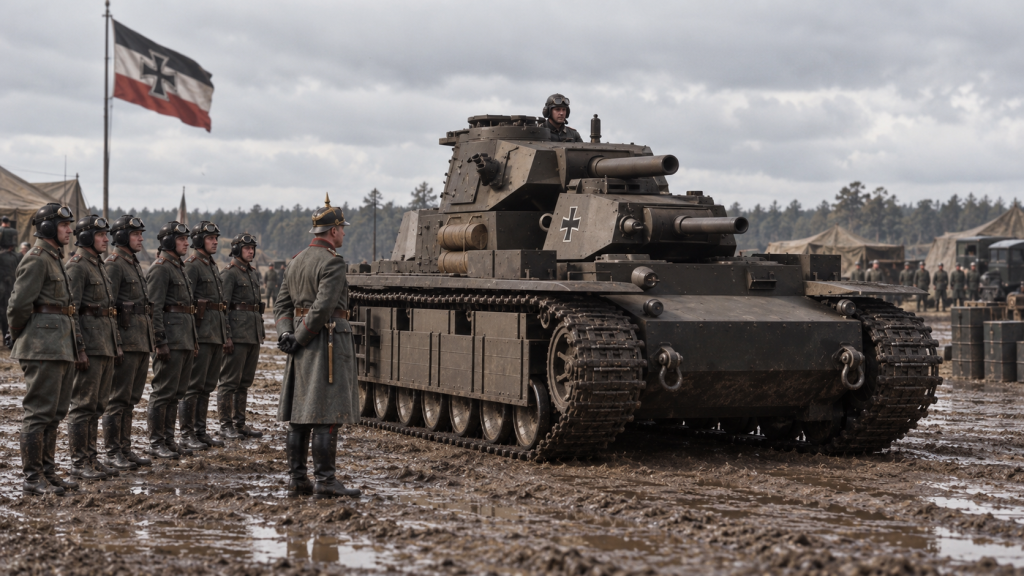
Why Would a Victorious Kaiserreich Need the “Bison”?
The key feature of this alternate history is that Germany would not have had to rebuild its armored forces almost from scratch. Instead, it could have directly analyzed the lessons of 1917–1918 and continued improving designs that were already under development.
However, the experience of the First World War could also have led German designers to a mistaken conclusion.
A tank of the early 1920s was primarily seen as a weapon for breaking through fortified defensive lines. It was expected to advance alongside the infantry, destroy machine-gun nests, suppress artillery, demolish field fortifications, and at the same time defend itself against enemy tanks. This led to an idea that seemed perfectly logical at the time: why limit a tank to just one gun?
A large hull allowed several turrets to be installed, with each one performing its own task. The tank thus became a kind of land battleship.
This idea was by no means uniquely German. Britain produced the five-turreted A1E1 Independent, while the Soviet Union developed the T-28 and the enormous five-turreted T-35. Even real-world Germany experimented with the multi-turret concept for a time. Developed during the 1930s, the Neubaufahrzeug had a main turret carrying 75 mm and 37 mm guns, supplemented by two smaller machine-gun turrets.
In our alternate timeline, however, a victorious Kaiserreich could have taken the concept much further.
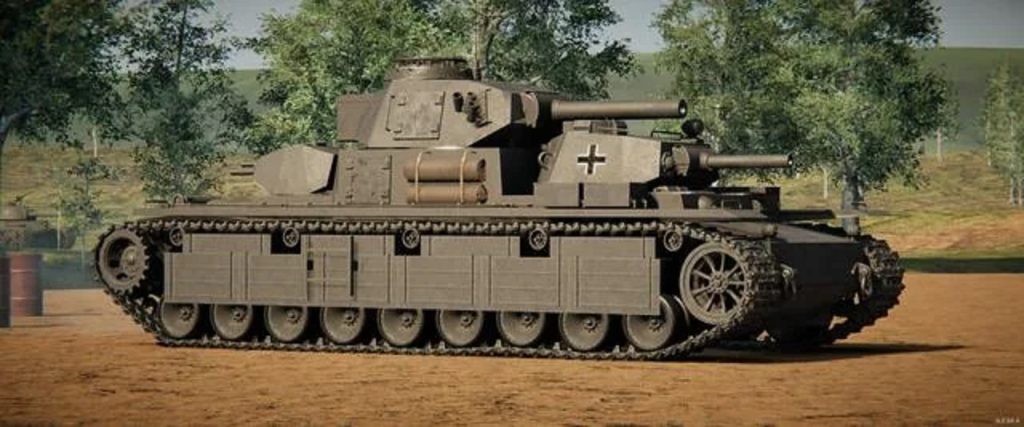
A Land Battleship
Even at first glance, the “Bison” looks like the multi-turreted tank concept of the interwar period taken to its logical extreme. It is not simply a German T-35, although the comparison is obvious. Rather, it resembles an imaginary transitional stage between the land-battleship philosophy of the First World War and the more rational heavy tanks of the 1930s.
The vehicle’s main armament consists of no fewer than two large-caliber artillery pieces: a 75 mm gun and a 105 mm gun. These are supplemented by two 20 mm automatic cannons and several machine guns. Operating this entire arsenal requires a crew of ten men. These are the specifications provided by the creator of the original project.
Within the framework of our alternate history, such a weapons configuration can be explained by assigning different roles to the individual firing positions.
The 105 mm gun would serve as the primary infantry-support weapon. Its main purpose would not be to penetrate armor, but to deliver heavy high-explosive shells against machine-gun positions, anti-tank guns, buildings, and field fortifications. In effect, the “Bison” would carry its own mobile heavy artillery.
The 75 mm gun could perform more general-purpose tasks, including engaging enemy armored vehicles. Meanwhile, the two 20 mm automatic cannons fit perfectly with late-1920s and early-1930s ideas about combating light tanks, armored cars, anti-tank gun crews, and infantry.
The result is a vehicle capable of engaging several targets simultaneously.
On paper, it looks extremely convincing.
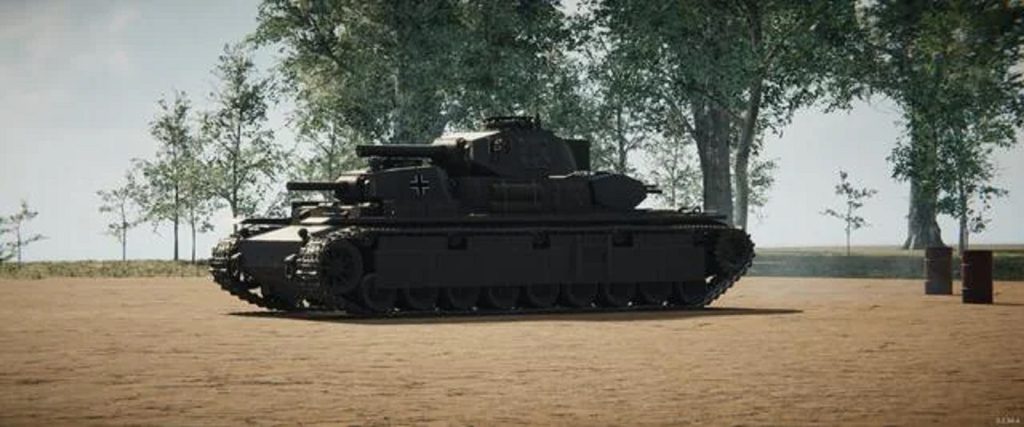
Armor That Tanks of the Next Generation Would Envy
Even more remarkable is the vehicle’s protection.
The concept’s creator specifies approximately 80–100 mm of frontal armor and 50–70 mm of armor over the remaining sections of the hull. At the same time, the vehicle is said to weigh only around 37 tons.
For a tank of the late 1920s or early 1930s, these figures are almost fantastical. If we treat the project as a genuine alternate-history vehicle, such heavy armor could be explained by a victorious Germany adopting the concept of shell-resistant armor for heavy tanks much earlier than it did in reality.
Such a “Bison” would have been practically invulnerable from the front to a large proportion of the light anti-tank weapons of its era. The enemy would have been forced either to bring up field artillery or to seek opportunities to hit vulnerable areas.
However, this is where the question of weight arises. Combining an enormous multi-turreted hull, a ten-man crew, four artillery weapons, and the stated armor thickness within a combat weight of just 37 tons would have been extremely difficult. It therefore makes more sense to regard this figure as one of the stated characteristics of the author’s alternate-history design rather than the result of a real engineering calculation.
Even so, the intention is clear: the “Bison” was not merely supposed to support infantry. It was intended to drive directly through the most heavily defended section of the enemy line.
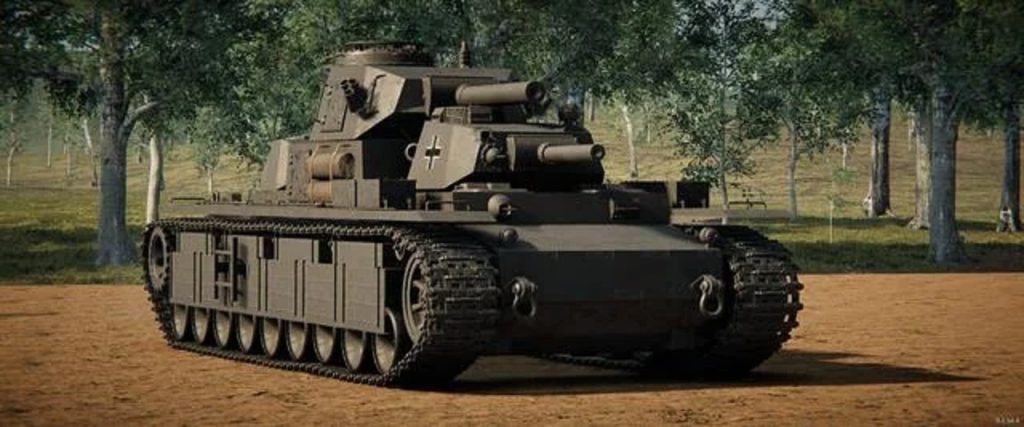
Specifications of the Durchbruchs- und Unterstützungswagen “Bison” Ausf. A
- Designation: Sd.Kfz. 195/M
- Type: Heavy breakthrough and infantry-support tank
- Combat weight: approx. 37 tons
- Crew: 10
- Main armament: 105 mm gun
- Secondary artillery armament: 75 mm gun
- Automatic armament: 2 × 20 mm cannons
- Additional armament: Several machine guns
- Frontal armor: approx. 80–100 mm
- Armor on other sections: approx. 50–70 mm
- Maximum speed: approx. 30 km/h
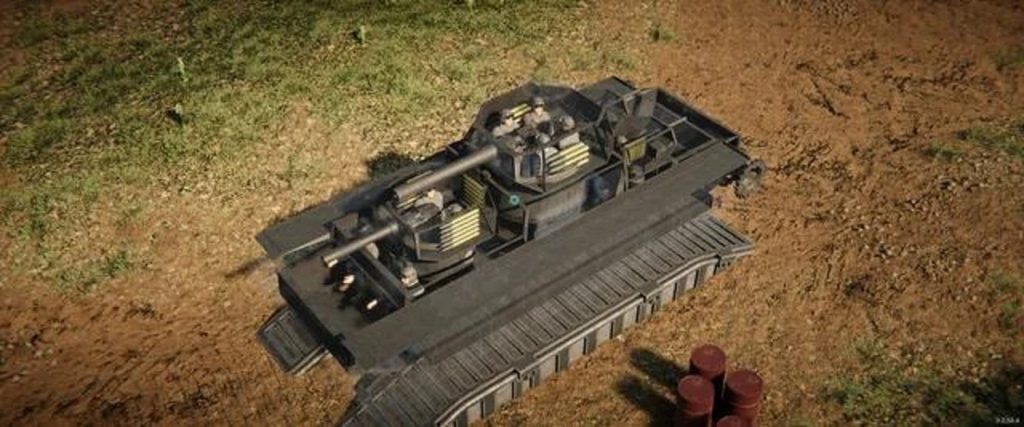
Ten Men Inside a Single Tank
But this is precisely where the problems begin.
A ten-man crew is practically a small military unit locked inside a single armored box. The commander would not simply have to identify targets and monitor the battlefield. He would also have to coordinate several independent firing positions, determine target priorities, and maintain communications with neighboring tanks and infantry.
Command and control was one of the fundamental problems of the multi-turret layout.
The Germans encountered the same basic issues with the real Neubaufahrzeug. The concept gradually came to be regarded as excessively complicated, while subsequent German medium-tank development moved toward a single full-size turret. The experience gained during these experiments nevertheless proved useful in shaping requirements for the future Panzer IV.
In the alternate “Bison,” this problem would have been even more serious.
In theory, ten crewmen could ensure high efficiency for each individual weapon. In practice, the commander would effectively become the leader of a small artillery battery—one that was also bouncing across rough terrain.
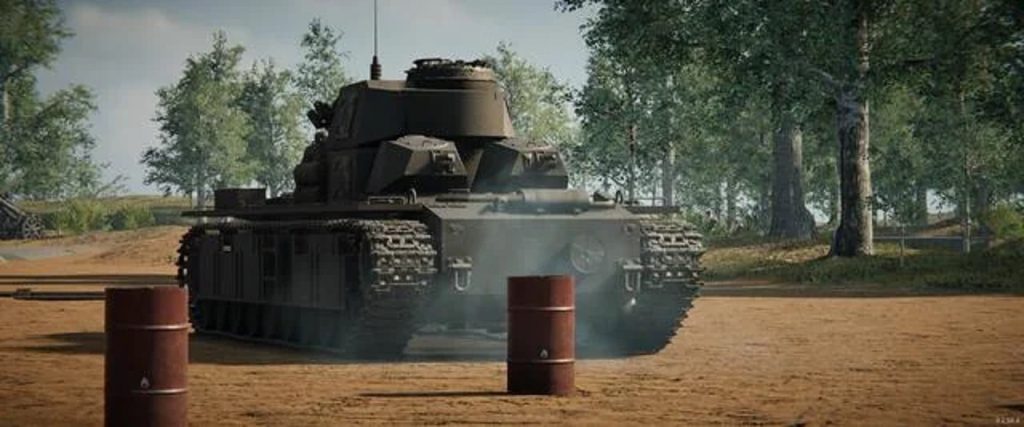
Illustration No. 3. One of the “Bison” views from the original gallery that best demonstrates the size of the hull and the arrangement of its multiple turrets.
30 km/h—As Long as the Tank Is Going Straight
The vehicle’s maximum speed is stated as 30 km/h. For a heavy tank of the late 1920s, this would have been quite respectable.
But maximum road speed is far from the most important consideration.
The project’s creator himself acknowledges in the comments that accelerating—and especially turning—this giant was a genuine nightmare. And that is a highly plausible problem for a vehicle of this kind.
A long track contact surface, substantial weight, and a complicated transmission would inevitably have impaired maneuverability. On soft ground, the situation would have been even worse. Add the stress placed on the engine, transmission, and suspension, and the impressive land battleship begins to look like a nightmare for maintenance crews.
During the First World War, such shortcomings might still have been acceptable. A tank moved slowly toward a trench line, and its primary task was simply to reach the enemy.
The next war, however, demanded an entirely different pace.
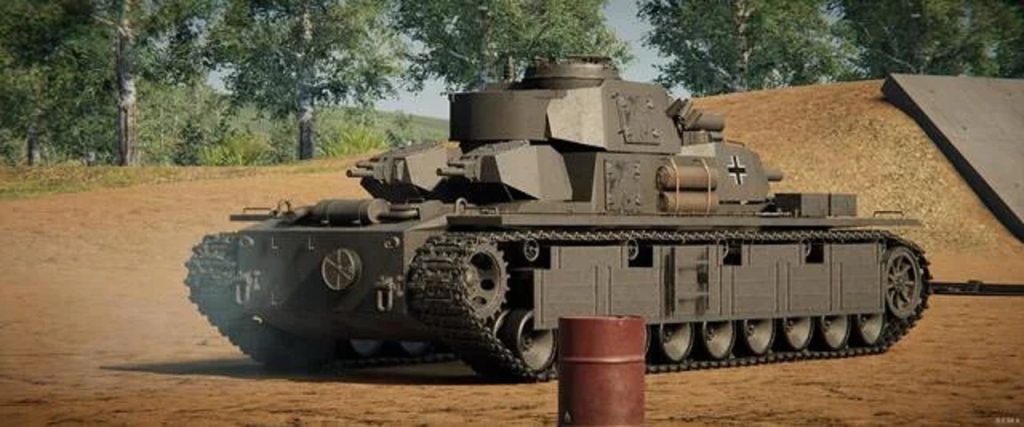
What Its First Battle Might Have Looked Like
Imagine Europe in the early 1930s.
Imperial Germany unveils its new heavy tank during military exercises. Huge “Bisons” roll down the road. A massive 105 mm gun projects from the main turret, accompanied by a 75 mm weapon, while the secondary turrets bristle with automatic cannons and machine guns.
For foreign military attachés, it would have been an impressive sight.
And in a real battle, several such vehicles could indeed have been extremely dangerous opponents. If the “Bison” were employed specifically as a breakthrough tank, operating on a carefully selected sector and supported by engineers, artillery, and infantry, its shortcomings could be compensated for—at least temporarily.
The 105 mm gun smashes fortifications. The 75 mm gun engages armored vehicles. The 20 mm automatic cannons and machine guns suppress enemy infantry. Thick frontal armor allows the tank to close in on hostile positions.
This is precisely the kind of situation in which the multi-turret layout demonstrates its greatest advantage: enormous firepower concentrated in a single vehicle.
But then the enemy retreats.
And the “Bison” has to pursue.
This is where the land battleship loses the war of the future.
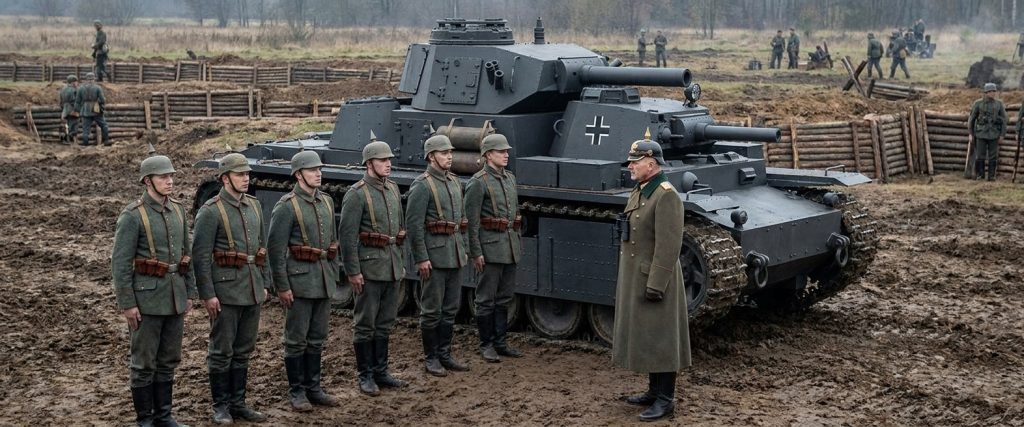
Why the “Bison” Would Have Been a Dead End
The problem with multi-turreted tanks was not that engineers of the 1920s had suddenly invented something inherently absurd. On the contrary, the concept was a perfectly rational response to the experience of the First World War.
The nature of warfare simply changed faster than such designs could mature.
Tank guns improved. A single weapon mounted in a rotating turret gradually became capable of performing almost all major combat tasks. More effective high-explosive and armor-piercing ammunition appeared. Communications improved, and mechanized formations became increasingly sophisticated.
The value of a tank was no longer determined by the number of gun barrels that could be fitted onto its hull.
Mobility, reliability, visibility, communications, crew ergonomics, and the ability of large formations to conduct rapid marches and concentrate at decisive points became far more important.
And in all these areas, the “Bison” would inevitably lose to a more compact single-turreted vehicle.
Real German tank development illustrates this perfectly. The Großtraktor served as an experimental stage, followed by the multi-turreted Neubaufahrzeug, but Germany subsequently moved toward much more rational layouts. Only five Neubaufahrzeug vehicles were built—two prototypes made of mild steel and three armored vehicles. It never became a true production tank.
In our alternate history, the “Bison” might have become a much larger-scale experiment. A victorious Kaiserreich would have had the money, the industrial capacity, and, most importantly, an uninterrupted school of tank design.
But even that could not have changed the fundamental laws governing the development of armored warfare.
The German T-35
This is precisely why the comparison with the Soviet T-35 is so appropriate.
Both vehicles embody the same philosophy: a heavy tank should carry multiple independent firing positions and literally flood the surrounding battlefield with fire. The more turrets and guns it carries, the greater its ability to engage different targets independently.
On parade, such machines looked like the embodiment of a state’s technological power.
On the battlefield, however, it became clear that every additional turret had to be paid for with greater weight, larger dimensions, a more complicated transmission, a larger crew, higher cost, and increasingly difficult fire control.
The creator of the original “Bison” effectively designed a German relative of the T-35, filtered through the aesthetics and engineering philosophy of the German school of tank design. The creator himself states that the Neubaufahrzeug was an inspiration, while one commenter rather accurately described the result as something between the Soviet T-35 and German armored vehicles.
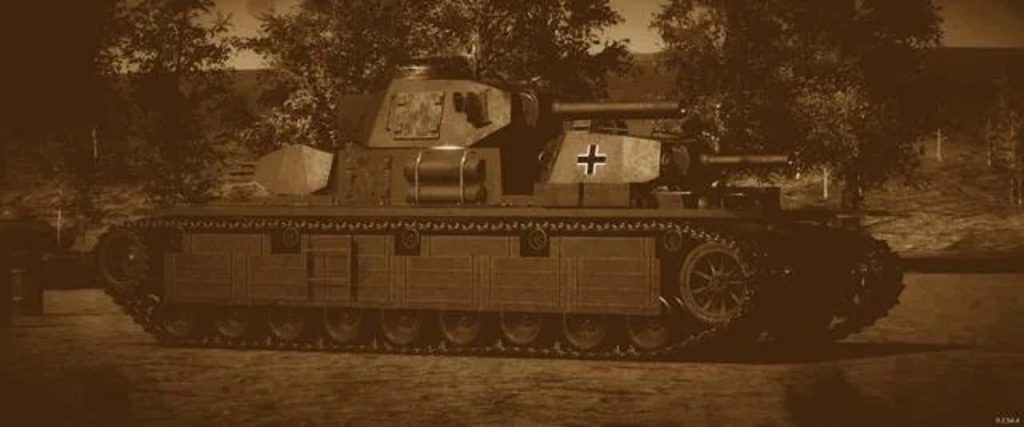
The Kaiser’s Last Land Battleship
If we imagine the “Bison” as a genuine vehicle in an alternate historical timeline, its career would most likely have been relatively short.
In the late 1920s, it might have appeared to be the tank of the future. In the early 1930s, it could have been regarded as a formidable heavy breakthrough vehicle. Perhaps a small production batch would even have entered service with separate heavy battalions of the Imperial German Army.
But by the end of the decade, it would have become clear that the future belonged to very different machines.
By the beginning of the Second World War, the concept of the multi-turreted tank had effectively exhausted itself. Armored vehicles were becoming faster, anti-tank artillery more powerful, and the demands placed on cooperation between tanks within large mechanized formations were increasing dramatically. Instead of several turrets, it proved far more effective to have one well-designed turret with a powerful multipurpose gun, good observation equipment, and a clear division of responsibilities among the crew.
The alternate Durchbruchs- und Unterstützungswagen “Bison” Ausf. A could therefore have become one of the symbols of a victorious Kaiserreich—a gigantic armored monument to an era when designers still tried to build tanks according to the principles of battleships.
Perhaps a handful of “Bisons” would even have remained in active service when a new world war began.
But by 1939–1940, they would no longer have looked like machines of the future. Instead, they would have appeared as magnificent, enormously expensive dinosaurs from a rapidly disappearing age.
The irony is that a Germany victorious in the First World War might indeed have been able to afford such a monster. But even victory itself could not have saved the multi-turreted tank concept.
Source link – https://www.reddit.com/r/SprocketTankDesign/comments/1wdts7d/schwerer_infanteriedurchbruchs_und/