The NATO Tank Revolution That Never Happened. What If the German-American KPz-70 Had Entered Mass Production?

In the late 1960s, the United States and West Germany were developing a tank intended to revolutionize armored warfare. An extremely powerful engine, adjustable hydropneumatic suspension, an autoloader, guided missiles, and a three-man crew housed entirely in the turret. According to its designers, the new vehicle was supposed to become NATO’s main battle tank for decades to come, giving Western armies an advantage over the Soviet T-64 and T-72.
However, instead of a single unified tank, the Western world ended up with two completely different families of vehicles: the American Abrams and the German Leopard 2. The ambitious joint MBT-70 project, known in Germany as the Kampfpanzer 70, was ultimately defeated by technical difficulties, constantly rising costs, and disagreements between the two countries.
But what if Washington and Bonn had managed to reach an agreement after all? What might a production KPz-70 have looked like, how would Western armored warfare have developed, and where would this tank have first seen combat?
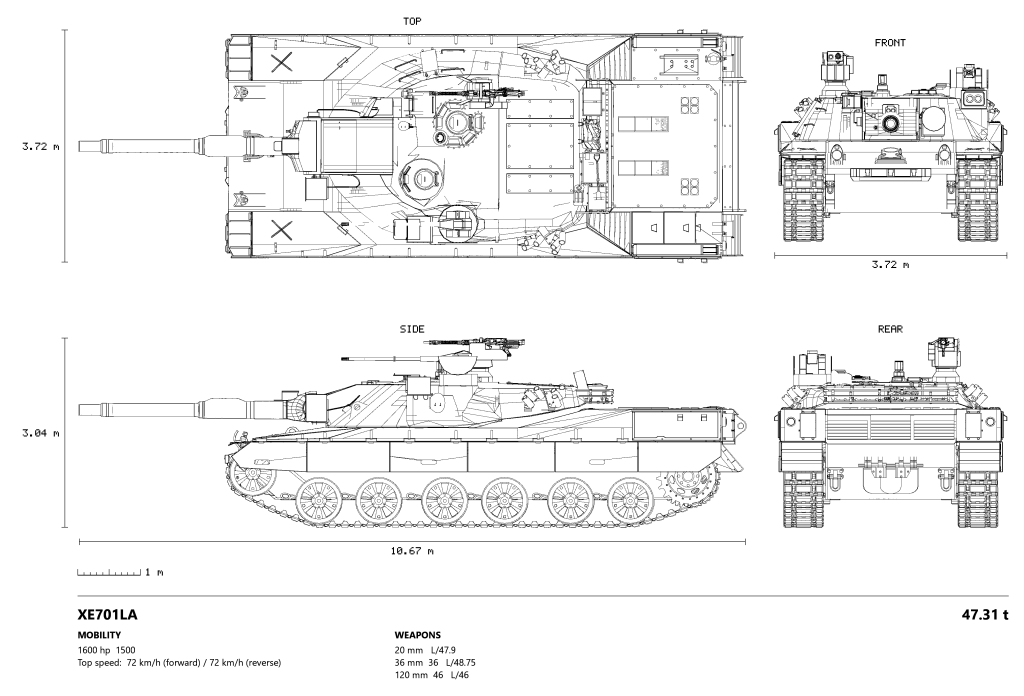
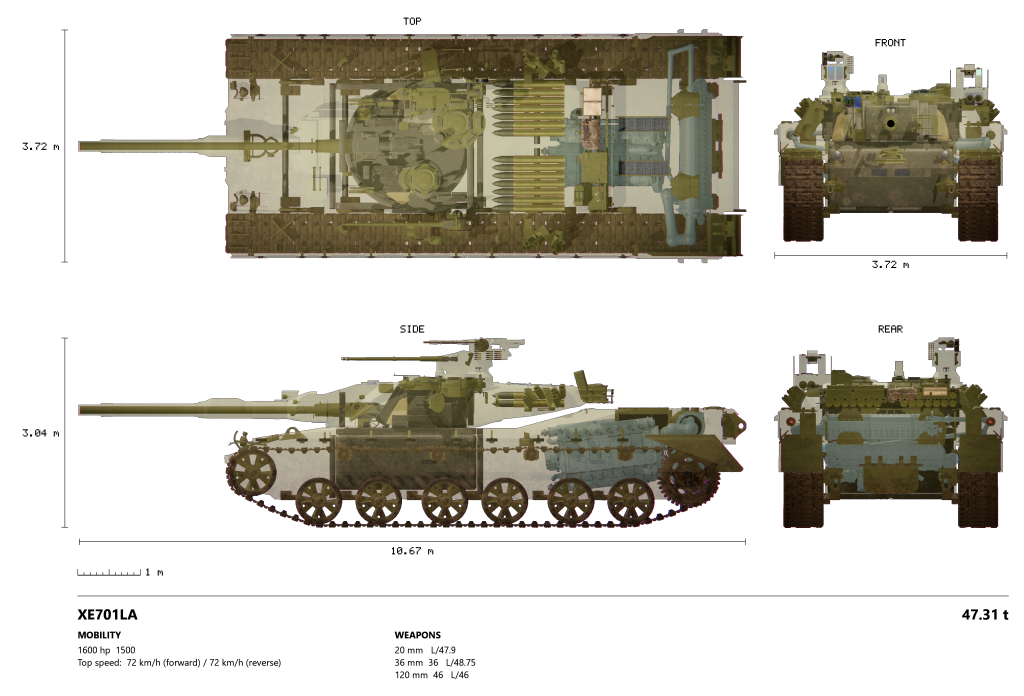
For this alternate-history scenario, we will use an interesting model called the XE-02/KPZ-70 XTH-05I F Type, published on Reddit by our fellow enthusiast Strong-Contest2225. The vehicle itself is the author’s modern interpretation of how the KPz-70 might have evolved, while the subsequent story of its development and combat service is our own reconstruction of an alternate reality.
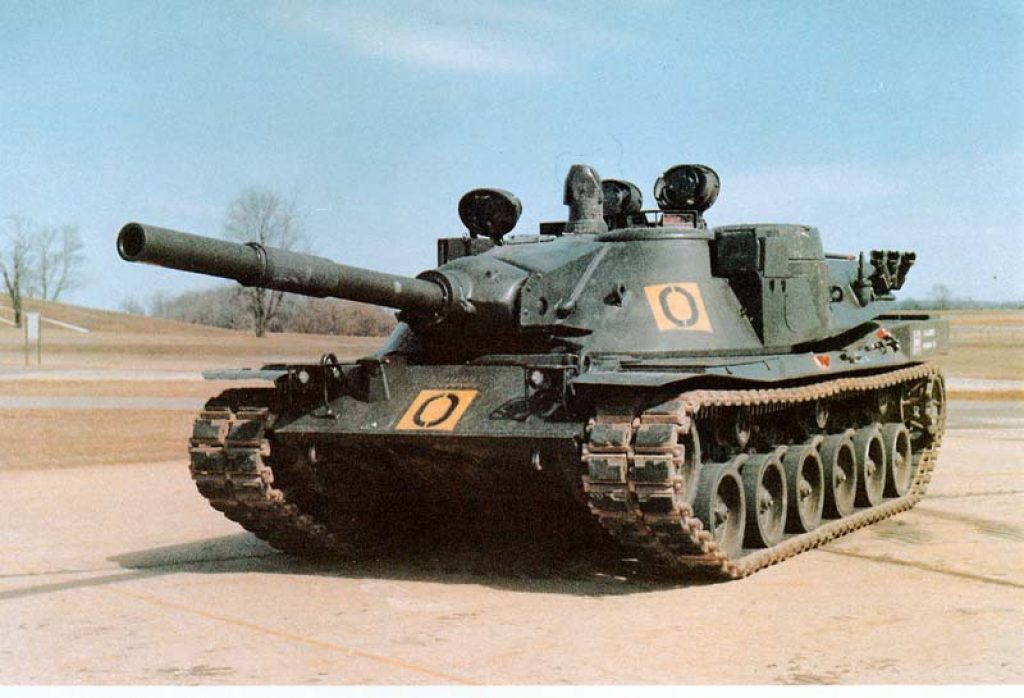
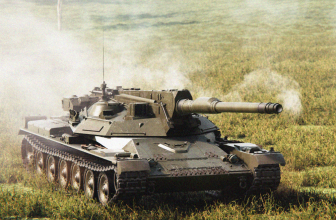
Historical MBT-70/KPz-70 prototype
The Real History: How the Americans and Germans Decided to Build a Common Tank
In August 1963, the United States and West Germany signed an agreement to jointly develop a new main battle tank.
The Americans called it the MBT-70, while the Germans designated it the KPz-70. The vehicle was intended to replace the M60 in the US Army and eventually replace Germany’s first generation of postwar tanks.
The project’s defining feature was its ambition to incorporate virtually every advanced technology available at the time.
The tank was equipped with a 152 mm gun-launcher capable of firing both conventional ammunition and Shillelagh guided missiles. An autoloader handled ammunition loading, while all three crew members were housed in the turret. Even the driver sat there, inside a special rotating capsule that kept him facing forward regardless of the turret’s position.
The design also included a 20 mm automatic cannon, a powerful diesel engine producing approximately 1,500 horsepower, and hydropneumatic suspension with adjustable ground clearance.
However, these revolutionary innovations created numerous problems.
The autoloader and suspension required further refinement, the driver’s position proved uncomfortable, and the American gun-missile system failed to satisfy the German military. Furthermore, the two countries disagreed on the tank’s optimal weight and armament.
Development costs rose rapidly. In 1969, West Germany effectively withdrew from the joint program, and cooperation officially ended in January 1970.
The Americans continued working on the simplified XM803 for some time but eventually shifted their attention to what would become the M1 Abrams. Germany followed its own path, developing the Leopard 2.
That marked the end of the KPz-70’s real history.
From this point onward, our alternate history begins.
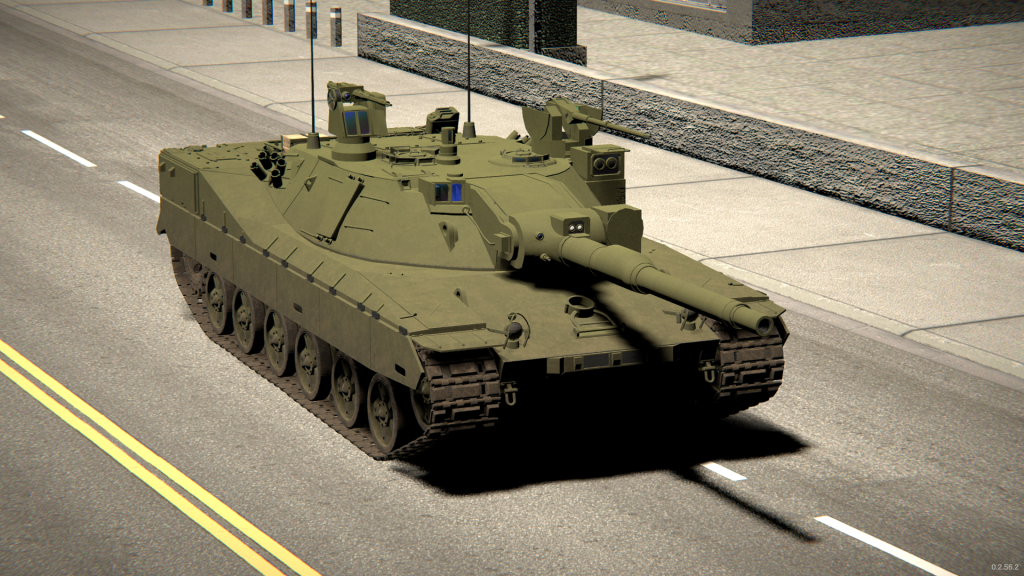
1969: The Compromise That Saved the Program
Our point of divergence occurs in September 1969.
Instead of withdrawing from the project, the West German government proposes a radical redesign of the future tank. Washington, concerned about the appearance of the Soviet T-64A with its 125 mm gun, agrees.
First and foremost, the Germans insist on abandoning the 152 mm gun-missile system.
It is replaced by a promising 120 mm Rheinmetall smoothbore gun, whose development both countries agree to accelerate through joint efforts.
The Americans also agree to abandon the idea of placing the driver in the turret. He returns to the front of the hull, while the turret becomes a two-man compartment.
The autoloader is retained, but its design is simplified.
The adjustable suspension is also preserved, becoming one of the vehicle’s most distinctive features.
As a result, a redesigned prototype designated KPz-70B appears in 1971. Compared with the original tank, it is slightly heavier but considerably more reliable.
By the end of 1973, the vehicle successfully completes joint military trials, and in the spring of 1974, the United States and West Germany sign an agreement on mass production.
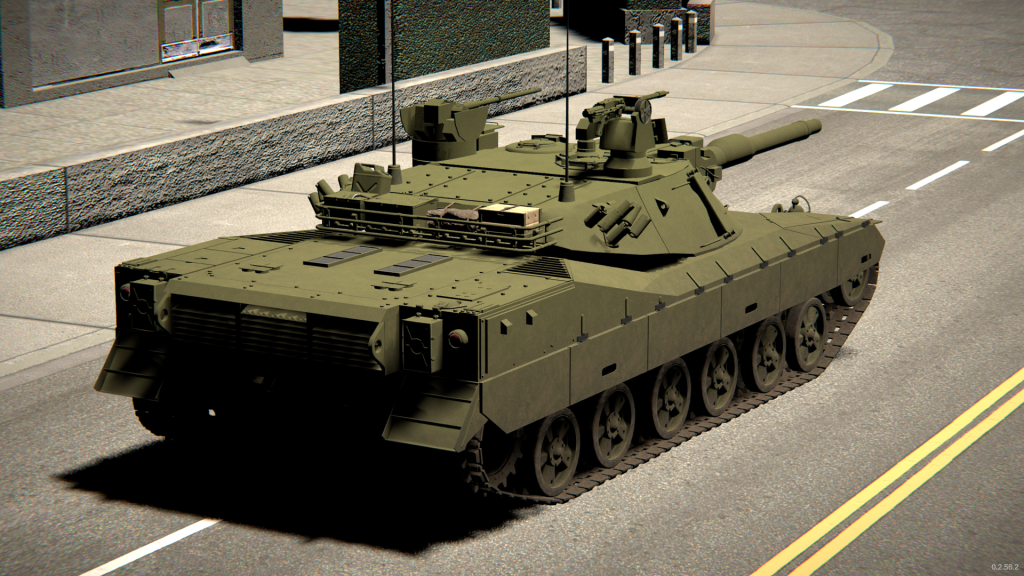
1975: The Birth of NATO’s New Main Battle Tank
In 1975, the first production tanks begin entering service with American armored divisions stationed in West Germany.
The American version receives the designation M70, while the German version retains the name Kampfpanzer 70.
Both versions are standardized to the greatest extent possible. Their differences mainly concern radio equipment, certain sighting systems, and national command-and-control systems.
Production begins on both sides of the Atlantic. German companies are responsible for the guns and much of the running gear, while American manufacturers supply electronic equipment and powerplants. Hulls and turrets are manufactured at national production facilities.
The design undergoes continuous improvement.
By 1980, the KPz-70A2 variant appears, featuring improved armor protection and thermal imaging equipment.
In 1985, production begins on the KPz-70A3, which receives new multilayer armor, an improved fire-control system, and more advanced armor-piercing fin-stabilized discarding-sabot ammunition.
This vehicle becomes the basis for the next major modernization: the hypothetical XTH-05I F Type, whose appearance was proposed by the Reddit model’s creator.
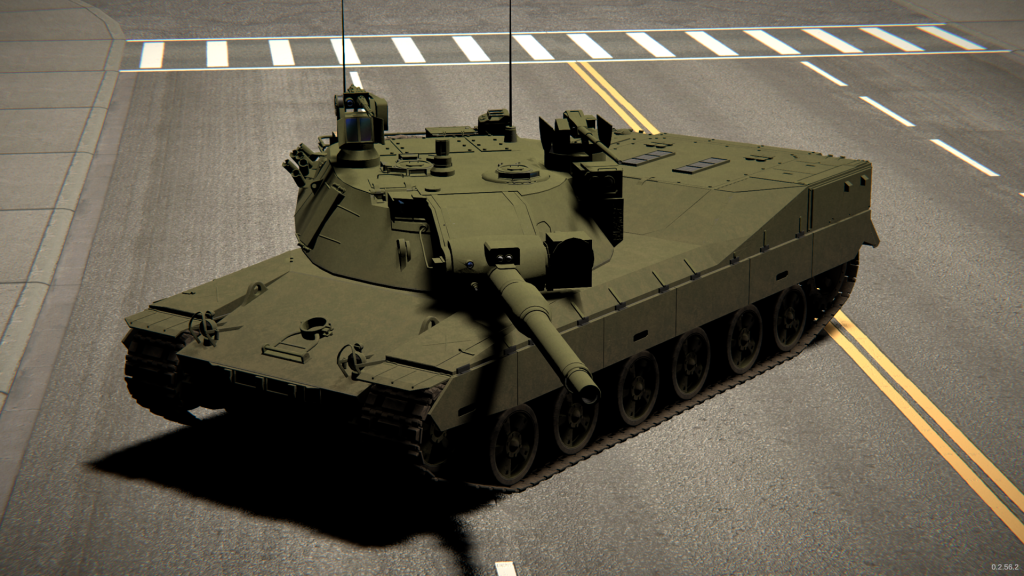
What Did the Production XTH-05I F Type Look Like?
By the mid-1980s, the original KPz-70 had already become noticeably outdated. The Soviet T-80U and advanced variants of the T-72 prompted Western designers to focus once again on improving armor protection.
In our alternate reality, development of a modernized variant begins in 1986. It receives the provisional designation KPz-70A4 XTH-05I F Type.
We will associate this version’s appearance with Strong-Contest2225’s model. However, the specifications listed below represent our own assumptions about a possible production tank, rather than figures confirmed by the creator of the 3D model.
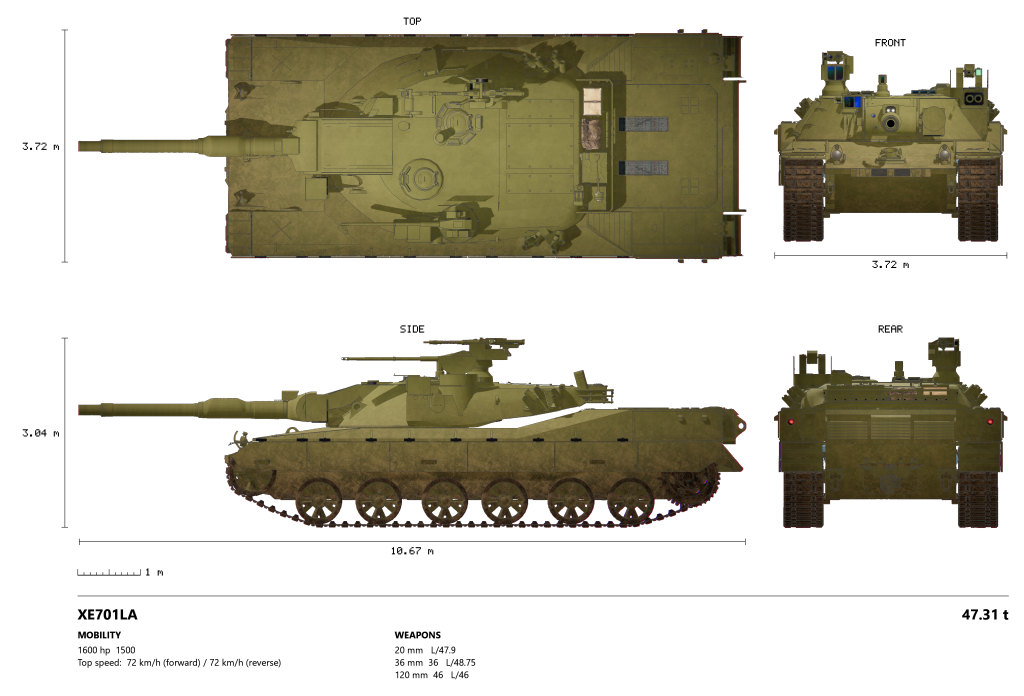
Estimated Specifications of the KPz-70A4
-
Combat weight: approximately 55 tonnes.
-
Crew: 3.
-
Main armament: 120 mm Rheinmetall Rh-120 L/44 smoothbore gun.
-
Ammunition capacity: 36 rounds.
-
Loading system: automatic.
-
Secondary armament: one coaxial 7.62 mm machine gun and one 12.7 mm anti-aircraft machine gun.
-
Engine: 1,500 hp diesel.
-
Maximum speed: approximately 68 km/h.
-
Operational range: approximately 450 km.
-
Suspension: hydropneumatic, with adjustable ground clearance.
-
Armor: multilayer composite armor with additional turret-mounted modules.
-
Fire-control system: laser rangefinder, thermal imager, and digital ballistic computer.
The most important feature of this modernization is a new turret with extensive additional protection. It noticeably increases the vehicle’s silhouette but makes it possible to accommodate more effective armor and upgraded equipment.
At the same time, the tank retains the defining characteristics of the KPz-70 family: a compact crew, an autoloader, and adjustable suspension.
1991: The First Combat Test in Iraq
The new tank faces its first real test during Operation Desert Storm.
In this alternate reality, the US Army deploys approximately 1,100 M70-family tanks to Saudi Arabia, including 320 of the latest M70A4s.
On February 24, 1991, American armored formations cross the Iraqi border and begin their offensive.
In the desert, the new vehicles demonstrate the advantages of their powerful engines and modern fire-control systems. Thermal imagers allow crews to detect Iraqi tanks at long distances, while the 120 mm guns reliably destroy outdated T-55s and T-62s.
However, their most important opponents are the T-72s of the Iraqi Republican Guard.
Particularly fierce fighting takes place on February 26 near 73 Easting, where American armored units encounter well-prepared Iraqi positions.
Over several hours of combat, M70A4 tanks destroy dozens of enemy tanks and armored vehicles.
However, shortcomings in the new equipment also become apparent.
Sand causes accelerated wear of hydropneumatic suspension components, while the complex autoloader requires careful maintenance. Several vehicles have to be evacuated because of mechanical failures.
Nevertheless, the overall outcome of the operation is convincing: Coalition armored vehicle losses remain relatively low, and the M70 earns a reputation as one of the most effective tanks of its time.
All the combat results described for the M70 are fictional. In reality, M1 Abrams tanks participated in Operation Desert Storm.
Illustration 4. A screenshot of the XTH-05I F Type in an urban environment from the original publication. It can be used to illustrate the vehicle’s hypothetical postwar service, identified as an artist’s reconstruction.
The Price of Standardization: Why the Common Tank Was Far from Perfect
After the 1991 war, the American military begins evaluating the prospects for further development of the M70.
And this is where an unexpected problem emerges: standardization with German tanks, once considered the program’s greatest advantage, is gradually becoming a limitation.
Germany wants to preserve relatively low vehicle weight and high mobility. The Americans, by contrast, propose strengthening armor protection, even at the cost of significantly increased weight.
Disagreements also emerge over further development of the autoloader, suspension, and electronic equipment.
By the late 1990s, the M70A4 has become too expensive to maintain, while the modernization potential of the original hull is gradually being exhausted.
Consequently, in 1998, the United States begins developing an entirely new tank, while Germany starts work on its own next-generation armored vehicle family.
This creates a peculiar historical irony.
The joint program that was canceled in 1970 in our reality ultimately produces a successful main battle tank in this alternate timeline. Yet a quarter of a century later, the same disagreements once again force the two allies to pursue separate development programs.
Conclusion
The real KPz-70 was one of the boldest attempts to create a tank of the future. Many of its innovations were far ahead of their time, but technical complexity and disagreements between the developers made the project excessively expensive.
Nevertheless, it is entirely possible that a timely revision of the technical requirements could have allowed the program to continue.
Switching to a 120 mm gun, abandoning the turret-mounted driver’s position, and simplifying several systems might well have made the vehicle more suitable for mass production.
In our alternate world, this approach enables the United States and Germany to develop a common family of tanks that remains in service for nearly thirty years.
And the XTH-05I F Type proposed by our fellow enthusiast can be imagined as the pinnacle of this unusual family’s evolution.
Perhaps a tank like this would now be regarded as the symbol of Western armored warfare during the Cold War. And the names Abrams and Leopard 2 might never have appeared in the forms we know today.
Source: XE-02/KPZ-70 XTH-05I F Type — Reddit, r/SprocketTankDesign