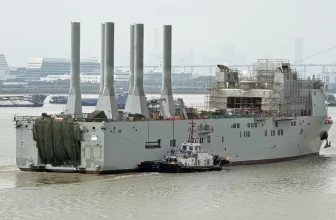
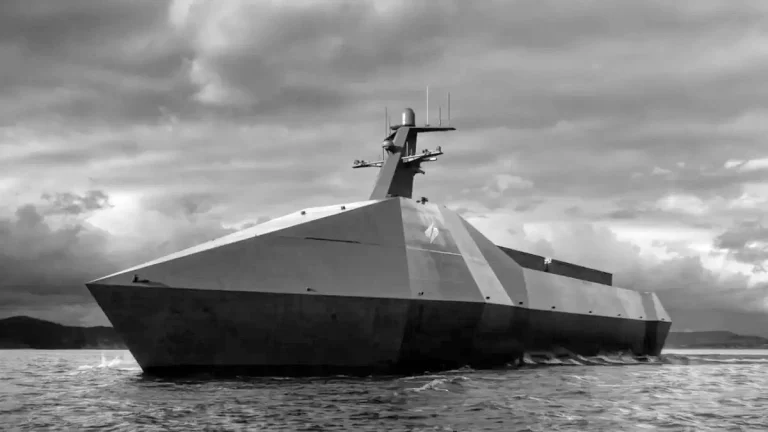
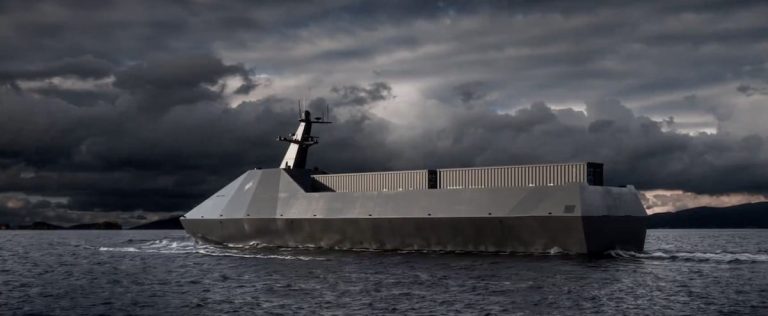
Over the past few decades, the development of unmanned technologies has been associated primarily with aviation. First came reconnaissance drones, then attack drones, and today unmanned aerial vehicles have become a familiar feature of the modern battlefield. However, a true revolution is gradually unfolding not only in the air but also at sea. One of the most interesting projects in recent months has been the American unmanned surface vessel Marauder, which Saronic recently launched.
At first glance, this new development looks like just another experiment in the field of autonomous shipping. But if you take a closer look, it becomes clear that this is not just an unmanned boat, but a full-fledged, next-generation transport vessel. Its developers expect that in the future, such vessels will be able to perform supply, cargo transport, and fleet support tasks without a crew.
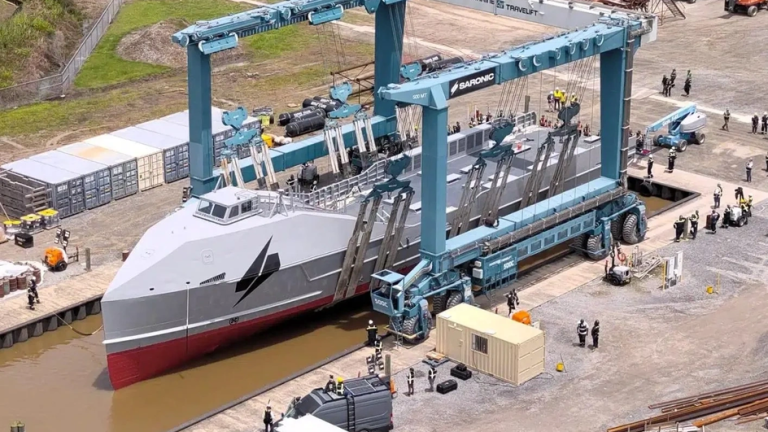
The most remarkable thing is that less than a year passed from the start of the design phase to the launch of the first hull. For modern shipbuilding, this is an almost unbelievable achievement. Until recently, developing a new class of ships could take anywhere from three to five years—and sometimes much longer.
How the Americans Decided to Speed Up Shipbuilding
One of the main problems in Western shipbuilding has long been considered to be the length of the production cycle. Even relatively small vessels require a vast amount of approvals, design work, and a lengthy construction process.
Saronic decided to move away from the traditional approach. Instead of dividing design, manufacturing, and software development among different contractors, all key areas were consolidated within a single production facility.
This approach made it possible to significantly reduce the project timeline. In addition, the engineers relied on commercially available components and a modular design. Individual sections of the hull and equipment can be manufactured in parallel and then quickly assembled into a finished vessel.
Another equally important decision was the use of an aluminum hull. Although steel remains the classic material for shipbuilding, aluminum is much easier to work with and allows for a reduction in the ship’s weight without a significant loss of strength.
According to the company, construction of the second building is proceeding about a quarter faster than that of the first, which suggests that production will ramp up quickly.
An unmanned ship
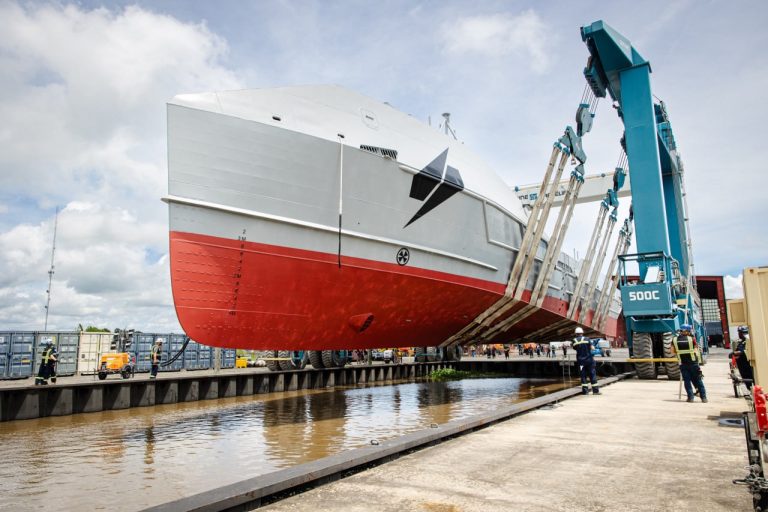
The Marauder’s most distinctive feature is not its design, but the fact that there are no people on board.
The vessel was originally designed as a fully autonomous platform. While most modern ships are equipped with automation features only after the design phase is complete, the Marauder was developed around an unmanned concept from the very beginning.
Every component of the ship is connected to a unified digital control system. Specialized software allows for real-time monitoring of the status of the engines, power systems, navigation equipment, and other systems.
An operator can be thousands of kilometers away from the ship and still receive a full set of telemetry data. At any time, the operator can perform remote diagnostics, check the status of the equipment, or take control.
If necessary, the vessel can operate completely autonomously, following its route without human intervention.
Why Are These Ships of Interest to the Military?
Military logistics appears to be the most obvious area of application for Marauder.
Contemporary conflicts show that the delivery of cargo is becoming one of the most dangerous tasks. Transport ships, supply boats, and auxiliary vessels often turn out to be no less important targets than combat units of the fleet.
Unmanned vehicles offer a solution to this problem. Even if the vessel is lost, there is no risk to the crew.
The developers believe that the Marauder will be able to transport ammunition, food, fuel, and spare parts between islands, naval bases, and ships at sea. This concept appears particularly promising for the Pacific region, where the distances between supply points can be measured in thousands of kilometers.
The use of such vessels in commercial shipping is considered an equally promising area. An autonomous vessel can operate regular routes between remote ports, reducing operating costs and minimizing reliance on crews.
Speed isn’t the most important thing
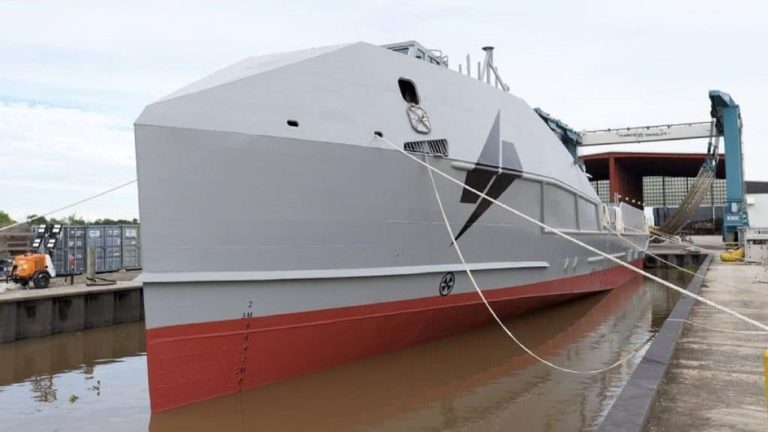
Compared to warships, the Marauder’s specifications may not seem particularly impressive. Its maximum speed exceeds 25 knots, which is approximately 46 kilometers per hour.
However, for a transport platform, another metric is far more important: range.
According to the developers, the drone is capable of traveling up to 5,400 nautical miles, which is equivalent to approximately 10,000 kilometers. This is sufficient for intercontinental flights and extended operations far from supply bases.
Another important feature is its cargo capacity. The vessel can carry up to 150 metric tons of payload, including standard ISO containers used in global logistics.
In fact, we are no longer talking about a reconnaissance boat or an experimental unmanned vessel, but rather a fully-fledged transport ship.
TTX Marauder
Type: Medium-sized unmanned surface vessel (MUSV)
Разработчик: Saronic Technologies (США)
Crew: none
Operating modes:
- fully autonomous;
- remote control;
- mixed mode.
Maximum speed:
- more than 25 knots (46 km/h).
Cruising range:
- up to 5,400 nautical miles;
- about 10,000 km.
Payload:
- up to 150 metric tons.
Cargo Standard:
- ISO containers.
Control systems:
- real-time telemetry monitoring;
- remote diagnostics;
- subsystem monitoring;
- historical data storage;
- remote operator intervention.
Scheduled release:
- up to 20 units annually by the end of 2026.
The Beginning of a New Era?
Today, many experts compare the emergence of large unmanned ships to the early days of aerial drones twenty years ago. Back then, drones were viewed as a supplementary reconnaissance tool. Today, they have become a fully-fledged class of weaponry.
It is possible that autonomous ships will follow a similar path. If Saronic is indeed able to establish an annual production rate of two dozen Marauders, in a few years the number of such ships could exceed the number of vessels in some classes of traditional U.S. Navy ships.
Of course, drones won’t replace destroyers, frigates, or aircraft carriers. But in the areas of logistics, patrols, and transport operations, they have the potential to be a real game-changer. And the Marauder may well turn out to be one of the first representatives of a new generation of maritime drones that will transform the ocean into yet another arena for autonomous technologies.