Memoirs of an Old Knight of Acre. Chapter II. Beneath the Tolling Bell

“There are men who believe a monastery to be the quietest place on earth. They have never lived in one.”
The procession appeared in the street as the sun was already sinking toward the west. I noticed it by chance when I looked up from the parchment upon which, for the better part of an hour, I had been unsuccessfully trying to arrange memories half a century old. Some twenty monks were slowly making their way up from the harbor toward the upper city. Their cloaks were covered with the dust of the road, their staffs worn smooth by the long journey, and at the head of the procession they carried a plain wooden cross. They were softly chanting a psalm, and the wind carried only scattered Latin words to my window—words I had known since childhood.
I listened to the chant and suddenly realized that I could still continue it to the very end without difficulty. More than fifty years had passed, yet memory holds with remarkable tenacity to those things learned in childhood. And then the thought came to me that, had God ordained my life differently, I might well have been walking in such a procession today. Just as grey, just as stooped, with a tonsure upon my head and a prayer book tucked beneath my arm, making my way toward yet another holy place instead of sitting in my own house in Acre, remembering the days when the world seemed far larger than it truly was.
Childhood rarely asks a man which road he would choose for himself. Least of all when he is an orphan.
After the death of my parents, I was placed in a Benedictine abbey several days’ journey from Rouen. No relatives could be found who were willing to take me in, and in those days monasteries were not merely houses of prayer, but also the last refuge of many children left without families. Some were given to the Church willingly by parents fulfilling a vow made to God; others were sent there for an education or in hopes of a future ecclesiastical career. And then there were those like me, whom fate itself had brought to the monastery gates.
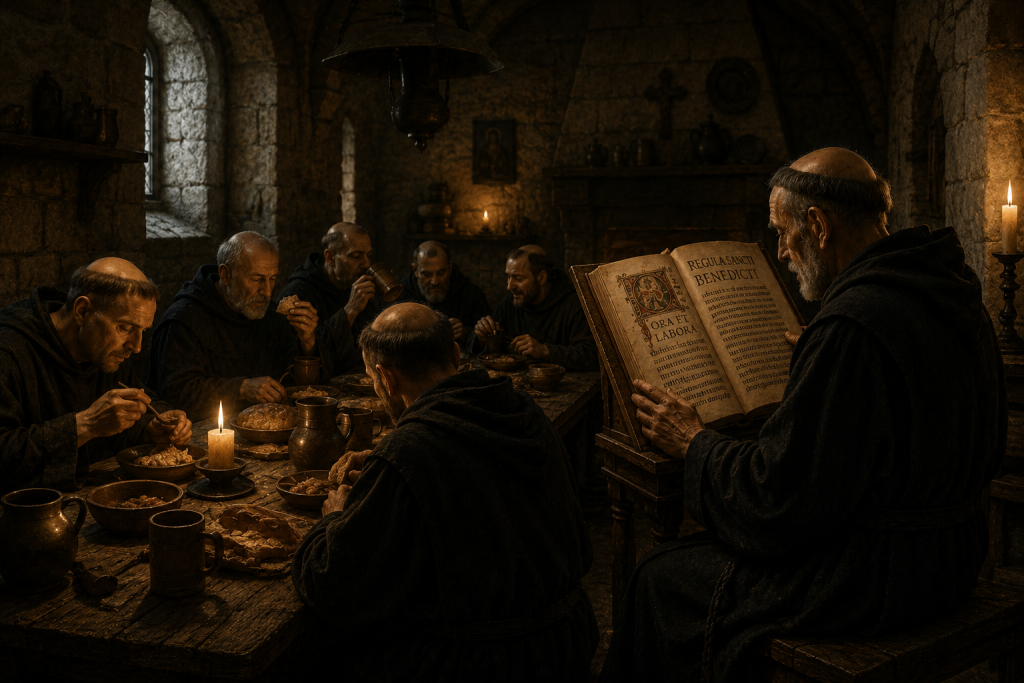
Contrary to what many people imagine, a monastery was by no means a place of endless silence. Quite the opposite. Life within its walls followed such a strict order that at times it resembled a military camp far more than a knight’s castle. Later, when I entered the service of Prince Robert, I often caught myself thinking how strangely familiar military discipline seemed to me. The bell had merely been replaced by the horn, the abbot by a lord giving orders, and the psalms by the shouted commands of sergeants.
Our day began long before sunrise.
If my memory serves me, the first stroke of the bell sounded at about the fifth hour. In summer the sun was already preparing to rise above the forest, but in winter it seemed as though God had forgotten to return light to the earth altogether. We boys hated that sound with all our hearts. It was loud, merciless, and never late. The moment it rang, dozens of sleepy figures rose from hard straw mattresses. The stone floor remained cold even in summer, and in winter it felt as though one were stepping barefoot directly onto ice.
Matins came first.
In those days I sincerely believed that God might have shown a little mercy to children and allowed us to pray after sunrise. Saint Benedict, however, was evidently of another opinion, and within the monastery his Rule carried more weight than any boy’s wishes. The abbot used to say that a man who could not conquer his own drowsiness would never conquer temptation. At the time, it seemed to me that the greatest temptation in all creation was simply to lie down again for another few minutes.
After prayers came a day ordered almost to its final moment. There was a rule in the monastery that every novice knew by heart: Ora et Labora—“Pray and Work.” Only when I became a grown man did I understand how perfectly those words described the life of the Benedictines. They truly knew how to join prayer and labor until there seemed to be no distinction between the two.
We learned to read, copied books, worked in the gardens, carried water, cleaned the stables, helped in the kitchens, tended the vineyards and watched over the sheep. No one was allowed to remain idle. Even the oldest monks, men who could no longer stand for long, sorted grain, mended clothing, or helped in the library. Within the monastery, idleness was regarded as a sin scarcely less dangerous than pride.
Of all our studies, Latin came most easily to me.
Brother Matthew, who taught us grammar, once said that my memory “clung to words like burrs to a dog’s coat.” He was right. I learned prayers, passages from Holy Scripture, and entire pages of Latin text with remarkable speed. Sometimes I needed only to read a paragraph twice before I could repeat it almost without error.
God, however, had evidently decided to balance this gift with another quality.
My handwriting was dreadful.
Whenever we were sent to the scriptorium to copy manuscripts, I knew beforehand that the day was ruined. Brother Matthew had only to walk between the tables before he would inevitably stop beside mine, stare in silence for a long while at whatever crooked line I had just produced, and then sigh heavily.
“Ansel,” he would finally say, “you write as though you were holding the quill in a chicken’s claw.”
At times I suspected the quill itself had taken a particular dislike to my fingers. The ink spread where it should not, the letters danced across the parchment, and my gilded initials looked less like the beautiful designs produced effortlessly by the older scribes than tangled vines after a violent storm.
I confess, I hated the scriptorium.
The smell of oak-gall ink, the scratching of goose quills, the ache in my back after hours spent sitting motionless—all of it seemed a form of torture to a boy who would much rather have been in the stables or out in the yard, where at least there was room to run.
Now, half a century later, I smile at my own foolishness. It is because of those endless hours in the scriptorium that I am able to set these memories down today. God often teaches a man something he will not need until many decades later.
Our food was as simple as our lives.
Dark bread, thick pottage made from lentils or peas, turnips, cabbage, onions, and sometimes cheese. Fish was served on the great feast days, while meat appeared at table so rarely that every such occasion remained in our memories for weeks afterward. We boys ate every last crumb, though we were forever dreaming of a true knightly feast, where the tables groaned beneath roasted game, great hams, and pitchers of sweet wine.
And yet, quite by accident, I once discovered that even monks remain men.
One night the cellarer sent me to fetch an empty basket. As I descended toward the wine cellar, I heard laughter. I cautiously pushed the door open and saw several of the older brothers seated around a small table. Before them stood a jug of young wine, slices of salted meat and cheese, boiled vegetables, and bread still warm from the oven.
At the time, I thought I had stumbled upon some terrible secret.
I was certain that by morning the abbot would know everything and that the guilty men would face some dreadful penance. But no one said a word. It was only many years later that I understood that even the most devout of men remain men. Some are better than others at mastering their weaknesses, but there is no man alive who has none.
And so our life flowed quietly and steadily, like water through a millstream. It seemed that it would always be so. One day differed little from another, the seasons followed one another, boys grew into men, old monks went to God, and new ones took their places. None of us could have imagined that very soon the familiar order of our world would be broken by a single piece of news.
It happened in the evening, with no more than an hour remaining before sunset.
That morning the monastery had gone about its life as usual, but sometime after midday the abbot unexpectedly summoned the senior brothers. Soon novices were hurrying across the courtyard, kitchen servants were hauling the best barrels of wine up from the cellars, silver goblets were being polished in the refectory until they gleamed, and the brother cook ordered two fattened rams slaughtered at once—an unheard-of extravagance in our abbey.
We boys exchanged puzzled glances, trying to understand what was happening.
The answer came only toward evening.
The old porter, who had spent his entire life in service at the monastery gate, slowly closed the heavy doors, turned toward us, smoothed his grey beard, and spoke the words I would remember for the rest of my life:
“Tomorrow, the son of the Conqueror comes to us… Prince Robert Curthose.”
And at that moment I did not yet know that when he passed through the monastery gates, my new destiny would enter with him.