“After Nicaea, we believed the worst was behind us. We were wrong. Sometimes victory is more dangerous than defeat—it makes a man too confident in himself.”
From the writings of Ansel de Nantes.
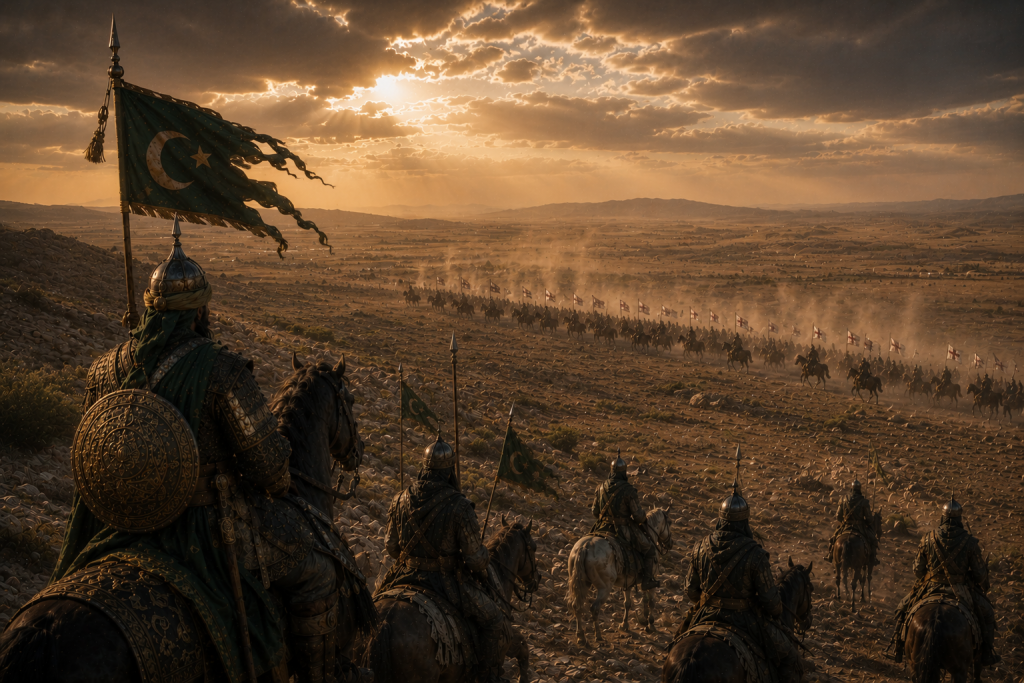
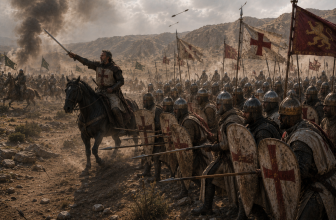
At dawn, the camp began to stir long before the trumpets sounded. Grooms led out the horses, squires loaded baggage onto pack animals, blacksmiths extinguished the last embers in their travelling forges, and cooks hurriedly served hot stew to those who would spend the entire day in the saddle. Not long ago, a veritable city of tents had stood beneath the walls of Nicaea. Now all that remained was trampled grass, cold fire pits, and the freshly raised earthworks around the fortress.
I looked back one last time.
The emperor’s purple banners were already flying above the towers. The city belonged to Byzantium once more, and we were marching farther east.
“Saying goodbye?” Clavier asked, drawing level with me.
“I suppose…”
He glanced toward the fortress and shook his head.
“Don’t grow attached to places, lad. On campaign, a soldier’s home is wherever he pitches his tent that evening.”
With that, he urged his horse forward and rode toward his ten.
The column moved slowly. The army stretched for miles, and it soon became clear that we could not continue marching together. The roads of Asia Minor were too narrow, the wells too few, and tens of thousands of men and horses required an astonishing amount of food and water every day.
That same day, the princes gathered for a brief council.
Before long, the news passed through the ranks.
The army was to be divided.
Bohemond of Taranto, Duke Robert of Normandy, Tancred, and Robert of Flanders would take the first road. Godfrey of Bouillon, Raymond of Toulouse, and the remaining princes would lead the second column. Only a day’s march would separate them—close enough to come to one another’s aid, yet far enough apart to avoid stripping the entire countryside of food and water.
When we resumed our march, I rode up beside Clavier.
“Couldn’t we have stayed together?”
He grinned.
“We could.”
“Then why split up?”
“Because we have plenty of swords, but there’s precious little bread around here.”
I said nothing.
Clavier continued.
“People often think an army marches on courage. It doesn’t. It marches on oats, water, and bread. Forget that, and all the heroism in the world won’t save you.”
I remembered the monastery’s household, where feeding even a few dozen people demanded an enormous amount of work. Now tens of thousands were marching before my eyes.
And indeed, keeping such an army fed was no less difficult than winning a battle.
The farther we travelled from Nicaea, the more the world around us changed.
The thick forests I had known since Normandy disappeared. The hills grew gentler, the grass was scorched by the sun, and the wind carried the smell of dry earth instead of familiar dampness. Sometimes it seemed as though nature itself obeyed different laws here. Rivers became less frequent, trees grew in small scattered groves, and villages resembled fortified settlements rather than peaceful farming communities.
There were hardly any people.
Sometimes we passed through abandoned villages. The doors of the houses stood open, the wells were empty, and the chickens had long since scattered into the surrounding countryside.
“They left ahead of us,” Geoffroi said.
“Or someone warned them,” Drogo added.
Clavier dismounted beside one of the houses and spent some time carefully studying the ground.
“Both.”
“How do you know?”
He pointed to some barely visible marks.
“See?”
I crouched beside him.
At first, I noticed nothing.
Then I made out the impressions of many hooves.
“Cavalry?”
Clavier nodded.
“And quite a large force.”
“When did they pass?”
He ran his hand across the earth.
“A day ago… perhaps a day and a half.”
Geoffroi immediately grew interested.
“So the sultan is gathering another army?”
Clavier stood up.
“Perhaps.”
“Then why aren’t we going after him?”
The commander adjusted his sword belt.
“Because if the enemy wants you to follow him, there’s probably someone waiting for you farther down the road.”
I remembered those words better than any lesson in swordsmanship.
The days grew hotter.
Sweat constantly gathered beneath my mail, the water in our skins quickly became warm, and the horses tired much sooner than they had in Europe. We began making short stops more frequently, allowing the animals to recover their strength.
During one such halt, Drogo removed his helmet and let out a heavy sigh.
“Never thought I’d miss Norman rain.”
Geoffroi laughed.
“A month ago, you swore you hated the rain.”
“Now I hate the sun.”
Even Clavier allowed himself a smile.
“Don’t worry.”
“In a couple of weeks, you’ll be wishing for weather as warm as this.”
We exchanged glances.
“Why?”
The commander looked into the distance.
“Because there are mountains ahead.”
“And hunger.”
He said it so calmly that he might have been speaking about tomorrow’s rain.
Despite our victory at Nicaea, Clavier had changed.
From the outside, it was barely noticeable. He still joked with Geoffroi, hurried along lazy squires, and inspected the weapons of his ten every evening. But now he rode ahead with the scouts much more often, personally examined the places chosen for our camps, and never allowed his men to settle for the night until he had ridden around the surrounding hills himself.
One evening, I could no longer contain my curiosity.
“Are you expecting something?”
He looked up from the fire.
“No.”
“Then why do you inspect the sentries yourself every time?”
Clavier was silent for a while.
Then he slowly tossed a dry branch into the flames.
“That’s exactly why.”
I did not understand.
“Because nothing is happening.”
He looked toward the darkening horizon.
“It’s not battle that frightens me most.”
“It’s the silence before it.”
That night, I was assigned to an outlying watch post for the first time.
The camp was already asleep. Horses neighed softly somewhere in the darkness, dying campfires crackled, and an extraordinarily bright sky filled with stars stretched above the endless plain. The air had grown cooler, and after the day’s heat, it felt like a gift.
I stared into the darkness until my eyes ached.
Several times, I thought I saw movement on the distant hills.
Each time, I tightened my grip on my spear.
But it always proved to be nothing more than the wind stirring the tall, dry grass.
In the morning, I told Clavier about it.
He did not laugh.
“Good.”
“What’s good?”
“That you were watching.”
He tightened his horse’s girth.
“A good sentry isn’t a man who always spots the enemy.”
“A good sentry is a man who’s afraid of missing him.”
By noon the following day, the road brought us to a high hill. Clavier raised his hand, and our ten halted. Below us, a small river wound through green meadows. The water glittered brightly in the sunlight, and the broad valley seemed remarkably peaceful after the scorched plains we had crossed over the previous days.
Robert soon rode up with several knights. They studied the countryside for a long time, discussing where best to make camp.
Geoffroi gave an appreciative whistle.
“Now that’s a place to camp.”
“Water close by.”
“And grass for the horses.”
Drogo nodded in agreement.
“Couldn’t ask for better.”
Clavier remained silent for a long time.
Then he spoke quietly, almost to himself.
“A good place…”
I looked at him.
His eyes were fixed on the hills across the valley.
“For a camp?” I asked.
He slowly shook his head.
“And for an ambush.”
At that moment, none of us knew that within a few hours this peaceful valley would enter history under the name of Dorylaeum, and that many of the men who had travelled with us from Normandy to Asia Minor would never live to see another dawn.