another parts
Part I. The Ambush
“Those who have never heard the whistle of arrows are fond of talking about war. But when they finally hear it for the first time, all talk comes to an end. All that remains is the desire to survive the next heartbeat.”
From the writings of Ansel de Nantes.
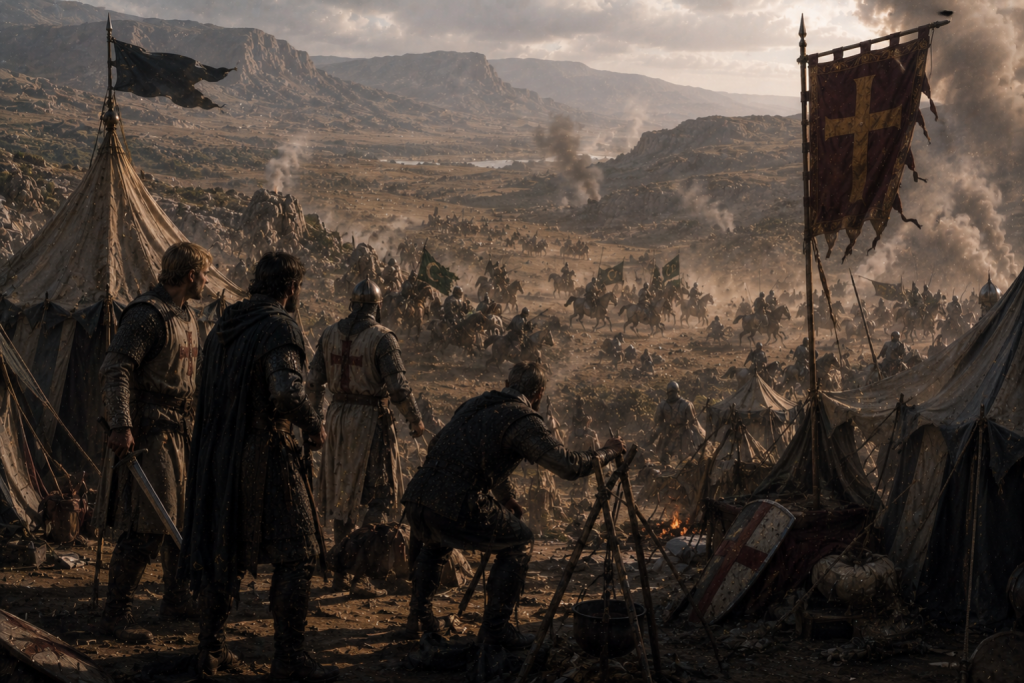
The first of July greeted us with a cool morning. A thin mist still lay across the valley, and the sun was only beginning to gild the hilltops. After weeks of marching without respite, the morning seemed almost peaceful. A small river murmured nearby, horses stretched their necks eagerly toward the water, and the smell of hot stew was already drifting through the camp. Some men had taken off their mail shirts, others still slept wrapped in their cloaks beside the fires, and only the sentries continued their unhurried rounds, more out of habit than any real sense of danger.
Our ten was among the first to wake. Geoffroi was busy with his horse’s harness, quietly humming some Norman song, Drogo was struggling to light a bundle of damp kindling, and I was helping tighten the girths on our spare horses. After Nicaea, everyone seemed to have relaxed a little. We had won our first great victory, there were no fortress walls ahead of us, no enemy army in sight, and the valley around us looked so tranquil that it was difficult to believe what Clavier had said the previous evening.
A good place for a camp… and for an ambush.
I glanced instinctively toward the hills surrounding the valley. They were low, covered in sparse bushes and grass scorched by the sun. Nothing unusual. No smoke, no horsemen, no glint of weapons. Only the wind lazily stirred the dry stalks along the slopes.
Clavier, as always, did not share the general sense of ease. While the others prepared breakfast, he had already ridden around the forward sentry posts and was now returning slowly to camp. His eyes moved across the hilltops, lingering on every ravine, every hollow, every patch of ground where a man might conceal himself. I had long since noticed that an experienced warrior looked at the countryside quite differently from a young man. Where I saw a beautiful landscape, he saw dozens of places from which an attack might come.
When he reached us, Clavier did not even dismount.
“Finish up,” he said curtly. “We march in a quarter of an hour.”
Drogo raised his head.
“In a hurry again?”
“Yes.”
“Think the sultan’s somewhere nearby?”
Clavier was silent for a moment.
“I think that if I were the sultan, this is exactly where I’d be waiting.”
Geoffroi grinned.
“Good thing you’re not the sultan, then.”
For the first time, Clavier did not answer with a joke. He merely looked toward the distant ridge, then turned his horse and rode toward Duke Robert’s tent.
I watched him go, scarcely noticing the uneasy feeling beginning to grow inside me.
Everything happened so quickly that afterward I spent a long time trying to reconstruct the order of events, only to discover that my memory had preserved little more than scattered fragments.
First came a short whistle.
Just one.
Some of the men paid no attention, thinking it was an ordinary bird.
Then came another.
A third.
And a moment later, the air seemed to tear apart.
A dense swarm of arrows swept over the camp.
They fell from every direction at once, striking wood, leather, and human flesh with sharp, dry cracks. A groom standing only a few paces from me did not even have time to cry out. An arrow pierced his neck, and he collapsed beside a bucket of water. Terrified horses tore free of their tethers, snapping stakes and overturning wagons, while cries from the sentries rose almost simultaneously throughout the camp.
“Turks!”
“To arms!”
“Alarm!”
A moment earlier, the camp had been going about its ordinary morning business. Now chaos reigned everywhere. Men rushed from their tents, pulling on mail shirts as they ran, squires struggled to catch maddened horses, priests seized their crosses instead of swords, and above it all continued the endless hiss of arrows.
I instinctively snatched up my shield, barely raising it in time before an arrow struck the wood with a dull thud directly in front of my face. My heart was beating so violently that I could scarcely hear anything around me.
And then I saw them.
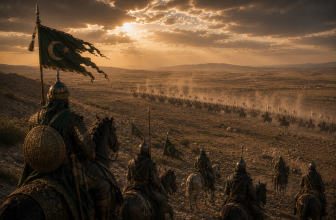
Seljuk horsemen were pouring over the distant hills, one group after another. There were so many that the earth itself seemed to be giving birth to warriors. They moved in wide arcs, keeping their distance from the camp, loosing arrows almost without pause and relieving one another with astonishing ease. As one group withdrew, another immediately took its place.
This was nothing like the warfare we had been taught.
Not formation against formation.
Not the clash of lances.
Not hand-to-hand combat.
The enemy seemed to dissolve into the landscape, appearing in several places at once.
For a moment, genuine panic swept through the camp.
Several young knights, unwilling to wait for orders, rushed to their horses, determined to chase down the Turks. That was precisely what the Seljuks had been waiting for. They immediately parted before their pursuers, showered them with arrows, and vanished just as quickly behind the next hill. Not one of those knights returned.
And it was then, above all the chaos, that Clavier’s voice rang out.
He was not shouting any louder than the others.
Yet somehow everyone heard him.
“To me!”
The commander of our ten was already standing beside the Norman banner, his helmet on and a spear in his hands. Our men were gathering rapidly around him.
“Shields forward!”
“Archers behind!”
“No running!”
“Hold the line!”
His confidence was more effective than any command. First our ten gathered around him. Then several men from a neighbouring conroi. They were followed by Flemings who had lost their commander, then Lorrainers whose banner had disappeared during the first minutes of the attack. Within a few minutes, Clavier was commanding not ten men but several dozen complete strangers, united by a single desire—to survive.
I suddenly understood something remarkable. No one asked who he was or whether he had the right to command them. In battle, men instinctively follow whoever manages to keep his head.
Clavier kept his.
“Don’t chase them!” his voice rang out again. “They’re stronger than us in the open! Make them come to you!”
We closed our shields into a tight line, with the archers sheltered behind us. The first wave of Seljuks came almost immediately. Arrows fell without pause, and some horsemen tried to push closer, but each time they encountered a wall of spearpoints and were forced to withdraw. The first attack was followed by a second. Then a third. Time ceased to exist. There was only my shield, my sword, Clavier’s voice, and the endless whistle of arrows filling the valley of Dorylaeum.
And it was then that I understood, for the first time, what made a true commander of ten.
He was not the man who wielded a sword better than anyone else.
He was the man whose presence made even frightened soldiers forget their fear.
Part II. As Long as the Line Holds
“Later, the chroniclers would write that on that day the Lord granted the crusaders victory. Perhaps He did. But there, amid the dust and blood, it seemed to us that God was watching in silence, waiting to see how much longer we could remain standing.”
From the writings of Ansel de Nantes.
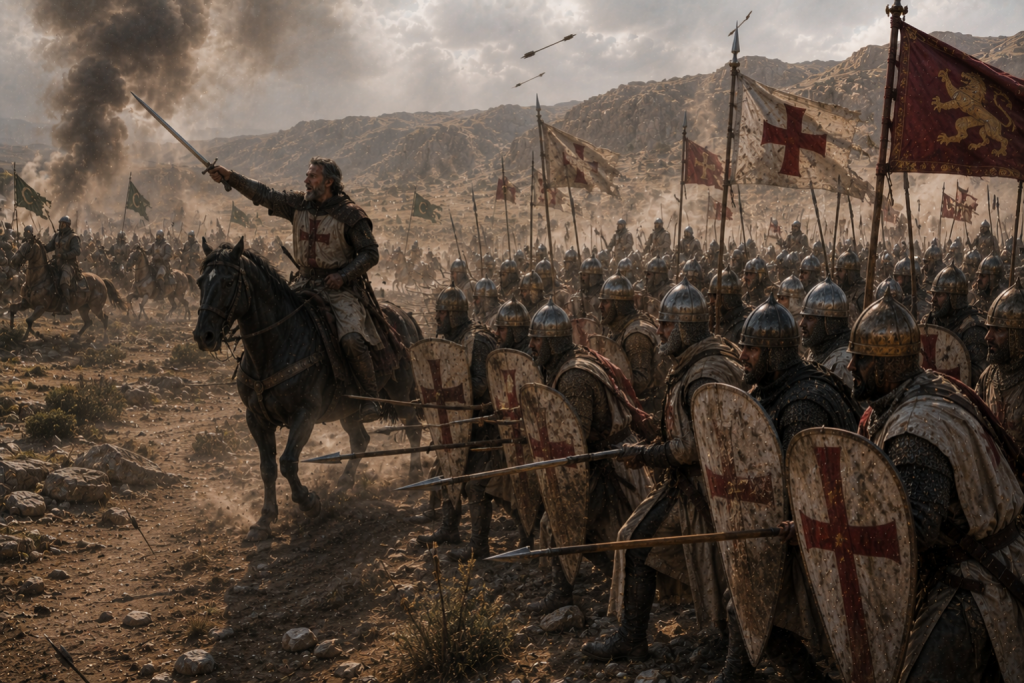
Time ceased to exist.
At first, I tried to count the attacks, but very soon I abandoned the useless effort. The Seljuks came wave after wave, like the sea breaking against coastal rocks. They never remained before our line for long. They rode within bowshot, showered us with arrows, sometimes made a brief charge with their spears, and immediately vanished, only to reappear a few minutes later from an entirely different direction.
Yet that was not the worst of it.
The worst was waiting.
After each attack came a brief silence. Men gulped down air, replaced shattered shields, pulled arrows from the ground and from wounded comrades, then raised their heads again, trying to guess where the enemy would appear next.
Clavier never allowed us to relax for a moment.
He moved constantly along the line, adjusting shields, exchanging exhausted men for fresher ones, and encouraging those who were beginning to lose their nerve. At times, it seemed that he could be in several places at once. Wherever someone took a step backward, Clavier appeared a moment later. Wherever a gap opened between the shields, he forced his way into the line and closed it with his own body.
“Don’t look at them!” he shouted. “Look at the man beside you! As long as your brother stands beside you, the line lives!”
I had no idea how much time had passed. Perhaps an hour. Perhaps two. The sun was already high, my mail had grown so hot that it seemed fresh from a blacksmith’s forge, and my arms had begun to tremble with exhaustion. My shield grew heavier with every new impact of an arrow, and several times I realized that I could no longer feel my fingers.
Drogo, standing beside me, was breathing heavily.
“A little longer…” he rasped. “A little longer and my arms will fall off.”
Geoffroi attempted a grin, but it came out strained.
“At least you won’t have to clean your armour afterward.”
No one laughed.
We no longer had the strength.
At some point, the Seljuks changed their tactics.
Until then, they had been circling the entire camp, testing our defences. Now their attacks became concentrated. Again and again, they struck the same section of the line, as though they had sensed where the men were tiring faster than the others.
Before long, alarmed cries rose on our right.
I turned and saw one of the neighbouring companies slowly giving ground. Judging by the arms painted on their shields, they were Flemings who had lost their commander during the first minutes of the attack. They were holding on with the last of their strength, but their formation was gradually breaking apart. Several men had already begun running toward the camp, drawing others after them.
Clavier saw it at the same moment I did.
“Follow me!” he shouted, and without waiting for an answer, rushed toward the breach.
We ran after him.
The sight before us was terrible. The men had almost stopped listening to orders; each was thinking only of his own survival. Several shields lay abandoned on the ground, spears were broken, and the Seljuk horsemen, seeing the confusion, were beginning to venture closer.
Clavier plunged straight into the retreating men.
He seized one soldier by the shoulder and roughly turned him back toward the enemy.
“Back into line!”
He personally raised another man’s shield.
A third, a very young sergeant, he shook so violently that the lad almost dropped his sword.
“You want to live? Then stand your ground!”
Unexpectedly, it worked.
The men seemed to awaken.
One raised his shield again.
Another stepped back into the line.
A third, seeing Clavier in front of him, stopped retreating.
Without quite realizing how it happened, I found myself beside him, shoulder to shoulder, holding the edge of the formation.
At that very moment, an arrow gave a sharp whistle.
There was a dull impact.
Clavier staggered.
I saw the shaft protruding from beneath his right arm.
“Clavier!”
He glanced down, almost as though surprised to discover an arrow in his own side. Then, perfectly calmly, he grasped the shaft, snapped it off close to his mail with a single movement, and threw the broken piece away.
“A scratch.”
His voice was steady.
He drew a deep breath and turned back toward the men.
“Close ranks!”
“Quickly!”
“Don’t let them see a gap!”
I stared at him, knowing perfectly well that it was no scratch. Blood was already seeping from beneath his mail, soaking his belt and the skirts of his surcoat.
“Clavier…”
He turned sharply toward me.
“Ansel.”
“Where is your place?”
I instinctively raised my shield.
“In the line.”
“Then stand.”
It was not merely an order.
It was a lesson.
The last lesson my mentor would ever teach me.
The battle continued.
Clavier moved a little more slowly now, but I seemed to be the only one who noticed. The others still saw the man who held a collapsing formation together through the force of his presence alone. He gave orders, rearranged the men, and encouraged the wounded as though he felt no pain at all.
Several times, I saw him secretly press a hand against his side.
Each time he took it away, his glove was darker.
I wanted to go to him.
To help.
To say something, anything.
But there was never time.
Every moment brought another attack.
Another gap.
Another wounded man.
And then…
Something changed.
At first, I could not understand what it was.
Then I noticed that the Seljuks had begun looking over their shoulders.
Almost at the same moment, new banners appeared above the distant hills.
There were many of them.
So many.
Red.
White.
Gold.
The crosses of Lorraine.
The banners of Toulouse.
The standards of Godfrey.
Raymond.
Hugh of Vermandois.
The second army had finally arrived.
For several long seconds, the entire valley seemed to fall still.
Then a cry swept across the battlefield unlike anything I have ever heard again in my life.
The crusaders understood.
We had held.
Clavier slowly removed his helmet.
He wiped his bloodstained forehead with his sleeve and smiled for the first time that day.
Only faintly.
So faintly that only those standing near him noticed.
“They made it…”
It was the last calm word I heard him speak that day.
For a moment later, Robert raised his sword, and the entire Christian army surged forward toward an enemy that, for the first time that day, had begun to retreat.
Part III. The Last Order
“Only those who have not seen the price of victory can celebrate it.”
From the writings of Ansel de Nantes.
The arrival of the second army changed the course of the battle almost instantly.
Only minutes earlier, the Seljuks had been certain that they had surrounded the smaller force commanded by Bohemond and Robert. Now fresh troops under Godfrey of Bouillon, Raymond of Toulouse, and the other princes struck their flanks. What had been a carefully prepared ambush suddenly became a trap for the Turks themselves.
Trumpets sounded one after another across the battlefield.
“Forward!”
I cannot remember who gave the order.
I remember only that our formation seemed to come alive. Men who, only moments before, had been holding their ground through sheer stubbornness suddenly realized that they were no longer alone. Shields moved forward, spears were lowered, and the heavy cavalry finally had the chance to do what it had been created to do.
I ran forward with the others.
All I remember is endless dust, the thunder of hooves, and faces flashing before my eyes. At some point, the Seljuks began to withdraw. Then their withdrawal became a rout. Only minutes earlier, they had been circling us, certain of victory. Now they were fleeing toward the distant hills, desperate to avoid close combat.
Yet somehow, I felt no joy.
Perhaps all my strength had been spent during those hours when we had done nothing but struggle to hold the line.
When the trumpets finally sounded the end of the pursuit, the valley seemed to fall dead.
In place of clashing weapons came the groans of the wounded, the neighing of crippled horses, and the quiet voices of priests moving from one man to another. Victors and vanquished lay mingled together. The first ravens were already circling above the field.
I slowly sank to the ground.
Only then did I feel my hands trembling.
My shield was riddled with arrows.
Blood had dried upon my sword.
I stared at my palms for a long time, unable to understand why they would not stop shaking.
“Alive?”
I looked up.
Geoffroi stood before me.
He held his helmet beneath one arm, and a fresh scratch ran along his cheek.
“Alive.”
“Drogo too.”
I let out a breath of relief.
“And Clavier?”
Geoffroi did not answer.
He merely looked away.
And then I understood.
We found him not far from the place where, several hours earlier, we had held the broken line together.
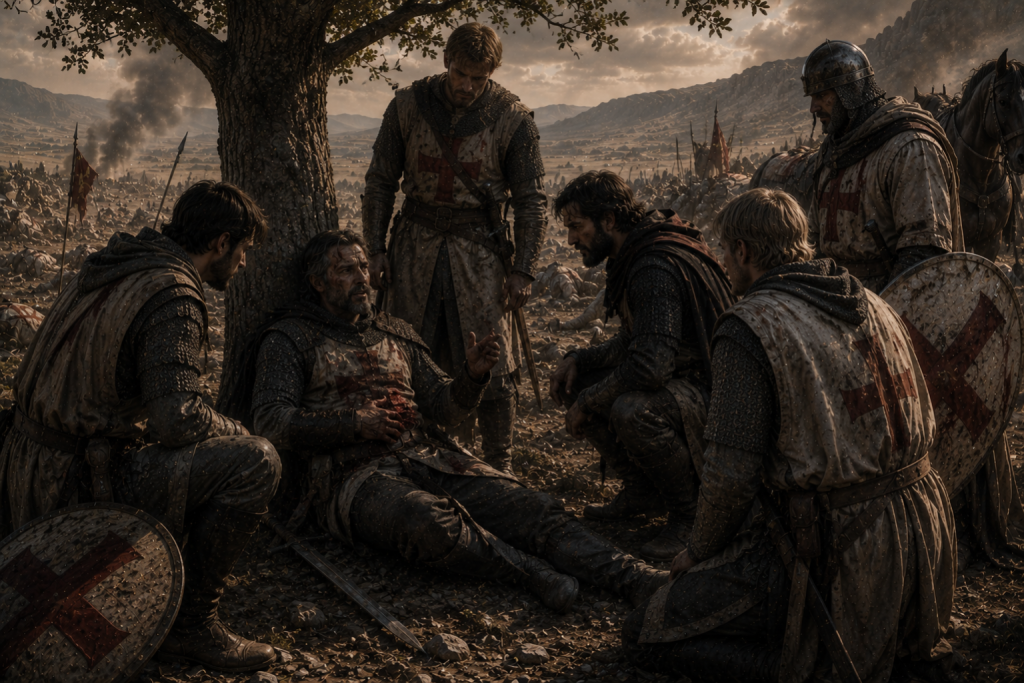
He was sitting beneath a small oak tree, his back resting against the trunk. His helmet lay beside him, and his sword had been carefully returned to its scabbard, as though the battle had ended long ago and the commander had simply decided to rest for a while.
Drogo was already standing nearby.
He said nothing.
Clavier opened his eyes as we approached.
He smiled.
A very tired smile.
“Alive…”
It sounded more like a statement than a question.
“Alive,” Drogo answered quietly.
Clavier nodded.
His breathing had grown laboured.
Only now did we see how thoroughly the mail beneath his right side was soaked with blood. He had long since pulled out the broken arrowhead himself, but with it had gone the last of his strength.
Geoffroi knelt beside him.
“We’ll fetch a physician.”
Clavier barely shook his head.
“Too late.”
A long silence followed.
For the first time in many years, I did not know what to say to this man.
He looked first at Geoffroi.
“The men… are yours now.”
Geoffroi merely clenched his jaw.
Then Clavier turned his gaze toward Drogo.
“Don’t be reckless.”
“Think… before you strike.”
Drogo nodded slowly.
At last, Clavier looked at me.
For a very long time.
As though he were seeing not the squire before him, but the boy he had once met in the monastery stables.
“Ansel…”
I knelt beside him.
“Yes.”
“Remember…”
He drew a short breath.
“A sword…”
“Doesn’t make a man…”
“A warrior…”
I said nothing.
He smiled faintly.
Just as he had in the armoury at Caen.
“Don’t…”
“Lose…”
“Your head…”
Those were the last words I ever heard from Clavier Viel.
He slowly closed his eyes.
Drew one more breath, so faint that I scarcely heard it.
And never breathed again.
No one wept.
Drogo removed his helmet and bowed his head.
Geoffroi stared into the distance for a long time, as though afraid to meet the eyes of our dead mentor.
I sat beside him, unable to make myself believe that the man who had held half our formation together only hours earlier would never give another order.
After a while, Robert came to us.
He asked no questions.
One glance was enough.
The duke slowly lowered himself onto one knee beside Clavier’s body. He carefully removed the armoured glove from his right hand and closed the dead man’s eyes with two fingers.
For a long time, he remained silent.
Then he said quietly:
“A good commander…”
He rose.
Looked at the three of us.
“You’re alive today because of him.”
Robert said nothing more.
He turned and walked away.
He still had to gather what remained of his army.
The sun was already sinking toward the horizon when we began burying the dead.
Smoke from the funeral pyres slowly rose above the valley of Dorylaeum. Priests recited their prayers, men silently dug graves, and all around us there was once again that same silence Clavier had feared so much.
I stood beside the fresh grave for a long time without speaking.
It seemed to me that we had buried more than our commander.
With him, we had buried the last remnants of the carefree youth with which we had once left Normandy.
And only then did I truly understand the meaning of his words.
War does not make a man a warrior.
It merely tests whether he has already become one.