Memoirs of an Old Knight of Acre. Chapter V. My First Day in the Conroi

“The monastery taught me how to pray. The conroi taught me how to live among men. And, I confess, the latter proved far more difficult than the former.”
From the writings of Ansel de Nantes.
I barely slept that night.
I lay upon my hard straw mattress, listening to the familiar sounds of the abbey, and suddenly realized that I was hearing them for the last time. Over thirteen years they had become so familiar that I had long since ceased to notice them: the quiet footsteps of the night brother in the corridor, the crackling of the fire in the kitchen oven, the whistle of the wind beneath the roof, and the steady breathing of dozens of sleeping novices. Only now, knowing that I would leave the monastery in the morning, did I understand how dear those sounds had become to me. A man rarely appreciates the comfort of habit until the time comes to leave it behind.
The bell rang, as always, before dawn. We gathered for Matins, and for the first time in all those years the prayers seemed too short. I found myself stealing glances at the stone walls, the old wooden benches, the faces of monks I had known for almost my entire life. After the service, the abbot called me to him. He gave me no lengthy counsel and made no attempt to persuade me to stay. He merely placed his hand upon my head and said:
“Wherever God may lead you, Ansel, remember this: it is easier to read Scripture than to live by it. Do not forget your morning prayers, even if one day it is the sound of war horns rather than a bell that wakes you.”
I nodded without speaking. At the time, it seemed pointless to say anything. There are words a man understands only years after hearing them.
With his blessing given, I returned to my cell and gathered my few possessions: a spare habit, a knife, several wax tablets for writing, a psalter Brother Matthew had given me, and a woolen blanket. Everything I owned fitted easily into a small travelling sack. It seems remarkable to me now, but at the time I felt as though I were carrying an entire life upon my shoulder.
The monastery courtyard was a very different place from the church I had left only an hour earlier. If the brethren began their day with prayer, Robert’s men began theirs with work. Some were already saddling horses, others tightening girths, others inspecting spearheads. One man sharpened a knife, another greased his mail, while a third cursed a squire who had forgotten to clean his stirrups the night before. No one shouted needlessly and no one rushed. Every man knew exactly what had to be done, and because of that the entire courtyard seemed like a well-made machine.
“Hey, little monk!”
I turned.
A short, broad-shouldered warrior with a thick, greying beard stood beside the stable, one hand resting upon his horse’s neck. His face was covered with small scars, and judging by the shape of his nose, it had been broken at least twice.
“You Ansel?”
“Yes.”
He looked me over carefully from head to foot.
“Good. My name is Clavier Viel. I command a ten. Until you learn to do something useful, you do whatever I tell you. And remember this from the start: don’t call me ‘my lord.’ We have only one lord here.”
He nodded toward Robert.
“To everyone else, I’m the man who commands your ten. Or Clavier. If you earn the right.”
I nodded quickly.
“Good enough. Geoffroi! Drogo! Take the boy.”
Two young warriors appeared from behind the stable. One was perhaps twenty-five, the other barely past twenty. The first was tall and fair-haired, with an open face and the perpetual smile of a man who could find something to laugh about even on the worst of days. The second was shorter, dark-haired, with a knowing squint and the expression of someone who had already discovered every weakness mankind possessed.
“This is our new brother,” Clavier announced. “Try not to break him before evening.”
“We’ll try,” the dark-haired one replied with complete seriousness.
“Don’t promise what you can’t deliver,” the commander grunted, and went off to inspect the others.
Geoffroi was the first to offer me his hand.
“Geoffroi.”
“Drogo.”
We shook hands, after which Geoffroi, without further ceremony, handed me the reins of a placid grey mare.
“She’s a packhorse. You’ll ride her until you earn something better. Don’t take offense. Almost everyone starts on one.”
I accepted the reins gratefully.
As we finished preparing to leave, the conversation somehow drifted toward matters that had nothing whatsoever to do with war.
“So?” Drogo asked as he tightened a girth. “Going to see the miller’s daughter again?”
Geoffroi did not even look up.
“I am.”
“So you’ve finally decided to marry her?”
“If God permits.”
Drogo sighed heavily.
“I don’t like that girl. Mark my words, Geoffroi: if the Welsh, the Bretons, or some bandit doesn’t kill you first, she’ll be the one to put you in your grave.”
Geoffroi laughed.
“And why is that?”
“Because she looks at you the same way a butcher looks at a fattened hog.”
They both burst out laughing.
I could not help smiling myself.
A few moments later, Drogo suddenly turned toward me.
“What are you laughing at? Have you ever even seen a woman?”
I nodded honestly.
“Of course.”
“Naked?”
I felt the blood rush instantly to my face.
“No.”
“Then it doesn’t count.”
Geoffroi slapped his friend on the shoulder.
“Leave him alone. Yesterday he was still living in a monastery.”
“That’s precisely why I’m asking.”
Drogo narrowed his eyes mischievously.
“Don’t worry, Ansel. If the Lord brings you to a decent town, we’ll soon correct that terrible deficiency.”
My face grew hotter still.
They both laughed again, but there was no cruelty in it. It was the sort of laughter with which older brothers torment a younger one.
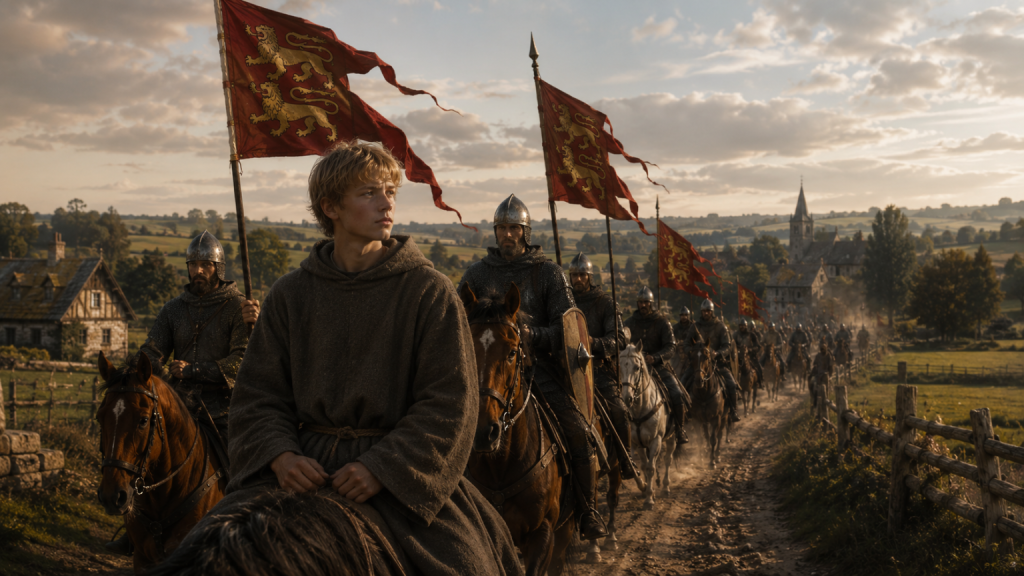
When at last we rode through the abbey gates, the road stretched away between the fields and damp meadows of Normandy. The morning sun was only beginning to burn away the mist lying over the little streams. Apple orchards lined both sides of the road, with oak groves rising beyond them. From time to time we passed a village: a dozen thatched roofs, a small stone church, a mill, and smoke drifting lazily from hearths. To me, the world seemed immeasurably vast. Now, half a century later, I understand how small my world truly was then.
The road encouraged conversation.
“What does a squire actually do?” I finally found the courage to ask.
Geoffroi looked at me.
“Everything.”
“That isn’t an answer,” Drogo remarked.
“It’s an honest one.”
Geoffroi thought for a moment.
“Remember this. While you’re a squire, your chief task is to make sure your knight has to think about nothing but the fight. The horse is fed—that’s your concern. The mail is clean—that’s your concern. The sword is sharp, the spear sound, the straps unbroken, there’s water to drink, the saddle isn’t rubbing the horse’s back—all of it is your work.”
“And if you forget something…” Drogo added.
“Your lord may die.”
There was no trace of a smile in his voice.
For several minutes we rode in silence.
Then I asked:
“And the man who commands ten?”
“He commands ten men.”
“And above him?”
“A commander of a hundred.”
“And above everyone?”
Geoffroi smiled.
“Above everyone is God. But if you mean in our conroi—Lord Robert.”
“And remember something else,” Drogo said unexpectedly. “You’re not a monastery novice anymore. No one here cares whether you’re a knight’s son or a peasant’s. If you cover the man beside you with your shield in a fight, you’ll become one of us. If you run, no one will remember how good your Latin was.”
For some reason, those words stayed with me more clearly than many sermons.
And so we rode until evening, talking and scarcely noticing the miles beneath us.
The sun had already begun to sink toward the horizon when the riders at the head of the column suddenly stopped. The order for silence passed down the line at once. Conversation died without anyone needing to repeat it.
Ahead of us, beside the road, lay an overturned merchant’s cart.
One mule lay with its belly torn open. The other was still alive, weakly kicking its legs. Two men in travelling clothes lay motionless beside the cart, while a little farther away several figures were hurriedly pulling boots from the dead and tearing open sacks of goods.
Bandits.
They had no idea that death was already looking over their shoulders.
Robert rode forward.
One glance was enough.
He did not waste time deliberating.
He did not demand their surrender.
He merely said:
“Lances.”
All along the line came the dull knock of wooden shafts being readied.
Then came the second order.
Short.
Cold.
“Spare no one.”
And in the next instant, the conroi surged forward.
I remained with the packhorses beside two other squires. A torrent of men and horses swept past my eyes. There came the thunder of hooves, a man’s scream, the clash of iron—
and then it was over almost as quickly as it had begun.
When the dust began to settle, the bandits were already on the ground. Some were dead. Others were still trying to crawl away, but there was no resistance left.
It was not the fight itself that struck me.
It had ended too quickly for me to understand what I had seen.
It was the faces of the victors.
They did not rejoice.
They did not laugh.
They did not shout.
Robert’s men silently wiped their swords clean, checked their horses, and returned just as calmly to the column, as though they had merely completed some difficult but entirely ordinary piece of work.
In the monastery I had been taught that killing was a grave sin.
That evening, for the first time, I saw men who killed neither from hatred nor for pleasure.
They did it because there was no other way.
And it was then that I understood that the world beyond the monastery walls was far more complicated than I had ever imagined.