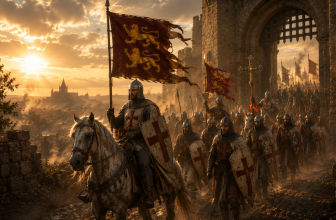
“When I was a boy, I thought war was made up of battles. Later I learned that a battle lasts only a few minutes. The rest of the time, a soldier lives, works, and waits for his next order.”
From the writings of Ansel de Nantes.
After the brief reckoning with the bandits, no one celebrated the victory. Several men silently examined the murdered merchants in the hope that one of them might still be alive, but there was no such luck. One of the sergeants crossed himself over the dead, while another dragged the overturned cart from the road so that it would not obstruct other travellers. Robert, meanwhile, was already thinking of what came next. To him, the encounter was not the end of the matter. It was merely the beginning.
He summoned Clavier.
“How many men do you need?”
“My ten will be enough.”
“Leave the horses here. Go on foot. Their camp must be somewhere nearby. Men like these rarely stray far from their spoils. Take only your weapons and be back before dark.”
Clavier gave a brief nod.
“It will be done, my lord.”
Within minutes, Clavier and his men had disappeared among the trees. I watched them go and thought that at last we would have a chance to rest.
How little I understood the life of a soldier then.
The moment the scouts vanished into the forest, the entire company went to work. Some began searching for a suitable place to make camp, others gathered brushwood, while still others cleared ground for the fires. Several men led the horses to a stream, and the squires immediately began removing their saddles and carefully inspecting the animals’ backs. Geoffroi later explained to me that a poor warrior might tolerate a blister on his own foot, but never a saddle sore on his horse. A tired or injured mount could kill its master more surely than any lance.
There was work for me as well. Together with the other squires, I made several trips to the stream for water, then helped gather fallen branches, and finally set about cleaning the tack from the road. The work was simple, but endless. Every time one task was finished, another seemed to appear in its place.
It must have been then that Drogo noticed my surprise.
“What are you staring at?”
“I thought… men rested after a fight.”
He smirked without looking up from the wooden peg he was carving.
“You rested after prayers in the monastery. A soldier rests when he’s ordered to. The rest of the time, he works.”
Geoffroi, sitting nearby, did not even raise his head.
“Sometimes, between one job and the next, he has to kill someone.”
Everyone around us accepted this as perfectly ordinary. No one laughed. No one argued.
It was only many years later that I understood how much truth there was in that simple piece of soldiers’ wisdom.
By evening, twilight had begun to settle over the forest. Sentries had already been posted around the edge of the camp, the horses had been fed and hobbled, and pots of pottage were beginning to boil over the fires. Then a short, distinctive whistle came from the trees. The sentries immediately answered with the same signal.
“Our men,” someone said calmly.
A few minutes later, Clavier’s party emerged from among the trees. They travelled light, but everyone seemed in considerably better spirits than they had been several hours earlier. Two men carried a small iron-bound chest. Two others bore the freshly dressed carcass of a young deer slung from a long pole. Behind them stumbled five ragged men with their hands bound. One was barefoot; another had evidently been in such a hurry to escape that he had not even managed to pull on his boots.
Clavier approached Robert.
“Found their camp, my lord. All five were there. Took them before they knew what was happening. One of them looked as though he was just sitting down to supper.”
A quiet ripple of laughter passed through the men.
“What did you find?”
“Not much coin. Silver cups, several church candlesticks, a pair of purses, some jewelry. Everything worth taking fitted into one chest. The rest was rags and household goods.”
He nodded slightly toward the carcass.
“And a deer.”
For the first time that evening, Robert smiled.
“Then the men will eat properly tonight.”
There was no lengthy discussion over the spoils. The chest was immediately taken to the baggage train, the bound bandits placed under guard, and before long the deer was turning on a spit above the largest fire. The smell of roasting meat quickly spread through the camp. After several days of road rations, such a supper seemed a feast fit for a king.
I sat beside Geoffroi and Drogo, silently watching the men around me. One was mending his boots, another sharpening a knife, while someone else was quietly telling an amusing story about the time his horse had been frightened by its own reflection in a river. Men laughed, interrupted one another, argued, and shared bread and wine. At some point I caught myself thinking how strangely it all resembled the refectory of our monastery. Only here warriors sat in place of monks, and coarse soldiers’ jokes took the place of readings from Scripture.
That night, for the first time in my life, I fell asleep not to the sound of a monastery bell, but to the crackling of a fire and the low voices of sentries.
The camp was already stirring before dawn. The fires were carefully doused with water and the embers covered with earth so that no stray spark could start a fire. The campsite itself was left almost as orderly as we had found it the day before. Even the leftover bones were buried well away from the road.
At the time, this surprised me.
“Does it really matter?” I asked Geoffroi.
He shook his head.
“We slept here tonight. Someone else may stop here tomorrow. The forest is dangerous enough without our help.”
With that, he threw the saddle over his horse’s back.
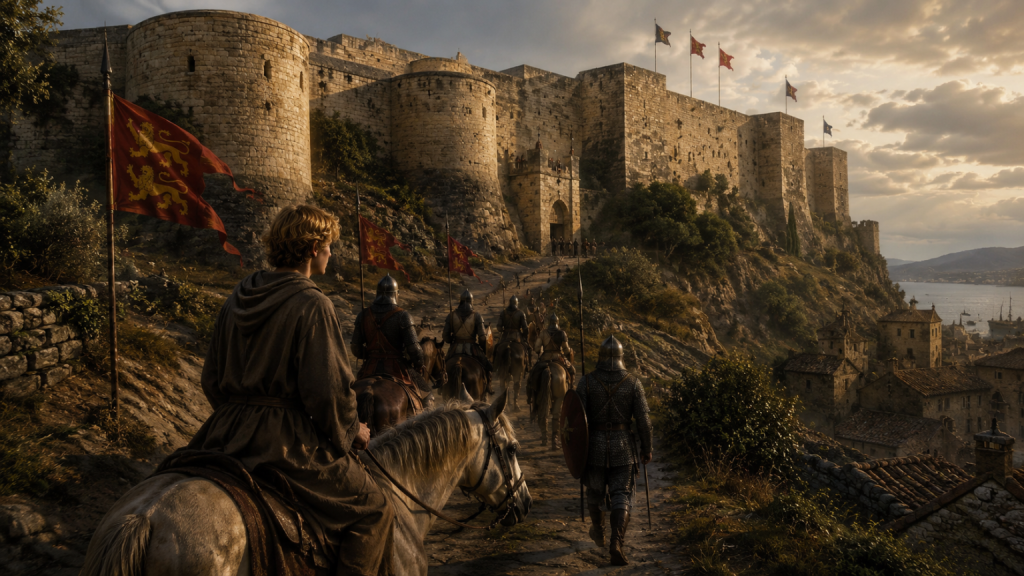
By midday, the towers of Caen began to take shape ahead of us.
Until that day, the largest structure I had ever seen was our abbey. Caen therefore seemed to me a true city. Of course, I understand now that by the standards of the cities I would later know, it was not particularly large. But to a thirteen-year-old boy, several hundred houses clustered around a mighty fortress looked almost like the capital of the world.
The city went about its ordinary life. Carts laden with grain crowded the roads, craftsmen carried bundles of timber, merchants argued near the market, women bore baskets of bread, barefoot boys darted between the stalls, and somewhere beyond the houses came the ceaseless ringing of a blacksmith’s hammer. The air was thick with the smells of smoke, fresh bread, leather, dung, and river water. In later years I would see Constantinople, Antioch, Jerusalem, and Alexandria, but Caen remained forever in my memory as the first true city I had ever known.
Above it all rose the castle built by William the Conqueror.
It looked nothing like the enchanted palaces I had imagined as a boy. This was an enormous fortress built first and foremost for war. High stone walls enclosed what seemed an entire town of its own, with barracks, workshops, storehouses, stables, a chapel, smithies, and quarters for the garrison. At its heart stood the massive keep, the principal stronghold, built to withstand a long siege. Only later did I understand that a castle was not a single building at all. It was an entire world, living according to laws of its own.
The guards met us at the gate. The moment they recognized the prince, the heavy doors were thrown open, and the conroi rode into the inner bailey without delay. The garrison seemed to have been expecting its lord for some time. The men greeted Robert without unnecessary ceremony, but with genuine respect. There was none of the elaborate formality I would later encounter in royal courts. Everyone had work to do, and even the arrival of the master of the castle did not bring that work to a halt.
Geoffroi swung easily from the saddle and beckoned to me.
“Come on. We’ll show you your new home.”
The stable seemed larger than the entire courtyard of our monastery. Dozens of squires, grooms, and servants were already at work inside. Some cleaned the stalls, others changed the bedding, while still others sorted and inspected the tack after the journey. Neat stacks of oats, hay, and straw stood against the far wall.
“You’ll sleep here,” Drogo said, pointing toward a broad wooden platform beneath an overhang. “Don’t worry. In winter, there’s nowhere warmer than beside the horses.”
Then he led me across the inner yard.
“We eat there. That’s the armory. The smithy is over there. Baths there. If the man commanding your ten tells you to wash, you wash and don’t argue. Horses are checked every day. Dung is cleared every morning. The well stays clean. And if some idiot decides to relieve himself anywhere near the water…”
He gave me a meaningful look.
“Clavier will tear his ears off with his own hands.”
I could not help smiling.
Over the long years of my travels, I heard many stories claiming that people in our time knew nothing of cleanliness. That is not true. We did not understand disease as physicians understand it today, but any experienced garrison knew perfectly well that a fouled well, spoiled food, or dung left beside living quarters could kill more men than a siege. Cleanliness was therefore not a matter of comfort. It was a matter of survival.
That evening, lying on fresh straw among dozens of horses, I remained awake for a long time. Beyond the stable walls, sentries called to one another. Somewhere in the smithy, a hammer was still ringing against iron. Voices drifted from the keep, while the wind carried the scents of smoke and fresh hay.
Only a few days earlier, the monastery bell had governed my life.
Now its rhythm was set by the garrison.
And strangely enough…
I was already beginning to feel less like a stranger.