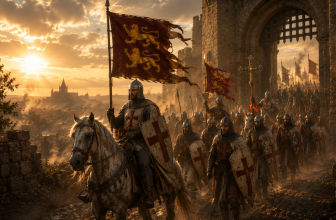
“People think a knight is made in battle. That is not true. Battle merely reveals what he was taught during the long months when no one was watching.”
From the writings of Ansel de Nantes.
My first days at Caen Castle passed so quickly that I almost ceased to notice the passage of time. Only much later did I understand that life in a garrison followed a rhythm of its own, no less strict than the Rule of Saint Benedict. Here, however, men were awakened not by a monastery bell but by the neighing of a stallion; orders came not from an abbot but from the man commanding your ten; and instead of beginning the morning with prayer, every man began it by tending to his horse and weapons.
We woke while it was still dark. The stables came alive before the first rays of sunlight touched the castle towers. Horses sensed the approach of a new day better than any man. The moment one began shifting its hooves, the others would stir. Then the squires and grooms woke, and only after them the warriors themselves.
On my very first morning, Geoffroi woke me with a light shove to the shoulder.
“Up.”
I raised myself sleepily.
“It’s still dark…”
He merely grinned.
“The horse doesn’t care whether it’s dark or light. He’s hungry now.”
That was the first rule I had to learn.
While the knight sleeps, his horse must already be fed.
While the knight eats his breakfast, his saddle must be ready.
While the knight puts on his mail, his squire must make certain that no strap has split, no buckle has worked loose, and every weapon is exactly where it belongs.
In the monastery, I had thought discipline one of the most important things in life.
Now I was beginning to understand that there was more than one kind of discipline.
There, it saved the soul.
Here, it saved lives.
There was work from morning until night. We cleaned stalls, changed straw, carted dung beyond the castle walls, watered the horses, sorted baggage after every journey, rubbed fat into leather tack to keep it from drying and cracking, and spent hours cleaning mail with sand and oil. I had sincerely believed that once I joined the garrison, they would immediately begin teaching me to use weapons. Yet the days passed one after another, and instead of a sword I still found myself holding a bucket, a brush, or a scraper.
At last, one evening, I could bear it no longer.
We were sitting beside the stables while Geoffroi once again took apart a saddle after the day’s training.
“When are they finally going to teach me to fight?”
He did not even look up.
“They already are.”
I stared at him in confusion.
“But I haven’t even held a real weapon yet.”
This time Drogo answered.
“And what happens if your lord’s girth snaps in battle tomorrow?”
I shrugged.
“He falls.”
“And dies.”
He looked calmly into my eyes.
“That is what you are learning now. How to make sure it never happens.”
It took me many years to understand just how right Drogo had been.
Victories are born long before the first sword is drawn.
A few days later, Clavier finally called me over.
“Come.”
He did not explain where we were going. We crossed the inner bailey, passed the smithy, and stopped outside a small armory. Beyond its heavy oak door hung dozens of spears, swords, shields, axes, and maces. In the dim light, the room seemed almost like a chapel, except that weapons rested upon the walls instead of sacred images.
Without a word, Clavier took a long sword from the wall and handed it to me.
I received it reverently in both hands.
The blade was considerably heavier than it had ever seemed in my childhood dreams.
Clavier watched me closely for several seconds, then unexpectedly took the sword back.
“Beautiful?”
“Very.”
“Forget it.”
I looked up at him in surprise.
Clavier grinned.
“Every boy dreams of a sword. That’s because knights always wave swords about in the songs. The songs rarely mention how many years it takes to learn to use one properly.”
He turned back to the wall and took down a very different weapon.
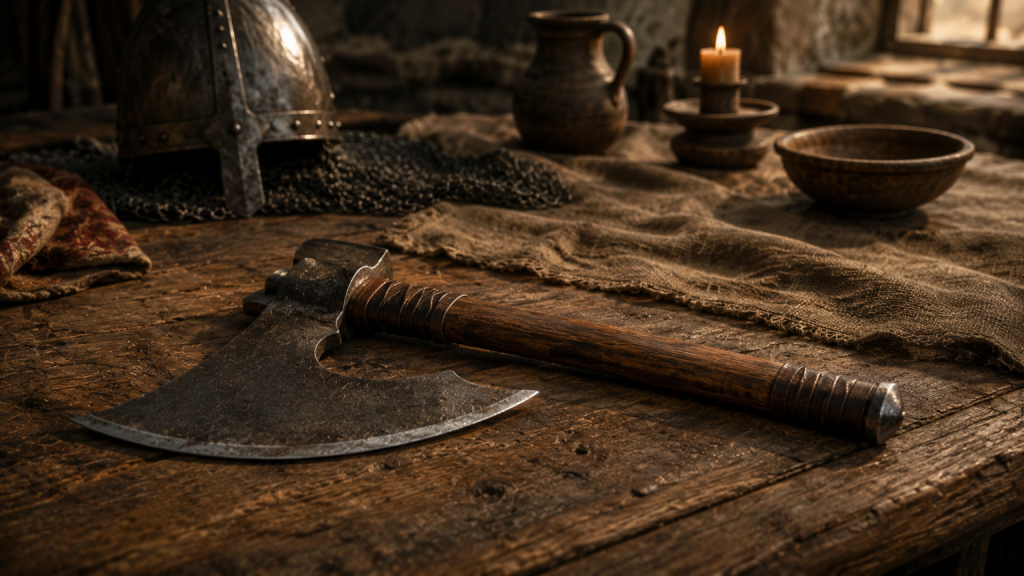
It was a small Norman axe. A plain wooden haft, a narrow undecorated blade, slightly darkened with age.
Nothing heroic.
Nothing beautiful.
Just a working weapon.
I studied it for a long moment.
For some reason, it caught my attention immediately.
Clavier noticed.
“You like this one?”
“Yes.”
“Good.”
He placed the axe in my hands.
“Remember something, Ansel. A sword demands skill. It does not forgive mistakes. To use one properly takes years. A good axe is more honest. Simpler. Easier to understand. It asks for no unnecessary movement.”
He made a short swing.
The blade hissed through the air.
“To become good with a sword, you need patience.”
Clavier looked at me again.
“To become good with an axe, you need only not to be afraid to strike first.”
I said nothing.
He could see that I was listening.
“One day you’ll learn to use all of them. But you begin with what is simple. Never be ashamed of a simple weapon. Many a proud man with an expensive sword has been outlived by one.”
I tightened my grip around the haft.
And for some reason, I knew at once that this axe truly would become my first weapon.
From that day onward, the real training began.
Every morning, after our work in the stables, we went out into the training yard. The first lessons bore no resemblance whatsoever to the heroic duels sung of by minstrels. No one was allowed to swing a weapon however he pleased. Quite the opposite: for much of the time, we trained without weapons at all.
For hours, Clavier made us place our feet correctly, keep our balance, turn on command, move forward and backward without breaking formation. If anyone made a mistake, the exercise began again from the start.
At times I thought the man was deliberately testing our patience.
But one day he stopped in the middle of the yard and spoke quietly.
“One man can be very brave.”
He took several steps.
“Ten men can win a fight.”
Then he raised his hand.
“But only a formation wins a war.”
After that, no one complained.
Gradually, the exercises came to include strikes against wooden dummies, shield work, running in full equipment, and endless hours spent with a practice axe. By evening my shoulders burned, my palms were covered in blisters, and my hands shook so badly that I could barely hold a spoon.
Geoffroi only laughed.
“That means tomorrow will be easier.”
“Really?”
“No.”
He grinned.
“But you’ll get used to it.”
After several weeks, Clavier began taking me into the city on patrol with Geoffroi and Drogo. Until then, Caen had seemed to me little more than a large settlement clustered around the castle. Now I began to see it differently.
We rode slowly through the narrow streets, greeting craftsmen, millers, smiths, and merchants. Fresh bread scented the air around the bakeries, the tanning yards reeked of their vats, and fishermen unloaded the morning catch at the river landing. Children ran between the stalls, women argued with merchants, and somewhere in the shade there was always a beggar hoping for alms.
“Remember this,” Drogo said to me one day. “We don’t guard the walls.”
He swept a hand toward the street.
“We guard this.”
I looked around.
The people.
The stalls.
The bakery.
The well.
The children.
The workshops.
And suddenly I understood something very simple.
The castle did not exist for its own sake.
It existed for the city.
That evening, after returning to the stables from another patrol, I placed my axe beside my mattress and stared at it for a long while in the half-light.
Not so long ago, the heaviest thing I held in my hands each day had been a monastery Bible.
Now there was a weapon lying beside me.
Man is a strange creature.
He can grow accustomed to almost anything.
Even to the thought that one day he may have to use that same axe to protect another man’s life—or to take one himself.
And without even realizing it, I was ceasing to be the boy Prince Robert had once met in a monastery refectory.
At Caen Castle, a squire was slowly being born from the novice I had been.