Memoirs of an Old Knight of Acre. Chapter XI. The Road Across Europe

“We thought we were marching with our duke. Only after several weeks on the road did I understand that an entire world was moving with us.”
From the writings of Ansel de Nantes.
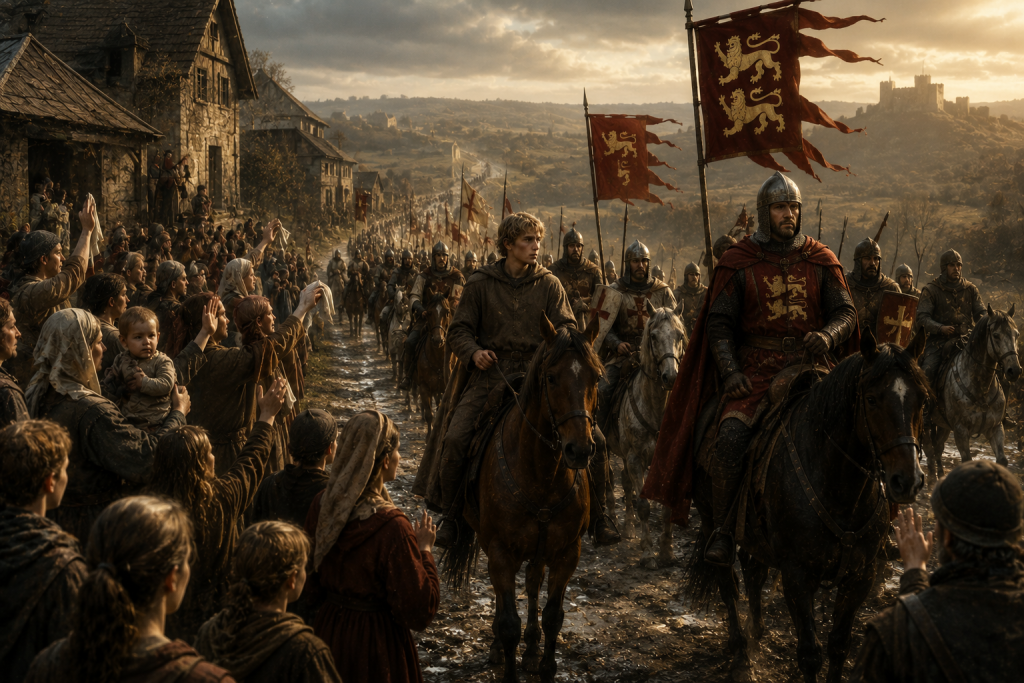
September 1096.
Almost ten months had passed since Duke Robert returned from Clermont. Throughout that time, Normandy had lived for the preparations. Now the waiting was over.
At dawn, the gates of Rouen opened once again.
Red banners bearing two golden lions swayed slowly above the column, trumpets sounded the signal to depart, and an endless procession of men, horses, and wagons began moving south.
Had anyone asked me then how many of us there were, I could not have answered. It seemed as though all Normandy had taken to the road. Chroniclers would later reckon that Robert’s banners gathered around a thousand knights, several thousand sergeants and foot soldiers, hundreds of squires, and scores of priests, smiths, carpenters, physicians, cooks, wagoners, and servants. Merchants, money changers, pilgrims, and even the families of some knights travelled with the army, intending to accompany their husbands at least as far as Italy.
This was no longer merely an army.
It was a city on the move.
The road quickly developed a rhythm of its own. We woke before dawn. While a priest said a brief morning prayer, the squires were already saddling horses, checking girths, and distributing oats. After sunrise, the column began its march. By noon we would have covered several leagues, then stop briefly beside the nearest river or stream. The horses rested, the men ate bread, cheese, and salted meat, while smiths immediately inspected horseshoes and carpenters repaired any wagon whose axle had failed on the road.
Then we marched again until evening.
At first, I imagined that endless adventures lay ahead of us.
I soon discovered that a real campaign is not made of heroic deeds.
It is made of a thousand days that look exactly alike.
Of blistered feet.
Of dust.
Of rain.
Of caring for your horse.
Of an endless road.
And only occasionally, of war.
The farther we travelled from Normandy, the more the land around us changed.
Burgundy impressed me most of all.
Until then, I had thought Normandy wealthy. Here, wealth seemed to have been poured across the countryside itself. Well-kept vineyards stretched along both sides of the road. Stone bridges joined the banks of swift rivers. Mills in the villages seemed never to stop turning, while the fields were so vast that the eye could not immediately find their end. Great monasteries rose above the countryside like small fortresses, and the markets were crowded with more people than I had previously seen anywhere outside Rouen.
For a long while I stared at the endless vineyards.
“What are you looking at?” Drogo asked.
“I’ve never seen so many vines.”
Geoffroi smiled.
“Now you understand why the Burgundians love their wine so much.”
“I thought it was because their wine was good.”
“It’s good because they have so much of it.”
Drogo snorted.
“That’s not why.”
“Then why?”
“Because rich men can always afford to make good things.”
After a short pause, he added:
“Remember that.”
At the time, I did not understand what he meant.
Later, after seeing Syria, Egypt, and Constantinople, I often remembered those words.
Every day, new people joined the roads around us.
First came small companies from Champagne.
Then Burgundian knights.
After that, we increasingly encountered entire columns of pilgrims wearing the same red crosses upon their clothing.
One day, on a road running not far from our own, we saw an enormous column of Lotharingians.
Thousands of spears.
Dozens of banners.
Endless baggage trains.
Never before had I seen an army so large.
“Who are they?” I asked.
Geoffroi looked into the distance.
“Duke Godfrey’s men.”
I watched the seemingly endless column for a long time.
Until that moment, I had thought the Crusade meant our duke and several thousand Normans.
Only then did I understand that God had not set Normandy upon the road.
He had set all Europe in motion.
Not every story we heard along the way, however, was a joyful one.
The closer we came to Italy, the more often villagers spoke of other pilgrims who had passed through several months before us.
One evening we stopped for the night near a small monastery. Its abbot proved a hospitable man and readily shared the latest news with Robert.
“A great host has already passed this way,” the old man said.
“Whose?” the duke asked.
“If it could be called a host at all.”
The abbot sighed heavily.
“Men, women, children… Hardly any knights. Hardly any provisions. Many carried nothing but clubs and hunting spears. They said the Lord would feed them along the road.”
Silence settled over the table.
“Peter the Hermit’s people,” one of the priests said quietly.
It was the first time I had heard the name.
Later, Geoffroi explained who Peter was.
“He’s a preacher. They say men hear him speak, abandon their homes, and set off at once to liberate the Holy Sepulchre.”
“What happened to them?”
Drogo answered.
“They were in too much of a hurry.”
He was silent for a moment.
“When a man goes on pilgrimage, faith may be enough.”
“When he goes to war…”
He looked around our camp.
At the baggage train.
At the smiths.
At the grooms.
At the sentries.
“He needs discipline as well.”
We did not yet know the full extent of the tragedy. The People’s Crusade of Peter the Hermit had already ended in terrible disaster in Asia Minor, where most of its participants had been killed by the Seljuks. But news of it had not yet reached the West. All people could tell us was that the first pilgrims had disappeared somewhere far beyond Constantinople.
That evening, I thought for a long time about Drogo’s words.
For the first time, I was afraid.
Until then, the Crusade had seemed to me like a very long journey.
Now I was beginning to understand that a real war awaited us.
When the first foothills of the Alps finally appeared ahead, I understood how vast God’s world truly was.
The mountains rose into the heavens, swallowing the horizon. I had never seen anything like them. We climbed slowly along narrow roads where even two wagons could barely pass one another. The air grew colder, the nights longer, and the horses tired more quickly from the endless ascent.
But once we crossed the mountain passes, the world changed again.
The southern slopes greeted us with gentle sunlight, unfamiliar trees, and the scent of warm earth. The stone houses grew taller, their roofs flatter, and unfamiliar Italian speech was heard more and more often along the roads.
Here, one could already feel the breath of ancient Rome.
Several days later, we saw countless campfires ahead.
Hundreds.
Then thousands.
Above them flew the banners of France, Lotharingia, Flanders, Provence, Normandy, and southern Italy.
It seemed as though half the Christian West had gathered in one place.
“Now,” Geoffroi said quietly, reining in his horse, “the real expedition begins.”
For a long time, I stared across the boundless sea of tents.
Until that day, we had been only one company travelling along a great road.
Now, for the first time, I saw an army unlike anything Europe had known since the days of Charlemagne.
And ahead, only a few days’ journey away, lay Rome—the city of Saint Peter, where we were to receive our final blessing before taking the road into the unknown.