“Until Rome, we were pilgrims. When we left it, we were crusaders. Yet the greatest revelation for me was not the Holy See, but the city itself—a city that had outlived its own glory.”
From the writings of Ansel de Nantes.
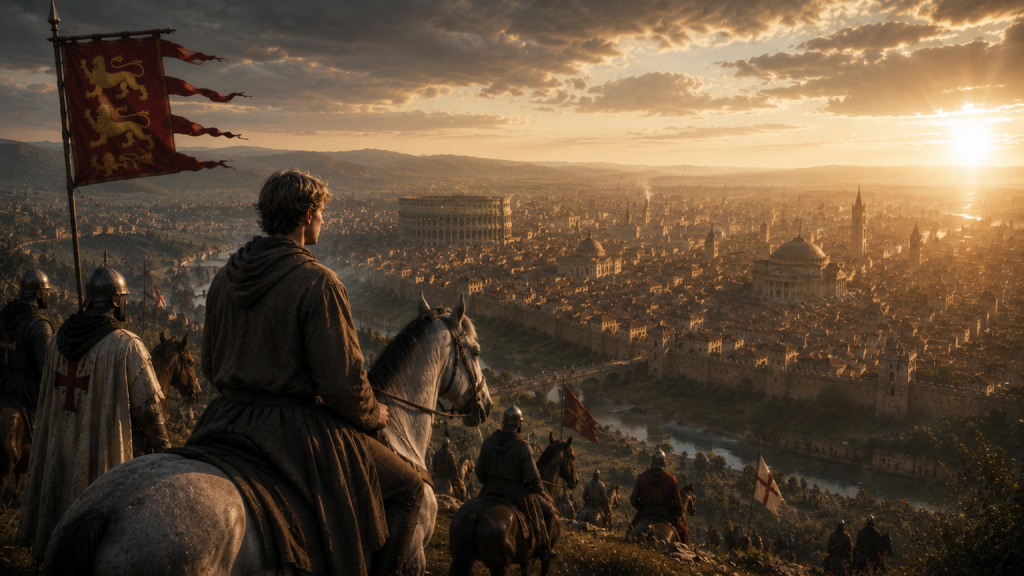
When, after long weeks upon the road, the walls of Rome finally appeared before us, I found myself more anxious than I had ever been before a battle. Even in the monastery, the name had seemed to echo through almost every prayer. Rome was the city of the Apostles, the destination of pilgrims from all across Europe, the heart of the Christian world. In my imagination, it had long since become something almost mythical. I pictured endless palaces, golden domes, and streets once walked by the great emperors. I expected to see the greatest city on earth.
The truth proved far more interesting.
Our camp was established outside the city walls. Tens of thousands of people could never have been accommodated within them, and the plains around Rome quickly filled with countless tents. Seen from the nearest hill, it seemed as though a second city had risen beside the ancient one—a city made of canvas. Fires smoked everywhere, horses neighed, smiths’ hammers rang, and merchants, monks, squires, and pilgrims hurried between the tents. Never before had I seen such an enormous host. There were Normans, Franks, Flemings, Lotharingians, Burgundians, Provençals, and Lombards. They spoke in different tongues, argued, bargained, and laughed, yet all wore the same red cross upon their clothing.
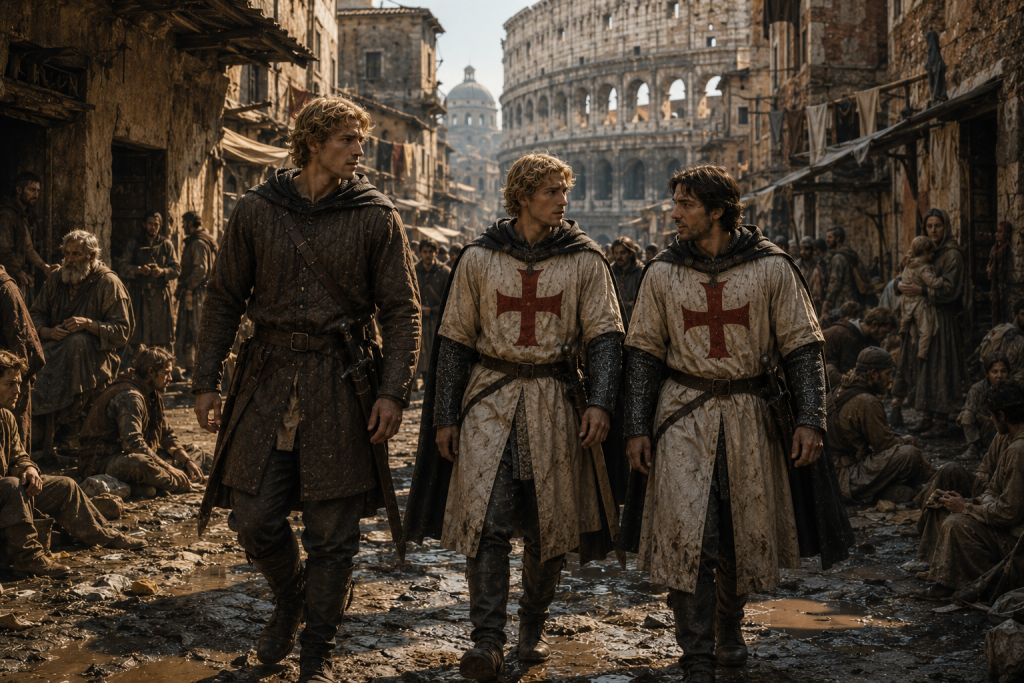
The following day, Geoffroi, Drogo, several other squires, and I were given leave to enter the city.
We passed through ancient gates built from blocks of stone so immense that I found myself wondering whether men could truly have raised them. A broad paved road stretched ahead, lined on either side by buildings unlike anything I had ever seen. Vast, half-ruined arches towered above modest medieval houses. Ancient columns stood beside wooden craftsmen’s stalls, while the inhabitants, showing not the slightest reverence, took marble from pagan temples and used it to build new walls.
For a long while, I said nothing, trying to understand what I felt.
Rome was beautiful.
But its beauty was not what I had expected.
Before me stood not a young conqueror, but an old warrior who had survived a hundred battles. He no longer ruled the world, yet one glance was enough to understand what he had once been.
We came to the Colosseum.
Even in ruin, it overwhelmed the imagination. The enormous ring of stone rose above the city like a fortress. Trees grew through gaps in its walls, children ran between its arches, and near one of the entrances a merchant sold flatbread and cheese.
“Did men really fight here?” I asked.
“They say tens of thousands came to watch them,” Geoffroi replied.
I shook my head.
I found it difficult to imagine so many spectators gathered in one place.
Afterward, we wandered for a long time among the ruins of the ancient Forum. Of many buildings, nothing remained but columns and fragments of walls, yet even those inspired awe. An old monk accompanying a group of pilgrims stopped beside one of the arches and quietly told his companions:
“Once, the whole known world was ruled from here.”
I looked around.
Goats grazed among the marble columns. A merchant loudly argued with a buyer from Genoa. Several boys chased a wooden ball across the very ground where Roman emperors had once celebrated their triumphs.
It was then that I first understood something very simple.
Even the greatest realms are mortal.
We were about to return to the main streets when Geoffroi suddenly smiled.
“Well then, little monk…”
He slapped me on the shoulder.
“Would you like to see the real Rome?”
Without waiting for an answer, he turned into a narrow alley.
The farther we went from the great churches and squares, the more the city changed. Broad streets vanished, giving way to cramped passages between houses two and three storeys high. Laundry hung from open windows, women shouted somewhere above us, and the air smelled of smoke, roasting meat, and sour wine. There was none of the reverent quiet of the pilgrims’ quarters here.
This Rome was simply living.
We emerged into a small square.
Several taverns crowded around it. Beneath their awnings sat men dressed in every manner imaginable. German mercenaries argued at one table; Lombards drank wine at another; farther away, Flemish sergeants laughed loudly. Women in brightly coloured dresses—cut rather too boldly for respectable townswomen—lounged upon the steps, talking idly among themselves and occasionally calling out to passing men. A broad-shouldered doorkeeper with a club stood outside the largest tavern, while nearby an old veteran tried to sell passers-by a battered helmet and a short sword with a notched blade.
I stopped dead.
“Can…”
For a moment, I could not find the words.
“Can people really live like this here?”
Drogo looked at me with a faint smile.
“This is Rome.”
Geoffroi laughed.
“In Rome, you can live however you please.”
As though to prove his point, one of the women noticed us and called loudly to Geoffroi.
“Hey, handsome! Surely you’re not just going to walk past?”
Geoffroi gave her an elaborate bow.
“Forgive me, my dear. The Lord requires a different journey of me today.”
The woman laughed brightly.
“Come back alive. Then we’ll talk.”
Once we were farther away, Drogo could not resist.
“Look at that. Even in Rome you manage to make new acquaintances.”
“Jealous?”
“Of course.”
“Why?”
“Because women like you. Innkeepers only like me when I pay them in silver.”
We all laughed.
But I found myself glancing back.
Only a few hundred paces away stood magnificent churches where thousands knelt before the relics of the Apostles. Here, taverns roared with noise, mercenaries threw dice, merchants argued over the price of wine, and women searched for customers.
They were two entirely different worlds.
And both were called Rome.
The next day, before dawn, the entire camp stirred into motion. Priests walked among the rows of tents, reminding men to put their weapons and clothing in order. Many knights put on their finest cloaks as though preparing for a coronation rather than a war. Some confessed beside their tents, some prayed alone, while others silently sharpened their swords, trying not to think about what awaited us.
Duke Robert himself, together with the other leaders of the expedition, entered the city before sunrise. We squires were not allowed beyond the outer court. We could only watch as, one after another, men whose names were already known across Europe disappeared behind the ancient walls: Robert of Normandy, Raymond of Toulouse, Godfrey of Bouillon, Bohemond of Taranto, and other princes who were to lead thousands of men across half the known world.
“Imagine,” Geoffroi said quietly as he watched them go. “Put all those men around one table and you’d have half of Western Europe sitting there.”
“More like half the troubles of Western Europe,” Drogo said with a grin.
We laughed, but quietly. Even Geoffroi understood that this was not a day for loud jokes.
The waiting lasted several hours. During that time, the square before Saint Peter’s gradually filled with people. Some knelt directly upon the cold ground. Others recited psalms. Still others silently passed prayer beads through their fingers. Never before had I seen so many people united by a single purpose. There were none of the usual quarrels between Normans and Frenchmen. Old feuds between barons went unmentioned. No one boasted of wealth or lineage.
All differences seemed to disappear beneath the red crosses sewn upon their cloaks.
When the princes finally emerged again, I noticed a change in Robert’s face at once. He looked calm, but it was a different kind of calm now—the calm of a man who has made his final decision and no longer intends to look back.
Clavier approached him first.
“My lord?”
Robert gave a short nod.
“We leave tomorrow.”
Only two words.
But it was then that I finally understood there was no road back.
The following morning, the papal legates celebrated a solemn Mass for the assembled host. Thousands filled the plain before the city. Hundreds of banners swayed above the sea of heads, while a light wind stirred thousands of red crosses at once. The voices of the priests rose over the camp, mingling with the ringing of bells and the murmur of the multitude.
Every man understood what was happening in his own way.
For some, it was a great pilgrimage.
For some, a chance to receive remission of sins.
For some, a duty owed to Christ.
For others, an opportunity to gain land they could never hope to possess at home.
I did not yet know that in years to come chroniclers would argue over why tens of thousands of people had left Europe. Some would write only of faith. Others only of the riches of the East. Still others would speak of landless younger sons and endless private wars.
But standing among those people, I understood one simple thing.
Every man had his own reason.
And in their own way, all of them were true.
After the service, many began making their wills. Monks and notaries sat behind long tables, recording the final wishes of knights. One left a mill to his eldest son. Another asked an abbey to care for his elderly mother. A third bequeathed silver for the building of a chapel.
Never before had I seen so many men calmly preparing for their own deaths.
Geoffroi watched the line for a long while.
“Going?”
“Where?”
He nodded toward the monks.
“To make your will.”
I laughed.
“What could I leave anyone? My old axe?”
“Exactly,” he said with a smile. “Much simpler for you.”
We both laughed.
For some reason, Drogo did not join us.
He remained silent for a long time, then quietly said:
“Life is a strange thing.”
“Only a year ago, my greatest fear was that I wouldn’t get a new shield before the spring muster.”
He looked toward the city.
“Now I wonder whether I’ll ever see Normandy again.”
No one answered.
Sometimes silence says more than words ever could.
That evening, I once again climbed one of the hills overlooking the city. The sun was slowly sinking behind the ancient walls, bathing them in warm golden light. From there, Rome seemed both magnificent and weary. Great basilicas rose above a maze of smaller houses, ancient arches cast long shadows across the squares, and above it all smoke from hundreds of hearths drifted slowly into the evening sky.
I remembered the Forum.
The Colosseum.
The broken aqueducts.
Merchants selling bread among ancient columns.
The noisy quarter of taverns.
The women laughing after Geoffroi.
And the great basilica of Saint Peter, where thousands had knelt in prayer.
All of it existed at once.
That day I understood that men remain men in every city. A holy place does not make every man a saint, just as a tavern does not make every visitor a sinner. God made men different, and perhaps that is why great cities are always made of contradictions.
Only many years later, sitting beside the window of my own house in Acre, did I understand something else.
Rome no longer ruled the world.
Its legions had vanished long ago. Its emperors had become memories. Many of its greatest palaces had fallen into ruin.
And yet, when the Bishop of Rome called upon the Christians of the West, princes from across Europe raised their banners and set out upon the road.
Rome had lost its dominion over lands.
But it had kept its dominion over the hearts of men.
At dawn the following day, our camp began to disappear. Wagons once again formed into long columns, smiths extinguished their forges, and grooms led out the saddled horses. Robert, as always, rode at the head of his conroi. He looked silently toward the city, crossed himself, and gave the trumpeter the signal.
We were leaving Rome.
At the time, it seemed to me that I was leaving the past of mankind behind.
I did not yet know that ahead of me lay a city utterly unlike the ancient capital of the Apostles. If Rome was a magnificent old warrior who had retained his wisdom while losing much of his former strength, Constantinople was still a young giant—wealthy, noisy, glittering with gold and marble, a city in which the Empire still lived.
And it was between those two capitals that I would first begin to wonder what a true kingdom ought to be.
But before that came thousands of leagues of road, the lands of the Romans, and my first encounter with an East that, until then, had existed for me only on the pages of monastery books.